Drawing on lessons from civil society in Northern Ireland, Beyond Social Capital examines the limitations of social capital theory in deeply divided societies. It draws on an ethnographic study of victim support groups and evidence from policymakers in Northern Ireland to reconceptualize the traditional bonding-bridging distinction in social capital theory. The role of leadership is particularly significant, as the book highlights the complex and compelling ways in which leadership supports and shapes the activities, practices and motivations of the victim self-help industry in Northern Ireland. Multiple dimensions of this industry are explored, including: social and victim policy; private, statutory, and voluntary sector collaboration; the political motivations of victim support groups; and the types of social capital being built in victim groups and the impact that this social capital has on victims and wider elements of the peace process.
Importantly, Laura K. Graham challenges the prevailing notion that all forms of social capital are inherently good for civic organizations and associational life. Instead, a new form of social capital existing in divided and post-conflict societies is advanced. This form of social capital, called 'dysfunctional bonding', may have negative impacts, causing distrust within and outside a group and can be particularly problematic for those traumatized by political conflict. With international relevance, this book willbe of great interest to those working in post-conflict studies as well as victim studies.
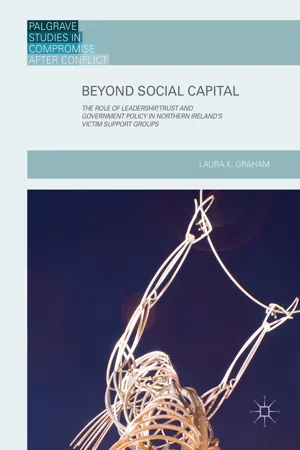
eBook - ePub
Beyond Social Capital
The Role of Leadership, Trust and Government Policy in Northern Ireland's Victim Support Groups
- English
- ePUB (mobile friendly)
- Available on iOS & Android
eBook - ePub
Beyond Social Capital
The Role of Leadership, Trust and Government Policy in Northern Ireland's Victim Support Groups
About this book
Information
© The Editor(s) (if applicable) and The Author(s) 2016
Laura K. GrahamBeyond Social CapitalPalgrave Studies in Compromise after Conflict10.1057/9781137518675_11. Civil Society
Laura K. Graham1
(1)
Peace and Justice Studies Program, Tufts University, Medford, Massachusetts, USA
Introduction
This is a book that calls into question the uncritical application of social capital theory in deeply divided societies. In order to rethink social capital, we must first understand the origins of the concept and how it functions. To do that, we must examine how certain ideas are defined, such as civil society, since it is the conceptual platform upon which social capital rests. There is, however, little definitional agreement about what is meant by civil society, as it is often viewed as a blanket concept covering a vast array of ideas. I aim to address this discrepancy in this chapter by examining four prominent discourses and by offering a definition of civil society that will enhance our understanding of social capital in the chapters that follow. I also explore the role of civil society during times of conflict and peace, and discuss the link between civil society and social capital.
What Is Civil Society?
Michael Edwards (2014:3), writing on the need for conceptual clarity, aptly proclaimed in his book, Civil Society: “an idea that means everything probably signifies nothing.” There is a great deal of truth in this statement, since as a concept with a lineage dating back to the Greek philosophers, civil society has come to have varied and disparate meanings over time, leading to conceptual ambiguity. While some view “civil” as an adjective (see Farrington 2004, 2008), signifying a polite or progressive view of society, others take the term to refer to the sphere where that which is private enters the public realm (see Brewer 2010). There is also disagreement as to whether civil society is descriptive, normative, or a combination of the two (Kaldor 2003). These distinctions are best understood by examining classical and contemporary texts.
My purpose here is not to expound upon the vast literature on civil society; rather, it is to consider what civil society is and what it does during times of peace and conflict, and to offer a conceptual framework for my examination of social capital. To that end, I offer a brief examination of four discourses of civil society, arriving at a general definition that is useful for the purposes of this book. The four discourses on civil society that are relevant to this discussion are:
1.
Civil society as associational life—by far the more prominent discourse and viewed as being synonymous with social capital.
2.
Civil society as the public sphere—where citizens and civic groups engage in democratic discourse through public debate.
3.
Civil society as activism—in this understanding, voluntary groups are seen as social movements engaging in political or social activism.
4.
Civil society as the “good society”—where “civil” is used as an adjective to describe a kind of society that exhibits certain idealistic qualities.
Each of these ideas offers a different perspective on what civil society is and does, during times of both peace and conflict. These discourses do not form a taxonomy of civil society. In other words, none of these ideas are mutually exclusive; rather, they are overlapping understandings of the roles played by civil society. With that in mind, I will now elucidate each of these discourses, providing the conceptual framework for the discussion on social capital that follows in Chap. 2.
Civil Society as Associational Life
In this neoliberal view, civil society consists of broad networks of voluntary associations. These networks constitute a third sector that is characterized by volunteering and a not-for-profit ethos. This voluntary sector can act as a check on state power and even act as a substitute for some functions traditionally performed by the welfare state (Kaldor 2003; Edwards 2014). Often seen as operating in the space between the state, the market, and the family, this modern view of civil society is not dissimilar to bürgerliche gesellschaft or “bourgeois society” as proposed by Hegel and Marx (see Kaldor 2003:19), where civil society offers a contrasting alternative to the functions of the state.
This idea contrasts earlier notions, as proposed by Aristotle, where the state operated as a form of civil society through the polis, and citizens (meaning free, landowning men) participated in decision making as part of the social contract (Edwards 2014:6). Advances in this conceptualization of civil society have come a long way, and in recent discourse, civil society is seen as curbing the power of the state, as well as nurturing social norms such as cooperation and generalized trust (Edwards 2014:7). Civil society as associational life is thus both normative and descriptive.
For Varshney (2002:46), civil society includes both formal associations and informal interactions in everyday life, as well as both voluntary and ascriptive associations, “so long as they connect individuals, build trust, encourage reciprocity, and facilitate exchange of views on matters of public concern—economic, political, cultural, and social.” This description stands in contrast to Gellner’s (1994 cited in Varshney 2002:42) understanding that civil society must only consist strictly of voluntary, nonascriptive groups. The gamut of what is considered a voluntary association is broad and consists of trade unions, secret societies such as the Freemasons, women’s groups, book clubs, bowling leagues, and many other groups who share some common interest or bond.
It is this view of civil society that underpins social capital theory, and is often seen as being synonymous with the concept. It is also the main discourse in modern use, having captured the imaginations of social intellectuals from Alexis de Tocqueville, circa 1835, who believed associational life was a key factor in a strong liberal democracy, to Robert Putnam, whose landmark study on the decline of civic engagement in the USA has inspired a generation of studies on social capital as well as international investment in the idea of civil society as a beacon of democracy. It is this idea of civil society that has been seized by international organizations such as the World Bank as an answer to a variety of social problems from poverty to globalization.
Since this discourse is prevalent among social capital exponents, it is this view of civil society that I will use to lay the foundation for the arguments advanced in this book. This view of civil society is also the most appropriate discourse for understanding the nature of social capital in Northern Ireland, since it is a society composed of more than 5,000 voluntary associations with over 30,000 volunteers in a public sector worth more than £400 million annually (NICVA., 2011). To that end, I will examine whether a strong civil society necessarily equates to high levels of social capital in deeply divided societies.
Civil Society as the Public Sphere
This view of civil society is contained in Habermas’s The Structural Transformation of the Public Sphere (see English translation in Burger and Lawrence, 1989). For Habermas, the public sphere acts as a space where discourse is used to resolve social and political disputes (see Farrington 2004). The public sphere is “an arena for contestation” where civil society is “steered by its members through shared meanings” and political debate (Habermas cited in Edwards 2014:8–9). It is also the space occupied as much by voluntary organizations and institutions as it is by the everyday interactions that make up civic life. According to Habermas (cited in Kaldor 2003:21–2):
The expression of ‘civil society’ has […] taken on a meaning different from that of the ‘bourgeois society’ of the liberal tradition, which Hegel conceptualised as the ‘system of needs,’ that is, as a market system involving social labour and commodity exchange. What is meant by ‘civil society’ today, in contrast to its usage in the Marxist tradition, no longer includes the economy […] Rather, its institutional core comprises those non-governmental and non-economic connections and voluntary associations that anchor the communication structures of the public sphere in the society component of the life-world. Civil society is composed of those more or less spontaneously emergent associations, organisations, and movements that, attuned to how societal problems resonate in private life spheres, distil and transmit such reactions to the public sphere. The core of civil society comprises a network of associations that institutionalises problem-solving discourses of general interest inside the framework of organised public spheres. These ‘discursive designs’ have an egalitarian, open form of organisation that mirrors essential features of the kind of communication around which they crystallise and to which they lend continuity and permanence.
For Kaldor (2003), the public sphere provides the space for activism and transformation. In that respect, civil society as the public sphere is quite similar to Alexander’s (2006) conceptualization of the “civil sphere”: a space where democratic values are practiced through Habermasian “communicative action.” The civil sphere is Alexander’s critique of Putnam’s social capital. As Brewer et al. (2011:19) aptly note, “The notion of the civil sphere introduces key advances because it places emphasis on the ‘dark side of civil society’ (Alexander 2006:6), the contradictions in civil society around ‘race,’ religion, gender, and its other structural divisions that ‘bonding social capital’ does not seem to adequately capture.” In this view, civil society is much more than voluntary associations, as understood by many scholars.
The public sphere may also provide a platform for citizens to engage in participative democracy through outlets such as civic forums, including town halls, and the media. The public sphere is as much about debate and dialogue as it is about finding consensus to resolve common problems (Edwards 2014). Brewer (2010:26) argues that the public sphere is supportive of democracy insofar as “public debate in a variety of public settings encourages feelings of shared interests, and a willingness to compromise and work together.” It is also the place where active citizens are tasked with “speaking truth to power” whenever necessary (Edwards 2014:76). Thus, civil society as the public sphere invokes active citizenship and participative democracy.
Civil Society as Activism
In this view, civil society acts as an agent for social and political change, as in the Solidarity movement in Poland (see Farrington 2004; Kaldor 2003; Mihaylova 2004) and the Civil Rights movement in the USA (see Alexander 2006). Inherent is the idea that civil society is the platform for transformative social movements. Kaldor (2003:8) explains this version of civil society as:
Cochrane and Dunn (2011:151) argue that as opportunities for citizens to participate in politics decline, civil society as activism emerges as an alternative to democracy. H...[A] definition that presupposes a state or rule of law, but insists not only on restraints on state power but on a redistribution of power. It is a radicalization of democracy and an extension of participation and autonomy. On this definition, civil society refers to active citizenship, to growing self-organization outside formal political circles, and expanded space in which individual citizens can influence the conditions in which they live both directly through self-organization and through political pressure.
Table of contents
- Cover
- Frontmatter
- 1. Civil Society
- 2. Rethinking Social Capital
- 3. Inside Victim Support Groups
- 4. Leadership Matters
- 5. Bonding, Bridging, and Constricting
- Backmatter
Trusted by 375,005 students
Access to over 1.5 million titles for a fair monthly price.
Study more efficiently using our study tools.
Frequently asked questions
Yes, you can cancel anytime from the Subscription tab in your account settings on the Perlego website. Your subscription will stay active until the end of your current billing period. Learn how to cancel your subscription
No, books cannot be downloaded as external files, such as PDFs, for use outside of Perlego. However, you can download books within the Perlego app for offline reading on mobile or tablet. Learn how to download books offline
Perlego offers two plans: Essential and Complete
- Essential is ideal for learners and professionals who enjoy exploring a wide range of subjects. Access the Essential Library with 800,000+ trusted titles and best-sellers across business, personal growth, and the humanities. Includes unlimited reading time and Standard Read Aloud voice.
- Complete: Perfect for advanced learners and researchers needing full, unrestricted access. Unlock 1.5M+ books across hundreds of subjects, including academic and specialized titles. The Complete Plan also includes advanced features like Premium Read Aloud and Research Assistant.
We are an online textbook subscription service, where you can get access to an entire online library for less than the price of a single book per month. With over 1.5 million books across 990+ topics, we’ve got you covered! Learn about our mission
Look out for the read-aloud symbol on your next book to see if you can listen to it. The read-aloud tool reads text aloud for you, highlighting the text as it is being read. You can pause it, speed it up and slow it down. Learn more about Read Aloud
Yes! You can use the Perlego app on both iOS and Android devices to read anytime, anywhere — even offline. Perfect for commutes or when you’re on the go.
Please note we cannot support devices running on iOS 13 and Android 7 or earlier. Learn more about using the app
Please note we cannot support devices running on iOS 13 and Android 7 or earlier. Learn more about using the app
Yes, you can access Beyond Social Capital by Laura K. Graham in PDF and/or ePUB format, as well as other popular books in Social Sciences & Peace & Global Development. We have over 1.5 million books available in our catalogue for you to explore.