eBook - ePub
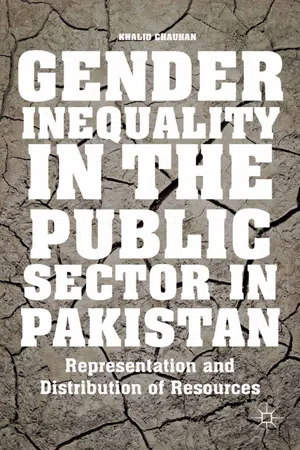
Gender Inequality in the Public Sector in Pakistan
Representation and Distribution of Resources
- English
- ePUB (mobile friendly)
- Available on iOS & Android
eBook - ePub
Gender Inequality in the Public Sector in Pakistan
Representation and Distribution of Resources
About this book
As gender training is applied increasingly as a development solution to gender inequality, this book examines gender inequality in Pakistan's public sector and questions whether a singular focus on gender training is enough to achieve progress in a patriarchal institutional context.
Information
CHAPTER 1
Introduction
This book problematizes the attempts by donor agencies and governments in developing countries to incorporate gender analysis in the work of development. It shows how after the global shifts from women to development institutions as the cause of gender inequality and the need to “get the institutions right” for achieving progress toward the goal of gender equality, gender sensitivity training became the main method of incorporating gender into development work, and why it is not a satisfactory solution.
The case of public sector of Pakistan with a focus on gender sensitivity trainings has been used as evidence. In Pakistan, only 5 percent of the public sector workforce is women, which points to the issue of unfair representation of women. Similarly, there are issues of constraints on women’s access to resources and uncongenial institutional policies. When the world was focusing on Women in Development (WID) and Women and Development (WAD) as the key strategies to improve women’s representation and their access to resources for progress toward achieving the goal of gender equality, women in Pakistan were facing regressive Islamist military regime of General Zia ul Haq. As a result women in Pakistan missed the benefits of WID and WAD approaches enjoyed by women in other developing countries, neither their numbers increased significantly in the public sector institutions nor were the issues of access to resources addressed. In this context, donor agencies and government of Pakistan’s relatively recent jump to Gender and Development (GAD) approach using gender sensitivity training has come to mean training by the men to men with no tangible benefits to women.
The problem of gender inequality in the public sector of Pakistan is of entrenched patriarchal processes, policies, and procedures that secure the interests of dominant groups, invariably men, thus maintaining their effective control over women. The primary positions of leadership and seniority in the public sector are invariably occupied by men, and women are concentrated in the secondary sectors or secondary and junior positions. This imbalance creates both vertical and horizontal gender inequality in the public sector. Political dynamics and power mechanisms—such as promotion rules based on time of service, entry into service only at the junior organizational levels—ensure control of seniors in hierarchy and results in occupational closure,1 at least to the extent of senior positions for women in the public sector. The elite status and the conflict of interest between groups vying for a monopoly over existing opportunities determine the extent to which an organization or positions within it remain closed to women. Ironically, a novice may not feel tricked by the patriarchal benevolence shown by those in the more senior levels and may not judge that they may simply be supporting more women in institutions because they know that existing human resources rules and policies will only result in more women in the entry level positions, which would not compromise their elite status due to occupation of senior positions which can only be filled through promotion. This begs an understanding of the politics of inequality in a given situation. This suggests that women’s low representation and limited access to resources rather than being thought of as the causes must be seen as the effects of the patriarchal control of institutions. The political theories of gender inequality in the labor market that had been unequivocal about patriarchal processes, policies, and procedures giving power to men and disenfranchising women merit serious consideration by the development actors (Connell 2005; Johnson 2005; Shankar and Northcott 2009; MacKinnon 2010; Walby 2010).
However, for development in practice, unfortunately this is not the case, and instead often a benign and soft solution of more and better training is often assumed as a taken for granted recipe for the problem of gender inequality. As you read, the research described in this book will show how after staff training on gender sensitivity and awareness, organizational practices continued to be shaped by the overarching gender-blind mandates and policies of the public sector. You will realize that rather than an emphasis on training, both government of Pakistan and development agencies could have made progress toward the goal of gender equality if they had worked for a critical reorientation of institutional policies and mandates, including human resources recruiting and promotion rules.
This chapter will introduce you to the key aspects of gender inequality taken up in the book, that is, (i) women’s low representation, (ii) limited access to resources, and (iii) gender-insensitive policies. It will give a brief account of how GAD and gender mainstreaming policies around gender training are considered as a solution for the elimination of gender inequality in the public sector of Pakistan. Also listed are the research questions, the scope of the study, the methods adopted for data collection and analysis, the limitations of the study, and an outline of the organization of the chapters.
Research Issues
The focus of the book is the attempts by donor agencies and governments in developing countries, such as Pakistan, to incorporate gender analysis in the work of development. With the rise of GAD approaches, gender sensitivity training has increasingly become the most favored development solution for incorporating gender into development work (Woodford-Berger 2004). Development institutions, the governments of developing countries, and development feminists are invariably found busy in imparting gender trainings to employees of the public sector and nongovernmental organizations (NGOs) (e.g., see Kusakabe 2005; Dasgupta 2007; Mukhopadhyay 2007b; UNDP 2007). There is a belief that action on gender inequality through gender sensitivity training can always be effective, albeit in isolation and recognition of the significance of context, power, privileges, interests, and institutional structures (Verloo 2001; Abou-Habib 2007; Verloo et al. 2009). The social, economic, and political theories of gender inequality in the labor market, and their concurrent development approaches including WID, WAD, and GAD that have evolved over the last four decades have identified three separate issues: the low representation of women in the labor market, their low access to resources, and the preservation of institutional structures that inhibit progress toward gender equality (Razavi and Miller 1995; Epstein 2007; Acker 2009; Kabeer 2009; Vijayamohanan, Asalatha, and Ponnuswamy 2009; MacKinnon 2010). However, there is little research on how the policy solution of training relates to these issues of gender inequality and how these issues relate to each other. The following subsections introduce the theoretical and development underpinnings and give a brief account of these issues in the context of the public sector of Pakistan to carry the debate forward.
Issue of Representation
Increasing the representation of women in the labor market is the core solution in the social theories of labor market gender inequality as well as in the WID approaches to social development. Social theories of gender inequality in the labor market argue that the socially constructed roles of men and women in society result in the gender inequality in labor markets (Maccoby 1999: 118; Wharton 2005; Epstein 2007; Ballantine and Roberts 2010: 290). Since the 1970s the representation of more women in institutions has formed the core of the WID approaches to overcoming gender inequality in the labor market (Boserup 1970; Tinker 1976; UN 1976; Mazumdar 1979; Bandarage 1984; Vijayamohanan Asalatha, and Ponnuswamy 2009), with the United Nations (UN) leading the push for the increased representation of women in institutions (UN 1976; UN General Assembly 1979), and this has been taken up to varying degrees by member states.
In Pakistan, from that time, there has been a notional commitment to women’s representation (GOP 1973b; 1998; 2003) but with little success as there are less than 5 percent women in Pakistan’s public sector and almost all at lower levels (GOP 1998; 2003; 2006b). Reports commissioned by development agencies such as the Asian Development Bank (ADB) and the Pakistan government recommend the adoption of a quota policy, but this has not been implemented in any real way (GOP 1998; 2003; ADB 2000). Instead, since 2004, a liberal gender sensitivity training strategy under the banner of GAD approaches has been advocated by development agencies such as United Nations Development Programme (UNDP) as the key solution to the problem of gender inequality, thus completely ignoring the issue of women’s low representation in the public sector.
There is little research in Pakistan that examines how gender sensitivity training could be a solution for gender inequality when public sector institutions are almost all male institutions due to marginal representation of women as such. Some self-confessing accounts of development feminists involved in imparting gender sensitivity training to the employees of NGOs in other places indicate the limitation of gender sensitivity training when patriarchal contexts of these institutions are completely ignored (Abou-Habib 2007; Dasgupta 2007; Mukhopadhyay 2007b) but they have not looked specifically at the public sector. Therefore this book asks how gender sensitivity training impacts gender norms that could confidently be taken as signs of progress toward the goal of gender equality, and that too when in Pakistan women are marginally represented in the public sector.
Access to Resources
Women’s access to resources as the solution to the problem of gender inequality has its genesis in both the economic theories of gender inequality in the labor market and the parallel WAD approaches. Economic theories of gender inequality in the labor market argue that a capitalist economy accrues economic advantage to men over women (Calás and Smircich 1999: 226; Connelly et al. 2000; Aitchison 2003: 29; Chowdhury 2010) and this can be taken care of by a greater integration of women aimed at equitable access to resources. WAD also considers “unjust international economic relations” as the cause of disadvantage faced by women (UN 1980: 5; Rathgeber 1990) and assumes a link between income earning and the development of women as equals to men (Khan et al. 1989). Representation in the workforce therefore results in women’s increased access to resources. The critics maintain this view ignores the reality of women’s responsibility for housework (McSweeney and Freedman 1980; Rathgeber 1990; Kabeer 1994; Momsen 2009). As a result of the double burden of labor and patriarchal norms and attitudes, women are increasingly being exploited in terms of cheap labor, uncongenial work conditions, and limited mobility (Elson and Pearson 1981; Safa 1981: 60).
In Pakistan, there is little research to show how women in the public sector face problems of access to social resources such as transport and other facilities including toilets and child day care centers, and accommodation when posted elsewhere (Qureshi 2000; Maqsood et al. 2005; Faisal 2010). This is, in part, due to the very low representation of women in the public sector, but more generally there is also a debate that low access to social resources such as education is due to a low demand by parents (Mahmood 2004; Aslam and Kingdon 2008) or due to a failure of supply by the state (Khan 1997; Mbeer 1998; Barber 2010). This low representation in education can also result in a low representation in the public sector workforce.
This book asks how gender sensitivity training impacts gender norms facilitating women’s increased access to resources in the public sector, or signs of change in policies that could confidently be taken as signs of progress toward the goal of gender equality.
Institutional Practices
Transformation in institutional policies, routines, and practices is rooted in both the political theories of gender inequality in the labor market and the GAD approaches. Political theories of gender inequality in the labor market argue that patriarchy is the primary cause (Donovan 2000: 156; Aitchison 2003: 28; Eagleton 2003: 59). Men dominate in a range of social structures including the modes of production, paid work, government, prisons, and cultural institutions (Walby 1990: 20) and they use state machinery, laws, and policies to maintain this domination (MacKinnon 2006). This necessitates going beyond issues of women’s representation and their access to resources to examine the patriarchal structures, policies, and power relations that create unequal gender relations. This line of reasoning formed the core of the GAD approaches to gender inequality (Molyneux 1985; Kabeer 1994; Razavi and Miller 1995; Cornwall 2003: 1326). Opposed to the theory, the practices of GAD, however, are often criticized for focusing on women’s agency and ignoring the role of institutional structures that put conditions and boundaries on women’s ability to pursue their interests (Molyneux 2004; Kabeer 2005b; Jakimow and Kilby 2006; Kilby 2011). Moreover, development institutions have also been criticized for lack of formal structures for accountability required to achieve the goal of gender equality (Kilby 2004; Kilby 2011).
The concept of gender mainstreaming (True 2010: 191) that became the main face of GAD after the Beijing Conference also aimed to change gendered policies (COE 1998; Beveridge and Nott 2002; Daly 2005; Verloo 2005) by taking a gender perspective across all aspects of the workplace. In practice, however, it is shaped by a widespread belief that change in patriarchal policies can be achieved by the gender sensitivity training of bureaucrats (Woodford-Berger 2004; Verloo 2005; Abou-Habib 2007; Mukhopadhyay 2007b; Tiessen 2007; Verloo et al. 2009), which will result in changes in attitudes and behavior. Little is known about how training relates to the activities of bureaucrats or if it can result in a change in patriarchal policies, behavior, and attitudes (Howard 2002; Dawson 2005; Kusakabe 2005), showing signs of institutional change (Verloo 2001; Woodford-Berger 2004; Verloo et al. 2009).
In Pakistan, there is little research on how gender sensitivity training relates to change in patriarchal practices in public sector institutions, with state policies generally believed to produce and reproduce the gendered identities of citizens (Naseem 2006; Durrani 2008; GOP 2009; Rashid 2009; Halai 2010). What is known is the dark side of the state, which in the past has enacted laws to disenfranchise women and made them half citizens (Mumtaz and Shaheed 1987; Weiss 2003; Mullally 2005; Rashid 2009; Shaheed 2010). The question that emerges is how, if at all, gender equality policies and practices of the public sector of Pakistan relate to the broader gender policies of the state (GOP 1973c: 72).
These issues are discussed along with the following questions.
Book Questions
How does women’s representation, access to resources, and institutional policies relate to the issue of gender inequality in the public sector of Pakistan?
How do the gender of employees, their position in the organization, the sociopolitical context, and the structure of the organization impact the effectiveness of gender sensitivity training?
Scope of the Book
This book is grounded in the development approaches. WID and WAD identify integration of women in institutions and their access to resources as the solutions to the problem of gender inequality in the labor market. GAD and gender mainstreaming approaches seek to change patriarchal institutional policies to effect transformation in institutional practices. There is ongoing discussion as to which of these correctly identifies the solution, and what solutions could best achieve progress toward elimination of gender inequality in the public sector of Pakistan.
This book is important because it comes at a time when GAD gender mainstreaming approaches, rather than changing patriarchal institutional policies and practices, are increasingly emphasizing the gender sensitivity training of employees as a means to eliminate gender inequality in the public sector. Other factors such as the structure of organizations, the sociopolitical context, gender, and the position of women in organizations have not been examined as possible variables (Mathur and Rajan 1997). There is often a naive belief that gender sensitivity training results in the transformation of unequal gender relations, but research to validate this belief is generally lacking (Verloo et al. 2009). The existing research is generally in the context of NGOs and multilateral agencies and not public sector organizations of developing countries (Mathur and Rajan 1997; Woodford-Berger 2004; Mukhopadhyay 2007b). Kusakabe, for example, suggests that gender sensitivity training is not related to change in the institutional activities of organizational members (Kusakabe 2005) and the solution to the apparent failure of gender sensitivity training is seen merely as more training, with no commensurate effort to understand the patriarchal institutional mechanisms that result in gender inequality (Howard 2002). By focusing on the relationship that gender sensitivity training and other...
Table of contents
- Cover
- Title
- Chapter 1 Introduction
- Chapter 2 Gender and Development
- Chapter 3 From Gender Mainstreaming to Training
- Chapter 4 Patriarchal Pakistan: Women’s Representation, Access to Resources, and Institutional Practices
- Chapter 5 Echoes of Patriarchal Benevolence, Fierce Resistance to Equality, and Institutional Inertia
- Chapter 6 Gender Inequality: The Effect of Patriarchy
- Chapter 7 Conclusion
- Appendix 1 Interview Questionnaire
- Appendix 2 The General Linear Model Used in the Research
- Notes
- References
- Index
Trusted by 375,005 students
Access to over 1.5 million titles for a fair monthly price.
Study more efficiently using our study tools.
Frequently asked questions
Yes, you can cancel anytime from the Subscription tab in your account settings on the Perlego website. Your subscription will stay active until the end of your current billing period. Learn how to cancel your subscription
No, books cannot be downloaded as external files, such as PDFs, for use outside of Perlego. However, you can download books within the Perlego app for offline reading on mobile or tablet. Learn how to download books offline
Perlego offers two plans: Essential and Complete
- Essential is ideal for learners and professionals who enjoy exploring a wide range of subjects. Access the Essential Library with 800,000+ trusted titles and best-sellers across business, personal growth, and the humanities. Includes unlimited reading time and Standard Read Aloud voice.
- Complete: Perfect for advanced learners and researchers needing full, unrestricted access. Unlock 1.5M+ books across hundreds of subjects, including academic and specialized titles. The Complete Plan also includes advanced features like Premium Read Aloud and Research Assistant.
We are an online textbook subscription service, where you can get access to an entire online library for less than the price of a single book per month. With over 1.5 million books across 990+ topics, we’ve got you covered! Learn about our mission
Look out for the read-aloud symbol on your next book to see if you can listen to it. The read-aloud tool reads text aloud for you, highlighting the text as it is being read. You can pause it, speed it up and slow it down. Learn more about Read Aloud
Yes! You can use the Perlego app on both iOS and Android devices to read anytime, anywhere — even offline. Perfect for commutes or when you’re on the go.
Please note we cannot support devices running on iOS 13 and Android 7 or earlier. Learn more about using the app
Please note we cannot support devices running on iOS 13 and Android 7 or earlier. Learn more about using the app
Yes, you can access Gender Inequality in the Public Sector in Pakistan by K. Chauhan in PDF and/or ePUB format, as well as other popular books in Politics & International Relations & Asian Politics. We have over 1.5 million books available in our catalogue for you to explore.