eBook - ePub
Supernatural, Humanity, and the Soul
On the Highway to Hell and Back
- English
- ePUB (mobile friendly)
- Available on iOS & Android
eBook - ePub
About this book
Through nine seasons the TV show Supernatural has delved into social, philosophical, literary, and theological themes that not only add depth to the show, but reflect our era's intellectual concerns. This book contextualizes Supernatural within the renaissance of the fantastic in pop culture and traces its roots in folklore and Biblical narrative.
Information
Subtopic
Art General1
Introduction: The Highway to Hell and Back
Regina M. Hansen and Susan A. George
Over nine seasons, the television series Supernatural has inspired a large and still growing fandom—with conventions, fanfic websites and blogs, comic books, an animated series, and a series of novels. At the same time, like similarly fan-centered or cult shows, such as those of the Star Trek franchise, The X-Files (1993–2002), and Buffy the Vampire Slayer (1997–2003), throughout its run Supernatural has delved into social, philosophical, literary, and theological themes—as well as issues related to gender, family, capitalism, and postmodernism—that not only contextualize and add depth to the show’s ongoing plots, but also reflect our era’s intellectual concerns and may, in the end, be part of the reason for the program’s popularity.
Supernatural, Humanity, and the Soul: On the Highway to Hell and Back analyzes the ways in which the series represents humanity, the human soul and will. The Winchester brothers struggle to retain their own humanity as they fight for humanity as a species. The brothers, Dean and Sam Winchester (Jared Padalecki and Jensen Ackles), represent the human condition even as they experience demonic and angelic powers that challenge them personally and as members of the human race. Much as the reimagined Battlestar Galactica (2004–2009) did, Supernatural plays with the line between human and monstrous Other, between justice and vigilantism, reflecting post-9/11 America’s simultaneous acceptance of and unease with issues such as torture and preemptive violence. At the same time, this assertion of and for humanity—as well as the series’ interrogation of what humanity entails—takes place amid micro- and macronarratives: at the family level, the societal level, and the metaphysical level.
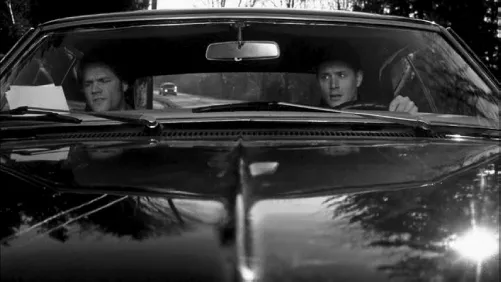
Figure 1.1 Sam and Dean Winchester (Jared Padalecki and Jensen Ackels) in the Impala on the road hunting evil things.
Supernatural’s stories and central concerns have effectively tapped into our human tendency to create narratives about our lives, to live our lives as narratives, and to subordinate ourselves to the cultural narratives prescribed for us. In the show, the Winchesters serve as our representatives in their struggle to maintain agency within a series of overlapping story lines in which the conflicts and denouement are controlled by others. In fighting for (and as) humans, the brothers must contend with constraining external narratives. First, there is the family narrative: the effects of their mother’s death, their identities as John Winchester’s sons, and the carrying on of the family business, or tradition of hunting. While “the boys” strive to maintain their humanity within these narratives—which are often represented as their destiny—they are also denied many elements of human free will and happiness. More specifically, they are denied—and also deny themselves—the loving relationships that could lead them to start families of their own and rewrite their family story. Until recently, they had been denied a typical home, both in the physical sense (they were always moving) and in the sense of comfort and safety.
The Winchesters also exist and do their work amid social narratives that often conflict with the tasks of a hunter, as well as with Sam and Dean’s attempts to remain human as they fight to protect humanity. These include the stories being lived by everyday humans, who usually do not know that they are in danger from supernatural forces (or deny it as long as they can), as well as the narratives put in place by civil authorities (police, politicians, businessmen). Often, the Winchesters end up impersonating these authorities and undermining them by giving themselves the names of rock stars, the traditional icons of rebellion. Also, as KT Torrey writes in this collection, within the world of the show, the Winchesters must directly contend with the idea of themselves as “characters in someone else’s story”—as the heroes of a series of potentially prophetic novels, as television characters played by actors named Jared Padelecki and Jensen Ackles as well as in the fan fiction written by recurring character Becky Rosen (Emily Perkins).
The Winchesters’ struggles also take place within narratives that include supernatural or metaphysical elements. Early on (and sometimes even in later episodes), this meant fighting creatures from urban myth and folktales (stories that already had “endings” the brothers tried to avert) as well as literary fairy tales, stories of gods and tricksters from various cultures, and even stories from “real world” authors like H. P. Lovecraft. Sam and Dean, at various times, also have to contend with their fates as “chosen ones” or instruments of various actors in these narratives—in particular Lucifer and the Archangel Michael, in the apocalyptic story line from seasons four and five. Since the closing of that narrative arc, which ended in season five when Supernatural creator Eric Kripke stepped down as showrunner, the Winchesters have been caught up in ever-expanding, if less logical, story lines including the angel Castiel’s quest to control Heaven, the Leviathans’ plans for world domination, and Metatron’s plot to rid Heaven of warring angels. In each case, the Winchesters are denied narrative agency. They either lack the knowledge and power to change the story or, in other cases, are deceived and unaware of the story being written for and about them.
In its portrayal of the Winchesters’ struggles for agency, Supernatural simultaneously embraces and resists the postmodern impulse to critique and deconstruct hierarchies of thought and cultural value. Sam and Dean find small ways to break free of their subordination to narrative, which is usually framed as destiny. These ways include using humor through satire and self-effacing jokes and by asserting masculinity, through their embrace—especially Dean’s embrace—of the immediate rewards of popular and material culture (classic rock music, the Impala, casual sex, hamburgers and pie), and also through constantly reaffirming their relationship as brothers, a relationship that their antagonists seek to undermine. At the same time, as it recounts the Winchesters’ and other characters’ entrapment within layered narratives, the show itself plays with and deconstructs social and storytelling forms in surprising ways. It challenges scripture and foundational religious writings through the portrayal of sarcastic “dick” angels and its embrace of free will over scriptural determinism. This can be seen in the outcome of the aforementioned Apocalypse plot as well as the ways in which the episodes concerning angels have since broken free from the religious and literary texts that first inspired them. Whereas seasons four and five clearly and explicitly resonated with the Book of Revelation and Milton’s Paradise Lost, in seasons since then, the angels have in effect been writing their own stories. More generally, through its story lines and characters, Supernatural questions the binary in which popular culture is subordinated to high culture, and attempts, in philosopher Jacques Derrida’s words, to “deconstruct” the “structure of opposition” or “hierarchy” in which one idea is always privileged over another (42). The show brings into the popular culture zeitgeist some of the world’s oldest stories, from the Bible and theology to folklore and mythology, as well as echoes of literary fairy tales, and puts them all on an equal footing with literary genres from mystery to horror to paranormal romance, film noir, situation comedy, reality television and, of course, the road film. All these genres can and are used to generate fear, but are just as often played for laughs, sometimes in the same episode. In overturning genre conventions, not only those of the horror genre to which the show ostensibly belongs, but also those of the genres it borrows from, Supernatural ends up engaging in all aspects of culture to address a number of philosophical questions, questions of free will and right action, of what makes us human, and to what extent our lives are governed by the stories others tell. This deconstruction of genre also helps to critique traditional social structures, including religious hierarchy as well as familial and class hierarchies. Even where Supernatural holds onto tradition, in its embrace of a potentially regressive hard masculinity, the show’s use of satire—its winking at gender stereotypes—opens the door for a masculinity that takes into account discussions of how the narrow definition hurts both men and women.
Perhaps because of its long run and the change in showrunners, and because making a television series is always a collaborative effort, Supernatural has played with its own narrative structure as well, allowing it to become more complex over the years. Early episodes of the series seemed to follow the monster-of-the-week format and looked to urban legends and occasionally folklore for antagonists. The first elements of a mythology had to do with the death of the Winchesters’ mother, followed by the gradual introduction of other hunters, and, later, demons and recurring monsters like the reapers, and the powerful seasons four and five apocalyptic narrative that continues to resonate with viewers and critics. Yet, the Winchesters’ struggle for agency continues because every time they win one battle for humanity (and for themselves), another challenge appears. With the conclusion of the Apocalypse story line, the show addressed Sam’s return from Hell (an event from which this book takes its subtitle) and the loss of his soul. Later seasons have evoked the Leviathans, and most recently Metatron, the angel known as the voice of God in Jewish tradition. In each case, the series moves further away from its grounding in its scriptural and literary source material. Yet while some fans and critics long for the narrative consistency of earlier seasons, in making brand new unrecognizable stories out of traditional narratives, rebuilding tradition in a new image, Supernatural is only being faithful to its postmodernist impulse.
As Supernatural incorporates and builds upon other narratives, so this book builds upon the work of others in the ever-expanding field of scholarship on the series, particularly In the Hunt:Unauthorized Essays on Supernatural and Stacey Abbott and David Lavery’s collection, TV Goes to Hell: An Unofficial Road Map of Supernatural, which covers the first five seasons of the show, concluding with Sam’s sacrifice to avert the Apocalypse. This book continues the discussion of gender/women (or lack thereof), the importance of the music, the Impala, and lore, but also adds a more extensive focus on the theological and philosophical underpinnings of the series. This collection takes Supernatural seriously as a popular culture artifact in the same way that the series itself takes seriously (but also has fun with) its borrowings from throughout the culture.
Although some chapters focus on those early seasons, the chapters in this collection also engage with what has happened on the show in the years since Kripke left as showrunner, allowing the series to try out a number of story lines that did not necessarily flow from the five-season plan he initially imagined. Seasons six through nine have continued the use of religious themes through the ongoing interaction between angels and demons, as well as the conflicts among fallen versus unfallen angels. These seasons have also introduced new concepts from religion including the Catholic concept of Purgatory, although used in a way very different from how it is conceptualized in theology (another example of how Supernatural plays with and deconstructs traditional sources to create its own narratives). The introduction of the biblical monsters the Leviathans as a foil for capitalism also shows the ways in which Supernatural continues the discourse between the present moment and literary and cultural tradition. The series also keeps questioning traditional values by giving us angels who are truly evil and demons who may be good—or if not good than at least understandable. These characterizations challenge the idea of what good and evil are and whether the terms continue to have meaning in the postmodern milieu. In many ways, since the end of season five, the show has been in a cycle of starting over, from Dean starting over without Sam, to Sam trying to start over with the veterinarian Amelia (Liane Balaban) and the dog Sam hits with his car, to the brothers starting over without Bobby Singer (Jim Beaver) to the angels starting over, first after losing the surety of the apocalyptic narrative and, as of season nine, having to rebuild and reassert their identities after being ejected from Heaven.
At the time of submitting this manuscript, Supernatural has gotten an early renewal from the CW for a tenth season. Even though some fans and critics have been less than awestruck with the seasons since Kripke’s departure, the program has continued to hold a high market share for the CW. As one website notes, Supernatural has
doubled the network’s Tuesday night ratings year-to-year in adults 18–34 . . . grown +150% in adults . . . and gained +88% in total viewers (3.2 million vs. 1.7 million) versus last season. In its ninth season, Supernatural has seen double-digit increases year-to-year in total viewers and all key demos, and recently had its most watched episodes since 2010. (“Supernatural Officially Renewed”)
Although Kripke’s five-season story line ended four years ago, Supernatural is still generating new fans, scholarship, fanfic, blogs, and interest in the news media, including a recent spot on National Public Radio (Ulaby). Those first five powerful seasons of Supernatural laid the groundwork, creating a long-term narrative and characters strong enough to be deconstructed and reconstructed many times, to be played with, satirized, and layered with meaning and meta-meaning just as the show does with its sources.
The fourteen chapters in this collection consider these narratives through close reading of the series episodes but also by grounding their analysis of Supernatural in philosophical, social, and theological discourses. Some of the chapters in this anthology employ the classic works of philosophy and theology reflected in the series’ themes, including The Bible, the works of Thomas Aquinas, Plato, Augustine of Hippo, John Milton, and so on. Others use modern works of social, literary, and film criticism, such as Maria Tatar and Marina Warner’s work on fairy tales, Tabitha Freeman and Stanley Greenspan on family dynamics, and various psychological approaches. Still other chapters locate Supernatural within the current popular cultural fascination/renaissance of the fantastic—including the shows already mentioned as well as phenomena such as the Twilight series. The series’ roots in folklore and scripture are also examined, from seasons four and five’s apocalyptic arc based in (but also challenging) Judeo-Christian scripture to more recent evocations of religious concepts such as Purgatory and biblical figures such as the Leviathans.
The authors in this collection are all admirers of the series although we are of varying opinions about its postmodernist project. The chapters in section one “Religion, Theology and Philosophy through a Supernatural Lens,” discuss how the show engages with age-old texts in Western culture from the Old Testament and the works of Plato through the medieval Christian theologians. Regina Hansen’s “Deconstructing the Apocalypse? Supernatural’s Appropriation of Angelic Hierarchies” posits the representation of angels in the apocalyptic narrative of seasons four and five as a postmodernist attempt to overturn the concept of hierarchy, both the subordination of humans to God, and sons to fathers, and the subordination of human agency to narrative. The chapter consults the Bible as well as Jewish and early and medieval Christian authors as a balance against Supernatural’s particular understanding of angels and, through them, religion. Elizabeth’s Wolfe’s “The Greatest of These: The Theological Virtues and the Problem of an Absent God in Supernatural” attempts a traditional “moral reading” of Supernatural as a text in which the characters of Sam, Bobby Singer, and Dean are viewed as admittedly not perfect representatives of the theological virtues of faith, hope, and love, respectively. Patricia Grosse’s “Suffering Nuclear Reactors: Depictions of the Soul from Plato to Supernatural” looks at Supernatural’s attempts to answer one of the great philosophical questions, what it means to be human, while also exploring the character of soulless Sam from season six through the lens of Platonic and Augustinian concepts of the soul. In keeping with Supernatural’s interrogation of religious narratives, KT Torrey’s “We’re Just . . . Food and Perverse Entertainment: Supernatural’s New Gods and the Narrative Objectification of Sam and Dean” focuses on Castiel (Misha Collins), the brothers’ greatest ally in stopping the Acopalypse, and champion of free will, taking away their agency and all the brothers hav...
Table of contents
- Cover
- Title
- 1 Introduction: The Highway to Hell and Back
- Part I Religion, Theology, and Philosophy through a Supernatural Lens
- Part II “Killing Evil Things” or Not—Supernatural’s Complex Considerations of Monstrosity
- Part III Men, Women, and Supernatural
- Notes on Contributors
- Index
Trusted by 375,005 students
Access to over 1.5 million titles for a fair monthly price.
Study more efficiently using our study tools.
Frequently asked questions
Yes, you can cancel anytime from the Subscription tab in your account settings on the Perlego website. Your subscription will stay active until the end of your current billing period. Learn how to cancel your subscription
No, books cannot be downloaded as external files, such as PDFs, for use outside of Perlego. However, you can download books within the Perlego app for offline reading on mobile or tablet. Learn how to download books offline
Perlego offers two plans: Essential and Complete
- Essential is ideal for learners and professionals who enjoy exploring a wide range of subjects. Access the Essential Library with 800,000+ trusted titles and best-sellers across business, personal growth, and the humanities. Includes unlimited reading time and Standard Read Aloud voice.
- Complete: Perfect for advanced learners and researchers needing full, unrestricted access. Unlock 1.5M+ books across hundreds of subjects, including academic and specialized titles. The Complete Plan also includes advanced features like Premium Read Aloud and Research Assistant.
We are an online textbook subscription service, where you can get access to an entire online library for less than the price of a single book per month. With over 1.5 million books across 990+ topics, we’ve got you covered! Learn about our mission
Look out for the read-aloud symbol on your next book to see if you can listen to it. The read-aloud tool reads text aloud for you, highlighting the text as it is being read. You can pause it, speed it up and slow it down. Learn more about Read Aloud
Yes! You can use the Perlego app on both iOS and Android devices to read anytime, anywhere — even offline. Perfect for commutes or when you’re on the go.
Please note we cannot support devices running on iOS 13 and Android 7 or earlier. Learn more about using the app
Please note we cannot support devices running on iOS 13 and Android 7 or earlier. Learn more about using the app
Yes, you can access Supernatural, Humanity, and the Soul by Susan A. George, R. Hansen in PDF and/or ePUB format, as well as other popular books in Media & Performing Arts & Art General. We have over 1.5 million books available in our catalogue for you to explore.