- English
- ePUB (mobile friendly)
- Available on iOS & Android
eBook - ePub
About this book
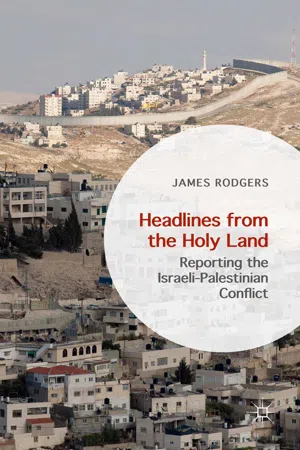
Tied by history, politics, and faith to all corners of the globe, the Israeli-Palestinian conflict fascinates and infuriates people across the world. Based on new archive research and original interviews, Headlines from the Holy Land explains why this fiercely contested region exerts such a pull over leading correspondents and diplomats.
Information
1
Reporting from the Ruins
The End of the British Mandate and the Creation of the State of Israel
The heat and harsh light of the Holy Land – especially when the sun is high in the summer sky – can make covering difficult and dangerous stories particularly hard. The reflected glare of the sun’s rays at midday make you squint, closing one eye to a tiny slit if you are not wearing sunglasses; the sun’s heat – beating down from above, and bouncing back up from stone below – soon becomes uncomfortable; mouths and throats crave cool water. Proximity to death makes all these symptoms worse, and yet more easily ignored: drowned out by the thrill of being in the centre of a major story, a thrill that, at that moment, makes many journalists forget everything except their desire to tell that story. Reflection, and perhaps realization that they could themselves have been among the dead or wounded, often only comes later.
22 July 1946 seems to have been just such a day. To tell the story of the way that the Israeli-Palestinian conflict has seemed to those who have written and broadcast about it, this seems the place to start. The experience of the journalists then, and in the days that followed, is both telling of its time, and an experience in which some of their counterparts in our time would recognize parts of their own. They would know the same sense of urgency; pressure of competition; struggle to make sense of sudden, violent events; fear of danger. At 12.37 pm local time, as hotel residents, British colonial officials, and, probably, some reporters, were having a pre-lunch drink in the bar, a huge explosion destroyed part of the King David Hotel in Jerusalem. It is hard to imagine now what a blow this must have been, what a show of strength by the bombers and the cause that they served. For the hotel housed the headquarters of the British Administration which was the government of the country then still known as Palestine. Not only that, it was the main meeting place for the international press corps. One reporter, Barbara Board, whose fate we will learn shortly, was on her way there to consult the ‘Reuter’s board’. Today, reporters and officials may meet in certain hotels and other places to exchange information – to question, to spin, to mislead, to assist each other – but rarely is their activity as concentrated as it seems to have been in the King David Hotel: a seat of government, a military headquarters, an international press centre, and the residence of many of those involved in all those activities, and others beside. It is the equivalent in the early years of this century of an attack causing scores of casualties in the Green Zone of Kabul or Baghdad. For that reason – that shock – it seems a good starting point for an account of the way that the Israeli-Palestinian conflict has been reported. For the journalists then in Jerusalem, it was a massive news story combining scores of deaths, politics, foreign policy, and personal good fortune.
The King David Hotel had officially opened in 1931, more than a decade after Britain had, in the aftermath of the First World War, been ‘mandated’ by the League of Nations to administer Palestine. Palestine had for centuries been part of the Ottoman Empire – one of the vast political power blocs, along with Tsarist Russia, which did not survive the early 20th century’s first experience of mass, mechanized warfare. As Britain’s time in charge of Palestine went on, the country became increasingly unstable. Jewish immigration was at first tolerated, even encouraged, by the country that had produced the Balfour Declaration – a British pledge made in 1917, ‘incautiously and ambiguously’, to ‘establish a “national home” for the Jews’ in Palestine.1 Jewish immigration had then increased dramatically during the Holocaust, and continued after the Second World War. By 1946, the British found themselves between belligerents divided by tradition, culture (many of the more recent Jewish arrivals were from Europe, and must have understood little of the lives of some of their co-religionists, never mind their Arab neighbours), desire for land, and faith. Far from succeeding in satisfying the needs of the different inhabitants of Palestine, old and new, the British Administration satisfied very few. It may have been an impossible task. It certainly seems to have been an ill-defined one. As Naomi Shepherd wrote in her account of British rule in the Holy Land, ‘The purpose of the Mandate was never entirely clear to those serving in Palestine.’2 In any case, the bombing of the King David Hotel convinced one correspondent, Clare Hollingworth, of the nature of the determination of some of the Jews then in Palestine to have the land for their state. She wrote later of the attack, and Menachem Begin, the future Israeli prime minister who was one of those behind it, ‘It was, in fact, a diabolical statement by the terrorist leader that the fight was on again and the State of Israel would be created out of blood if necessary.’3
Hollingworth may by then have been writing with the benefit of hindsight – the quotation above comes from a book published in 1990 – but her disgust did not diminish with the years. Her account concludes, ‘When Begin rose to power in the late 1970s I often found myself in his presence. But I never greeted him. I would not shake a hand with so much blood on it.’4 Perhaps her enduring enmity was prompted in part by her own proximity to the bombing. At the time, she was talking in a car about 300 yards away but, as a resident of the hotel, she could just as well have been inside it. Barbara Board, who was working for the Daily Mirror, just about was. Her front-page story the following day, 23 July, was headlined, ‘50 die as Jews blow up our Palestine H.Q.: digging goes on’. It began:
I owe my life, and the fact that I am able to write this story of the bloodiest terrorist outrage, to the cool courage of a British military policeman. When a great charge of dynamite blew up the Palestine Government Secretariat in the King David Hotel, a few moments ago, I was walking into the hotel entrance.
As the thunderous boom roared out and the five-storey building collapsed like a pack of cards with 200 British, Arabs, and Jews inside, one military policeman on guard at the entrance threw me onto the ground and shielded me with his body.5
Hollingworth and Board were lucky – and their writing shows that they both understood that. In her 1990 account, Hollingworth puts the number killed at, ‘Over a hundred – Britons, Arabs, and Jews.’6 Other sources give 91.7 Still, the competitive journalistic instinct kicked in. Had the Daily Mail news desk perhaps read an early edition of Board’s dramatic account of her near miss when they headlined their story, ‘3 am News: 50 still missing in “King David” ruins. Hotel Ghq death-roll may be over 90’8? Their ‘3am News’ seems like an attempt to trump her eyewitness story by bringing their readers later developments. A. Gordon, the Daily Mail’s special correspondent, was also on hand to witness a moment of drama, one without a happy ending.
This morning, as cranes and bulldozers and Arab labourers still tear at the wreckage, it is feared that the death toll in the King David Hotel bomb outrage in Jerusalem may exceed 90 [ … ].
I have just seen a paratrooper dig his way under a two-ton ceiling to reach a corporal.
But when the man was brought out he was dead.9
In newsreel footage from the time, British servicemen, shirtless and in shorts, some with cigarettes hanging from their lips, toil away in the Middle Eastern midsummer heat. Even in black and white, perhaps especially in black and white, the daylight seems strikingly bright. There is no natural sound on the film, which has been overlaid with funereal music, and a voiceover in the kind of mid-20th-century British accent which is heard no more, clipped vowels its characteristic. The newsreel begins with the caption ‘Tragedy in Jerusalem’10 and shows soldiers shifting rubble by hand, occasionally a crane lifting larger pieces of wreckage, bodies covered by blankets carried away on stretchers. ‘In broad daylight, dozens of Jews, Arabs, and Britishers, were murdered in cold blood by the notorious Jewish terrorist organization, Irgun Zvai Leumi’11 the voiceover, credited to Flight Sergeant Flitchen, tells the viewer. ‘Words cannot express the stark tragedy of this ghastly incident.’12 In the newspaper coverage, the solemn, condemnatory tone is also present – the attackers are everywhere referred to as ‘terrorists’ – but combined with breathless eyewitness accounts like Board’s close escape, and, in the following days, excitement about the ‘manhunt’ which is launched to find the killers.
In the Daily Express, Peter Duffield, who was staying in the hotel at the time, could not quite compete with Board’s being shielded by a policeman – but his colleagues in London made the most of his presence.
The Daily Express reporter was sitting in his room, No 105, on the second floor of the King David Hotel at noon yesterday when terrorists blew one-eighth of the hotel skyhigh.
The reporter was typing a feature requested by the Daily Express called ‘Date Line King David’.13
The introduction to the feature in question concludes with Duffield’s allowing himself a little journalistic joke – in questionable taste. ‘Hours later he cabled, “A lot of the hotel I was writing about is not standing now – but maybe the feature will stand up.” ’14 The article, most of which was obviously written before the bombing, is a description of life inside the building which was the centre of political and military power in Mandate Palestine. It includes a glimpse of the daily routine of Sir John Shaw, then chief secretary (second in command) of the British Administration. It was a routine which would not last much longer: as Motti Golani notes in his introduction to the diary of Sir Henry Gurney, Shaw’s successor, Shaw left Palestine later that year, 1946, ‘unable to continue in office because he was under certain threat of assassination.’15 Sir John Shaw, it seems, hardly felt safe then. Duffield describes the numerous security checks to which he is subject before being admitted to Shaw’s office. Prior to describing the maps which hang on the walls, Duffield cannot resist falling back on an old British journalistic way of conveying the size of a country or territory. The only surprise here is that it was considered worn-out even as far back as the first half of the last century. ‘The geographic cliché about Palestine is that it is the size of Wales,’16 he explains. It is in this office that Shaw tries to deal with the claim and counterclaim on property and territory which make fulfilling the British Mandate an increasingly impossible task. Under the crosshead ‘Propaganda’, Duffield explains the wider situation which makes Shaw’s role so difficult, and dangerous. ‘That Palestine scene – with its fierce hatreds, its distortions and mutilations of the truth – is visible in Shaw’s wastepaper basket. Into it each day, after perusal, go thousands of words of propaganda, pleading, demands and threats.’17 This image of the ‘thousands of words’ which end up in the wastepaper basket is understandable, if, at this distance a little unsettling – especially as one aspect of the bombing upon which opinions seem to differ even today is whether warnings of the bombing were adequately given, or acted upon. Could there have been some vital piece of intelligence among the ‘propaganda, pleading, demands, and threats’?
With the eyewitness reports of the ‘bloodiest terrorist outrage’ came attempts to piece together what had happened, and predict the response that would follow. A ‘staff reporter’ for the Daily Express reported in that newspaper’s front-page story that, ‘The bombs were planted in the basement by Jewish terrorists, dressed as Arab milkmen, and carrying the bombs in churns.’18 The Times, whose Special Correspondent seems not to have joined his or her mid-market colleagues either in narrowly missing death, or in watching the rescue operation among the rubble, does judge that ‘the outrage was planned with fresh ingenuity and cold-bloodedness’,19 and does seem to have spoken to the ‘Arab servants’ in an attempt to work out how the attack had been carried out:
several men dressed as Beduin began to unload milk churns, and one, it is reported, carried a sack. Five went farther into the kitchens of the cabaret restaurant called La Régence, situated next to the hotel kitchens. Here, according to the story of the Arab servants, the men held up the kitchen staff of the restaurant and apparently set to work to lay the bomb.20
The Manchester Guardian (as the forerunner of today’s Guardian was then known) offers a fuller account, although the correspondent who sent it was not identified in that day’s paper. The report appeared under the byline ‘From Our Special Correspondent’, and, at the end of the article, added ‘ “The Times” & “Manchester Guardian” Service’. This detailed and well-written account described how ‘several men dressed as Bedouins began unloading milk churns’, before going on to report the first, smaller, explosion, in the street outside, which was designed to distract attention from those disguised bombers who had entered the hotel itself.
Meantime outside in the street a small bomb exploded 100 yards away; it had been placed in a box under a tree. No one was seriously injured. Firing began at various points. The first shot was fired when a British officer emerged from a military telephone exchange at the basement entrance while the ‘milk churns were being unloaded.’21
The Manchester Guardian correspondent seems to have been able to get a lot of detail which eluded competitors, and his or her account stands up to scrutiny even today. With their target in mind, the bombers, ‘Irgun members disguised as Arabs’,22 as the hotel’s own account has it,23 set about their task. Today, even as the Israeli-Palestinian conflict continues, it is hard to imagine that the King David Hotel was a war zone. The lobby is a picture of luxury, where guests chat quietly, or tap away at tablet computers or smartphones. The chairs are deep and comfortable, the ceilings high. The odd, overheard, snatch of conversation gives away the fact that, as well as casual glancing at news headlines or social media, there is serious business in hand here. Where once the King David was home to British diplomatic and military power, it is now home from home for the global political and business elite when they visit Jerusalem. One corridor leading away from the reception area has the signatures of prestigious guests petrified for posterity among the marble floor tiles. Beneath here, though, are places which allow today’s visitor to try to picture what the place must have been like the day the attackers struck. Having decided to plant their explosives in a kitchen which was located in the basement of the hotel’s south wing, the Irgun attackers made their way along a subterranean passage, running beneath the corridor tiled with the autographs of presidents and prime ministers. Today the passage still lead...
Table of contents
- Cover
- Title Page
- Copyright
- Contents
- Foreword by Rosemary Hollis
- Acknowledgements
- Introduction
- 1. Reporting from the Ruins: The End of the British Mandate and the Creation of the State of Israel
- 2. Six Days and Seventy-Three
- 3. Any Journalist Worth Their Salt
- 4. The Roadmap, Reporting, and Religion
- 5. Going Back Two Thousand Years All the Time
- 6. The Ambassador’s Eyes and Ears
- 7. Social Media: A Real Battleground
- 8. Holy Land
- Notes
- Bibliography
- Index
Trusted by 375,005 students
Access to over 1.5 million titles for a fair monthly price.
Study more efficiently using our study tools.
Frequently asked questions
Yes, you can cancel anytime from the Subscription tab in your account settings on the Perlego website. Your subscription will stay active until the end of your current billing period. Learn how to cancel your subscription
No, books cannot be downloaded as external files, such as PDFs, for use outside of Perlego. However, you can download books within the Perlego app for offline reading on mobile or tablet. Learn how to download books offline
Perlego offers two plans: Essential and Complete
- Essential is ideal for learners and professionals who enjoy exploring a wide range of subjects. Access the Essential Library with 800,000+ trusted titles and best-sellers across business, personal growth, and the humanities. Includes unlimited reading time and Standard Read Aloud voice.
- Complete: Perfect for advanced learners and researchers needing full, unrestricted access. Unlock 1.5M+ books across hundreds of subjects, including academic and specialized titles. The Complete Plan also includes advanced features like Premium Read Aloud and Research Assistant.
We are an online textbook subscription service, where you can get access to an entire online library for less than the price of a single book per month. With over 1.5 million books across 990+ topics, we’ve got you covered! Learn about our mission
Look out for the read-aloud symbol on your next book to see if you can listen to it. The read-aloud tool reads text aloud for you, highlighting the text as it is being read. You can pause it, speed it up and slow it down. Learn more about Read Aloud
Yes! You can use the Perlego app on both iOS and Android devices to read anytime, anywhere — even offline. Perfect for commutes or when you’re on the go.
Please note we cannot support devices running on iOS 13 and Android 7 or earlier. Learn more about using the app
Please note we cannot support devices running on iOS 13 and Android 7 or earlier. Learn more about using the app
Yes, you can access Headlines from the Holy Land by James Rodgers in PDF and/or ePUB format, as well as other popular books in History & Social History. We have over 1.5 million books available in our catalogue for you to explore.