This book examines the language of public inquiries to reveal how blame is assigned, avoided, negotiated and discussed in this quasi-legal setting. In doing so, the author adds a much-needed linguistic perspective to the study of blame – previously the reserve of moral philosophers, sociologists and psychologists – at a time when public inquiries are being convened with increasing frequency. While the stated purpose of a public inquiry is rarely to apportion blame, this work reveals how blame is nevertheless woven into the fabric of the activity and how it is constructed by the language of the participants. Its chapters systematically analyse the establishment of inquiries, their questioning patterns, how blame can be avoided by witnesses, how blame is assigned or not by an inquiry's panel and how such blame may result in public apologies. The author concludes with an engaging discussion on the value of public inquiries in civic life and suggestions for changes to the processes of public inquiries. This book will appeal to readers with a general interest in public and political language; in addition to scholars across the disciplines of communication, media studies, politics, sociology, social policy, philosophy, psychology, linguistics, rhetoric, public relations and public affairs.
This book is about blame and in particular how it is performed at public inquiries. Blame has been extensively thought about by moral philosophers, sociologists and psychologists, but has been investigated very little by linguists. The public inquiry as a site of action has also been under-studied, despite its increasing frequency in public life. This work seeks to remedy this—by analysing the talk of actors involved in public inquiries with a view to investigating how blame is constructed in this setting. I will show that, despite not being explicitly performed, blame pervades the discourse of the participants at inquiries. Unlike some, I do not see this as a bad thing, and I hope to argue that blame is a healthy and natural part of public life. Whilst the establishment of a blame culture can have negative effects, these are not outweighed by the importance of accountability in civic life. The public inquiry may be seen as the ultimate arbiter of such accountability and I will demonstrate how this accountability emerges, from the establishment of the inquiry panel, to the questions which are asked of witnesses, to the evidence which those witnesses provide and to the reports which emerge as a result of this evidence.
Having set out the broad aims of this work, in this chapter I will go into some detail about the purpose of the public inquiry and their relationship with blame (Sect. 1.1), the typical processes of inquiries (Sect. 1.2) and the history of public inquiries as a part of civic life in the United Kingdom (Sect. 1.3). In Sect. 1.4, I will go into some more detail about how inquiries unfold over time and the hurdles which are encountered as the inquiry progresses. Section 1.5 explains the general approach of the book, touching upon the main methodological tools and theoretical ideas invoked in the study and Sect. 1.6 outlines the structure of the work. I conclude in Sect. 1.7 with an explanation of why I think this book is needed, and what I seek to achieve in presenting a view of blame at public inquiries.
1.1 The Purpose of Public Inquiries
A public inquiry is an ad-hoc temporary body established by the government for specific purposes. There are a variety of such bodies with varying functions; some examples include Royal Commissions, Committees of Inquiry, reviews or task forces. As the House of Commons Library note on public inquiries puts it:
The term ‘public inquiry’ has a very broad meaning, and the history of the British government shows that there are in fact a number of forms of ‘inquiry’ available, designed, in principle to fulfil specific functions. Sometimes the wish may be simply to establish the relevant facts, leaving their interpretation, the allocation of ‘blame’ and recommendations for future to other agencies such as Ministers, Parliament or the courts. In other circumstances it may be thought desirable that the ‘inquiry’ itself undertake these broader, perhaps more delicate tasks. A prime purpose of some inquiries may also be to allay public (and Parliamentary) disquiet about some public issue or a ‘scandal’. (Briefing note SN/PC/2599)
For the purposes of this book, however, the focus will specifically be on those types of public inquiry which are ‘investigative’ in nature and which have been set up in a context where something has gone seriously wrong in terms of government procedures or actions, or where the matter has raised issues of public concern regarding the behaviours of bodies such as the police, the NHS and the press. Moreover, only inquiries established under the terms of the Inquiries Act (2005) or its predecessor the Tribunals and Inquiries Act (1921) are examined in this work (I will discuss these acts in Sect. 1.3). This will ensure some level of commonality between the rules governing the inquiries and, therefore, offers the possibility of comparison between different inquiries.
Public inquiries are now a central part of modern political structures not only in the UK but also Australia, New Zealand and Canada where older colonial links have created public inquiry models very similar to those found in the UK. But outside such connections the overall concept of the public inquiry is also central to other developed democracies, for example the USA has its own forms of investigation such as Presidential Committees and Congressional Committees.
Public inquiries were first instituted with the central aim of:
establishing the facts...the modern model of the public inquiry often has as its central (but not only) question, ‘what happened?’. And further it also functions to ‘identify wrongdoing, blameworthy conduct, or culpability by individuals and organs of the state’. (Beer 2011: 2)
Contrast this, however, with the then Government’s view expressed to a 2004 parliamentary commission that the purpose of a public inquiry was ‘to prevent recurrence...and learn lessons, not to apportion blame’ (House of Commons Public Administration Select Committee, Government by Inquiry, Evidence 29, iii, my emphasis).
These two sets of aims seem potentially contradictory or at the very least in conflict with one another, after all given that public inquiries are called where something has gone wrong how does one identify culpability without apportioning blame? Furthermore, how does one learn lessons and avoid recurrence without accepting that what did occur was wrong or should not have happened? In stating that something is wrong, if one shows that someone can be held responsible for such negative actions or outcomes, is this not a form of blame? From the Government’s viewpoint it seems that ‘facts’ should be neutral, i.e. person X did action Y; the perspective of some inquiries is that it is not so simple as to say that X did Y, but that Y is a negative action which X is responsible for and therefore to blame for. Views of what blame is do differ, but a straightforward way of thinking about it is that it sees a speaker assigning responsibility for an action considered to be negative to a hearer or third party. As such, any act which identifies culpability is surely also an act which blames. Describing an act as one which needs to change surely allows a hearer to infer that the act is a negative one. I shall return to these complexities around blame in Chapters 4 and 5. I will also consider the delicate Terms of Reference which inquiries are given which have in mind these conflicting views in the next chapter. But these initial thoughts should plant the seed of an issue which will emerge in this book: blame is something which can be, and is, carried out indirectly.
1.2 The Process of Public Inquiries
In most cases public inquiries are chaired by a judge, although this is not necessary. The chair of an inquiry is not tasked with assessing innocence or guilt, that is the function of the courts. At the start of the Chilcot Inquiry into the Iraq War, the matter was put in this way:
Nevertheless, whether chaired by a judge or not, and Chilcot’s comments notwithstanding, most such investigative inquiries take on a quasi-legal status, and although they are said to be less adversarial rather than prosecutorial in nature, their organisation, procedural production and questioning patterns, as well as the overall style/register of the language used places them within a set of recognisable legally-based, if not legally bound, activities. One of the aims of this book is to examine where the language of inquiries is marked as being distinctive from prosecutorial (criminal) forms of courtroom talk and how this relates to the construction of blame and responsibility. I will take up this aspect in Chapter 3.
In this case, and like most legal or legally influenced activities, public inquiries are dependent on ‘language’. As Tiersma puts it:
any legal activity, such as settling disputes, making contracts, or providing for what happens to your possessions after you die, presupposes the existence of a sophisticated system of communication, which is another way of saying that such legal activities require language. (Tiersma 2009: 11)
It is a fundamental claim of this book that language is central to the nature of public inquiries and that they may be seen as discursive activities. That is to say, they are forms of talk in which the organisation, processes, understanding and outcome of public inquiries may be analysed in terms of units of language which are packaged—often as discrete discourse structures: e.g. openings and closings; sequential patterns: e.g. questions and answers; or individual actions: e.g. accounts, justifications, and apologies.
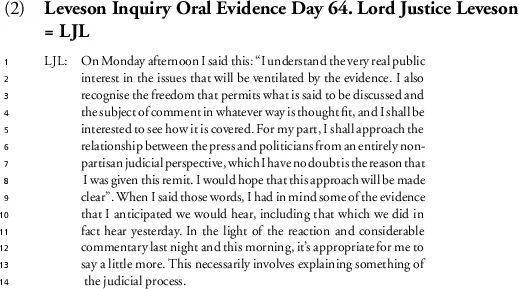
Consider, by way of introductory example, the following extract from the Leveson Inquiry into the Culture, Practice and Ethics of the Press:
We can notice, without the need for invoking any linguistic theory at this stage, several things about this short extract. Its quasi-legal style is clear in several ways, not least of which is Leveson’s own use of the term ‘judicial’ both in judicial perspective and judicial process. But the level of formality used is also noteworthy—both lexically, as in the interesting used of ‘ventilate’ as found in will be ventilated by the evidence and the use of grammatical complexity in lines 2–5 for example, which includes both embedding and conjunction of clauses. In that same extract, note also the use of the auxiliary ‘shall’ which is preferred in more formal genres over the more commonly used ‘will’ (Biber et al. 1999: 148ff.).
Finally, consider the way in which Leveson uses direct quotation to refer to what he said previously (line 1 introduces this). This is a verbatim account, readily available from previous recordings and transcripts. This differs from more informal use where our direct quotations are often more ad-hoc paraphrases, e.g. quotatives such as: I was like, and the expectation of our interlocutors is that what we are reporting is not a completely verbatim account (see Buchstaller and van Alphen 2012). This is clearly something which Leveson is keen to avoid by referring and evidencing what he said, word-for-word.
In this informal assessment of a brief extract from one of the inquiries which I will return to later in this book, we can see some of the things that will be explored in what follows. Many such things we will look at in more technical detail. For now though, let us consider briefly how ...
Table of contents
Cover
Front Matter
1. Introduction
2. Openings: Terms, Conditions and Getting Started
3. Questioning
4. Blame Avoidance
5. The (Non-)Assigning of Blame
6. Apologising
7. Conclusion
Back Matter
Trusted by 375,005 students
Access to over 1.5 million titles for a fair monthly price.
Study more efficiently using our study tools.
Frequently asked questions
Yes, you can cancel anytime from the Subscription tab in your account settings on the Perlego website. Your subscription will stay active until the end of your current billing period. Learn how to cancel your subscription
No, books cannot be downloaded as external files, such as PDFs, for use outside of Perlego. However, you can download books within the Perlego app for offline reading on mobile or tablet. Learn how to download books offline
Perlego offers two plans: Essential and Complete
Essential is ideal for learners and professionals who enjoy exploring a wide range of subjects. Access the Essential Library with 800,000+ trusted titles and best-sellers across business, personal growth, and the humanities. Includes unlimited reading time and Standard Read Aloud voice.
Complete: Perfect for advanced learners and researchers needing full, unrestricted access. Unlock 1.5M+ books across hundreds of subjects, including academic and specialized titles. The Complete Plan also includes advanced features like Premium Read Aloud and Research Assistant.
Both plans are available with monthly, semester, or annual billing cycles.
We are an online textbook subscription service, where you can get access to an entire online library for less than the price of a single book per month. With over 1.5 million books across 990+ topics, we’ve got you covered! Learn about our mission
Look out for the read-aloud symbol on your next book to see if you can listen to it. The read-aloud tool reads text aloud for you, highlighting the text as it is being read. You can pause it, speed it up and slow it down. Learn more about Read Aloud
Yes! You can use the Perlego app on both iOS and Android devices to read anytime, anywhere — even offline. Perfect for commutes or when you’re on the go. Please note we cannot support devices running on iOS 13 and Android 7 or earlier. Learn more about using the app
Yes, you can access The Discursive Construction of Blame by James Murphy in PDF and/or ePUB format, as well as other popular books in Languages & Linguistics & Linguistics. We have over 1.5 million books available in our catalogue for you to explore.