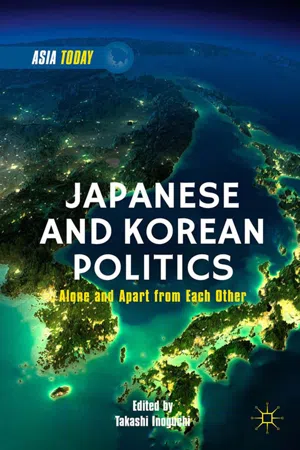
This volume examines Japanese and Korean politics from both Japanese and Korean angles, exploring why the two countries do not cooperate bilaterally or consult one another, despite their geographical closeness and a number of common features that are central to both countries' domestic politics and foreign policies.
- English
- ePUB (mobile friendly)
- Available on iOS & Android
eBook - ePub
About this book
Information
Korean Politics
5
South Korea’s 2012 Presidential Election*
Won-Taek Kang
Elections provide voters not only with an opportunity to decide who will govern the country but also with a chance to express how they view politics as a whole. Just before the 2012 presidential election it appeared that Korean party politics was at the crossroads as public dissatisfaction with the existing party politics was prevalent. Many people wanted an extensive transformation of politics, and some hoped for the possibility of “new politics.”
Generally speaking, the 2012 presidential election in Korea has produced some interesting results. Korean voters elected a female candidate as president for the first time in history. The election was a very close competition. Park Geun-hye, a candidate from the ruling Saenuri Party, won 51.6 percent compared to the Democratic United Party (DUP) candidate Moon Jae-in who garnered 48.0 percent of votes. The margin between the two major candidates was merely 3.6 percent. Park wooed conservative voters and Moon won liberal votes. This narrow victory indicated that South Korean society is evenly divided in terms of ideology, region, generation, and partisan commitment.
From the beginning, the presidential race in 2012 attracted widespread public attention because of their political background. Park’s father, Park Chung-hee still stirs mixed feelings among Koreans. He was the main architect of rapid economic development and modernization in the 1960s and 1970s. But some people remember Park Chung-hee as a brutal dictator who oppressed political dissidents and violated human rights. By contrast, Moon Jae-in, a close friend and aide to the late-President Roh Moo-hyun, is a former human rights lawyer and was jailed under the Park Chung-hee regime.
This election is rare in that the presidential competition was held only between two major parties. There has been usually a viable third candidate in previous elections. As a matter of fact, the 2012 presidential election was a three-way competition at the outset. An unexpected independent candidate won a high proportion of popularity. Ahn Cheol-soo was a former professor and software mogul, but he had no prior experiences in politics. His popularity began to surge along with a by-election of the Seoul mayor in October 2011. An exit poll of the by-election asked respondents if they would be willing to support a new party led by Ahn; a plurality of respondents in their 20s (43.2%), 30s (50.9%), and 40s (46.3%) answered in the affirmative. Support is particularly noticeable among white-collar workers and students groups. The sociodemographic cohort confirms that to be of independents.1 This indicates that he was popular among those who were disenchanted with the major parties, particularly popular among young and independent voters. Ahn ran without relying on a political party, distancing himself from the establishment and promising “new politics.” In the last phase of the campaign, Moon and Ahn agreed to field a single candidate between them, so as not to divide opposition votes, and Ahn decided to step down in favor of Moon. However, the so-called Ahn phenomenon signifies that there is widespread and deep dissatisfaction with current party politics in general and that strong demands for change and new politics exist. In reality Ahn played “politics of anti-politics,” exploiting widespread sentiment against established party politics.2 According to public polls examined well before the presidential election, Ahn demonstrated strong electoral competitiveness as a presidential candidate. When a poll was conducted before the 2012 National Assembly election, the approval rating of Ahn was 21.2 percent, whereas that of Park was 31.8 percent and that of Moon was 14.8 percent.3 Another survey asked respondents to respond to a hypothetical two-way presidential race. In the first of these hypothetical competitions, Park won 46.3 percent of the vote to Ahn’s 49.7 percent, and, in the second scenario, Park garnered 55.7 percent whereas Moon received 39.7 percent.4 Around the time of the National Assembly election Ahn appeared to be the likely winner in the presidential election.
Even though a rise of a third candidate in Korea’s presidential election was not new, the scale and intensity of Ahn’s support is unprecedented. Even though he came from nowhere, his popularity suddenly threatened the major parties’ candidates. This implies that party identification may be considerably weakened and that voters lack trust in their traditional parties. Subsequently, this also may indicate that Korea’s party politics is in crisis and faces a strong challenge from outside. This chapter attempts to better understand the 2012 presidential election in Korea by analyzing how and why the voters made up their minds to support a third candidate. For this purpose, this chapter focuses on whether the 2012 presidential election demonstrated “crisis of party politics” and suggests some signs of partisan dealignment. Specifically this chapter analyzes the relationship between voters’ choices in the presidential election and their party identification and later examines some characteristics of Ahn supporters.
Party Politics and Party Identification since Democratization
Korea’s party system has been fairly stable since 1990. The first elections in the post-democratization period created a four-party system, in which each party politically depended on a specific region. However, the four-party system transformed into a two-party system in 1990, when three of the four parties merged to form the Democratic Liberal Party (DLP). This agreement to create a new party was effectively an expedient marriage between former enemies. President Roh Tae-woo’s party was founded by former authoritarian dictator Chun Doo-hwan, who seized power with Roh’s help in a military coup in 1980. By contrast, Kim Young-sam was one of the prominent pro-democracy movement leaders. Roh, who politically suffered from a divided government, wanted a majority of seats in the National Assembly. Kim Young-sam wanted to enhance his chances to become the next president. Along with the merger, the old political division between pro-democracy forces and the authoritarian regime became less significant. Regionalism took its place. The DLP represented Gyungsang and Chungcheong regions while the remaining Peace Democratic Party (PDP) represented the Jeolla region.
Since then, the two major parties have consistently dominated Korean party politics despite frequent alteration of party names. Regionalism has been identified as the key process underlying electoral choice since democratization. The regional rivalry was firmly established, particularly between Gyungsang and Jeolla. Voters cast their ballots to a party that they respectively perceived as representing their “home” region. In this regard, regionalism has been almost the only determinant for people’s voting behavior in all the elections since 1987.5 Political duopoly has never been seriously threatened although there have been many attempts to challenge it. First-past-the-post electoral system combined with regionalist party politics effectively helps to consolidate the system of two-party dominance. With time ideology also has gained political significance. Ideological division also reinforced partisan commitment to the two major parties. In the past, ideological differences between parties were not very salient in Korean politics. The conservatives dominated party politics in spite of rapid industrialization and the consequent growth of the working class. This is greatly attributed to the bitter experience of the Korean War and the lingering effects of the “red complex.” Red complex has often been used to suppress political dissidents by the authoritarian regimes. Even after democratization, ideology did not have much significance in Korean electoral politics, and the liberal ideology, not to mention socialist ideology, was not politically represented at all. However, ideology began to visibly matter since the 2002 presidential election,6 when Roh Moo-hyun and the so-called 386 generation dramatically highlighted progressive political causes including anti-Americanism. However, ideology in the Korean context does not contain the connotation of class politics. Security issues such as policy toward the United States or North Korea are ideologically more significant. Since the 2002 presidential election, ideology combined with regionalism has characterized Korean party politics. The Saenuri Party (and its predecessors) tends to represent the Gyungsang region and conservative ideology, whereas the Democratic United Party (and its antecedent parties) stands for the Jeolla region and liberal ideology in the Korean political context.
Electoral results confirm that many voters have maintained fairly stable partisan choices throughout elections. Gyungsang voters tend to strongly support the DLP and its descendants, whereas Jeolla voters are very likely to vote for the PDP and its successors. In this regard, strong partisan attachment has developed toward the two major parties. Since Angus Campbell and his colleagues’ seminal work, The American Voter (1960)7 was published, party identification has been regarded as an important attitude that influences votes. Campbell et al. maintains: “Few factors are of greater importance for our national elections than the lasting attachment of tens of millions of Americans to one of the parties. These loyalties establish a basic division of electoral strength within which the competition of particular campaigns takes place. And they are an important factor in ensuring the stability of the party system itself . . . the strength and direction of party identification are of central importance in accounting for attitude and behavior.”8 According to this work, party identification is influenced by political socialization during childhood. Parents, close family members, and immediate surroundings, such as the neighborhood community, influence the formation of party identification. Countless studies have been conducted by employing the concept of party identification. Despite huge debates over the effect of party identification, it cannot completely be ignored. In recent studies, the direct influence of party identification on the vote probably is small in presidential elections. But the indirect influence of party identification is much greater, in that partisan loyalties influence how candidates are evaluated, government performance assessed, and political events perceived. Put simply, party identification is a perceptual screen—a pair of partisan tinted eyeglasses through which the voters view the political world.9
The concept of...
Table of contents
- Cover
- Title
- Introduction: Are Japan and Korea Alone and Apart from Each Other?
- Japanese Politics
- Korean Politics
- Foreign Policy: Japan and Korea
- Bibliography
- List of Contributors
- Index
Trusted by 375,005 students
Access to over 1.5 million titles for a fair monthly price.
Study more efficiently using our study tools.
Frequently asked questions
Yes, you can cancel anytime from the Subscription tab in your account settings on the Perlego website. Your subscription will stay active until the end of your current billing period. Learn how to cancel your subscription
No, books cannot be downloaded as external files, such as PDFs, for use outside of Perlego. However, you can download books within the Perlego app for offline reading on mobile or tablet. Learn how to download books offline
Perlego offers two plans: Essential and Complete
- Essential is ideal for learners and professionals who enjoy exploring a wide range of subjects. Access the Essential Library with 800,000+ trusted titles and best-sellers across business, personal growth, and the humanities. Includes unlimited reading time and Standard Read Aloud voice.
- Complete: Perfect for advanced learners and researchers needing full, unrestricted access. Unlock 1.5M+ books across hundreds of subjects, including academic and specialized titles. The Complete Plan also includes advanced features like Premium Read Aloud and Research Assistant.
We are an online textbook subscription service, where you can get access to an entire online library for less than the price of a single book per month. With over 1.5 million books across 990+ topics, we’ve got you covered! Learn about our mission
Look out for the read-aloud symbol on your next book to see if you can listen to it. The read-aloud tool reads text aloud for you, highlighting the text as it is being read. You can pause it, speed it up and slow it down. Learn more about Read Aloud
Yes! You can use the Perlego app on both iOS and Android devices to read anytime, anywhere — even offline. Perfect for commutes or when you’re on the go.
Please note we cannot support devices running on iOS 13 and Android 7 or earlier. Learn more about using the app
Please note we cannot support devices running on iOS 13 and Android 7 or earlier. Learn more about using the app
Yes, you can access Japanese and Korean Politics by T. Inoguchi in PDF and/or ePUB format, as well as other popular books in Politics & International Relations & Asian Politics. We have over 1.5 million books available in our catalogue for you to explore.