This edited collection examines the politics of semi-presidential countries in the Caucasus and Central Asia. Semi-presidentialism is the situation where there is both a directly elected fixed-term president and a prime minister and cabinet that are collectively responsible for the legislature. There are four countries with a semi-presidential constitution in this region - Armenia, Azerbaijan, Georgia, and Kyrgyzstan. The authors introduce the concept of semi-presidentialism, place the countries in a general post-Soviet context, and compare them with Kazakhstan. They investigate the relationship between semi-presidentialism in the formal constitution and the verticality of power in reality, explore the extent to which semi-presidentialism has been responsible for the relative performance of democracy in each country, and chart the relationship within the executive both between the president, prime minister and ministers, and between the executive and the legislature.<
Robert Elgie and Sophia Moestrup (eds.)Semi-Presidentialism in the Caucasus and Central Asia10.1057/978-1-137-38781-3_1
Begin Abstract
1. Semi-presidentialism in Democracies, Quasi-democracies, and Autocracies
Robert Elgie1 and Sophia Moestrup2
(1)
Dublin 9, Ireland
(2)
Arlington, VA, USA
End Abstract
This book examines semi-presidentialism in the Caucasus and Central Asia. Semi-presidentialism is the situation where a country’s constitution makes provision for both a directly elected fixed-term president and a prime minister (PM) and cabinet who are collectively responsible to the legislature. Currently, there are four countries with semi-presidential constitutions in this region: Armenia, Azerbaijan, Georgia, and Kyrgyzstan, plus Kazakhstan, which is on the constitutional cusp of semi-presidentialism and presidentialism but which is presidential. We are interested in the extent to which presidential institutions in these countries have had an impact on the practice of politics there since statehood in the early 1990s.
There is now a large literature identifying the consequential effect of institutions and, more specifically, a literature identifying both the effect of different forms of executive/legislative relations on political outcomes (Samuels and Shugart 2010) and the effect of institutional variation within semi-presidentialism (Samuels and Shugart 2010; Elgie 2011). This work gives us reason to think that institutions should have shaped outcomes in the five countries under investigation. At the same time, though, there is also a literature suggesting that the effect of formal institutional structures matters only in relatively democratic countries. In the five countries we examine, the degree of democracy has varied greatly both generally from one country to the next and over time within a number of countries. This leads us to expect that the effect of institutions will vary accordingly. What is more, there is a further area-centric body of work indicating that outcomes in countries of the former Soviet Union are shaped more by informal vertical power relations than formal institutions. The countries under investigation in this book are all part of the former Soviet Union and achieved statehood in relatively similar circumstances at around the same point in time. This suggests they are likely to share certain post-Soviet political practices that may go so far as to negate the standard impact of formal constitutional arrangements.
In this context, we ask the following questions: firstly, what is the relationship between semi-presidentialism in the formal constitution and the verticality of actual power relations in these five countries; secondly, to what extent, if any, have presidential institutions been responsible for the relative performance of democracy in these countries; and thirdly, in what ways have particular institutional arrangements shaped the relationships both within the executive between the president, the prime minister (PM), and ministers, and between the executive and the legislature? At the risk of a major spoiler alert, we find that in some cases, vertical power relations have made formal constitutional structures almost entirely redundant. In other cases, though, institutions have mattered, and semi-presidential arrangements have had consequential effects.
This book has eight chapters. There are chapters on each of the five countries under investigation. These chapters are preceded by a chapter on the general features of post-Soviet politics in this region. There is also this introduction to the themes of the book and a conclusion that draws together the findings. In this introductory chapter, we set the scene by identifying the concept of semi-presidentialism and reviewing the existing literature about the supposed effects of this constitutional form. In particular, we address the importance of institutional variation within semi-presidentialism and discuss some common misconceptions about semi-presidentialism. We also provide an institutional overview of the countries to be examined and the effects we might expect to identify in those countries on the basis of the existing literature. Finally, the chapter outlines the structure of the book and the specific organization of the country case studies. To begin, we outline the concept of semi-presidentialism and how it has changed over time.
Semi-presidentialism: What Is It and Where Is It Found?
Semi-presidentialism was first conceptualized by Maurice Duverger (1970) to describe a type of regime that was different from both presidential and parliamentary systems. The introduction of the direct, popular election of the president in France in 1962 was the institutional change that prompted Duverger to identify semi-presidentialism as a separate regime type. Duverger’s original definition was as follows:
[A] political regime is considered as semi-presidential if the constitution which established it combines three elements: (1) the president of the republic is elected by universal suffrage; (2) he possesses quite considerable powers; (3) he has opposite him, however, a prime minister and ministers who possess executive and governmental power and can stay in office only if the parliament does not show its opposition to them. (Duverger 1980, p. 166)
Duverger’s conceptualization of semi-presidentialism was a welcome innovation and addition to the study of comparative governmental systems. For more than a century, attention had been focused solely on presidentialism and parliamentarism, even though the first countries with semi-presidential constitutions had appeared as far back as 1919. Duverger’s definition of semi-presidentialism quickly took hold and became the standard way of thinking about semi-presidentialism. More than that, given the context in which the concept was formulated, Duverger’s own writing on France and his position within the French academy, France became the default semi-presidential reference point. Largely thanks to Duverger, when scholars thought about semi-presidentialism, they thought about the French case.
Gradually, though, Duverger’s definition was contested. In this regard, a recurring problem not only with Duverger’s definition but also with subsequent attempts at regime classification was the inclusion of clauses referring to the actual powers of either president or PM in order for a regime to be considered semi-presidential. As seen above, Duverger’s original definition states that the president must have “quite considerable powers” for a country to be considered semi-presidential. In his alternative formulation, Sartori (1997) focused on the effective powers of the PM. As a condition for a country to be classified as semi-presidential (ibid., 131), he believed that there should be a “dual authority structure” where the president shared power with a PM. However, definitions of semi-presidentialism that include reference to essentially subjective criteria such as the presence of “quite considerable” presidential powers hamper our ability to agree on a common set of countries for comparison. How “considerable” do the president’s powers have to be for a country to fall in the semi-presidential category? Subjective classification criteria mean that the universe of country cases is likely to shift from one researcher to the next. In addition, focusing on the effective powers of the president and the PM (e.g. power sharing between the president and the PM) as part of the definition of semi-presidentialism conflates operation with constitutional form. This hinders our ability to infer about the effects of institutions, given such effects are already part of the definition of the institutional variable we are studying. For these reasons, there was dissatisfaction with Duverger’s definition of semi-presidentialism and with equivalent reformulations.
The solution to these definitional problems was to define semi-presidentialism and regime types in general without reference to the actual powers of the presidents and the prime ministers (Elgie 1999). This way of understanding semi-presidentialism has now been adopted by the majority of scholars (Schleiter and Morgan-Jones 2009). In line with this way of thinking, we define semi-presidentialism as the situation where a direct or popularly elected fixed-term president exists alongside a PM and cabinet who are collectively responsible to the legislature. By responsible to the legislature, we mean that the legislature has the constitutional power to refuse to approve the cabinet in an investiture vote and/or to topple the cabinet through a vote of confidence and/or no confidence. We stress that the responsibility must be collective. If the legislature can remove the head of government without that necessarily resulting in the collapse of the cabinet as a whole, then we do not class the constitution as semi-presidential. Equally, if the legislature can vote to recommend the removal of both the PM and cabinet but if the final decision still lies with the president, then we do not class the constitution as semi-presidential. By contrast, if the legislature can dismiss the PM and cabinet collectively, but the dismissal automatically leads to the dissolution of the legislature, then we still classify the constitution as semi-presidential.
While it is necessary to specify some of these rules, defining semi-presidentialism in this way provides a much more reliable way of identifying a set of semi-presidential countries than any definition, including Duverger’s and Sartori’s definitions, that requires an assessment of the actual powers of the president and the PM in practice. This is because the definition presented here requires no expert knowledge of any given country, knowledge that in any event is bound to be contested among the set of experts working on that country. Instead, all that is required is access to the wording of a country’s constitution. Moreover, in the age of the Internet, such access is now freely available for all countries of the world. What is more, including only references to the constitutional text in the definition of semi-presidentialism avoids problems of endogeneity and self-fulfilling prophesies about the functioning and effects of semi-presidentialism. In short, it leaves us better placed to identify the effects of semi-presidential institutions.
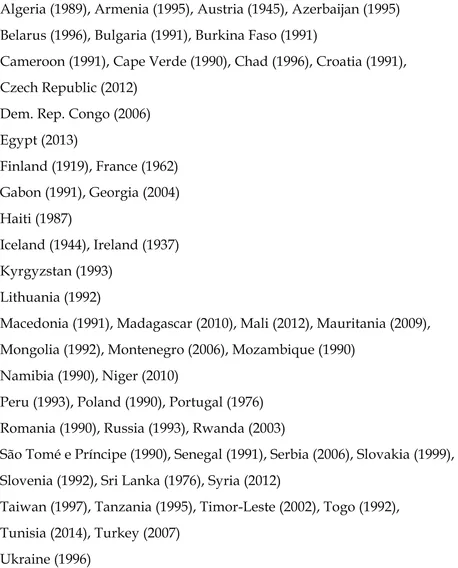
Whereas this constitutional mix was relatively rare until the early 1990s, since this time, it has become the most common constitutional choice for new democracies. There are now over 50 countries with a semi-presidential constitution across the world. (For a list of countries with semi-presidential constitutions, see Fig. 1.1.) While this constitutional form has been predominantly popular in Western Europe (including countries such as France, Portugal, and Finland), in the post-communist world (e.g. Bulgaria, Russia, and Lithuania), and across Africa (e.g. Cape Verde, Mali, and Tunisia), semi-presidentialism is also found in Asia (Mongolia, Sri Lanka, Timor-Leste, and Taiwan) and even in Latin America and the Caribbean (Haiti and Peru). New democracies with a colonial history have often followed in the constitutional path of their former colonial power—which explains why semi-presidentialism is the predominant constitutional form in Francophone and Lusophone Africa. In other cases, semi-presidentialism offered itself as a convenient compromise constitutional choice in debates between supporters of presidentialism on the one hand and the introduction of a parliamentary system on the other. This was the case in Mongolia, for example (Moestrup and Ganzorig 2007).
Fig. 1.1
List of semi-presidential countries and the date when a semi-presidential constitutional was adopted or reinstated after the collapse of democracy
Some Common Misconceptions about Semi-presidentialism
As noted above, the definition of semi-presidentialism that we employ in this book has been adopted by the majority of scholars (Schleiter and Morgan-Jones 2009). Indeed, there is now a considerable body of work both on the concept of semi-presidentialism as it is understood here and on the politics of countries with semi-presidential constitutions (Elgie 1999, 2011; Elgie and Moestrup 2007, 2008; Elgie et al. 2011; Sedelius and Mashtaler 2013). In fact, the study of semi-presidentialism has been a burgeoning research area in the last decade or more (Elgie 2004). However, semi-presidentialism remains a somewhat controversial and poorly understood topic in some quarters. There are some scholars who simply refuse to recognize the validity of the concept, or at least who use the term but who deliberately refuse to employ it in the way that it is understood here. There are also other scholars who are perfectly willing to accept the concept and who use the term quite freely, but who unwittingly refer to it in a way that is different from how it is understood in this project, usually defaulting to Duverger’s original definition and thinking of France as the archetypal semi-presidential case. The problems surrounding the use of the term are further complicated by the fact that the concept has very practical political application. Countries debate whether or not they should adopt semi-presidentialism. However, this means that the concept can become laden with party political connotations. These vary according to the context of the particular situation. For example, in Italy, the introduction of semi-presidentialism has been debated for many years. However, the party politics of the debate have meant that semi-presidentialism is automatically associated with the introduction of a powerful president who will provide decisive leadership in a fragmented system. Immediately, this generates a set of people who are in favor of semi-presidentialism for their own party political reasons and a set of people who are opposed to it for their own reasons. In such a context, carefully crafted academic definitions with their accompanying semantic niceties soon go out of the window, all of which adds to the conceptual and empirical confusion surrounding the term generally.
Against this background, we address some of the most commonly held misconceptions about semi-presidentialism. We will not be able to convince everyone of the validity of the concept, nor do we aim to do so. We will certainly not be able to change the terms of the political debate in some countries. However, we can help to clarify the way in which we believe the concept should be understood, how it should be applied, and what we can reasonably say about it.
Misconception no. 1—Semi-presidentialism is a regime type midway between presidentialism and parliamentarism
It is not uncommon to hear people referring to semi-presidentialism as a hybrid regime, a mixed regime (Cheibub 2010), or worse, a “bastard” regime (Bahro and Veser 1995). In one sense, there is nothing unproblematic with such a description, or at least perhaps with the first two. After all, if we define presidentialism as the situation where there is a directly elected, or popularly elected, fixed-term president and where the government is not collectively responsible to the legislature, and if we define parliamentarism as the situation where there is either a monarch or an indirectly elected president and where the PM and cabinet are collectively responsible to the legislature, then semi-presidentialism does indeed exhibit one characteristic of each of the other two main regime types. In this sense, it can indeed be described as mixed. In another sense, though, we should be a little wary of this terminology. If we think about regimes in this way, then semi-presidentialism is not the only mixed type. We can think of what Shugart and Carey (1992) call assembly-independent regimes, that is, Switzerland, as being mixed regimes too. They are characterized by the situation where there is an indirectly elected president and where the government is not collectiv...
Table of contents
Cover
Frontmatter
1. Semi-presidentialism in Democracies, Quasi-democracies, and Autocracies
2. From Patronal First Secretary to Patronal President: Post-Soviet Political Regimes in Context
3. Semi-presidentialism in Armenia
4. Semi-presidentialism in Azerbaijan
5. Semi-presidentialism in Georgia
6. Constitutional Development of Independent Kazakhstan
Access to over 1.5 million titles for a fair monthly price.
Study more efficiently using our study tools.
Frequently asked questions
Yes, you can cancel anytime from the Subscription tab in your account settings on the Perlego website. Your subscription will stay active until the end of your current billing period. Learn how to cancel your subscription
No, books cannot be downloaded as external files, such as PDFs, for use outside of Perlego. However, you can download books within the Perlego app for offline reading on mobile or tablet. Learn how to download books offline
Perlego offers two plans: Essential and Complete
Essential is ideal for learners and professionals who enjoy exploring a wide range of subjects. Access the Essential Library with 800,000+ trusted titles and best-sellers across business, personal growth, and the humanities. Includes unlimited reading time and Standard Read Aloud voice.
Complete: Perfect for advanced learners and researchers needing full, unrestricted access. Unlock 1.5M+ books across hundreds of subjects, including academic and specialized titles. The Complete Plan also includes advanced features like Premium Read Aloud and Research Assistant.
Both plans are available with monthly, semester, or annual billing cycles.
We are an online textbook subscription service, where you can get access to an entire online library for less than the price of a single book per month. With over 1.5 million books across 990+ topics, we’ve got you covered! Learn about our mission
Look out for the read-aloud symbol on your next book to see if you can listen to it. The read-aloud tool reads text aloud for you, highlighting the text as it is being read. You can pause it, speed it up and slow it down. Learn more about Read Aloud
Yes! You can use the Perlego app on both iOS and Android devices to read anytime, anywhere — even offline. Perfect for commutes or when you’re on the go. Please note we cannot support devices running on iOS 13 and Android 7 or earlier. Learn more about using the app
Yes, you can access Semi-Presidentialism in the Caucasus and Central Asia by Robert Elgie, Sophia Moestrup, Robert Elgie,Sophia Moestrup in PDF and/or ePUB format, as well as other popular books in Politics & International Relations & Asian Politics. We have over 1.5 million books available in our catalogue for you to explore.