eBook - ePub
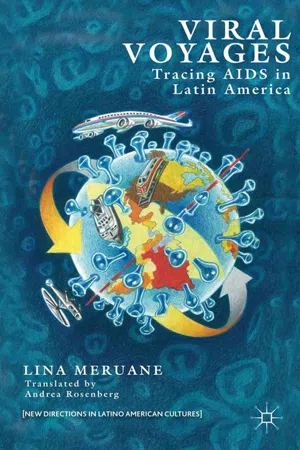
Viral Voyages
Tracing AIDS in Latin America
- English
- ePUB (mobile friendly)
- Available on iOS & Android
eBook - ePub
Viral Voyages
Tracing AIDS in Latin America
About this book
This is the first book to comprehensively examine Latin America's literary response to the deadly HIV virus. Proposing a bio-political reading of AIDs in the neoliberal era, Lina Meruane examines how literary representations of AIDS enter into larger discussions of community, sexuality, nation, displacement and globalization.
Information
Topic
LetteraturaSubtopic
Critica letterariaP A R T I I
Viral Voyagers
C H A P T E R 1
Itinerant Infirmity
The motif of wandering appears with relentless frequency in twentieth-century Latin American dissident narratives. Long before the epidemic began, writers and their peregrinating protagonists traveled, whether in reality or in the imagination, in search of others with the same difference, or in flight from the stigma of moral and sexual illness ascribed to them. The persecution of homosexuals as pathological subjects who threaten to corrupt the nation has long-standing precedent in religion, and it continued in the medical and legal sciences that gradually imposed upon the certainty of faith the truths of science. Religion had tried to punish deviance, and now medicine would try to cure it. Curing homosexuals, making their desires conform to normality, was the objective, and only geographic escape could fend it off for a time. This escape was at first a gesture of resistance to the rigid expectations set out by the nation. These movements never followed a fixed pattern: though the nation was the point of departure, the destination changed. But that itinerancy always led toward a foreign place whose norms were not imposed on the traveler. An analysis of the situation makes it clear that this impatience to leave was a result of “very concrete processes of social engineering and modernization” (Quiroga 12) that preceded the emergence of the homosexual as a category imported from the old continent.84 Homosexuals arose as the modern incarnation of a diagnosable danger. The new nomenclature medicalized and criminalized an ancient sexual practice that was suddenly understood as a threat to the pure body of the nation still under construction, a body whose existence depends on defining its limits—inventing its others. Distinctions were drawn, and the word homosexual, which came from Europe, also suggested the practice of homosexuality as something foreign, the result of cultural importation made possible through the mechanisms of capitalism, itself also foreign.
The paradox is striking. Capitalism in metamorphosis, which, according to some purists, opened the door to the destruction of traditions, was also the great ally of a crucial internal displacement that had a profound influence on the creation of homosexual identity—an identity understood as a way of thinking, identity constructed as it was reflected in others. The processes of modernization altered the structure of society and produced irreversible shifts in the economic function of the family. Industrialization stimulated its collapse. Many left the sheltered but repressive home environment and moved toward less guarded spaces: the incessant movement that began at the time was from the countryside to the city and from one continent to another. In this slow, intermittent, unequal movement in search of paid work, we find the seeds of an incipient sexual liberation. Some of those men—and possibly some of those women85—could find partners of the same sex with whom to share a mutual desire and, even more crucially, with whom to identify. To put it another way, homosexuality—like community-mindedness, like political consciousness, like militancy—arose in those initial encounters and in that possibility of sexual fulfillment. The urban space was important not only because it allowed the establishment of certain erotic practices and particular modes of enjoyment (desire has always found an opportunity and a place in which to be fulfilled, however adverse the circumstances), and not only because it produced the more or less explicit recognition of a shared subjectivity. What constituted the homosexual subject, historian John D’Amilio has said, was his consciousness of his identity and of a community with rights: political engagement, not just an affinity of tastes.
Yet we should note the varying velocities at which these changes took place. The formation of Latin American dissident groups was a markedly slower process. All sorts of factors—cultural, social, historical, and even linguistic—caused detours in the journey, which did not move in a straight line in the rest of the world, either. Among these factors were the beliefs about sex in the different local ethnicities; the influence of a stubborn, castrating Catholicism; the migratory trends of different eras that took on new patterns and names; the omnipotent presence of the family that, when it collapsed, was replaced by a patronage that was eerily similar in its workings; and the continent’s slow, intermittent process of industrialization and its ever-postponed modernization. But sooner or later that alternative community would emerge. It grew despite being in impossible tension with the nation’s moral precepts. Excluded from the masculine pact that defines proper citizens (one that forbids sex between men, transferring that erotic tension to the virile negotiation of power), homosexuals exercised their desire behind the nation’s back, though never completely separated from it. They were tormented, split between national expectations and individual desires that did not conform to the norms of the nation. They were aware of the rejection and stigma attached to dissident bodies as if they were carriers of a contagious disease, a situation that later fictions allegorized in various violent acts that always led to the death of those enigmatic characters.
One wonders who, exactly, that nation is. Or what it is, how it imposes repression so consistently. Here I respond in accordance with the view of the renowned Benedict Anderson: the nation is a type of community, one of many possible types. The nation constitutes itself dynamically, conceives of itself or, rather, imagines itself—without knowing itself yet, without ever having seen or heard of any others—through supposedly shared elements: some occasional readings; a literature that represents exclusive values; common norms within a single sovereign, limited, and conjectured territory.86 The nation, to legitimately exist, must think of itself as a brotherhood of men governed by a profoundly egalitarian camaraderie, the parameters of whose actions have been agreed upon among all included. Of course, that association between equal men is not, in fact, equal, nor is it, as we know, exclusively male and heterosexual. What is essential is that it conceive of itself that way in order to draw a line, to be able to exclude subjects who visibly do not conform to those imaginings. The nation justifies itself in the fiction of opposites, and homosexuals fulfill that necessary function. Their particular introduction into society at the beginning of the twentieth century must be understood strategically. In its beginnings it was limited to personal contact within a secret community: one community within another or, seen from another perspective, one that imagined itself simultaneously within and outside of the nation. From that ambivalent position, from those contradictory affiliations, the secret community articulated its own code, legible only to those who understood its grammar. They organized a parallel order in alternative spaces, with divided loyalties. The community’s problematic coexistence with the nation (sometimes internalized, at others manifested in policies and practices of violence) sparked the dream of escape outside—beyond—immediate experience. There are no studies to confirm this, only isolated episodes in the texts of many authors of the time, tales of the displacement of strange, unsatisfied men, expressions of extraterritorial utopias that played out in the territories of desire.
It is key that the fledgling homosexual community of the diaspora, just like the national community, imagined itself as a brotherhood of equals (though it wasn’t one, really, and never could be, thanks to the profound class and race differences among its members). Nevertheless, in order to be articulated, the sexual community must conceive of itself as being united by affinities and by a series of shared texts, a literature that circulated in secret, moving between and along with the members of this traveling caste. Yet the utopia of the wandering community that began to be established in the first half of the twentieth century was seen not as no place (outopia) nor merely as a good place (eutopia), but as the demarcation of spaces of specific sexual actions and interactions, places where those men made dates and practiced what Néstor Perlongher called nomadismo erótico [erotic nomadism]. Those spaces were seen as heterotopias, territories or counterterritories within society: a sort of utopia positioned in a particular space to represent, impugn, and invert or undiscipline (Foucault would say) all of society’s real, fixed spaces.87 Heterotopias exist at the margins—which are not the same as the periphery—of legitimate spaces. These spaces of others that appear on Foucault’s list are the insane asylum, the jail, and the circus, while Argentine critic Sylvia Molloy’s queer list includes others: islands, for example. Islands are preferential locations for utopias, says Molloy, as they are spaces where “pequeñas comunidades idílicas” [small idyllic communities] are established behind the world’s back (“La cuestión” 816). Domingo Faustino Sarmiento encountered some strange American castaways living on the island of Más Afuera (Farther Seaward)88 in 1845 and was unable to persuade them to return to civilization: they’d gone far beyond farther, notes Molloy. Also included on that list of utopian alternatives to normative spaces are, of course, groups of disciples, guilds, cultural centers, and communes such as the short-lived Colonia Tolstoyana, founded in 1904 in a remote area of southern Chile by the nomadic writer—the wandering brother—of Chilean literature. Augusto D’Halmar was the most conspicuous figure to travel to East Asia and Europe, continents where he encountered travel companions and experiences that he later incorporated into his novels: his Egyptian lover was quite possibly transformed into the young man Aceitunita in Pasión y muerte del cura Deusto. D’Halmar’s roving was the precursor to the journeys of a dissident community that sought to flee its sexual namelessness. This flight was apparent in the decades that followed, when the search for a place of their own was repeated in varying ways.
More recent and even more famous is the case of Federico García Lorca, whose geographic movements were more contradictory and less communitarian than those of D’Halmar. Lorca was forced out of Spain against his will. His father, worried by his son’s nonchalance, arranged and funded his departure for New York to extract him from an unacceptable relationship, to cure him of that illness that was beginning to become public knowledge in 1930s Madrid (Lorca had had to leave southern Spain for the capital city to meet up with his lover and a small group of associates). That trip to the United States was a form of exile; remaining in Spain, even in the capital, was dangerous, and it was impossible for him to practice his homosexuality openly there. And yet New York allowed him to see ways of being with others, to discover a world that he had barely dreamed of in Madrid. Although Lorca made no mention in his poetry of the relationships he formed in Manhattan (in Poeta en Nueva York [Poet in New York], like most avant-garde poets, he portrayed the great capitalist city as a dehumanized environment), his letters to his family reveal that it was a time of freedom and great friendships. It is no surprise that Lorca omitted from his letters any description of the great flourishing of gay theater taking place in the city at the time (Smith), and it can be assumed that nothing of the romantic aspects of his experiences in New York, Buenos Aires, or Cuba was ever put down in writing. Those spaces remained hidden, were kept secret: they depended on secrecy to avoid failure or a normative intervention that might destroy them.
Allow me to point out one additional case: that of the eccentric modernist writer Salvador Novo, founder of a homointellectual group that soon dissolved, the influential Mexican movement known as Los Contemporáneos (The Contemporaries). Novo, a personal friend of Lorca’s from the time they met in Buenos Aires in 1933, was another homosexual who found in exile a way to negotiate local oppression. As he describes in “Continente vacío” (1934; Empty continent), written upon his return from New York and South America, the Mexican writer felt “en casa” [at home] when he disembarked in Rio de Janeiro. That feeling of being at home can be read as the projection of his own mental state onto the whole city. How else can we explain his choice of words, the “embriagadora avidez” [intoxicating eagerness] provoked in him by that “tierra lujuriosa” [lustful land] where the passengers, or perhaps just he alone, descended into the city, “ávidos de huir de sí mismos por 24 horas” [eager to flee from themselves for 24 hours] (746). Although Novo had to remain in Mexico, where he was known and accepted—he had become skilled at somehow saying everything but revealing nothing—he recognized in Brazil the inverse of Mexico, where he, had he been able to choose, “tendría que haber nacido” [should have been born] (748).
These movements are marked by a cartographic idealization: Lorca left Granada for Madrid and traveled from there to the Americas; D’Halmar began his journey from Chile to southern Spain and East Asia, passing through a number of Latin American port cities; Novo visited these same great cities; and later the Cuban writer Virgilio Piñera went to Buenos Aires, where he met and became friends with another mysterious European in exile, the Polish writer Witold Gombrowicz. What is striking is not the places they chose but that they were always far-flung capital cities where the traveler would be a foreigner—that is, someone who by definition does not belong and of whom nothing can be required. Removed from their origins, these men symbolically cut their ties with the past and were able to reinvent it. Only outside their homelands was it possible to create a homoerotic refuge with some guarantee—or at least the illusion—of safety.
A ONE-WAY TRIP FROM PATRIA TO FILISTRIA
Wandering is a one-way path. It is triggered by the experience of rejection and a need to seek out others. Once the journey has begun—the fevered rovings of Witold Gombrowicz—there seems to be no way to turn back. But how to keep going? That question is the most difficult to answer and demanded, in Gombrowicz’s era, an uninhibited literary imagination like his. Let’s follow the path he blazed. The Polish writer dared to set out a course for the mobile community, a community that could travel together and yet stay in one place—as he himself did, for many years, in Argentina. We’ll start by going back to 1939, when Gombrowicz disembarked in Buenos Aires, an emblem of the modern city governed by the vast bureaucracies of social capitalism. At the time Buenos Aires was a thriving, cosmopolitan city, the destination for an endless wave of immigration from different backgrounds, itself difficult to distinguish from that other, sexual migration that was also slipping into the city and was identified, with increasing alarm, as something dangerous, a social ill—or illness. Gombrowicz fictionalized his arrival in the capital and his surprising decision to remain there in his first Argentine novel,89 published 15 years after his arrival. Originally written in Polish and suggestively titled Trans-Atlantyk (1953), the plot is more than a simple tale of voluntary exile: the beginning of the Second World War and the German invasion of the author’s native Poland that would have forced him back into the army, symbol of national heroism. Going back would have meant going to war, voluntarily dying for the limited imaginations of the homeland described by Anderson. Refusing to make that sacrifice, Gombrowicz opted instead to remain in the south, even though his desertion cost him: he was marked by that act of betrayal, bearing forevermore the suspect mark of foreignness.90
Having made his decision, Gombrowicz began to formulate a brutal critique of Poland’s policies of blood sacrifice. That critique is at the foundation of his Argentine novel, as he himself noted in his 1957 prologue.91 In the prologue, Gombrowicz demands—and we should question this prescriptive approach—a restricted reading from his readers: “Debo [exigirlo] porque . . . se trata de una obra que tiene que ver con la Nación” [I must (demand it) because . . . this work is one that has to do with the Nation] (Trans-Atlántico 7). Further down, the nation is abstracted and universalized, transformed into a universal dilemma: “El problema se refiere no tanto a la relación entre un polaco y Polonia, sino entre un indiv...
Table of contents
- Cover
- Title
- Beginning the Journey
- I Logbook of an HIV-Positive Voyage
- II Viral Voyagers
- Bibliography
- Index
Trusted by 375,005 students
Access to over 1.5 million titles for a fair monthly price.
Study more efficiently using our study tools.
Frequently asked questions
Yes, you can cancel anytime from the Subscription tab in your account settings on the Perlego website. Your subscription will stay active until the end of your current billing period. Learn how to cancel your subscription
No, books cannot be downloaded as external files, such as PDFs, for use outside of Perlego. However, you can download books within the Perlego app for offline reading on mobile or tablet. Learn how to download books offline
Perlego offers two plans: Essential and Complete
- Essential is ideal for learners and professionals who enjoy exploring a wide range of subjects. Access the Essential Library with 800,000+ trusted titles and best-sellers across business, personal growth, and the humanities. Includes unlimited reading time and Standard Read Aloud voice.
- Complete: Perfect for advanced learners and researchers needing full, unrestricted access. Unlock 1.5M+ books across hundreds of subjects, including academic and specialized titles. The Complete Plan also includes advanced features like Premium Read Aloud and Research Assistant.
We are an online textbook subscription service, where you can get access to an entire online library for less than the price of a single book per month. With over 1.5 million books across 990+ topics, we’ve got you covered! Learn about our mission
Look out for the read-aloud symbol on your next book to see if you can listen to it. The read-aloud tool reads text aloud for you, highlighting the text as it is being read. You can pause it, speed it up and slow it down. Learn more about Read Aloud
Yes! You can use the Perlego app on both iOS and Android devices to read anytime, anywhere — even offline. Perfect for commutes or when you’re on the go.
Please note we cannot support devices running on iOS 13 and Android 7 or earlier. Learn more about using the app
Please note we cannot support devices running on iOS 13 and Android 7 or earlier. Learn more about using the app
Yes, you can access Viral Voyages by L. Meruane, Kenneth A. Loparo, Kenneth A. Loparo,Andrea Rosenberg in PDF and/or ePUB format, as well as other popular books in Letteratura & Critica letteraria. We have over 1.5 million books available in our catalogue for you to explore.