eBook - ePub
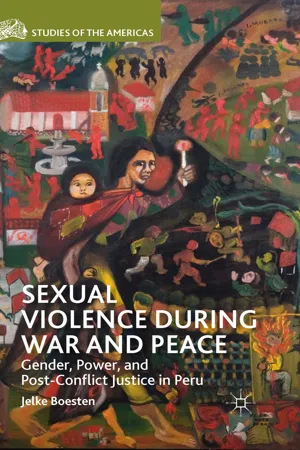
Sexual Violence during War and Peace
Gender, Power, and Post-Conflict Justice in Peru
- English
- ePUB (mobile friendly)
- Available on iOS & Android
eBook - ePub
About this book
Using the Peruvian internal armed conflict as a case study, this book examines wartime rape and how it reproduces and reinforces existing hierarchies. Jelke Boesten argues that effective responses to sexual violence in wartime are conditional upon profound changes in legal frameworks and practices, institutions, and society at large.
Information
Print ISBN
9781137383440
Subtopic
PoliticsChapter 1
Introduction
In early May 1989, Shining Path militants entered a remote community in the department of Abancay, located in the South Central Andes of Peru. The terrorists captured several young men and women, including Cecilia and her younger sister. They were taken to an unknown camp. Several weeks later, in a firefight between the military and Shining Path, Cecilia and several others were “arrested” and brought to a military base. Cecilia insisted on learning where her younger sister had been taken, but the soldiers ignored her. A captain took Cecilia inside the base, where he waved body parts at her—arms, heads, and men’s feet—threatening to kill her and cut her up in pieces if she did not stop asking questions. He told her he would start doing so if she did not undress, which she did. Then he raped her. Later, another official at the same base promised Cecilia that he would find her sister but in return for sex. Cecilia succumbed. She conceived a child as a result of this rape, which the soldier in question recognized as his. But he never gave her information about the whereabouts of her sister. Cecilia heard from others that her sister had been killed and cremated in the military base of Abancay.1
Cecilia survived the war, and now lives with her husband and children in the same community in Abancay where she was first captured by soldiers. She is severely traumatized and depressed; she hardly eats or sleeps; her body hurts chronically; she is irritated and aggressive, feels guilty, and has little capacity to think or act. She does not demonstrate any emotional attachment to her family. She is constantly afraid and feels threatened even by her own children and her husband. As she is not willing to have any consensual sexual relationships, her husband abuses her, reproducing the past trauma on a daily basis. Cecilia, in turn, beats and maltreats her children.2 Cecilia lives her misery utterly alone; she does not link her experiences to that of a broader sociopolitical history, she has no notion of her rights as a person or as a Peruvian citizen. Both the state and her own family represent abuse to her. Some form of justice is needed to help Cecilia and her family to come out of this cycle of violence, to regain citizenship and a notion of rights.3
Beatriz suffered similar abuse and lost many family members and neighbors in 1983 in the district of Cangallo, in the Department of Ayacucho, where eighteen comuneros were killed and nine women captured, tortured, and raped by the Peruvian military after an incursion of Shining Path had killed some, and forcefully enlisted other comuneros. Now, in post-conflict Peru, Beatriz suffers from headaches and other physical pain, her ovaries hurt, and she often bleeds. She cannot stand or sit down for very long. She suffers much as a consequence of the loss of her children in the events of 1983 and the abuse she received at the hands of military when she was imprisoned; Beatriz says she could do no more than withdraw to living on a mountain, “eating my tears.”4
This book is an examination of meanings of sexual violence in war and peace and the responses to such violence in the period of political conflict in Peru (1980–2000) until the present. In 1980, Shining Path attacked a polling station in the mountain village of Chuschi, Peru, starting an internal war that lasted nearly 20 years. The goal, formulated by Shining Path’s founder, Abimael Guzman, was to dismantle state and society and replace it with a communist utopia using guerrilla techniques inspired by Maoist theories. Shining Path found support among provincial youth, especially the first generation of university-educated young men and women of rural origin, and initially among rural peasants.5 This Peruvian “revolution” stood out among its Latin American counterparts for its single-minded ideology and violent practice. Shining Path spread terror throughout Peru, and targeted all social groups.
The extremely violent methods of Shining Path were answered with an aimless counterinsurgency steeped in racism toward the Andean population, as the military received little political guidance in how to combat Shining Path.6 Impoverished and marginalized peasants became both agent and victim of a very destructive spiral of violence and fear. Historically, the Andes and its population have been of relatively little importance to the central government and elites in Lima. As such, it is no surprise that the state took two years to take the activities seriously enough to respond. When the state finally responded, the consequences were dramatic. In December 1982, several Andean departments were declared to be in a “state of emergency,” which gave the military free rein in large parts of the country, particularly, in the most impoverished and marginalized regions in the South Central Andes: Huancavelica, Apurímac, and Ayacucho.7 Military and, later, paramilitary counterinsurgency forces (made up of peasant militias, or Comitées de Autodefensa, CADs), transformed the conflict by adopting military strategies that had been characteristic of conflicts in Algeria and Vietnam or, closer home in El Salvador. These strategies (which, from the military’s perspective, meant that every peasant was a potential terrorist) had severe consequences at the local level, and contributed to further alienating the population and destroying the existing social, economic, and political structures. Almost immediately after the army took over, the South Central Andes sank into a chaos characterized by violence and fear. Many rural areas became involved in a difficult-to-distinguish mix of conflicts: the “popular war,” as Shining Path called its actions; the counterinsurgency battle; and internal settling of scores, common crimes, cattle rustling; and emerging conflicts as a result of displacements and refugees in existing settlements.8 Shining Path’s methods of both “disciplining” the population and punishing soplones (snitches), as well as the army’s later strategy of seeking support among peasants, allowed for shifting allegiances among peasants, and accusations and counteraccusations among community members and neighbors that brought fear, fragmentation, and death.9 This was not an ethnic war; that is, the violence had no ethnically motivated objectives as it did, for example, in the wars in the former Yugoslavia and Rwanda. Shining Path focused on class in its analysis of the wrongs of Peruvian society, which did not ideologically translate into a conflict between specific ethnic groups. Nevertheless, class being intertwined with perceptions of race in Peru the violence had a strong racist dimension.10 This was clearly reflected in the occurrence of and subsequent institutional response to the use of sexual violence during the war.
As a result of the war, 69,280 persons died or disappeared, the majority (80 percent) of them young men of indigenous descent.11 Women also suffered tremendously, as witnesses, victims, survivors of violence, and as family members of the tortured and those disappeared.12 Women also acted as peace activists and, indeed, as Shining Path militants.13 The Truth and Reconciliation Commission (TRC), established in 2001, which published its multivolume report in 2003, made great efforts to include a gender perspective in its investigations. In doing so, it uncovered the widespread rape of women, especially young, indigenous women, perpetrated by the army and the police.14 The profile of the majority of victims of rape coincided with the overall victim-profile, and showed how much race, class, and gender are intertwined in informing hierarchies in Peru. Race is largely a construction, of course, and is, in Peru, strongly associated with language (Spanish versus indigenous languages, especially Quechua), geography, education, and dress, in addition to physical characteristics such as height, and the color of skin, hair, and eyes. Characteristics associated with class—education, profession, consumption patterns—are strongly racialized: one cannot be middle class and indigenous at the same time, as such “acculturation” changes one’s race. Indigeneity, in turn, is associated with poverty and marginalization, and tends to have a negative connotation in Peru. Gender (i.e., the way in which male and female roles are defined and understood in any given society) and sexuality (i.e., what sexual behavior is considered acceptable and “normal”) help define and naturalize the hierarchies based on race and class, as we will see in chapter 3. The intersecting inequalities of race, class, and gender strongly influenced the victim-profile of the conflict in Peru, and counterinsurgency forces used sexual violence as a tool to reinforce those peacetime inequalities.
The TRC concluded that Shining Path’s use of violence, including gender-based violence, was based on a different ideology than that which informed the violence perpetrated by the army and the police. Nevertheless, the use of sexual violence by all armed groups could be called a magnification of existing institutionalized and normative violence against women. Shining Path, in its zeal to promote a new moral society, imposed strict rules upon communities: adulterers and rapists, gay, transsexual people, and prostitutes were publicly and violently punished. Nevertheless, although Shining Path forbade its cadres from engaging in rape and sexual abuse, there is ample evidence that its activity led to forced marriages and forced pregnancies as well as infanticide, sexual torture, and sexual slavery.15 The use of sexual violence by Shining Path and its often-contradictory discourses and practices (a very moralizing discourse with regard to fidelity and family versus the prostitution of girls and infanticide) is worth consideration and analysis in its own right. An important reason for focusing my analysis on the Peruvian armed forces is that the Shining Path members were punished and imprisoned (albeit not for perpetrating sexual violence), while the armed forces are still largely exempt from prosecution. In addition, the fact that the state forces were the main perpetrators of sexual violence reinforces the idea that such violence builds on and reproduces institutionalized structures of violence and inequality. The impunity of these crimes further normalizes such violence, and perpetuates its persistence in peacetime. The distinct outcome of rape regimes perpetrated by the armed forces and Shining Path suggests that wartime rape often reproduces and reinforces existing gendered hierarchies, reflecting long-standing racism and sexism, despite different moral missions.
The “discovery” of systematic wartime rape has raised much outcry in certain circles (i.e., among some feminists and human rights activists),16 but it has not compelled the judiciary to the point of taking action. None of the 538 cases of wartime rape documented by the TRC, for which evidence could be raised,17 or the 16 cases for which evidence has been raised, have proceeded to trial. This is not because Peru’s judiciary does not work or because all human rights violations go unpunished: former president Alberto Fujimori (1990–2000) is completing a 25-year sentence for corruption and human rights violations, and many others are awaiting trial for wartime human rights violations. While the prosecution of human rights violations by the Peruvian armed forces is rare, contentious, and difficult to follow through for a range of political reasons,18 cases of sexual violence are persistently ignored. This judicial and broader political neglect of sexual violence is a result of mainstream societal ideas about violence against women in general, and sexual violence in particular, and is not unique to Peru. This book investigates how impunity of wartime sexual violence reflects peacetime values regarding gender and gendered violence. I am interested in examining how social understandings of violence against women are reflected in legal and policy practices, if not in actual rules and regulations, and how these transcend the terms “war” and “peace.”
The idea that the past is the past, and, as Ana Jara, minister for women’s development suggested shortly after her appointment in December 2011, that not only do raped women learn to live with their experiences, but also that the “natural bond” between the mother and child erases the violence with which it was conceived,19 is simply not true. To the women who have to live with those memories, the physical consequences, including children born from rape, these events are never in the past.20 As the experiences of Cecilia and Beatriz, who had much difficulty sustaining a peaceful post-conflict family life, indicate, the sequels can be many and are likely to reverberate into the next generation; dismissing these experiences from a perspective of women’s “natural” role as mothers only emphasizes the gender binary, and in doing so, perpetuates inequality and the possibility of violence.
As such, the problem is much more extensive than the difficult lives of victims-survivors of violent conflict and their families. According to a recently published investigation that amalgamates statistics from different Peruvian institutions that receive reports of sexual violence (police, emergency centers, Ministry of Women and Social Development), 68,818 such reports were received over the past ten years, an average of 6881.8 a year, or 18.8 a day. These numbers put Peru very high on the world ranking of registered cases of sexual violence (number sixteen) and make it number one in South America.21 However, in 2009 the Institute of Forensic Medicine carried out 34,153 exams of “sexual integrity” suggesting an even higher level of sexual violence, and a problem of registering and archiving reported cases. Few reported cases are processed judicially, and even fewer lead to convictions (an average of 642 per year calculated for 2006–2009, which amounts to less than 10 percent).22 Experts estimate that only 16 percent of victims of sexual violence report it to the appropriate institutions; hence, the numbers are likely to represent only the tip of the iceberg. Overall, impunity is high and is likely to feed into high rates of sexual violence and overall violence against women and girls in both war and peace.
The related events took place in the context of an internal war between Shining Path and the Peruvian armed forces in the 1980s and 1990s, but they are not unique to Peru. In a context of increasing international attention toward the occurrence of rape in war following the widely publicized events in the former Yugoslavia and Rwanda in the 1990s, and the concerns about continuous widespread and systematic perpetration of sexual violence in the conflicts in the Democratic Republic of Congo and elsewhere, Peru represents an important case study. Despite international, legal, and scholarly attention toward sexual violence, the problem persists, not only in contemporary conflicts but also in post-conflict societies, and arguably, in more stable societies. Impunity is high, as are the misconceptions surrounding rape.23 Peru is signatory to all relevant international treaties and has followed an exemplary transitional justice path in many ways, but has neither been able to provide justice to victim-survivors of war-related sexual violence, nor been able to ...
Table of contents
- Cover
- Title
- Chapter 1 Introduction
- Chapter 2 Sexual Violence in War
- Chapter 3 Sexual Violence and the Reproduction of Inequalities
- Chapter 4 Transitional Justice, Truths, and Narratives of Violence
- Chapter 5 Impunity
- Chapter 6 Peacetime Violence
- Chapter 7 Sexual Violence and Post-Conflict Justice
- Truth Commission Testimonies Consulted
- Notes
- Bibliography
- Index
Trusted by 375,005 students
Access to over 1.5 million titles for a fair monthly price.
Study more efficiently using our study tools.
Frequently asked questions
Yes, you can cancel anytime from the Subscription tab in your account settings on the Perlego website. Your subscription will stay active until the end of your current billing period. Learn how to cancel your subscription
No, books cannot be downloaded as external files, such as PDFs, for use outside of Perlego. However, you can download books within the Perlego app for offline reading on mobile or tablet. Learn how to download books offline
Perlego offers two plans: Essential and Complete
- Essential is ideal for learners and professionals who enjoy exploring a wide range of subjects. Access the Essential Library with 800,000+ trusted titles and best-sellers across business, personal growth, and the humanities. Includes unlimited reading time and Standard Read Aloud voice.
- Complete: Perfect for advanced learners and researchers needing full, unrestricted access. Unlock 1.5M+ books across hundreds of subjects, including academic and specialized titles. The Complete Plan also includes advanced features like Premium Read Aloud and Research Assistant.
We are an online textbook subscription service, where you can get access to an entire online library for less than the price of a single book per month. With over 1.5 million books across 990+ topics, we’ve got you covered! Learn about our mission
Look out for the read-aloud symbol on your next book to see if you can listen to it. The read-aloud tool reads text aloud for you, highlighting the text as it is being read. You can pause it, speed it up and slow it down. Learn more about Read Aloud
Yes! You can use the Perlego app on both iOS and Android devices to read anytime, anywhere — even offline. Perfect for commutes or when you’re on the go.
Please note we cannot support devices running on iOS 13 and Android 7 or earlier. Learn more about using the app
Please note we cannot support devices running on iOS 13 and Android 7 or earlier. Learn more about using the app
Yes, you can access Sexual Violence during War and Peace by J. Boesten in PDF and/or ePUB format. We have over 1.5 million books available in our catalogue for you to explore.