This book is an ethnographically-informed interview study of the ways in which middle-class mothers from three Israeli social-cultural groups – immigrants from the former Soviet Union, Palestinian Israelis and Jewish native-born Israelis – share and differ in their understandings of a 'proper' education for their children and of their role in ensuring this. The book highlights the importance of education in contemporary society, and argues that mothers' modes of engagement in their children's education are formed at the junction of class, culture and social positioning. It examines how cultural models such as intensive mothering, parental anxiety, individualism, and 'concerted cultivation' play out in the lives of these mothers and their children, shaping different ways of participating in the middle class. The book will be of interest to anthropologists and sociologists studying mothering, education, parenting, gender, class and culture, to readers curious about daily life in Israel, and to professionals working with families in a multicultural context.
eBook - ePub
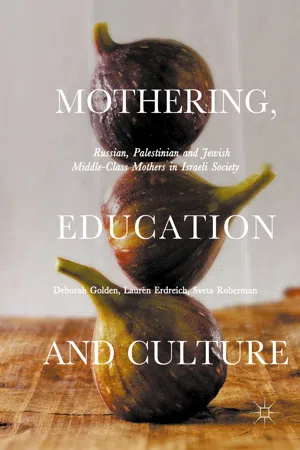
Mothering, Education and Culture
Russian, Palestinian and Jewish Middle-Class Mothers in Israeli Society
- English
- ePUB (mobile friendly)
- Available on iOS & Android
eBook - ePub
Mothering, Education and Culture
Russian, Palestinian and Jewish Middle-Class Mothers in Israeli Society
About this book
Information
Topic
EducationSubtopic
Comparative Education© The Author(s) 2018
Deborah Golden, Lauren Erdreich and Sveta RobermanMothering, Education and Culturehttps://doi.org/10.1057/978-1-137-53631-0_11. Introduction
Deborah Golden1 , Lauren Erdreich2, 4 and Sveta Roberman3, 5
(1)
Faculty of Education, University of Haifa, Haifa, Israel
(2)
Levinsky College of Education, Tel Aviv, Israel
(3)
Gordon Academic College of Education, Haifa, Israel
(4)
Beit Berl Academic College, Kfar Saba, Israel
(5)
Hebrew University of Jerusalem, Jerusalem, Israel
This study began on a sunny summer day over coffee and conversation between two anthropologists—Deborah
and Lauren
—a conversation that turned into the first of many, and was subsequently joined by a third anthropologist, Sveta
. At the time of that first conversation, Lauren had moved to the town in Israel where Deborah was living with her son, then 13 years old. As Lauren’s daughter toddled around the table, we discussed our past work and interests. Sometime later, Deborah called Lauren with an idea. When we met this time, Deborah brought with her a stack of fliers that had been shoved into her postbox—advertisements for after-school activities, private tutoring, and leisure activities for mothers and children. ‘Let’s do something about this—about how mums are inundated with educational goods and services that tell them how they should be taking care
of their kids,’ she suggested. This hit home with Lauren
, who had just given birth to her second daughter and had spent a lot of time checking out possibilities for child care for both daughters. The town in which we lived offered many options—for a price. We noticed almost immediately how our particular locale shaped our experience as mothers—the abundance of educational goods and services required that we make choices among them, choices that were decisions about what sort of mothers we are or would like to be.
From the perspective of this study, mothering
must be understood in relation to perceptions and practices of what constitutes a proper education
for children—since the two are inextricably interwoven. In today’s world, education plays an increasingly important role in equipping children with knowledge
and practical and social skills
, as well as defining social location and potential social mobility
. With the onset of industrial society and the burgeoning of nation-states, education of children was removed from the home and replaced by a formal system of compulsory schooling
. Schooling was deemed necessary to adequately prepare children with basic skills, knowledge
, values and sentiments requisite for a future citizen
in the modern nation-state (Gellner 1983) and was put in the hands of professional educators. In this form of social organization, the family fulfilled a supporting role; in this supporting role women were viewed as the most appropriate caretakers of home and as primarily responsible for the children’s upbringing and education.
Education—within school and without—is a major arena in which parents—primarily through the gendered work of mothers
—reproduce their own class and cultural sensibilities. Although family life has undergone changes, and men
are increasingly involved in the upbringing of their children, recent decades have seen the ‘transformation of women’s domestic labour to include extensive educational work in the home’ (Reay 2005a, 113); mothers take prime responsibility for the ‘complementary education work’
around schooling (Griffith and Smith 2005) and for decision-making relating to educational matters (Ball 2003). Perceptions and practices of mothering
are culturally embedded and produced in response to changing requirements and expectations of what mothers can and should be doing in relation to their children’s education and the demands produced by educational institutions. In seeking to ensure a proper education for their children, mothers are obliged not only to make decisions regarding their children’s schooling but also to negotiate a market of ‘extra-curricular’ ideas, goods and services, all of which hold out the promise of ensuring a proper education for the children. This negotiation requires knowledge, financial resources and time—putting the middle class at a distinct advantage and, in turn, positing middle-class mothering
as something to be emulated and as a widely disseminated cultural model
of what is considered to be proper mothering
.
In a landmark study entitled The Cultural Contradictions of Motherhood, published in 1996, Sharon Hays
coined the term ‘intensive mothering’
to describe middle-class motherhood—a ‘gendered model
that advises mothers to expend a tremendous amount of time, energy, and money in raising their children’ (Hays 1996, x). With its roots in western middle-class sensibilities and values, this model has evolved into a dominant cultural model
and benchmark for proper mothering
among other mothers elsewhere (Arendell 2000; Ennis 2014; Faircloth et al. 2013; Lee et al. 2014; O’Reilly 2014). But how far could this construct take us in understanding diverse social realities? We wondered how middle-class mothers
, far removed from the context of the American mothers who formed the basis of Hays’ study, interpret and implement ‘intensive mothering’? How are these perceptions and practices elaborated in ways of educating their children?
This study looks at how women reflect upon and make sense of this task. Grounded in an approach that brings together ideas of class
, culture and social positioning
, our study is a comparative, ethnographically
informed interview study of Israeli middle-class mothers’ understandings and modes of engagement in their children’s education. Focusing on middle-class mothers from three Israeli social-cultural groups
—Russian immigrants from the former Soviet Union, Palestinian Israelis and Jewish native-born
Israelis1—the book examines the ways in which these mothers
both share and differ in their understandings of a proper education for their children and of their task as mothers in ensuring this. Propelled throughout by a comparative thrust, our study is guided by four main questions:
- What are mothers’ understandings of a proper education for their children and of their role in ensuring this?
- What perceptions and practices of mothering and education do women share and in what ways do they differ?
- How do class, culture and social positioning conjoin in shaping perceptions and practices of educating children and of what it means to be a mother?
- How do global discourses about proper education and competent mothering interweave with local concerns and possibilities?
© The Author(s) 2018
Deborah Golden, Lauren Erdreich and Sveta RobermanMothering, Education and Culturehttps://doi.org/10.1057/978-1-137-53631-0_22. Setting the Scene—Theory, Context, Method
Deborah Golden1 , Lauren Erdreich2, 4 and Sveta Roberman3, 5
(1)
Faculty of Education, University of Haifa, Haifa, Israel
(2)
Levinsky College of Education, Tel Aviv, Israel
(3)
Gordon Academic College of Education, Haifa, Israel
(4)
Beit Berl Academic College, Kfar Saba, Israel
(5)
Hebrew University of Jerusalem, Jerusalem, Israel
In this chapter, we outline the theoretical, contextual and methodological knowledge that sets the scene for the empirical findings to be presented in subsequent chapters. The chapter comprises four main sections. In the first (‘Conceptual underpinnings’), we present the conceptual underpinnings of our study—the ideas and concepts that inform our understanding of the issues at hand; in the second (‘The Israeli context’), we provide some background information on Israeli society necessary for making sense of and contextualizing o...
Table of contents
- Cover
- Frontmatter
- 1. Introduction
- 2. Setting the Scene—Theory, Context, Method
- 3. En Route
- 4. The ‘Well-Invested’ Child
- 5. Homing In
- 6. A Comparative Look
- 7. Conclusion: Envisioning Possibilities
- Backmatter
Trusted by 375,005 students
Access to over 1.5 million titles for a fair monthly price.
Study more efficiently using our study tools.
Frequently asked questions
Yes, you can cancel anytime from the Subscription tab in your account settings on the Perlego website. Your subscription will stay active until the end of your current billing period. Learn how to cancel your subscription
No, books cannot be downloaded as external files, such as PDFs, for use outside of Perlego. However, you can download books within the Perlego app for offline reading on mobile or tablet. Learn how to download books offline
Perlego offers two plans: Essential and Complete
- Essential is ideal for learners and professionals who enjoy exploring a wide range of subjects. Access the Essential Library with 800,000+ trusted titles and best-sellers across business, personal growth, and the humanities. Includes unlimited reading time and Standard Read Aloud voice.
- Complete: Perfect for advanced learners and researchers needing full, unrestricted access. Unlock 1.5M+ books across hundreds of subjects, including academic and specialized titles. The Complete Plan also includes advanced features like Premium Read Aloud and Research Assistant.
We are an online textbook subscription service, where you can get access to an entire online library for less than the price of a single book per month. With over 1.5 million books across 990+ topics, we’ve got you covered! Learn about our mission
Look out for the read-aloud symbol on your next book to see if you can listen to it. The read-aloud tool reads text aloud for you, highlighting the text as it is being read. You can pause it, speed it up and slow it down. Learn more about Read Aloud
Yes! You can use the Perlego app on both iOS and Android devices to read anytime, anywhere — even offline. Perfect for commutes or when you’re on the go.
Please note we cannot support devices running on iOS 13 and Android 7 or earlier. Learn more about using the app
Please note we cannot support devices running on iOS 13 and Android 7 or earlier. Learn more about using the app
Yes, you can access Mothering, Education and Culture by Deborah Golden,Lauren Erdreich,Sveta Roberman in PDF and/or ePUB format, as well as other popular books in Education & Comparative Education. We have over 1.5 million books available in our catalogue for you to explore.