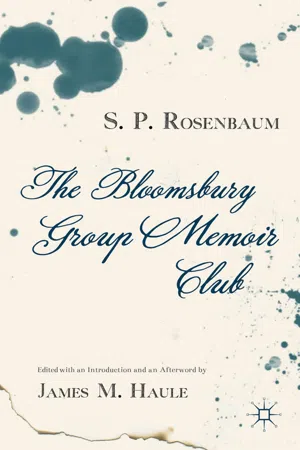
Shortly before his death, S. P. Rosenbaum began work on the history of the Bloomsbury Group's 'Memoir Club'. With original archival material and valuable insights on leading Bloomsbury figures such as Woolf, Keynes and Forster, this illuminating book offers a new perspective on our understanding of twentieth-century autobiography and life writing.
- English
- ePUB (mobile friendly)
- Available on iOS & Android
eBook - ePub
The Bloomsbury Group Memoir Club
About this book
Information
1
Outlines
In the spring of 1949 a small posthumous book by an economist appeared in London under the title Two Memoirs. Economists’ memoirs are not often of general interest but these turned out to be among the twentieth-century’s most interesting works of what is now called life-writing. Part of that interest comes from the remarkable origin of the memoirs.
The economist was John Maynard Keynes. His memoirs were introduced by David Garnett who noted that they were not written for publication but rather ‘read to a small audience of old and intimate friends’ who had been meeting over the years to listen to one or two of their memoirs. The memoirs were written without reserve or veils, Garnett continued, noting that their personal allusions and jokes would have been understood by the listeners, who would not have been shocked by their truth and wit.
Garnett’s brief introduction is virtually the first published description of the Memoir Club that had been meeting since the 1920s, though he does not give its name. Virginia Woolf had alluded to the Club earlier in her 1940 biography of Roger Fry when introducing a memoir of his that was written, she said, ‘for friends who took a humorous rather than a reverential view of eminent Victorians’ and thus owed something ‘to the temper of the audience’.1
The Memoir Club was named for the first time in print by Leonard Woolf when he reviewed for the Listener Keynes’ Two Memoirs in 1949. Leonard doubted if the memoirs could really be understood by outsiders, for they
are private papers read to a small circle of people who had been intimate friends for thirty years and more, and who met from time to time in what they called their ‘Memoir Club’. At each meeting of the ‘Club’, members, in rotation, after a dinner, read a ‘memoir’ which was intended to be quite frank and truthful and was, therefore, almost always indiscreet.
Leonard goes on to discuss the subjects of Keynes’ two memoirs, defending the first, which is entitled ‘Dr Melchior: A Defeated Enemy’ and mostly agreeing with the brilliant second memoir, ‘My Early Beliefs’, but about which he has one serious reservation (he will have others later). He thought Keynes confused the efficacy of reason with the rationality of human beings. Woolf, Keynes, and their college friends believed in the former, but not the latter. And in making this distinction, Leonard invokes the book Virginia had alluded to by another Cambridge friend and Memoir Club member: Lytton Strachey’s Eminent Victorians, which appeared two years before the Club was founded.2
Since the publication of Keynes’ Two Memoirs, the Memoir Club has become widely known as biographers have used its papers in their lives of Keynes, Strachey, the Woolfs, Vanessa Bell, Duncan Grant, Desmond and Molly MacCarthy, E. M. Forster, and Roger Fry – to stop with these founding members. But sometimes the Memoir Club context of these memoirs has been inaccurately represented. Even David Garnett, himself – a later member of the Club, as he says – rather exaggerates in claiming that Keynes’ memoirs wore no veils. ‘My Early Beliefs’ is concerned, among other things, with D. H. Lawrence’s hostility to Keynes and his friends, but the memoir omits any mention of their crucial ‘early belief’ having to do with homosexuality that so upset Lawrence. Keynes’ audience (which included at least one of his former lovers) would not need to have his sexual history spelled out.
The circumstances of the Memoir Club are essential to understanding its memoirs, and not only because of the shared experiences of its members. A number of the memoirs are interactive, as it were, stimulated by other Club memoirs and contingent on the occasions of their readings. Then there is the pervasive use of humour in the recollections of old friends. Leonard Woolf refers to the sharp edge of Strachey’s irony, which is present in many of the memoirs.3 More than one of Virginia Woolf’s interpreters, for instance, have cut themselves handling the irony in her memoirs.
* * *
Ours has been called the age of the memoir. (This is not new. E. M. Forster in the 1930s thought his an age of recollectionism.) Memoirs are now seen to rival novels in popularity. It is rather surprising, then, that so little attention has been given to one of the most notable manifestations of memoirs in modern times. Despite the frequent citations of its memoirs in various accounts of and commentaries on the members and their works, there has still been no detailed account of the Memoir Club.
The main reason for this is simply the absence of accurate information about the Club. Scattered comments in biographies are based on allusions in letters, diaries (Virginia Woolf’s are an important source), autobiographies, and most especially in the memoirs themselves. The Club appears to have kept no records, no minutes of meetings, no inclusive record of memoirs read. When Vanessa and then Quentin Bell became secretaries of the Club in the 1940s, Molly MacCarthy – the founding ‘secretary and drudge’, as she called herself – passed on a handsome logbook that Virginia Woolf had originally presented to her. Quentin found it blank. Molly also thought there was a suitcase of Club memoirs somewhere but it has never been found.
Over the forty-some years of its existence, the Memoir Club underwent frequent changes in membership, the frequency of its gatherings, and the focus of its memoirs. Members, meetings, -memoirs – these are the components of the Club’s history. They can be reconstructed in varying degrees as the following pages will show. The founding members of the Memoir Club were the -following: Mary (Molly) MacCarthy, Desmond MacCarthy, Roger Fry, John Maynard Keynes, Vanessa Bell, Clive Bell, Duncan Grant, Virginia Woolf, Leonard Woolf, Lytton Strachey, and E. M. Forster as well as Mary Hutchinson and Sidney Waterlow, who did not continue as members.4
Meetings
Molly MacCarthy called the Memoir Club into being early in 1920. Her intention has been variously described. One account has her trying once more to get her charming, dilatory husband to write a book – this time his memoirs. Another purpose was to bring together old friends, scattered by the war, to share their memories. It was not lost on these friends or their convener that there was something absurd in an early-middle-aged group of people reading one another their memoirs.
The original plan was to have the invited members read a section of their memoirs at a monthly meeting. For reasons that will become clear later, the existence of the Club was to be a secret; there were no stated rules at the beginning, just an understanding that the memoirs should be completely frank. But as Leonard Woolf observed, ‘in our reminiscences what we said was absolutely true, but absolute truth was sometimes filtered through some discretion and reticence’.5 Such was the case certainly with Keynes’ ‘My Early Beliefs’.
The meetings of the Memoir Club, however, are the most difficult aspect of the Club’s history to recapture. The dates of many meetings are uncertain, and the number of meetings held each year changed. Indeed the Memoir Club underwent various vicissitudes over the years, stopping for a while, starting up again, changing with the death of members and the addition of new ones. Even after the Club finally ceased with the death of Clive Bell in 1964, surviving members sometimes misremembered who had belonged.
How many meetings there were over the years it is not possible to say definitely. Molly MacCarthy wanted to have a so-called centenary dinner of the Club in 1931, and this led some commentators, misled by her hyperbole and her original intention of meeting eight times a year, to conclude that there had been nearly a hundred meetings over the previous decade. From letters, diaries, and the memoirs themselves it now seems clear that the Club had only around sixty meetings during the forty-four years of its existence.
More critical for a history of the Memoir Club than the uncertainty about the number of meetings at which memoirs were read is the absence of records about what was talked about at them after the memoirs were read. The general procedure of the Club that developed was to meet at a restaurant and then adjourn to a member’s house or flat for the reading of memoirs. The domestic setting was appropriate for the intimacy of the memoirs and the conversation they brought about. Comments, anecdotes, questions, and laughter usually followed, but not much more than that is now known about the post-memoir talk.
The fact of this talk brings out, however, perhaps the most striking feature of the Memoir Club memoirs, and that is their performative aspect. The memoirs were read to an audience of old friends – people, Forster said later, they had grown up with – who would know how to take the memoirs. Thus questions of authenticity that bedevil modern memoirs did not arise. Which is not to say that the Club’s memoirs were not spiced with irony and spaced with things that did not need to be said. The uses of silence in Bloomsbury, often remarked upon by themselves and others, carried over into the Memoir Club.
It was a formidable audience, these friends and relatives. Reading a memoir to them was taken seriously though never solemnly. In assessing the Club’s memoirs their performative context should never be ignored. The memoirs were shaped in part by the audience they were intended for. And the interactive character of a Memoir-Club reading appears not just in the reactions of the listeners, which are unrecoverable, but in other memoirs as well that were written in response to previous ones. The departure point of Keynes’ early-belief memoir was David Garnett’s recollection of D. H. Lawrence at the previous meeting of the Club. And the subject of Old Bloomsbury that Molly MacCarthy proposed to Virginia Woolf in the late Twenties resulted in a series of memoirs that are among the primary sources for our knowledge of the Group.
Memoirs
The lives of the memoirists, especially the original ones, being well known, and the particulars of their meetings being largely unknown, the emphasis of a reconstructed account of the Memoir Club falls on the memoirs themselves. Their history is therefore essentially a literary history.
Before beginning it, the many meanings of the term memoir so widely used today may need some clarification. Molly MacCarthy’s original intention, it seems, was to use its plural sense of collected recollections: the members were to read chapters from their memoirs at subsequent meetings. A few memoirs continued their narratives from one meeting to another but most were self-contained essays, episodic rather than diachronic, to use a current terminology.6
Autobiographies have been traditionally classified by genre according to whether they were primarily confessions, apologies, or memoirs. That is whether they are essentially concerned to admit things about the memoirists’ lives, to explain and defend them, or to reminisce about them. The categories are not absolute, and most autobiographies contain elements of the confessional and the apologetic as well as the reminiscent.7
Until fairly recently the term memoir in the singular seems to have meant a selective recollection as distinguished from a birth-to-writing autobiography. (All true autobiographies are necessarily incomplete.) Now however memoir has become the common term for autobiographies of self-justification, testimony, redemption, nostalgia, therapy, or just plain misery. There is not much confession or apology in Memoir Club memoirs; they did not bear witness to the past or try to exorcise it. And they were not nostalgic. Sharing recollections for the amusement of intimate friends was their abiding purpose, which distinguishes them from many memoirs today.
A memoir for the Memoir Club could be about almost anything, from childhood memories and pre-war reminiscences to the recounting of quite recent experiences. The platform of time, in Virginia Woolf’s metaphor, from which the memoirist looked back, could be quite low at times, as in Keynes’ peace-treaty memoir. Subjects might range from childhood recollections through sexual encounters to imperial experiences or current servant problems. Later some members took to reading letters, ancestral and otherwise, though this was considered not quite fair by other memoirists.
The Memoir Club habit also appears to have influenced other short memoirs by members that may not have been written particularly for the Club. Occasionally it is difficult to determine whether or not a memoir was originally written for the Club. Some non-Club memoirs were done under intensely personal circumstances, such as grief – E. M. Forster’s for his Egyptian lover, or Virginia Woolf’s for her nephew Julian Bell. Others were written for various commemorative occasions, and still others for their own sakes. The relevance of these diverse memoirs to those written specifically for the Memoir Club is frequently worth noting.
From correspondence, diaries, and the memoirs themselves, it looks as if about 125 memoirs were read during the some sixty meetings of the Memoir Club. A number of the memoirs can no longer be identified. About a dozen others have been lost. Still others can no longer be distinctly separated from longer autobiographies or essay collections in which they are embedded. Despite these obstacles, it remains possible to identify ninety memoirs from the Club’s history. Many of these have been published, but in scattered places, ranging from diverse collections of memoirs to the appendices of collected works. At least twenty-five Club memoirs remain unpublished. Others may emerge as more collections of papers become available. Part of the problem was that various memoirists – especially the writers among them – took their memoirs home after reading them. The memoirs, currently known and unknown, published and unpublished, are listed in Appendix 2.
It is a considerable corpus of twentieth-century life-writing that needs to be considered together as a complex whole and not just as body parts of biographies. Contributing to that unity were some of the most remarkable figures of twentieth-century English culture. The memoir papers of E. M. Forster, J. M. Keynes, and Virginia Woolf, to stop with the most well-known of them, cannot be fully understood or appreciated apart from the settings for which they were written and performed.
Twenty-five members over the forty-some years, around sixty meetings at which some 125 memoirs were read: such are the outlines of the Memoir Club. The aim of a history of the Memoir Club is to fill them in as much as possible with discussions of the memoirs and their contexts.
* * *
Before beginning that history, the pre-history of the Memoir Club needs to be considered. In the next chapter the tradition of family autobiography and the influence of Cambridge that shaped the Club and its memoirs will be discussed. Here, the more immediate backgrounds of the First World War and, in the decade preceding it, the formation of Bloomsbury, should be outlined.
Bloomsbury
The history of O...
Table of contents
- Cover
- Title
- Copyright
- Dedication
- Contents
- Introduction
- 1 Outlines
- 2 Ancestral Voices, Cambridge Conversations
- 3 Beginnings
- 4 Private and Public Affairs: 1921–1922
- 5 Hiatus: 1922–1928
- 6 Old Bloomsbury
- Afterword
- Appendix 1: Virginia Woolf Among the Apostles
- Appendix 2: A List of Memoir Club Papers
- Notes
- Works Cited
- Index
Trusted by 375,005 students
Access to over 1.5 million titles for a fair monthly price.
Study more efficiently using our study tools.
Frequently asked questions
Yes, you can cancel anytime from the Subscription tab in your account settings on the Perlego website. Your subscription will stay active until the end of your current billing period. Learn how to cancel your subscription
No, books cannot be downloaded as external files, such as PDFs, for use outside of Perlego. However, you can download books within the Perlego app for offline reading on mobile or tablet. Learn how to download books offline
Perlego offers two plans: Essential and Complete
- Essential is ideal for learners and professionals who enjoy exploring a wide range of subjects. Access the Essential Library with 800,000+ trusted titles and best-sellers across business, personal growth, and the humanities. Includes unlimited reading time and Standard Read Aloud voice.
- Complete: Perfect for advanced learners and researchers needing full, unrestricted access. Unlock 1.5M+ books across hundreds of subjects, including academic and specialized titles. The Complete Plan also includes advanced features like Premium Read Aloud and Research Assistant.
We are an online textbook subscription service, where you can get access to an entire online library for less than the price of a single book per month. With over 1.5 million books across 990+ topics, we’ve got you covered! Learn about our mission
Look out for the read-aloud symbol on your next book to see if you can listen to it. The read-aloud tool reads text aloud for you, highlighting the text as it is being read. You can pause it, speed it up and slow it down. Learn more about Read Aloud
Yes! You can use the Perlego app on both iOS and Android devices to read anytime, anywhere — even offline. Perfect for commutes or when you’re on the go.
Please note we cannot support devices running on iOS 13 and Android 7 or earlier. Learn more about using the app
Please note we cannot support devices running on iOS 13 and Android 7 or earlier. Learn more about using the app
Yes, you can access The Bloomsbury Group Memoir Club by S. Rosenbaum,J. Haule in PDF and/or ePUB format, as well as other popular books in Literature & Literature General. We have over 1.5 million books available in our catalogue for you to explore.