eBook - ePub
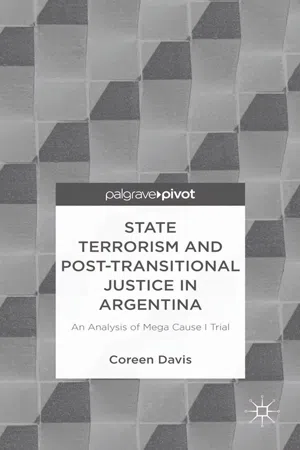
State Terrorism and Post-transitional Justice in Argentina: An Analysis of Mega Cause I Trial
An Analysis of Mega Cause I Trial
- English
- ePUB (mobile friendly)
- Available on iOS & Android
eBook - ePub
State Terrorism and Post-transitional Justice in Argentina: An Analysis of Mega Cause I Trial
An Analysis of Mega Cause I Trial
About this book
Mega Cause I was one of the largest in a recent surge of trials in Argentina for human rights violations committed during the dictatorship of 1976-1983. This study analyzes Mega Cause I within a post-transitional justice framework, examining the role played by the state and human rights organizations and the trial's successes and difficulties.
Information
Print ISBN
9781137367495
Subtopic
Civil Rights in Law1
Introduction
Abstract: The introduction situates the research and provides historical background and definitions of Mega Cause I trial, ESMA, state terrorism/dictatorship in Argentina, and the human rights movement in Argentina. It supplies the three research questions that drive the study: 1) what was the role of the state and human rights organizations in Mega Cause I, 2) what were the successes and hardships of the trial and their relation to the future Mega Cause II, and 3) what were the effects of Mega Cause I on truth, memory, and reconciliation? It states the significance of the study, the methodology, existing literature, and outlines the following four chapters.
Keywords: Argentina; Dirty War; ESMA; human rights trials; Mega Cause; post-transitional justice; state terrorism.
Davis, Coreen. State Terrorism and Post-transitional Justice in Argentina: An Analysis of Mega Cause I Trial. New York: Palgrave Macmillan, 2013. DOI: 10.1057/9781137367501.
On October 26, 2011, the streets outside Comodoro Py courthouse in Buenos Aires, Argentina were a sea of people, television, and camera crews. The crowd held oversized banners that screamed messages of memory, truth, justice, and punishment for the crimes committed 30 years ago during the period of state terrorism.1 Other posters showed the faces of the family members and friends who had been disappeared.2 A military bus that had once been used to kidnap and transport prisoners had been reclaimed by human rights organizations. The vehicle was painted in the blue and white of Argentina’s flag and re-decorated with busts of some of the heroes of the human rights movement. These faces included President Nestor Kirchner and the disappeared journalist and writer, Rodolfo Walsh, a political activist famous for condemning the dictatorship in his Open Letter from a Writer to the Military Junta. People young and old stood on top of and around the bus, wearing memorabilia that supported the many human rights organizations.
The large crowd was gathered to watch the live sentencing of the Mega Cause I trial3: the trial of 18 naval officers for crimes committed at the secret detention center in the Navy Petty-Officers School of Mechanics (ESMA) during the 1976–1983 dictatorship. This trial represents a recent change in Argentina towards justice and punishment for the human rights abuses committed during the dictatorship three decades ago and it sets a precedent of accountability for human rights abuses. This study will use post-transitional justice4 to analyze Mega Cause I as case study for the recent trials throughout Argentina. The study will address the gap of literature on the recent human rights trials in Argentina. This project is driven by the following three research questions: 1) what was the role of the state and human rights organizations in Mega Cause I; 2) what were the successes and hardships of the trial and their relation to Mega Cause II;5 and 3) how does Mega Cause I relate to the important transitional justice concepts of truth, memory, and reconciliation?
The 1976 military coup of the army, the navy, and the air force, brought into power a repressive military dictatorship led initially by General Jorge Rafael Videla.6 During the following seven years of state terrorism, the military government followed a systematic plan to eradicate organizing members of the political opposition.7 The military and security forces operated over 500 clandestine detention centers throughout the country and disappeared an estimated 30,000 people (Careaga, 2010). They were also responsible for crimes including: kidnapping, torture, the robbery of personal property, abduction of babies and infants, inhumane detention, rape, and murder.
The ESMA extermination center in Buenos Aires housed Navy Task Force 3.3.2.8 The task force was under the ultimate supervision of the Navy Commander-in-Chief Emillio Massera, but it was run by Jorge Acosta. Acosta was responsible for the orders and operations of the task force; it was Acosta who decided who was abducted, the treatment of the prisoners, who was tortured and how, and who was killed.
Under Task Force 3.3.2, ESMA became one of the largest and most brutal torture centers in operation during the military dictatorship. An estimated 5,000 people were forcibly detained at ESMA and only around 200 survived (Institute of Space for Memory [IEM], n.d.). Of the 35 buildings on the complex, the Officers House became one of the main buildings for torture and imprisonment. The second floor housed a prisoner’s maternal ward large enough to service pregnant prisoners from detention centers throughout Buenos Aires. These women were kept alive until they gave birth and then immediately robbed of their infant. The babies were often given to military families to be raised under different identities (IEM, n.d.). The basement of the Officers House was used as a gathering place for prisoners before they were shot to death or taken aboard the death flights.9 Every Wednesday, around 20 prisoners were gathered in this basement before they were injected with tranquilizers and loaded into a plane. Once airborne, the prisoners were given another shot, stripped of their clothing and, while still alive, were thrown into the Plate River or the Atlantic Ocean (Verbitsky, 2005).
The 200 survivors of ESMA were mainly a result of the Navy’s re-education program. The objective of this program was to break prisoners of their previous political ideology. The program kept prisoners under inhumane and torturous conditions for long periods of time, often forcing them on threats of death to do slave labor until they “recovered” from their way of thinking. Eventually, some were slowly releasing them into the city where they were watched and often required to return to ESMA to work (Rosenberg, 1991).
Mega Cause I
For almost 20 years amnesty laws protected the military personnel from prosecution for crimes committed during the years of state terrorism. However, in 2005 these laws were nullified, causing a surge of trials from the 1980s to be re-opened and new investigations to commence. Human rights trials against all ranks of military officers spread rapidly throughout Argentina: before 2005, only 32 people were imprisoned for crimes committed during the dictatorship, and between 2006 and 2011, 239 people were sentenced to prison (Center for Legal and Social Studies [CELS], 2012, 35).
When Mega Cause I began in December 2009 it was the largest of the recent human rights trials. The trial included 18 defendants, 86 cases, and 150 testimonies. The accusations were divided into three parts: Testimony A, Testimony B and Testimony C.10 Testimony A was re-opened from its suspension in 1986 and charged nine defendants11 for crimes against humanity committed at ESMA against 73 victims. Specific cases were brought against Adolfo Donda, Oscar Antonio Montes, and Carlos Capdevilla.
Testimony B was known as the Case of the Flying Nuns or the Santa Cruz Church. It accused 13 defendants12 of the kidnap and murder of 12 women from the Santa Cruz Church in 1977. Amongst the victims were two French nuns and three founders of the Mothers of the Plaza de Mayo (the non-violent group famous for protesting the disappearance of their children). One of the defendants, Alfredo Astiz, was accused of infiltrating the group of Mothers by pretending to be the brother of a disappeared. Once inside, he identified the leaders who were kidnapped, brought to ESMA, tortured, and thrown into the ocean on one of the death flights.
Testimony C was the Rodolfo Walsh Case; it accused ten defendants13 of the abduction and murder of Rodolfo Walsh as well as the aggressive robbery of his personal property in 1977. His abduction was witnessed on a corner in downtown Buenos Aires, and his body was later seen by prisoners at ESMA before it was disappeared.
The day of the sentencing of Mega Cause I was thick with anticipation. After the year-and-a-half of testimonies and the 35 years of amnesty, 18 of the perpetrators of state terrorism were poised to receive punishment for their crimes. This was a monumental achievement for Argentina and an example for the world. The noise lowered to a quiet bubbling as the three Argentine judges of the Federal Criminal Trial Court N°5 (TOF N°5) took their seats at the head of the courtroom. For the next hour, the center judge and President of the Tribunal, Judge Daniel Obligado, read the lengthy decisions of the tribunal. The verdict condemned 12 of the defendants to life in prison (including Astiz and Acosta); two to serve 25 years; one to serve 20 years; one to serve 18 years; and two were absolved. With each conviction, the crowd let out cheers of triumph, tears of joy, and intimidating chants promising that justice would follow the torturers wherever they tried to run.
The argument
This project analyzes the challenges of the trial that resulted in this historic victory for human rights, why it is important, and what Mega Cause I means for the future. I use post-transitional justice theories, based upon transitional justice theories, to support my argument, situate it within a contemporary context, and expand upon the existing literature by analyzing the recent trials in Argentina. This research project analyzes the importance of both the state and human rights organizations in conducting Mega Cause I. The effort of both groups in the trial shows that the state is taking responsibility for the crimes committed during the dictatorship and is creating policy that is focused on human rights. This is demonstrated by the branches of the state that worked in conjunction with human rights organizations throughout the Mega Cause I trial. I look at the involvement of both groups by analyzing the Human Rights Secretariat (Secretariat), the Dr. Fernando Ulloa Center for the Assistance of Victims of Human Rights Violations (Ulloa Center), the Institute of Space for Memory (IEM), and the Center for Legal and Social Studies (CELS). The Ulloa Center is a dependent of the Secretariat, which is a dependent of the Ministry of Justice, Security, and Human Rights. Professionals from the Ulloa Center offered psychological support for the victims of state terrorism and the witnesses at the trial. The Secretariat represented victims and human rights organizations of the prosecution in Mega Cause I.
The IEM links the state and human rights organizations. The institute is funded by the federal government and the government of the autonomous city of Buenos Aires. The board consists of members of the executive branches of the Buenos Aires government as well as human rights organizations. The director at the time the research was conducted, Ana Maria Careaga, is herself a torture survivor and the daughter of one of the founding Mothers of the Plaza de Mayo who was kidnapped and disappeared at ESMA with the Santa Cruz Church group. IEM supported the trial by publishing many leaflets and books about the proceedings, the victims, the defendants, and the history of the detention center. Since 2004 the IEM has maintained the ESMA campus and designated six of the buildings used for torture and secret detention as sites for memory.14 These buildings include the Officers House, the Infirmary, and the spacious front building where training took place called the Four Columns. The preservation of ESMA provided physical evidence for the court in Mega Cause I.
CELS was founded during the dictatorship in 1979 to promote and protect human rights and to strengthen the democratic system in Argentina. Today it is one of the top human rights organizations in the country. In Mega Cause I, CELS represented numerous human rights organizations and victims of the prosecution. I will explain their participation in the trial, their cooperation with departments of the state, and the significance that this represents for the human rights agenda of the state.
The study also analyzes the successes and the challenges encountered while conducting Mega Cause I, especially resulting from the involvement of both human rights organizations and the collaboration of the state with the prosecution. The trial was ultimately considered a success because the verdict condemned 16 men to prison.
Finally, I will measure what effects the trial had beyond the scope of justice on three common topics in post-conflict societies: truth, memory, and reconciliation. My data found that Mega Cause I became a venue for discovering the truth and was important for the re-construction of memory. There was no indication that the trial contributed to reconciliation. Instead of focusing on reconciliation to move forward, the data showed that the tools for re-building society are related to justice and creating a future run by the rule of law.
Purpose of the study
The uniqueness of the ongoing human rights trials in Argentina is due to the timing of the trials (three decades after the crimes), the large number of trials, and the large size of many of the trials. Argentina is the first to judge and sentence large numbers of human rights violators. However, there is very little literature that analyzes these trials. The information that is available is limited to newspapers, online blogs, or publications with little analysis. Additionally, most of these newspapers are in Spanish. My research will address this gap by providing in-depth analysis and better understanding of the Mega Cause I. My findings are significant because they relate to other trials in Argentina as well as to the overall changes in the Argentine state in relation to human rights. A better understanding of this process, including where it was successful and the difficulties it encountered, will benefit future trials that can learn from the difficulties of the past. Additionally, this analysis can help other countries, especially in Latin America, that are attempting to find justice for dictatorships of the past.
The purpose of my study is to analyze Mega Cause I as the most recent step towards justice in the aftermath of the state terrorism in Argentina. The continued protest of the human rights movement within the country demonstrates the dissatisfaction with impunity and the need for justice. This study will focus on the Mega Cause I trial for three reasons: 1) it was the largest of the initial wave of recent human rights trials after the nullification of the amne...
Table of contents
- Cover
- Title
- 1 Introduction
- 2 The Role of the State and Human Rights Organizations
- 3 Successes and Difficulties of Mega Cause
- 4 Beyond Justice: Truth, Memory, and Reconciliation
- 5 Conclusion
- Appendix A: Historical Timeline
- Bibliography
- Index
Trusted by 375,005 students
Access to over 1.5 million titles for a fair monthly price.
Study more efficiently using our study tools.
Frequently asked questions
Yes, you can cancel anytime from the Subscription tab in your account settings on the Perlego website. Your subscription will stay active until the end of your current billing period. Learn how to cancel your subscription
No, books cannot be downloaded as external files, such as PDFs, for use outside of Perlego. However, you can download books within the Perlego app for offline reading on mobile or tablet. Learn how to download books offline
Perlego offers two plans: Essential and Complete
- Essential is ideal for learners and professionals who enjoy exploring a wide range of subjects. Access the Essential Library with 800,000+ trusted titles and best-sellers across business, personal growth, and the humanities. Includes unlimited reading time and Standard Read Aloud voice.
- Complete: Perfect for advanced learners and researchers needing full, unrestricted access. Unlock 1.5M+ books across hundreds of subjects, including academic and specialized titles. The Complete Plan also includes advanced features like Premium Read Aloud and Research Assistant.
We are an online textbook subscription service, where you can get access to an entire online library for less than the price of a single book per month. With over 1.5 million books across 990+ topics, we’ve got you covered! Learn about our mission
Look out for the read-aloud symbol on your next book to see if you can listen to it. The read-aloud tool reads text aloud for you, highlighting the text as it is being read. You can pause it, speed it up and slow it down. Learn more about Read Aloud
Yes! You can use the Perlego app on both iOS and Android devices to read anytime, anywhere — even offline. Perfect for commutes or when you’re on the go.
Please note we cannot support devices running on iOS 13 and Android 7 or earlier. Learn more about using the app
Please note we cannot support devices running on iOS 13 and Android 7 or earlier. Learn more about using the app
Yes, you can access State Terrorism and Post-transitional Justice in Argentina: An Analysis of Mega Cause I Trial by C. Davis in PDF and/or ePUB format. We have over 1.5 million books available in our catalogue for you to explore.