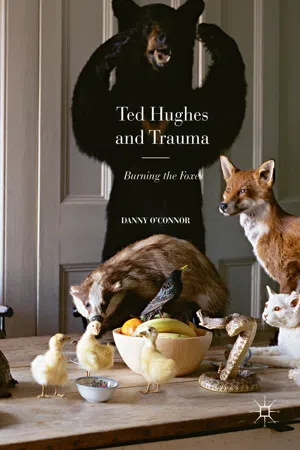
As a student at Pembroke College, Cambridge, Ted Hughes dreamed he was still at his desk, struggling to write his weekly essay when ‘The door opened & a creature came in’, a ‘long skinny’ fox, ‘but erect, & with human hands’. This fox-man had ‘escaped from a fire’, its skin ‘charred’ and ‘bleeding’ as he crossed the room, placed his hand on the poet’s page and announced, ‘Stop this. You are destroying us’. When he removed his hand from the page what remained was a ‘blood-print’. 1 From this point onward—so the legend goes—Hughes devoted his life to poetry and ‘burning the foxes’ becomes a byword for the destructiveness of literary criticism.
As critics, we stand before Hughes’s work with a jerry can of petrol and a packet of matches. He envisions poems as a ‘kind of animal’: they have a ‘vivid life of their own’ that cannot be added or reduced without ‘maiming and perhaps even killing them’. 2 The literary critic, serial butcher and immolator, maims and kills by breaking the unity of a poem, investigating its inner workings in the way his empiricist St George of Crow cleaves hearts ‘With a knife-edge of numbers’. 3 Schooled in the eviscerations of Leavisite close reading, one could only have sympathy for a Hughes that feared his own work might be anaesthetised and subject to the same dissections, though he claims to have had ‘nearly a sadistic streak’ for such criticism, he also felt that it was ‘deeply destructive’ of himself (LTH 423). Conversely, Neil Roberts has corrected our view of Leavis representing a damaging influence on Hughes’s burgeoning poetic talent, arguing that Leavis’s understanding of poetic thinking is actually highly compatible with Hughes’s. 4 Likewise, Neil Corcoran has noted that if we are to take the poet’s vituperations against Leavis seriously, it is precisely because he repeatedly demonstrates himself to be an exquisite practitioner of such close reading. 5 However, the moral challenge his ‘burnt fox’ poses to the critic is more profound than a fear of being subject to criticism. Having avoided any concentrated critical activity during his writing life, the letter recounting the dream quoted above is written on the cusp of a decade when he would return to the medium with an intensity only paralleled in his undergraduate days: Hughes fears his own involvement in the ‘deeply destructive’ act of literary criticism. Furthermore, this letter in which Hughes details his traumatic encounter with criticism is, of course, written to one of his most loyal literary critics, Keith Sagar. Sagar, in his published correspondence with the poet, unfortunately fails to include his response to the dream (presuming he provided one); his wider, critical response to this challenge is to attempt to ‘divine […] the author’s own inner idea of what he or she is after’—less ‘death of the author’ than ‘defer to the author’, then. 6 Perhaps this is closer to the kind of critical practice that Hughes imagines taking place at Oxford, for instance, where he suggests that he (and his foxes) may have survived intact. Certainly, it is this mode that defines his treatment of Shakespeare, for instance, if not in practice then in spirit. “Lit Crit,’ my friend said, ‘and Agrochemicals are Siamese twins’ Hughes recalls in ‘Astringency’ (CP 1094); given the poet’s well-informed crusade against such intensive farming later in his life, perhaps we may want to consider this alternative mode of criticism as closer to the pastoral criticism he promotes, a birthing and dehorning of poems into the critical landscape. For now, however, we ought to return to the dock for a moment and consider the accusation: What, exactly, is the point of literary criticism? Why are we wasting our time subjecting poems to transient critiques, destined to be outlasted by the poems themselves? What has this trail of butchery achieved that the poems could not have alone? How can we be so callous?
In spite of his animosity, the poet/critic was a prominent feature of the literary environment of Hughes’s formative years as a writer, shaping the poet/critic he eventually became. The impact of Robert Graves’ The White Goddess (1948), given to Hughes by his English teacher in 1951, does not need reiterating here; but we ought to consider the significance of that more unlikely of poetic fathers, T. S. Eliot. Modernism regards criticism as the ferryman to the literary afterlife (hence James Joyce’s famous line about keeping the professors guessing). John Berryman makes a similar joke in Dream Songs when Henry wonders about his literary afterlife: ‘will assistant professors become associates/by working on his work?’ 7 But if the text is filled with puzzles and enigmas simply to keep the professors busy then surely the spirit of the text is corrupted? The literary enterprise becomes a self-perpetuating cycle of ambiguity and argument for the sake of each other. Hughes is, on occasion, just as guilty of this as any other modern poet of ambition—this is particularly the case in Cave Birds (1978). This renders the role of the critic as curatorial, or worse still: one of a hoard of Shabti, taken into the author’s tomb in order to work for them in the afterlife.
Yet Modernists also recognised an investment in criticism as a worthy pursuit in itself. The collected critical writing of Eliot is at least as voluminous as that of his creative output, likewise Virginia Woolf. Central to this project was a way of engendering sensitive compatibility between poetry and criticism (the extensive annotations provided by Eliot—mockingly, perhaps—and David Jones for various works are indicative of this). Rejecting this project is a way of creating some space for himself; yet just as Hughes’s work is not a wholesale rejection of Modernism but is in many ways late Modernist, he did not turn his back to literary criticism altogether either. It is a discipline that still has some use for the poet; this use is, I think, related to the Modernist assessment that literary criticism is important as an intellectual project, even if its importance cannot be defined exactly. Corcoran argues that Hughes utilised critical activity to delineate the boundaries of his own critical reception (Poetry and Responsibility 161); inherent in this is an understanding that literary criticism is somehow necessary in order to translate the message of the work. The relationship between text and criticism is a necessary condition of modernity. Matters seem too complicated, and with them, literature; the message has to be wrested from the text. This appears to be deeply troubling to Hughes, who, on the one hand endeavours to write straightforward mythologies—for adults and children—that explain the world with simple wonder, and on the other finds himself bogged down in arcane philosophies, occult symbolism, and an incredibly lengthy and convoluted piece of literary criticism that claims to explain Shakespeare’s work with a clear formula (and yet does no such thing). However, the idea of critic as translator or fathomer is deeply unsatisfying, not least because literature can and does survive without ‘the critical exhalations and toxic smokestacks and power stations of Academe’, as Hughes puts it (LTH 617). Still, T. S. Eliot makes the point: ‘Of what use, or uses, is literary criticism, is a question worth asking again and again, even if we find no answer satisfactory.’ 8
One answer that Eliot provides elsewhere is that ‘a good part of criticism has consisted simply in pursuit of answers’ to the questions: What is poetry? What is it for? What does it do? 9 Eliot equivocates in response to these questions, but the tenor of his argument suggests that a fair conclusion would be that poetry is a provocation to precisely such interrogation—that poetry, good poetry at least, asks these questions and so creates space for the critic, however transient or unfulfilling the critic’s conclusions may be. Hughes, however, renders such an attitude towards poetry problematic when he grants it animal independence. The way in which we approach animals is not entirely distinct from the critic’s approach to the text. Treated with a combination of awe and superiority, the text is brought into the university as a wild animal to be contained and studied. In the background of this enterprise is the uncomfortable feeling that such an activity is an intrusion or a disturbance, that in the same way animals do not belong in a zoo, poems ought to have a life outside the university. Nonetheless, in many respects, Hughes’s poetic approach to animals is comparable to that of the critic’s to poetry: concentrated study and recreation. Hughes’s ‘translation’ of animals into language—which will be looked at in some detail in this study—is not entirely different from the critic’s transmutation of a poem from poetic language into the language of criticism. There are, accordingly, reasonable grounds to view literary criticism as a cocreative act. The poem is emergent in the philosophical sense of being greater than the sum of its parts. This emergent quality, its ‘animal life’ to borrow Hughes’s metaphor, makes it resistant to mutation into any other medium. Hughes’s poetry comes up against the same barrier where it attempts to capture nature. If we think of literary criticism as an act of transmutation then we begin to stage a defence of it in view of the burnt fox: in the same way that translating a poem into a different language somehow misses a vital element of that work, converting the ‘meaning’ of a poem into a critical idiom inevitably loosens its grip on an element of the poem. What results in both instances is a new work. Criticism is another kind of provisional fiction, gesturing towards absolute meaning—even kidding itself on occasion into believing it has attained the definitive answer to a text—but just as prone to poetry to the slipperiness of language. This is particularly striking in the case of the poet-critic, such as Hughes: Shakespeare and the Goddess of Complete Being is nothing if not a creative response to the playwright. If poetry is a fiction about the ‘truth’—the truth of a fox, of a thought about a fox, of a thought about a thought of a fox, and so on—then criticism is a fiction about that poetic ‘truth’. It is a continuation of the conversation. Despite this there is still a striking qualitative difference between criticism and poetry: the former rarely holding the privileged position of the latter.
In this regard, it is hard not to feel that Hughes was correct in his assessment of the dream. Perhaps we ought to concede that criticism, and the intellectual attitude that moulds it, does have a damaging effect on the ‘creative spirit’. It is a reactive labour, and therefore inherently conservative. It relies on pre-existing formulas, whether from critical practice or in response to pre-existing literature. No one, to my knowledge, has written good poetry in response to a paradigm invented by criticism. But this is to allow Hughes to stride into the argument like a biblical Joseph. He may have had a fox lurking somewhere in his unconscious that had a particular grievance with Dr Johnson, but this is not to say that criticism cannot in itself be aligned to the ‘creative spirit’. Hughes’s essays on the Romantics, his huge work on Shakespeare, as we shall see, are part of the same project as his poetry. As he writes to Seamus Heaney in 1998: ‘I sometimes wondered if t...