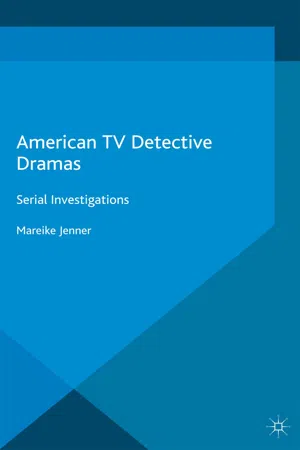
- English
- ePUB (mobile friendly)
- Available on iOS & Android
eBook - ePub
About this book
The way detectives access and attain the 'truth' about a crime is an important indicator of how they relate to contemporary political developments. This book explores these methods of detection and positions the genre in a specific political, aesthetic, narrative and industrial context.
Information
1
Introduction
This book looks at the American TV detective genre and its function within a broader social and political landscape. Specifically, it explores the American TV detective genre via the methods of detection used to access the ‘truth’ about a crime. To explain what this means, it may be worth looking back a few years to the television landscape of around 2006. During George W. Bush’s second term as president of the USA and amidst revelations of torture in the Abu Ghraib and Guantanamo prisons and discussions of ‘legalising’ torture, two television dramas with very different approaches to detection were very much part of the US political discourse and at the height of their success: CSI: Crime Scene Investigation (CBS, 2000–15) and 24 (Fox, 2001–10). Both were aesthetically innovative and were Network television’s response to HBO-style ‘quality’ cable television: CSI: Crime Scene Investigation with its CSI-shot, showing the inside of the human body with CGI images, and 24 with its real-time narrative and split-screen aesthetics. CSI: Crime Scene Investigation was in its heyday and found itself within the top five in Nielsen ratings for eight seasons (see Kompare 2010, 4), while 24’s anti-hero Jack Bauer (Kiefer Sutherland) took on a prominent role in the public debate on torture. Each displayed decidedly different methods to gather evidence and access ‘truth’: the CSIs through methodical analysis of crime scenes, focussing on minute traces the killer left behind and relying on scientific analysis, while Jack Bauer used threats, blackmail and violent torture to access ‘truth’. In a socio-political context dominated by the still relatively fresh memory of the 9/11 attacks, and in the midst of public debate on what retribution would look like and what means justify the ends, the popularity of two dramas that deal with this issue of truth-finding in such different ways takes on an important role. This is not to say that either drama explicitly voices political opinion, but both are aligned with certain positions. As argued throughout this book, what is called here the rational-scientific methods of CSI: Crime Scene Investigation are relatively conservative – not in terms of Republican Party politics, but in terms of preserving established power structures, social norms and value systems. It is exactly this conservatism that makes the text rely on the ‘tried and tested’ means of science, while 24 relies on violent instinct and often openly challenges ‘tried and tested’ means of investigation on the basis that they take too long. In the fictional realm, where scenarios can be played out as fantasies, both sides come with a range of advantages and disadvantages: the rational-scientific approach does not challenge existing power structures or ideologies and insists on being able to access a supposedly objective ‘truth’. The irrational-subjective approach Jack Bauer uses has the potential to rethink existing power structures and explore new ways of thinking about ‘truth’. But Bauer’s instinctual approach is also excessively violent, and torture often happens on the basis of only suspicions rather than evidence.
CSI: Crime Scene Investigation and 24 are particularly potent examples of the two poles in the discourse of ‘truth-finding’, but these differences in approaches to accessing and attaining ‘truth’ have a long history: they reach back to Raymond Chandler explicitly positioning his literature as a counter-reaction to the British tradition of Agatha Christie-style whodunits in ‘The Simple Art of Murder’ (1950). The two literary traditions of hard-boiled and Golden Age fiction, which, as will be explored throughout this book, stand in for the two different approaches to detection, have mostly existed in parallel. Dashiell Hammett’s Red Harvest was published in 1929, while the so-called Golden Age of detective fiction (describing whodunits or murder mystery novels) was at its height. Hammett’s novel can be viewed as starting the hard-boiled mode, named after main character Sam Spade’s characterisation as ‘hard-boiled’. Instead of complicated murder plots deduced by supremely capable, ‘distanced’ and analytical detectives, the hard-boiled mode features detectives who often act on instinct rather than definitive knowledge. They use violence to gain information, but also are not safe from being beaten up themselves. Rather than provide definitive ‘truth’ at the end of a novel, plots often leave readers with a sense of ambiguity. This is not necessarily regarding a criminal’s guilt, but whether it is morally ‘right’ to punish them or because other, maybe worse, criminals are left unharmed. This epistemological dichotomy between rational-scientific and irrational-subjective methods of detection is carried into television drama, where one method usually dominates for a period, but without eliminating the other. This book explores this history in more detail, tying these methods of detection to specific philosophical traditions and positioning them within a historical context of social and political debate. But this study also explores whether and how this binary opposition (if it can be understood as such) is deconstructed through alternative methods of detection.
It needs to be highlighted that this book is specifically about American detective dramas. This is due to the need to limit the number of industrial and political discourses that can be looked at in a study like this. The detective genre is an international phenomenon, but it is also shaped by political and industrial discourses in the countries of production. For example, contemporary Danish detective dramas like The Killing (Forbrydelsen, DR, 2007–12) or The Bridge (Bron/Broen, DR/SVT, 2011–) are shaped by their contexts as Danish public service broadcasting, national debates surrounding feminism and immigration, foreign politics and the relationship between Denmark and Sweden. How specific some of these debates are is obvious when attempts to transfer similar dynamics to British television with Hinterland/Y Gwyll (BBC, S4C, 2013–), Broadchurch (ITV, 2013–) or Shetland (BBC, 2013–) result in decidedly different texts. The setting of these texts alone dictates thematic and aesthetic differences between the individual texts, but the British texts also express decidedly different thematic concerns than their Nordic cousins. Similarly, the American adaptations of The Killing and The Bridge show different concerns from the original. The US version of The Killing (AMC, 2011–13, Netflix, 2014–), for example, emphasises issues like ‘good’ and ‘bad’ mothers more clearly than the Danish version. Meanwhile, the US version of The Bridge (FX, 2013–) is set on the American–Mexican border, discussing international relations decidedly different from the Danish–Swedish relationship. These few examples show that there is a tension within the genre between the transnational and the nationally specific. This study focusses on the nationally specific and how methods of detection and the detective genre are shaped by American political, social and industrial discourses. Yet, transnational influences can never be completely ignored, as narrative structures or themes can be adapted from other cultural contexts and some cultural, social or political concerns overlap.
Up until a few years ago, not much literature existed on the detective genre on television, let alone specifically American dramas. When I first started research on the American television detective genre in 2009, I assumed, wrongly as it turned out, that with such a prolific genre, vast amounts of literature must be available on questions of defining the genre and its history on US television. But there was no book discussing the intricacies of the crime genre on television. There was no detailed account of genre history, especially one focussed on American television. Despite a wealth of journal articles on individual dramas like Miami Vice (NBC, 1984–9), there were few accounts of the detective or the crime genre as genre. The most detailed account was Steven D. Stark’s excellent article ‘Perry Mason Meets Sonny Crockett: The History of Lawyers and the Police as Television Heroes’, published in 1988 in the University of Miami Law Review, focussing specifically on representations of the legal system. At the time, what proved to be particularly helpful was a look towards literature studies, where Stephen Knight’s Form and Ideology in Crime Fiction (1980) and Crime Fiction, 1800–2000: Detection, Death, Diversity (2004) and John Scaggs’ Crime Fiction (2005) offer comprehensive overviews of the different sub-genres of the crime genre in literature. With the help of these accounts, I developed an understanding of the crime genre as divided into many sub-genres, each with its own narrative, aesthetic and thematic conventions.
Yet, though many of the sub-genres on television are rooted in literature, their conventions are decidedly different. A potent example of this is even a cursory comparison of the Dexter novels by Jeff Lindsay (2004–13) and their adaptation to television with Dexter (Showtime, 2006–13): while the title character narrates his murders in graphic detail and in chirpy tones in the novels, the television series, with all the liberties it takes in the depiction of violence, never actually shows how Dexter (Michael C. Hall) cuts up his victims. Instead, the series limits itself to the moment of him stabbing them in the heart and then cuts to him drowning bin bags (presumably filled with body parts) in the sea, barely hinting at the gory scenes that must lie in between. Extravagant displays of murder victims, for example by the Doomsday Killer in Season 6, are always instigated by the killers Dexter chases, not by himself. In the TV series, Sgt Doakes (Erik King) is killed by Lila (Jamie Murray), sparing audiences Dexter’s voiceover as he mercilessly mocks the disabled Doakes (whose mutilation he caused) in the novels. Rather than taking on his stepson Cody (Preston Bailey) as apprentice, the TV series explores Dexter’s relationships with children as attempts to bond with others. In parts, the TV series’ efforts to diverge from the novels can be explained by the fact that the literary series was ongoing when the TV series started, forcing Lindsay and the TV writers to take different directions if they wanted to preserve the element of surprise. While always being controversial in its own right, the TV series has also often taken a less transgressive route than the novels. This is likely to be due to a range of discourses, including censorship and other industrial discourses, for example the broadcast of the series in a censored version on CBS from 2008. But this example highlights how different the industrial, aesthetic or narrative conditions of the two media are. Furthermore, reading about cutting up a dead body and watching it on TV are distinctly different experiences, so discourses relating to audience experience work to shape texts, sub-genres and genres.
Luckily, the canon of literature on the television genre has grown in recent years, with Deborah Jermyn’s book on Prime Suspect (ITV, 1991– 2003), Charlotte Brunsdon’s work on the British Law & Order (BBC, 1978), James Lyons’ and Steven Sanders’ books on Miami Vice and Douglas L. Howard’s edited collection on Dexter all published in 2010, and, as more comprehensive accounts of the genre as genre, Jonathan Nichols-Pethick’s TV Cops: The Contemporary American Television Police Drama published in 2012, and, as I was writing this book, Sue Turnbull’s The TV Crime Drama (2014). With this range of literature, I was able to develop a broader understanding of the television genre, its texts and its relationship with discourses external to what might be understood as the detective genre. This book draws on these experiences and aims to write one history of the detective genre. In this, it aims to offer one narrative of the genre among many. This particular narrative accesses this vast genre via the modes of investigation used in the genre. As such, it excludes all texts that feature non-investigative storylines, focussing only on the detective genre. A more detailed genre definition will be given in Chapter 3, following an outline of how this book intends to grasp the seemingly elusive generic feature of ‘methods of detection’ in Chapter 2. Methods of detection are understood here not as the specific tool or instrument employed in individual steps of the investigation, but broader concepts that inform how the ‘truth’ about a crime is accessed. As outlined in Chapter 2, this is tied to far-reaching discourses of how knowledge is accessed that emerge from Enlightenment, modern and postmodern discourses. But methods of detection are also tied to specific narrative modes, the literary traditions of the hard-boiled novel (often adapted into films noirs) and the Golden Age or whodunit novel. From these traditions also stems a convention of how narratives are structured. Chapter 4 is dedicated specifically to these narrative structures and in what ways they shape and are shaped by methods of detection. Though narrative structures are often highlighted as an important aspect of the detective genre, sometimes even invoked to dismiss the genre as trivial and formulaic, they are rarely discussed in any detail. Chapter 4 outlines how different narrative structures are developed specifically for television drama, and frames them as having ideological implications. Narrative structures appear to be relatively stable elements within the genre: the whodunit as narrative structure, with only slight modifications, has been a staple of the genre since Edgar Allan Poe’s The Murders in the Rue Morgue, published in 1841. Yet, these modifications are varied and carry with them different conditions for methods of detection. Particularly in relation to narrative closure, the structures that shape the narrative also shape the ideological outlook of a text. Furthermore, some texts, particularly Hill Street Blues (NBC, 1981–7) and The Wire (HBO, 2002–8), offer radical change to narrative structures, and with this also to methods of detection.
Chapters 5–9 can be understood as an outline of the history of American detective dramas via methods of detection and how these interlink with contemporary socio-political, industrial and aesthetic discourses. These debates are tied together through time periods rather than formal features, as is done in Chapter 4 on narrative structures. As Chapter 4 will show, narrative structures can be viewed as comparatively stable. But discourses of politics, aesthetics and industry change more quickly, and, in the way they shape the detective genre and methods of detection, seem more closely linked to each other. Many texts may be innovative, even revolutionary, without disrupting established narrative structures. One example is Twin Peaks (ABC, 1991–2): the text stands out due to a decidedly postmodern aesthetics and world view, which implies a laissez-faire attitude towards social and identity politics (see Chapter 7). Yet, its narrative structures follow the flexi-narrative soap-like structure (as hinted at through the use of the fictional soap Invitation to Love on characters’ TV screens), established for the detective drama a decade earlier in Hill Street Blues. Thus, though Twin Peaks is radical in many ways, its innovations are in aesthetics and social politics, determined by industrial change, but not in narrative structure. Even though some dramas, such as Hill Street Blues, introduce major formal innovations to narrative structure, this structure quickly becomes part of the genre discourse and is used and refined by other texts. But these major changes are few and far between. In fact, narrative structures seem to form a relatively stable ‘anchor’ for the genre. The familiar whodunit structure can serve as a starting point for (comparatively) minor innovations (see Chapter 4). But it can also function as an anchor that frames aesthetic innovation, for example in Miami Vice or Twin Peaks. Thus, narrative structures, though diverse, also form a relatively stable ‘anchor’ for the genre in times of political uproar, social change or aesthetic innovation. Dramas like Hill Street Blues or The Wire often seem radical because they dare to change the anchor of the genre, the narrative structure. Meanwhile, socio-political discourses, developments in the industry and in television aesthetics, seem more changeable. Partly because of this, they are of variable importance to genre development (or at least considered so here) depending on the historical moment. Methods of detection remain surprisingly stable until the early 2000s, and, in this study, serve to tie different discourses together and offer a way to access and interpret the history of the detective genre.
Chapters 5–9 are structured chronologically in order to link the two historical discourses of US history in the 20th and 21st centuries with genre history. These discourses are not meant to be a definitive history of either, but merely represent one way to look at the genre. After all, US history and genre history are necessarily networks of competing and dissenting discourses, and this study cannot escape some generalisations about the detective genre and political context. These chapters are divided into different periods, defined by genre developments in tandem with dominant socio-political discourses of the time. Chapter 5 deals with a period from roughly the 1950s to the late 1960s; Chapter 6 spans from 1968, as a crucial moment in US history, to the early 1980s, followed by a chapter that spans across the 1980s and 1990s to more contemporary dramas that are situated in the political arena of post-9/11 America, which form chapters 8 and 9. All of these eras are rough estimates and need to be viewed as periods when specific social and political discourses become particularly pertinent, or, in the case of the year 1968 or post-9/11 America, even erupted. The dominance of certain discourses in specific eras does not mean that the...
Table of contents
- Cover
- Title Page
- Copyright
- Contents
- Acknowledgements
- 1. Introduction
- 2. Investigating Detection: Methods of Detection in American Detective Dramas
- 3. Defining Detection: The Detective Genre
- 4. Telling Detection: The Narrative Structures of American TV Detective Dramas
- 5. Stabilising Detection: Protecting and Serving the Status Quo 1950–68
- 6. Reforming Detection: Social Change and Political Corruption 1968–80
- 7. Diversifying Detection: Proliferation of Channels and Television Cycles 1980–2000
- 8. Disillusioned Detection: DNA and 9/11 2000–10
- 9. Rethinking Detection: Alternative Methods of Detection
- 10. Conclusion
- Appendix
- Notes
- Bibliography
- Index
Trusted by 375,005 students
Access to over 1.5 million titles for a fair monthly price.
Study more efficiently using our study tools.
Frequently asked questions
Yes, you can cancel anytime from the Subscription tab in your account settings on the Perlego website. Your subscription will stay active until the end of your current billing period. Learn how to cancel your subscription
No, books cannot be downloaded as external files, such as PDFs, for use outside of Perlego. However, you can download books within the Perlego app for offline reading on mobile or tablet. Learn how to download books offline
Perlego offers two plans: Essential and Complete
- Essential is ideal for learners and professionals who enjoy exploring a wide range of subjects. Access the Essential Library with 800,000+ trusted titles and best-sellers across business, personal growth, and the humanities. Includes unlimited reading time and Standard Read Aloud voice.
- Complete: Perfect for advanced learners and researchers needing full, unrestricted access. Unlock 1.5M+ books across hundreds of subjects, including academic and specialized titles. The Complete Plan also includes advanced features like Premium Read Aloud and Research Assistant.
We are an online textbook subscription service, where you can get access to an entire online library for less than the price of a single book per month. With over 1.5 million books across 990+ topics, we’ve got you covered! Learn about our mission
Look out for the read-aloud symbol on your next book to see if you can listen to it. The read-aloud tool reads text aloud for you, highlighting the text as it is being read. You can pause it, speed it up and slow it down. Learn more about Read Aloud
Yes! You can use the Perlego app on both iOS and Android devices to read anytime, anywhere — even offline. Perfect for commutes or when you’re on the go.
Please note we cannot support devices running on iOS 13 and Android 7 or earlier. Learn more about using the app
Please note we cannot support devices running on iOS 13 and Android 7 or earlier. Learn more about using the app
Yes, you can access American TV Detective Dramas by Mareike Jenner in PDF and/or ePUB format, as well as other popular books in Literature & Literature General. We have over 1.5 million books available in our catalogue for you to explore.