Religion and social action is both empowering and limiting for women. This study shows the Guadalupanas' awareness of themselves as agents for change and their difficulties in understanding and maintaining their limited gendered roles within church and community.
1. The Kansas City Westside: Home of the Shrine of Our Lady of Guadalupe
This chapter depicts the history of the Mexican and Mexican American experience on the Westside of Kansas City, particularly the progressive nature of both ethnic identity and the patterns of change, negotiation, accommodation, response, and resistance within this community. We will see that the Kansas City Westside community of Mexicans and Mexican Americans actively dealt with the difficulties they encountered due to immigrant status, poverty, exploitation, and discrimination by fostering mutual solidarity among families, friends, and neighbors over generations. This chapter also addresses the role of leadership developed in the face of external discrimination and exploitation. In that regard, the chapter does not focus specifically on the Guadalupanas, (their leadership as a group is described in chapter two), but instead addresses the significant socio-historical context that was the foundation for the development of Mexican American leadership in the Kansas City Westside. Through the creation of organizations, supportive networks, and the strength of their religious and cultural heritage, as shown in various institutions in the Westside neighborhood, this community has uniquely demonstrated strong leadership.
In order to protect the identities of the Guadalupanas and Guadalupanos, I do not identify individual members; suffice it to say that a number of them are key leaders in local politics, educational reform, immigrant rights, and non-profit agencies that serve the poor, elderly, and youth of the area.
Early historical treatments of Mexican history in the United States address their subjects like any other immigrant population who would eventually assimilate.1 Although revisionist historians of the 1970s and 1980s took an ethnic historical approach characterized by Oscar Handlin’s oft-quoted statement that “immigrants were American history,” they still tended to be assimilationist.2 This generalized approach to the construction of immigrant history does not address the complexities of Mexican history in the United States, particularly in the Midwest. In the West and Southwest, Mexican residents have existed for generations before other ethnic settlers and we cannot easily categorize their means of adaptation into linear patterns of assimilation. A number of authors have recently published books on the history and current contexts of Latina/o immigrants in the Midwest that document the different patterns of adaptation these immigrants encountered; when they arrived in the Midwest they gained opportunities for employment in agriculture and on the railroads, while still adapting to a climate and vegetation unlike their homeland.3 Despite such books, until this one, no serious study has documented in detail the early- to present-day socio-historical context of Latina/os in Kansas City.4
Part of the reason for this lack of research is that such documentation was not easy to do. Complications of writing a history of Midwestern Mexican immigration include the effects of competition among other minority groups, cyclical patterns of nativism, daily individual and collective experiences of racial prejudice, and periods of repatriation that prevent clear assimilation patterns and slow development of a middle class. Chicana/o historian Juan García insists that, “Mexicans were not passive victims. On the contrary, Mexicans actively resisted political, economic, and legal exploitation and discrimination.”5 Here, I detail the responses of the Kansas City Mexican people, especially Westside leaders, to local, regional, and national hegemonic forces that affect the community.
Despite their differences, studies of identity and customs in other areas in which Mexicans settled are useful as a comparison. In his study of Los Angeles from 1900–1945, George J. Sánchez, another Chicana/o studies scholar, notes that ethnic identity within immigrant Mexican and Mexican American populations evolves as migrants become established residents.
Ethnicity, therefore, was not a fixed set of customs surviving from life in Mexico, but rather a collective identity that emerged from daily experience in the United States. As such, ethnicity arose not only from interaction with fellow Mexicans and Mexican Americans but also through dialogue and debate with the larger cultural world encountered in Los Angeles. Whether accommodation, resistance, or indifference marked an individual’s stance toward American culture, everyone reacted to living in the United States. . . . They assumed a new ethnic identity, a cultural orientation that accepted the possibilities of a future in their new land.6
Sánchez stresses the need for a variety of analyses within any ethnic historical study as ethnicity evolves over successive generations.
Similarly, in Tejano Religion and Ethnicity, Timothy Matovina considers the evolution of ethnic identity by focusing on religious celebrations of the feast of Our Lady of Guadalupe during a transitional period of Mexican American history in San Antonio.7 He notes that his study on Tejano experience “illustrates the inadequacy of unilateral assimilationist theories for understanding the complexities of religion and ethnicity in the American milieu.”8 His research highlights the often neglected but important role of religion as a means of understanding both ethnic identity and patterns of negotiation, accommodation, and resistance.
THE FIRST GENERATION AND THE FOUNDING OF A MEXICANO COLONIA, 1910S–1930S
Early histories of Kansas City note the first people of Latina/o descent in the area. Spanish explorers entered Missouri and Kansas during the sixteenth and seventeenth centuries, and in the nineteenth century, Mexicans passed through Kansas City along cattle drives or on their way to the Santa Fe Trail9 bringing goods from the United States to the Central Plateau region of Mexico.10 In the late 1800s, the railroads replaced that Trail with a system that linked the United States across the western frontier and to the southern border with Mexico. During the same period, Mexican President Porfirio Díaz initiated the building of railroads to support the shipment of both goods and troops within Mexico. These Mexican trains linked with railroads in the United States, thus establishing opportunities for migrant workers to travel easily to the Midwest.11
An established presence of Mexicans in the Kansas City area has existed for more than a century. Numerous factors led to the initial transfer of Mexican immigrants into the United States that in turn led to migration to the Midwest (specifically Kansas) beginning in the early 1900s. First, Mexico’s economy went through two depressions during 1890 to 1910, which caused underemployment and unemployment. A reduction in tillable land compounded the effects of those depressions since these economic factors forced campesinos (rural peasants) to leave agricultural work and seek employment in the railroad industry, in Mexican urban areas, and as migrant workers harvesting cotton, sugar beets, and wheat in the United States.12
Additional internal economic factors in the United States encouraged Mexican workers to travel north looking for employment. Nativist attitudes opposing immigration resulted in political changes in immigration policies, leading to the passage of the 1882 Chinese Exclusion Act and the 1907 Gentleman’s Agreement with Japan. Both bills exempted Mexican immigrants from expulsion while stopping the flow of Asian immigrants, thus reducing the total numbers of laborers available to serve the railway, agriculture, and construction businesses.13 Although initially these businesses employed Mexicans in the Southwestern part of the United States, by 1900 several railroads dispersed Mexican employees throughout their system, including the Midwest and Kansas City areas.14
These first immigrants arrived primarily as solos (married men without their families) and solteros (single men), who traveled to the United States to work in whatever capacity they could find employment,15 which was primarily for the railroads, or in packinghouses, agriculture, and industrial jobs such as steel manufacturing and construction. Some of those who followed the rural agricultural migratory work returned during the winter months to cities like Kansas City, centrally located in the agricultural belt and accessible by the railway.16
From 1910 to 1920, prompted by the violence and loss of jobs and land during the Mexican Revolution, another wave of immigrants arrived in Kansas City. These arrivals included not only solos and solteros, but also families and members from business and professional classes. Most of these families settled in the Kansas City Westside neighborhood or nearby.17 From 1915 to 1919, we find many depictions of life in the early Mexicano colonia (Mexican colony or small enclave) in Kansas City’s El Cosmopolita newspaper.
Before 1917, there were few stable Mexican communities in the Midwest, and in Kansas City these communities fluctuated with the seasonal availability of employment on the railroads and in agriculture. After 1917, an additional wave of immigrants arrived, filling the need for manual workers. With opportunities for stable employment, the end of the Mexican Revolution, and fear of political reprisals if they returned to Mexico, many of these immigrants established permanent communities.
The majority of these new residents came from the Central Mexican Plateau region18 and settled into enclaves “in spite of the adverse conditions.”19 From her research into the patterns and settlements in the Argentine area of Kansas City, historian Judith Laird argues that the migration of Mexican immigrants to the region was not solely by drift, but that relatives and friends from the same locale tended to settle together. Before 1940, 87.5 percent of the employees in the Kansas City area came from the Central Plateau, including the states of Michoacán, Guanajuato, Zacatecas, Jalisco, and Aguascalientes. The Santa Fe data traces the migratory histories of the immigrants and found they remained in the Kansas City area for years, sometimes for decades.20 These records are significant because they reveal that these early immigrants were not internal migrants (diaspora) but came directly from Mexico.
Immigrants tended to settle according to their employment. For example, railroad companies provided both the workers’ jobs and the boxcars in which they lived. To replace the loss of Asian employees and European immigrants,who preferred permanent rather than seasonal employment, railroad companies welcomed Mexicans who were willing to accept these working conditions.21
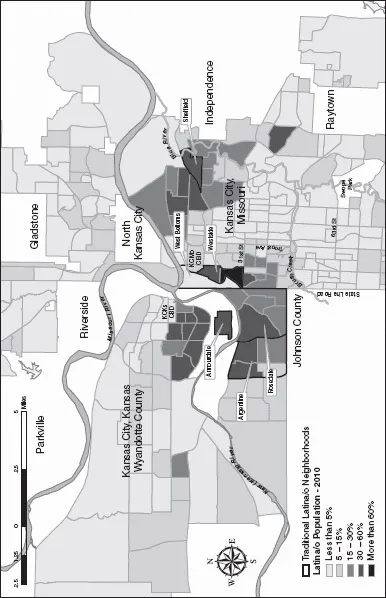
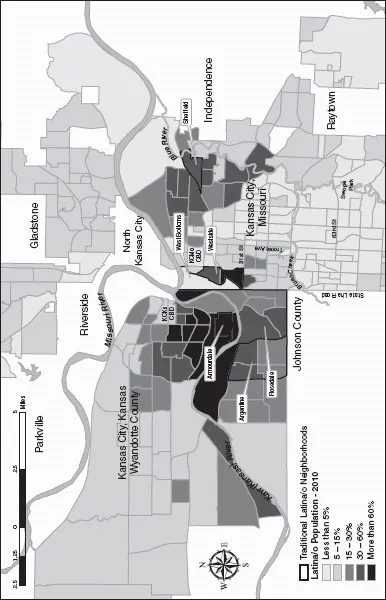
The colonia in Kansas City consisted of six enclaves of Mexican settlers with three in Missouri and three in Kansas. Of those, the first Mexicans who moved to the Westside neighborhood (an urban settlement along the Westside bluffs, which looks down on the Kansas River) in 1909 to work on the construction of Union Station, the central train station for Kansas City, Missouri. Two other smaller barrios in Missouri included a railroad enclave in the Burlington yard in North Kansas City and the Sheffield district along the Blue River. In Kansas City, Kansas, three barrios existed near the Westside: the Santa Fe railroad camp in Argentine (which means silver in Latin and designates the area that was once the home of the Kansas City Smelter and Refining Company), the West Bottoms (of the Missouri River), and Armourdale and Rosedale barrios along the tracks of the Frisco and Katy railroads, respectively.22
Before long, the Santa Fe Railroad in Kansas City became dependent on Mexican workers. By 1912, the company had to provide more living quarters on railroad property for laborers and their families. While some Mexican children attended school outside of the barrio, the families rarely encountered local residents because the railroad yards provided all of their food and clothing needs (at a price!).23
The Westside was the largest barrio in Kansas City, Missouri and a major shopping center for the Mexican population of metropolitan Kansas City. The Westside’s location as a center for the railroad and the street railway enabled Mexicans to travel easily to nearby downtown and to Union Station, which was the city’s central freight post. Mexicans living in the Argentine district found transportation to the Westside easier than to downtown Kansas City, Kansas since the railway access in Kansas did not connect Argentine with downtown. The Kansas barrios of Argentine, Armourdale, and Rosedale and the Missouri barrio of Sheffield connected through the Westside by traveling along the Metropolitan Street Railway.24 These connections made the Westside neighborhood the central business hub for the other barrios.
Map 1.1 KCMo and KCKs 2000 Latina/o Population by Neighborhood
Map 1.2 KCMo and KCKs 2010 Latina/o Population by Neighborhood
In 1917 to 1919, El Cosmopolita described the Mexican businesses established in the barrios of the Westside and Armourdale. At least thirty-four Mexican-operated businesses served the population: two barber shops, three drug stores, five restaurants, two movie theaters, two pool halls, two tailors, two trucking firms, one printing press, one newspaper, four money exchange offices, one photographer, one grocery store, several guest houses, a sewing machine business, a used furniture exchange store, a general merchandise store, and a business selling fruit, fountain drinks, and tobacco.25
Besides these goods and services, the Westside neighborhood offered Mexican physicians and pharmacies, currency exchanges, lawyers, printers, laborer agents, artists, musicians, voice instructors, book dealers, and English and Spanish teachers. The presence of Mexican businesses and services in the colonia reduced the number of adjustments that new residents made, thus allowing them to feel a part of la patria (their own country) in the midst of an alien environment. The barrio also limited the number of exchanges the immigrants made with the rest of the world, thus reinforcing their own feeling of being a separate community with its own ethnic identity and connections.26
By World War I, Kansas City was at the heart of the Mexican migratory movement to the interior of the country. A...
Table of contents
Cover
Title
Introduction
1. The Kansas City Westside: Home of the Shrine of Our Lady of Guadalupe
2. The History of the Kansas City Shrine of Our Lady of Guadalupe
3. Russian German Immigration and Imagined Families
4. “Guadalupe Speaks to Me”: Interpreting Las Guadalupanas’ Voices
5. Practicing Belief: The Activities and Rituals of Las Guadalupanas
6. The Border Crossing Virgin and Her Daughters: Understanding the Vision and Transgressing New Territories
Appendix: Guadalupanas Society of Kansas City, MO. By-laws
Notes
Bibliography
Index
Trusted by 375,005 students
Access to over 1.5 million titles for a fair monthly price.
Study more efficiently using our study tools.
Frequently asked questions
Yes, you can cancel anytime from the Subscription tab in your account settings on the Perlego website. Your subscription will stay active until the end of your current billing period. Learn how to cancel your subscription
No, books cannot be downloaded as external files, such as PDFs, for use outside of Perlego. However, you can download books within the Perlego app for offline reading on mobile or tablet. Learn how to download books offline
Perlego offers two plans: Essential and Complete
Essential is ideal for learners and professionals who enjoy exploring a wide range of subjects. Access the Essential Library with 800,000+ trusted titles and best-sellers across business, personal growth, and the humanities. Includes unlimited reading time and Standard Read Aloud voice.
Complete: Perfect for advanced learners and researchers needing full, unrestricted access. Unlock 1.5M+ books across hundreds of subjects, including academic and specialized titles. The Complete Plan also includes advanced features like Premium Read Aloud and Research Assistant.
Both plans are available with monthly, semester, or annual billing cycles.
We are an online textbook subscription service, where you can get access to an entire online library for less than the price of a single book per month. With over 1.5 million books across 990+ topics, we’ve got you covered! Learn about our mission
Look out for the read-aloud symbol on your next book to see if you can listen to it. The read-aloud tool reads text aloud for you, highlighting the text as it is being read. You can pause it, speed it up and slow it down. Learn more about Read Aloud
Yes! You can use the Perlego app on both iOS and Android devices to read anytime, anywhere — even offline. Perfect for commutes or when you’re on the go. Please note we cannot support devices running on iOS 13 and Android 7 or earlier. Learn more about using the app
Yes, you can access The Paradox of Latina Religious Leadership in the Catholic Church by T. Torres in PDF and/or ePUB format, as well as other popular books in Ciencias sociales & Cristianismo. We have over 1.5 million books available in our catalogue for you to explore.