eBook - ePub
Reconsidering Value and Labour in the Digital Age
- English
- ePUB (mobile friendly)
- Available on iOS & Android
eBook - ePub
Reconsidering Value and Labour in the Digital Age
About this book
This volume explores current interventions into the digital labour theory of value, proposing theoretical and empirical work that contributes to our understanding of Marx's labour theory of value, proposes how labour and value are transformed under conditions of virtuality, and employ the theory in order to shed light on specific practices.
Information
Part I
Foundations
1
Introduction: Value and Labour in the Digital Age
Christian Fuchs and Eran Fisher
This book attempts to point our attention to contemporary transformations in capitalism by focusing on a single question: how has the process of extracting value from labour changed with the recent digitization of capitalism? This question makes two, seemingly contrasting, assumptions. One is that digital communication technologies have not transformed our society in a way that changes its underlying capitalist nature. Hence, we can and should analyse contemporary capitalism with established analytical and theoretical categories, first and foremost Marxist theory. The other is that digital communication technologies are implicated in a radical transformation in capitalism, one which requires us to re-evaluate, re-formulate, and update our Marxist categories to account for these transmutations.
Capitalism, so agree both Marxian and non-Marxian theorists, has historically been the most flexible and adaptable social system. We therefore need a flexible and adaptable theoretical framework to account for the constants and variables in the ever-changing social environments it faces.
The labour theory of value is one of the core tenets of Marx’s theory of historical materialism, and of his understanding of capitalism. It is the theory that connects value to class structure, and that unveils the exploitative social relations that lay behind the prices of commodities. It is obvious, therefore, why contemporary scholars interested in Marxian theory would be keen to find out to what extent Marx’s categories still stand and also to what extent they need to be modified to reflect contemporary realities.
If – as the labour theory of value would have it – the source of capital, and the motor for its accumulation is labour, and labour alone, this puts the burden on contemporary Marxian theorists to unveil the new modes by which labour is organized and subsumed to the control of capital under the new realities of peer production, free social media, the commodification of life itself, the emergence of “playbour”, and many other empirical realities of contemporary digital capitalism.
In this introduction we first outline the background around which these questions emerge: transformations in capitalism, transformations in communication and media technology, and the intersection between the two (1). We then offer two general discussions concerning the return of Marxist theory to social science in general and to media and communication in particular (2) and a recap of Marx’s theory of value and labour (3). Lastly, we discuss how key Marxian concepts – value, productive labour, class, rent, subsumption and so forth – are revised and updated in the context of digital media, and give a brief outline of the chapters that make up this volume (4).
1. Social media, value, and labour
Recent developments in digital technology – from “social media”/“Web 2.0”, such as Facebook, YouTube, Twitter, Weibo, LinkedIn, Pinterest, and Foursquare, to mobile devices – have spurred the development of new forms of production. A variety of terms have been used to describe the new production practices and new products enabled by the internet, including participatory culture, co-creation, mass collaboration, social production, commons-based peer production, mass customization, prosumption, produsage, crowdsourcing, open source, social production, user-generated content, user participation, folksonomics, wikinomics, collaborative innovation, open innovation, user innovation (see, for example, Hippel 2005; Benkler 2006; Tapscott and Williams 2006; Bruns 2008; Howe 2009; Jenkins 2009).
These terms and debates are often over-optimistic, celebratory, lacking any critical understanding of “social media” as a site of social contestation, and thereby ignoring the social problem-dimension of “social media”. The multiplicity of neologisms is also a symptom of a “technologistic” outlook, which assumes that each technical innovation brings about a paradigmatic change in culture and in society and more democracy and a better society (Robins and Webster 1999). While such a multiplicity of terms attests to a phenomenology of technological innovation and diversity, it is also an analytical and theoretical liability, as it ignores some unifying coordinates underlying these forms, giving precedence to the trees over the forest.
Concurrent with this dominant approach, there have been attempts for a systematic critical analysis of new forms of online production, digital labour and commodification on social media through the prism of the labour theory of value (see, for example, Fuchs 2014a, 2014b, 2015), as well as the ideologies that have emerged with the turn towards digital and online media (see, for example, Fisher 2010a, 2010b). Such theoretical approaches attempt to apply a unified conceptual framework in order to gain better understanding of the socio-economic foundations of digital media and the social relations, power relations and class relations on which they are founded and which they facilitate. They also help to connect these new productive practices with a long-standing theoretical tradition emerging from Marxian political economy.
In recent years, the labour theory of value has been a field of intense interest and debates, particularly in respect of the appropriateness of using Marxian concepts in the digital context. This discussion has focused on a multitude of such concepts: value, surplus-value, exploitation, class, abstract and concrete labour, alienation, commodities, the dialectic, work and labour, use- and exchange-value, general intellect, labour time, labour power, the law of value, necessary and surplus labour time, absolute and relative surplus-value production, primitive accumulation, rent, reproductive labour, formal and real subsumption of labour under capital, species-being, and social worker.
The critical conceptualization of digital labour has been approached from a variety of approaches, including Marx’s theory, Dallas Smythe’s theory of audience commodification, Critical Theory, Autonomous Marxism, feminist political economy and labour process theory.
This collected volume explores current interventions into the digital labour theory of value. Such interventions propose theoretical and empirical work that contributes to our understanding of Marx’s labour theory of value, proposes how the nexus of labour and value are transformed under conditions or virtuality, or employ the theory in order to shed light on specific practices.
2. Marx’s return and communications
Since the onset of the new global economic crisis in 2008, there has been an increased public, academic, and political interest in Marx’s works. Among the books that have been published about Marx since 2008 are titles such as Digital Labour and Karl Marx (Fuchs 2014a), Reading Marx in the Information Age: A Media and Communication Studies Perspective on Capital Volume 1 (Fuchs 2016), Marx and the Political Economy of the Media (Fuchs and Mosco 2015), Marx in the Age of Digital Capitalism (Fuchs and Mosco 2015), Deciphering Capital: Marx’s Capital and its Destiny (Callinicos 2014), Value in Marx: The Persistence of Value in a More-than-Capitalist World (Henderson 2013), Karl Marx: An Intellectual Biography (Hosfeld 2013), A Companion to Marx’s Capital (Harvey 2013, 2010), Karl Marx: A Nineteenth-Century Life (Sperber 2013), Capitalism: A Companion to Marx’s Economy Critique (Fornäs 2013), Beyond Marx: Confronting Labour-History and the Concept of Labour with the Global Labour-Relations of the Twenty-First Century (van der Linden and Roth 2013), In Marx’s Laboratory: Critical Interpretations of the Grundrisse (Bellofiore, Starosta and Thomas 2013), Karl Marx (Ollman and Anderson 2012), Marx for Today (Musto 2012), A Guide to Marx’s Capital, Vols I–III (Smith 2012), An Introduction to the Three Volumes of Karl Marx’s Capital (Heinrich 2012), Love and Capital: Karl and Jenny Marx and the Birth of a Revolution (Gabriel 2011), The Marx Dictionary (Fraser 2011), Why Marx Was Right (Eagleton 2011), Why Marx Was Wrong (Eubank 2011), How to Change the World: Marx and Marxism, 1840–2011 (Hobsbawm 2011), Representing Capital: A Commentary on Volume One (Jameson 2011), Marx Today (Sitton 2010), Karl Marx and Contemporary Philosophy (Chitty and McIvor 2009), Zombie Capitalism: Global Capitalism and the Relevance of Marx (Harman 2009).
Figure 1.1 shows that there was a relatively large academic article output about Marx in the period 1978–1987: 3,247 articles. The data were obtained from the social sciences citation index. One can observe a clear contraction of the output of articles that focus on Marx in the periods 1988–1997 (2,305) and 1998–2007 (1,725). Given the historical increase in the number of published articles, this contraction is even more severe. This period has also been the time of the intensification of neoliberalism, the commodification of everything (including public service communication in many countries), the end of the Soviet Union – an event that allowed ideologues in the West to argue for an end of history and the endlessness of capitalism – and a strong turn towards postmodernism and culturalism. One can see that the average number of annual articles published about Marxism in the period 2008–2014 (361) has increased in comparison with the periods 1998–2007 (173 per year) and 1988–1997 (239 per year). This circumstance is an empirical indicator for a renewed interest in Marx and Marxism in the social sciences as effect of the new capitalist crisis. The question is if and how this interest can be sustained and materialized in institutional transformations.
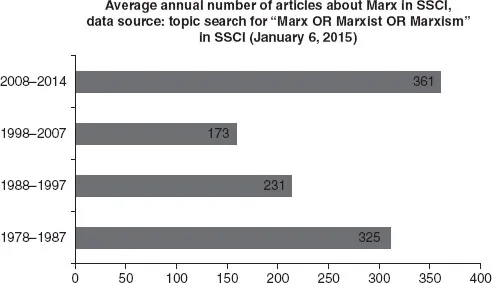
Figure 1.1 Articles published about Marx and Marxism in social sciences citation index
This intellectual interest in Marx, however, has not been accompanied at the political level by a substantial strengthening of left-wing parties and movements. Rather, in many countries far right, fascist, neo-Nazi, and conservative parties and groups have been strengthened and there has been a further deepening of neoliberalism. Post-crisis developments are complex, dynamic, unpredictable, and long-term in nature. The general elections held in Greece in 2015 were won by Syriza, which thereby became the only left-wing government in Europe. This development has, first and foremost, tremendous political significance because it is a symbol that governments that question neoliberalism are possible, something which can give an impetus and practical hope to the left in general. It is possible in the near future that a similar development could take place in Spain if Podemos wins the 2015 general elections. Furthermore, there is a chance that the left in other countries in a sort of domino effect is strengthened and gains new confidence.
The period since 2008 has also seen the strong growth of the interests in and the number of users of “social media” such as YouTube, Facebook, Twitter, Weibo, LinkedIn, Pinterest, Instagram, Tumblr, Blogspot, Wordpress, Wikipedia, and so on. This reflects in part the interest of users and citizens in using the internet for networking, community maintenance, and the generation and sharing of content, and is partly an effect of the increasing shift of advertising expenditures from print to the internet. In times of capitalist crisis, targeted online advertising seems for many companies to appear as a more secure, effective and efficient investment than print advertisements, which explains that the share of online advertisement in global advertising expenditure has increased from 15.6% in 2009 to 24.8% in 2013, whereas newspapers and magazines’ combined share decreased from 32.3% to 25.2% (data source: Ofcom International Communications Market Report 2014).
Although the analysis of communication from a Marxian perspective has since the start of the new world economic crisis in 2008 gained some impetus within media and communication studies (see Fuchs and Mosco 2012, 2015a, 2015b), there has been, with some exceptions, no comparable interest in any study of media, the digital, and communications within general Marxist theory and critical political economy. This becomes evident if, for example, one considers the number of times that specific keywords are mentioned in article titles in the journal Historical Materialism over a period of nine volumes (Table 1.1).
Table 1.1 Number of articles in the journal Historical Materialism that contain certain title keywords, Vol. 14 (2006) – Vol. 22 (2014), data
Title keyword | Number of articles |
Marx | 41 |
capital | 40 |
capitalism | 37 |
history | 31 |
political | 30 |
Marxism | 25 |
economy | 24 |
class | 23 |
politics | 23 |
crisis | 22 |
labour | 21 |
critique | 20 |
global | 17 |
revolution | 17 |
social | 15 |
imperialism | 14 |
American | 12 |
historical | 11 |
development | 8 |
technology | 2 |
media | 1 |
internet | 1 |
digital | 1 |
communication | 0 |
communications | 0 |
information | 0 |
computer | 0 |
ICT(s) | 0 |
cyberspace | 0 |
web | 0 |
WWW | 0 |
Source: Social sciences citation index.
Historical Materialism is arguably one of the significant journals of Marxist theory. The analysis in Table 1.1 indicates that it is a journal that focuses on the Marxist critique of the economy and politics in contemporary capitalism. The subjects of media, communications, and the digital have received little attention, illustrating that 38 years after Dallas Smythe (1977) published his famous Blindspot article, communications remains the blind spot of Marxist theory. Marxists often consider to regard issues relating to information, communication, culture, and the digital as a mere superstructure that is not worthy of any detailed engagement. Today, however, communications is a capitalist industry of significant size and employing a significant amount of communication workers. Communication processes are at the core of the organization of any modern economic prod...
Table of contents
- Cover
- Title Page
- Copyright
- Contents
- List of Figures and Tables
- Series Preface
- Notes on Contributors
- Part I: Foundations
- Part II: Labour and Class
- Part III: The Labour of Internet Users
- Part IV: Rent and the Commons
- Part V: Productivity in Reproduction
- Index
Trusted by 375,005 students
Access to over 1.5 million titles for a fair monthly price.
Study more efficiently using our study tools.
Frequently asked questions
Yes, you can cancel anytime from the Subscription tab in your account settings on the Perlego website. Your subscription will stay active until the end of your current billing period. Learn how to cancel your subscription
No, books cannot be downloaded as external files, such as PDFs, for use outside of Perlego. However, you can download books within the Perlego app for offline reading on mobile or tablet. Learn how to download books offline
Perlego offers two plans: Essential and Complete
- Essential is ideal for learners and professionals who enjoy exploring a wide range of subjects. Access the Essential Library with 800,000+ trusted titles and best-sellers across business, personal growth, and the humanities. Includes unlimited reading time and Standard Read Aloud voice.
- Complete: Perfect for advanced learners and researchers needing full, unrestricted access. Unlock 1.5M+ books across hundreds of subjects, including academic and specialized titles. The Complete Plan also includes advanced features like Premium Read Aloud and Research Assistant.
We are an online textbook subscription service, where you can get access to an entire online library for less than the price of a single book per month. With over 1.5 million books across 990+ topics, we’ve got you covered! Learn about our mission
Look out for the read-aloud symbol on your next book to see if you can listen to it. The read-aloud tool reads text aloud for you, highlighting the text as it is being read. You can pause it, speed it up and slow it down. Learn more about Read Aloud
Yes! You can use the Perlego app on both iOS and Android devices to read anytime, anywhere — even offline. Perfect for commutes or when you’re on the go.
Please note we cannot support devices running on iOS 13 and Android 7 or earlier. Learn more about using the app
Please note we cannot support devices running on iOS 13 and Android 7 or earlier. Learn more about using the app
Yes, you can access Reconsidering Value and Labour in the Digital Age by Christian Fuchs, Eran Fisher, Christian Fuchs,Eran Fisher in PDF and/or ePUB format, as well as other popular books in Social Sciences & Labour Economics. We have over 1.5 million books available in our catalogue for you to explore.