eBook - ePub
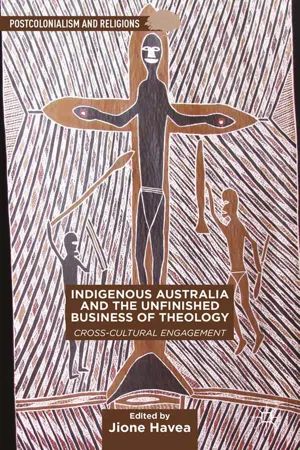
Indigenous Australia and the Unfinished Business of Theology
Cross-Cultural Engagement
- English
- ePUB (mobile friendly)
- Available on iOS & Android
eBook - ePub
About this book
This book engages a complex subject that mainline theologies avoid, Indigenous Australia. The heritages, wisdoms and dreams of Indigenous Australians are tormented by the discriminating mindsets and colonialist practices of non-Indigenous peoples. This book gives special attention to the torments due to the arrival and development of the church.
Information
1
COLONIZATION HAS MANY NAMES
Neville Naden with Jione Havea
Any reflection on what the Australian government (in general, even though leadership changes from time to time) decides or does to/for Australia’s indigenous people must take into account the history of White colonization and ask, in the interests of Aboriginal people, “So what?” This is the key question behind this chapter. How the question is answered will, of course, be different between communities (indigenous and nonindigenous) and between different Aboriginal people. “So what?” is the question I pose toward colonizers as well as to those who talk and work in response to colonization. I raise the question in this chapter, and suggest that we do something about what we think needs to be done. It is important not only to ask the question, but also to work toward doing something about it!
Australia has been subject to many forms of colonization, and colonization is the name I give to any illegal or legal action that breaks the spiritual ties of people with the land. This is a complex definition because “land” for Aboriginal people is very complex, having to do with country as well as ancestors, memories, songlines, religion, customs, spirituality, language, and so forth. Land for the majority of my people is everything about them, and they are everything about land. Land will survive without people, but our people need land to remind them of who they are. Land is not just a place we occupy; it is also what gives us meaning and belonging.
DISPOSSESSION
Land dispossession took place when White colonization occurred, and the outcome was the forced acquisition of land, which robbed our people of their identity. Loss of land resulted in loss of language and loss of culture for many of us, simply because land, culture, and language are connected. Land dispossession meant two things: people were uprooted from the land, and land was taken from the people.
Land dispossession continues in the 2007 Intervention program of the Liberal government under former prime minister John Howard. (The Intervention program is the context for Rudd’s Apology speech, and I will come to that later.) When the First Fleet arrived 200 years back, the Aboriginal people were illegally dispossessed. In 2007, the government dispossessed our people again, but this time it was done legally. But, was it really legal? I ask this question because, for me, any government that has been set up illegally can never rule on a legal basis. Everything that this government does and will do may be legal in the eyes of the colonizers but not according to the colonized people. The 2007 intervention in the Northern Territory is therefore illegal, no matter how one looks at it.
The Intervention program took place at the center and north of the country, when the government (with soldiers in army vehicles) entered communities and enforced policies said to be in aid of people’s health and education. While there were some helpful outcomes from the program, the problem was the lack of consultation, which meant lack of respect for our people, and for the land. Land is us, and we are the land. The point I want to stress here is that the 2007 Intervention program continues the history of White colonization in Australia.
The Intervention did not have direct impact on my community (Broken Hill, NSW, to the south),1 but I see it as another push toward Assimilation. So my challenge is this: whether you call it Assimilation or Intervention, these actions are all about White colonization. Intervention happened in the Northern Territory, but Assimilation and Colonization happened throughout Aboriginal communities in the north, center and south, and in the islands. My point is simple: colonization by any other name is still colonization. Whether you call it Assimilation or call it Intervention, makes no difference, because those are, for me, different forms of colonization. They are forms of colonization because they break the spiritual ties of the people with the land. Colonization affects both, people and land.
DIVERSITY
I must address something that non-Aboriginal people do not respect (some don’t even recognize), namely, that we are a diverse people. They speak of us as if we are all the same, when in fact we are a very diverse people. There are many differences between Aboriginal people from the north, from the center, and from the south; between mainlanders and islanders, between freshwater and seawater peoples; and between bush and urban folk. Our differences have to do with language, land, and custom. Our differences are witness to the rich terrains of the land.
I am an Aboriginal person who did not have access to indigenous language. I won’t say that I have lost the language. I never had it in the first place. My father had a philosophy that we needed to learn English to survive in the modern world, so indigenous language was not taught to us kids. My aboriginality has English as its language. Indigenous language is important, and more important for traditional people. But for me and many others, our parents and the environment have given us English. We are tied to the land and Aboriginal customs, but our language is English. My aboriginality is therefore different from the aboriginality of other people, like many of my relatives who speak indigenous languages.
It is annoying when nonindigenous people speak of Aboriginal Australians as if we are all alike, expecting us to be like our indigenous people from the bush. Ask any nonindigenous person to describe what an Aboriginal person is, and most of the time s/he will describe a black person who is not cultured or civilized, and who does not speak English. Even some of our people think this way. Not long ago, I heard a top Aboriginal academic saying that because he grew up in an urban area he does not have Aboriginal culture. I do not agree with him because, for me, culture is the outward expression of an inward impression. Culture is about who we are in the present; culture is about who we are where we are, rather than about something in the past of our people. An Aboriginal person has culture even if he grew up among Whitefellas and enjoyed the benefits of dominant culture. We should not say that traditional people have culture, or they are more Aboriginal than people who grow up in the dominant culture. Which Aboriginal person does not live under the dominant culture? We all live, in one way or another, whether we live in the bush or in the city, under the dominant culture. There is no escaping the impact of dominant culture, and this is why I say that the legacy of White colonization continues today. But in different forms.
The point for me here is that we are a diverse people, and we should be respected for our diversity. This means that what the government decides to do with people in the north might not work for people in the south. We are different, our cultures and needs are diverse. Our many languages and dialects indicate our diversity, and now English is one of our languages, even though it is the language of the colonizers. If the Government or the Church wants to do something for us, they should first respect our diversity and ask us how we are different among ourselves. This is why the Intervention is a failure. The various governments over the years did not consult our people in the north, mainly because they do not respect us, our land, our ways, and our diversity.
Because of our diversity, we are not a one-size-fits-all, which is what drives colonization. The colonizers came and put us in the same box, thereby denying us our diversity. This continues today in the policies and programs of the government (e.g., “Closing the gap” and “Stronger future”) and other aid agencies. Until they consult our people from different parts of the land, they will not appreciate our diversity or do something effective for and with us.
INVASION
There is nothing new to add toward explaining the invasion of Australia. I am not a scholar on this matter, but the diversity of reactions to it from the dominant society is interesting. Some refuse to accept responsibility for it (the most famous being former prime minister John Howard, who refused to say sorry), while many others joined the Reconciliation Walk across Sydney Harbour Bridge in May 2000. No one can deny that the invasion took place, but not everyone takes responsibility for what has happened in the past. This is part of the problem in the relation between indigenous and nonindigenous peoples, for in our case, we are tied to our ancestors. It is shameful for us to deny links to them, for the memories of them live in us. We can’t turn away from them. Whitefellas are different, because they can walk away from their ancestors. They can forget the past, but we can’t. They can refuse to say sorry, but we want more than just people saying sorry. We want people to also accept responsibility for the past.
The arrival of Whitefellas was the illegal invasion of Australia, and there was nothing pretty about it. Anne Pattel-Gray described it as the “Great White Flood,”2 and Australia has been flooding ever since. Will the White people go away one day? No, I don’t think so. They are here to stay, and as long as they are here, the invasion of the land continues. Other boat people have arrived since, from and through Sri Lanka and Indonesia especially, and they too contribute to the story of the invasion. It would seem that the White colonizers are being colonized (by the more recent boat people), and they (White colonizers) don’t like it. People are up in arms that immigrants are making their way to this country. People are beginning to feel the way many of my people are feeling. Invasion is invasion. However, the later boat peoples do not have access to the privileges that White boat people have. Color makes a difference.
ANTI-DISCRIMINATION ACT
I am not a scholar in this area either, but I take it that one of the government’s responses to the invasion was the Anti-Discrimination Act in the 1970s (about 200 years after the invasion). This was a good act in my view because it protected Aboriginal people as well as minority ethnic groups. But a good act does not always lead to good outcomes and practices.
This act is about respecting the diversity of peoples in the land, and it is common in countries in the West. People have different colors and features, and we should respect those God-given characteristics. Discrimination against people because of their race is not on.
There is something funny though. Who benefits from this act? Some White Europeans even claim rights as members of minority groups, and their claims against discrimination are heard more often than claims of my people. Color makes a difference, and the act does not protect minority races equally. I am not saying that only White people discriminate against black people and other ethnic groups. We discriminate too. The issue for me here is about the Anti-Discrimination Act, and that it was supposed to be in the interest of Aboriginal people, but it does not always protect our people.
INTERVENTION
For the government to enact the Intervention program, it had to suspend the Anti-Discrimination Act. This is one of the things I learnt from Michael Anderson, an Aboriginal rights activist and one of the four people who launched the Tent-Embassy in Canberra in 1972. The act protected our people, but with the Intervention, the government decided what was good for our people. It did not consult our people, and this can only be legal (according to dominant law) if the Anti-Discrimination Act was first suspended. I am not an expert on government policies and laws, but I can see the absurdity of the decisions and programs of the Australian government.
If the act was in place, the government would be required to consult and respect our people. Since the government decided, without consulting us, what was good for our people and accordingly delivered the Intervention program, the Intervention was therefore a discriminating act. The Intervention program is where the government made the decision on behalf of me/us, and it had to suspend the Anti-Discrimination Act in order to make its decision legal.
The First Fleet came on boats, illegally. This time, the Intervention came in army vehicles. The First Fleet came under the assumption of terra nullius. This time, they have come with the assumption that our people do not know what is good for us, as if we are devoid of wisdom. Then and now, nothing has changed. I call both the First Fleet and the Intervention [Fleet] by the same name, “colonization.”
APOLOGY
When former prime minister Kevin Rudd delivered the Apology speech at Parliament in February 2008, many of our people were taken there to witness it. It was Rudd’s way of making his mark on politics, but nothing much has changed. There are two nonexpert points I wish to add here.
First, let me give my definition. I take “apology” to mean admission of wrongdoing in the past and working toward a better future. There are therefore three elements in apology: acknowledgment, reparation, and reconstruction. To say sorry without working to repair and to rebuild is not proper apology, as I understand it. If there is no work for reparation toward a better future, apology is not made properly. Words alone are not enough. There must be reparation and reconstruction.
The Intervention of the Howard government did not accept (with words) responsibility for the invasion, and it tried to reconstruct without reparation. There is something about calling it “Intervention” program. The government acted as an outside (foreign) entity, intervening i...
Table of contents
- Cover
- Title
- 1 Colonization Has Many Names
- 2 Receive, Touch, Feel, and Give Raypirri
- 3 Seeing Otherwise: Touching Sacred Things
- 4 Missionary Genocide: Moral Illegitimacy and the Churches in Australia
- 5 From Little Things Big Things Grow
- 6 Reconciling a Platypus Nation: Can Churches Help?
- 7 Ritual, in the Healing of Memories
- 8 Migration and Rudd’s Apology: Whose Voices Are Heard, and What Do They Mean for the Christian Community?
- 9 In Touch Out of Touch: The Church and Reconciliation
- 10 National Black Congress: Ambivalence and Ambiguity
- 11 Formation for Ordained Ministry: Out of Touch?
- 12 Envisioning an Emerging Asian Australian Christianity
- 13 Place and Displacement: Reading Scriptures with Indigenous Australians
- 14 Hope with and Trust in Aboriginal Stories
- 15 Forgive Us Our Trespasses: Black Australia, Peopled Wilderness, Eroding Islands
- Notes on Contributors
- Index
Trusted by 375,005 students
Access to over 1.5 million titles for a fair monthly price.
Study more efficiently using our study tools.
Frequently asked questions
Yes, you can cancel anytime from the Subscription tab in your account settings on the Perlego website. Your subscription will stay active until the end of your current billing period. Learn how to cancel your subscription
No, books cannot be downloaded as external files, such as PDFs, for use outside of Perlego. However, you can download books within the Perlego app for offline reading on mobile or tablet. Learn how to download books offline
Perlego offers two plans: Essential and Complete
- Essential is ideal for learners and professionals who enjoy exploring a wide range of subjects. Access the Essential Library with 800,000+ trusted titles and best-sellers across business, personal growth, and the humanities. Includes unlimited reading time and Standard Read Aloud voice.
- Complete: Perfect for advanced learners and researchers needing full, unrestricted access. Unlock 1.5M+ books across hundreds of subjects, including academic and specialized titles. The Complete Plan also includes advanced features like Premium Read Aloud and Research Assistant.
We are an online textbook subscription service, where you can get access to an entire online library for less than the price of a single book per month. With over 1.5 million books across 990+ topics, we’ve got you covered! Learn about our mission
Look out for the read-aloud symbol on your next book to see if you can listen to it. The read-aloud tool reads text aloud for you, highlighting the text as it is being read. You can pause it, speed it up and slow it down. Learn more about Read Aloud
Yes! You can use the Perlego app on both iOS and Android devices to read anytime, anywhere — even offline. Perfect for commutes or when you’re on the go.
Please note we cannot support devices running on iOS 13 and Android 7 or earlier. Learn more about using the app
Please note we cannot support devices running on iOS 13 and Android 7 or earlier. Learn more about using the app
Yes, you can access Indigenous Australia and the Unfinished Business of Theology by J. Havea in PDF and/or ePUB format, as well as other popular books in Social Sciences & Australian & Oceanian History. We have over 1.5 million books available in our catalogue for you to explore.