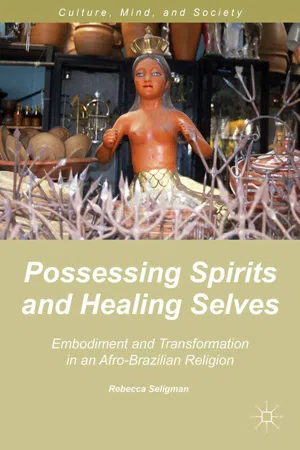
eBook - ePub
Possessing Spirits and Healing Selves
Embodiment and Transformation in an Afro-Brazilian Religion
- English
- ePUB (mobile friendly)
- Available on iOS & Android
eBook - ePub
Possessing Spirits and Healing Selves
Embodiment and Transformation in an Afro-Brazilian Religion
About this book
Spirit possession involves the displacement of a human's conscious self by a powerful other who temporarily occupies the human's body. Here, Seligman shows that spirit possession represents a site for understanding fundamental aspects of human experience, especially those involved with interactions among meaning, embodiment, and subjectivity.
Information
Chapter 1
Introduction: Stepping into the “Supernatural World” of Candomblé
On a blistering hot day early in my year of fieldwork in Salvador, Brazil, I set out to have a ritual divination performed on my behalf. I had come to Brazil to study spirit possession mediumship in the African-derived religion Candomblé, and motivated by curiosity and the desire to make connections within this spiritual community, I had made arrangements to have a spiritual leader1 perform a divination for me that would reveal to which of the Candomblé deities, known as orixás, I belonged. In Candomblé, every human being belongs to, or is the filho (child) of, a pair of orixás. These two deities share responsibility for both the personality characteristics and the destinies of the humans who belong to them. In order to discover who one’s orixás are, a divination, which involves throwing a set of cowry shells and reading the pattern in which they land, must be performed by a qualified spiritual leader. Before the day I had the cowries thrown for me, I did not realize the potential that such identification might have to transform experience.
I had arranged to meet with Mae Tiana, the leader of a small congregation to which I had been introduced several weeks before, at her house, which also served as her terreiro, the Candomblé equivalent of a church or temple. The house was in a working class neighborhood made up of other colorful concrete houses and cramped storefronts, and full of the noise and activity of hundreds of people, stray dogs, cars, and buses. In this chaotic setting it was hard to believe that Mae Tiana’s tiny, nondescript house was also a place of worship.
The largest room of Mae Tiana’s house served as the barracão, the space where ritual events are staged. It was a bright, open room sparsely furnished with several long benches for spectators and a few large, regal-looking chairs where the mae de santo and other senior initiates sat during festas (public rituals). When I arrived for my divination, however, Mae Tiana did not take me to the barracão. Instead, she ushered me into her dark, cramped living room, where I perched awkwardly on the edge of a lumpy couch. Mae Tiana, a very small, somewhat round woman in her mid-sixties with her grey hair in a knot on top of her head, and wearing a loose-fitting house dress and a pair of mules, was not exactly an imposing figure. With very little ceremony she took out her bag of cowry shells and, muttering something under her breath, she shook them onto a small woven mat on the low table between us. In spite of the informal setting and lack of ritual trappings, as Mae Tiana began to study the shells dispassionately, I realized I was excited and a little bit nervous about the revelation she was about to make. After studying the shells for several more moments, she gathered them back up, threw a few of them again, nodded to herself, and announced the owner of my head: it was Iansã, a female warrior goddess (and her own patron deity). My second-in-command, she went on to reveal, was another warrior, the male deity Ogum. I belonged to not one, but two warrior deities!
As Mae Tiana listed the qualities typically possessed by children of these two orixás, I was surprised by the little surge of pride I experienced. Filhos of these warrior deities are known for their fierce strength, confidence, adventurousness, and passion.2 What, if anything, I wondered, did it say about me that I was identified with not one but two such gods? Did I possess some inner power or vitality of which I was not even aware? Perhaps I should try harder to cultivate these attributes. I straightened a little in my seat just thinking about it.
When I had had a chance to reflect on it further, I realized that the experience of having my orixás identified was like being offered a supernatural guide to my self—it was like having someone look inside me and pronounce with a kind of cosmic certainty, “These are the characteristics that you possess.” But how was I to understand Mae Tiana’s role in making this identification? Was this simply what the pattern of the cowries indicated, or had Mae Tiana’s perceptions of me influenced her reading? I had always aspired to be strong and confident—there seemed an uncanny fit between my aspirations and Mae Tiana’s divination. It was as if she had performed some kind of personality analysis on me that included not only my existing personality, but aspects of my desired self as well.
The more I thought about it, the more I came to see the powerful implications that this experience had for what anthropologists call “subjectivity”—the basic modes of perception, thought, and emotion that inform our fundamental, and not necessarily conscious, sense of who we are (Holland and Leander 2004; Ortner 2005). I had responded to Mae Tiana’s divination by embracing the traits it revealed, by identifying with and incorporating them into my sense of self. In other words, the divination process had caused me to not only measure and reflect on my own sense of self, but also adjust it in relation to the attributions presented. There was thus an inkling of something transformative in this experience. What is more, I began to realize that this hint of transformative potential extended beyond a shift in the ideas I held about my own personality characteristics. As I sat in Mae Tiana’s living room thinking about how I might possess the strength, confidence, and adventurousness of my patron deities, I changed my posture. A shift in my sense of self had brought about a momentary shift in my default way of using and experiencing my body.
This tiny gesture thus drew my attention to an important link between ideas about who one is and the experience of one’s body. I had arrived in Brazil prepared to investigate whether the bodies of mediums differ from those of other Candomblé participants in ways that predispose them to experience trance and possession. I had come armed with high-tech medical equipment capable of gathering data on the internal workings of mediums’ bodies by measuring their psychophysiological functioning, hoping that this would be the innovative methodology to shed new light on trance and possession. But this early participant-observation pointed toward different ways of thinking about the role of the body in Candomblé mediumship. It suggested important links between bodily experience and subjectivity, and hinted at the potential for Candomblé participation to be transformative in ways that include the reshaping of both body and self.
It is worth noting, however, that not everyone immediately experiences a sense of connection and transformation upon having their orixás divined. Several people mentioned to me that their first divination had identified them as the filhos of orixás with whom they felt no sense of connection. Because the pantheon of deities in Candomblé includes many different types of gods––warriors, hunters, nurturers, those who are gentle and fierce, wise and vain––there are a wide variety of characteristics and combinations of characteristics with which Candomblé devotees may be associated. Filhos of the hunter god Oxossi are known to be calm and controlled, intelligent and loyal; those of Omolu, the deity associated with infectious disease and healing, are shy and pessimistic, hard-working, and orderly; those of the patron goddess of motherhood and the sea, Iemanjá, are calm and sensuous, strong, protective, and arrogant. When the characteristics of the orixás named through divination fail to resonate with either the existing or desired selves of a devotee, rather than motivating him or her to cultivate particular qualities, the process can instead be somewhat alienating.
It was not unusual in these cases for the individual to have a second divination performed by the same or a different spiritual leader, in hopes of a more satisfactory result the second time around. Such misfires, understood in spiritual terms as confusion resulting from multiple orixás battling for control over the individual’s head, are probably inevitable in what is surely a delicate process of matching orixás to the extant and desired selves of particular individuals. Breakdowns in this process may have to do with the ability of the spiritual leader to read particular individuals or the willingness of individuals to identify with characteristics that might diverge from their core sense of who they are. Variations in the receptiveness of individuals to these divinatory identifications may also have to do with the lived social and emotional contexts they occupy at the moment of divination. In other words, the success of this process might have to do with the subjective state of an individual at the time of his or her divination.
My divination experience, for instance, had come at a moment when I was feeling vulnerable and full of self-doubt, priming me to be particularly receptive to its transformative possibilities. Did Brazilian Candomblé participants, particularly those who would become spirit possession mediums, join the religion and begin to embrace the influence of the orixás at their own “moments of vulnerability”? Knowing that many Candomblé mediums are low-income Afro-Brazilian women, I wondered if there were ways in which these individuals were primed, perhaps by the effects of their life experiences and social positionality, to embrace the subjective implications and transformative possibilities of Candomblé beliefs and practices. As one of my medium friends later put it, there has to be a potent motivation for immersing oneself in this “mundo sobrenatural” (supernatural world).
It was striking to me that even in my mild state of vulnerability, and even without a conviction that the identification of my orixás was channeled through the mae de santo straight from the gods themselves, my sense of self was affected by the divination experience. But how much more powerful would this experience be for someone both more deeply in need and more deeply steeped in the Candomblé cosmology? And what about those who not only know these supernatural beings and the universe in which they exist intellectually, but who know them experientially through their embodiment of the deities in the context of spirit possession?
In spirit possession, the medium’s consciousness is suspended while her body takes on the characteristics of the orixás or other spirits who possess her. If the identification of my orixás had been enough to affect my bodily experience even momentarily, then the potential for spirit possession to transform the bodies of mediums was immense. This form of religious participation might therefore be a means of reshaping bodily ways of being along with self-understandings.
And so I came away from my divination experience with a sense of how potent the convergence of religious beliefs and meanings with bodily experiences and practices could be. What is more, I began to appreciate the powerful impact such convergence could have on subjective experience. With the tools I had brought to the field with me, I was uniquely positioned to trace the effects of these processes on the minds and bodies of mediums. Using ethnographic methods, I could offer a close examination of the lived experiences of mediumship, while the tools of psychophysiology would allow me to use measurement of autonomic nervous system regulation over cardiovascular activity as a window inside mediums’ bodies.
What might the processes through which meaning and bodily experience converge look like in peoples’ lives and in their physiologies? And what might the effects of such convergence be for individuals who became involved in Candomblé mediumship at “moments of vulnerability”? Could the transformation of subjectivity and selfhood through religious belief and practice act therapeutically for vulnerable individuals? These were the questions at the center of the research I conducted during a year of fieldwork among Candomblé spirit possession mediums in Brazil. The aim of this book is to answer them.
The Argument
Spirit possession involves the displacement of a human’s conscious self by that of a powerful, immaterial being—a spirit, god, ancestor, or demon—who temporarily animates the human’s body while he/she is in a state of trance. Spirit possession mediums enter into long-term relationships with these powerful others, becoming regular vehicles for their materialization in the human world. Mediums thus regularly experience what to many of us would seem like dramatic shifts in our relationship to self and body––their everyday self-awareness becomes suspended, while their bodies continue to operate without a sense of volition. The medium typically has no memory of the events that take place, yet she knows that her body has performed under the direction of some other consciousness, in ways that are not obviously linked to her own sense of identity and intention. To many people, these seemingly radical transformations of subjectivity make spirit possession appear quintessentially exotic––a novelty or example of the ways in which “others” are fundamentally different from “us.”
While intimate, sensory experiences of God have become common in some forms of contemporary Evangelical Christianity (Luhrmann 2012), many of us simply do not have a frame of reference for these kinds of subjective transformations. Even hearing God speak in vivid ways would represent an extraordinary experience for many of us, yet mediums appear temporarily to become one of their gods. This is why such experiences are so frequently understood in terms of analogy to what are commonly understood as pathological alterations in consciousness associated with dissociative disorders3––the most extreme version, known as dissociative identity disorder (DID), involves the experience of multiple, discrete identities housed within a single person. On the surface, possession trance looks a lot like DID. Both involve violations of the Euro-American cultural expectation that people’s memories, identity, and awareness should form a single coherent self. Faced with such exotic phenomena, questions inevitably arise about the “authenticity” of trance states, whether possession is “real” or “merely” performance, and whether it is a form of pathology. Above all, questions arise about what might motivate individuals to seek out or endure such extraordinary experiences.
Through the close examination of the experiences of Candomblé spirit possession mediums offered in this book, however, I will demonstrate that far from being exotic and “other,” this form of spirit possession mediumship represents a privileged site for understanding important aspects of our shared human experience.
Spirit possession is particularly valuable for drawing our attention to the ways in which individuals are shaped by and embody elements of their lived contexts. In particular, spirit possession is an ideal context in which to investigate the effects of meaning on the body—in which to undertake a close examination of the processes and mechanisms through which ideas, beliefs, and discourses can actually shape and transform the states and dispositions of people’s bodies.
The effects of meaning on the body have recently become the subjects of increasing attention in both the social and clinical sciences, as it becomes more and more clear that peoples’ interpretations and attributions about their experiences can have powerful effects on their health and well-being. Thus, while an analysis of spirit possession may seem far removed from research on the ways in which things like discrimination, stigma, social support, loneliness, and positive regard affect mental and physical health, I will show how spirit possession can actually help us to better understand these phenomena.
In broad terms, then, study of spirit possession has the potential to shed light on basic but crucially important questions about the convergence of individuals and sociocultural systems, and of minds and bodies. For example, the seemingly radical transformation of subjectivity that takes place in spirit possession can be understood as a particularly visible example of the more general process through which systems of meaning and embodied experiences come together to shape peoples’ sense of self, and affect their well-being. These are not exotic processes, but mundane ones that each of us experience throughout our lifetimes in more or less visible ways, as we enact and internalize the messages and meanings communicated by the people, institutions, and material structures that surround us.
Much of the time the interactions between systems of meaning and embodied experience result in a gradual process of learning, affecting subjectivity in ways that are subtle and incremental. The very “otherness” of spirit possession throws these processes into relief. In other words, we are able to see the embodied effects of religious belief vividly when mediums become possessed because possession seems to many of us like such an extreme and foreign expression of belief. What is more, the exaggerated visibility of these processes in spirit possession may reinforce this sense of foreignness. Because many people from Euro-American backgrounds are not accustomed to seeing such obvious effects of meaning on the body, we may think that “others” are somehow more susceptible. Yet more familiar examples of the embodied effects of meaning are all around us. The so-called placebo effect is an obvious example in which the symbolic act of consuming a substance that is understood to have therapeutic effects can actually produce such effects. If we take the time to really think about what this means––that consuming a substance that by definition can have no effect because it is inert4 (i.e., a sugar pill) makes people feel better simply because they believe it will––then we begin to more fully appreciate the power of ideas, of expectations, of meaning to effect bodily change.
Other examples of the effects of meaning on the body include the mental and physical benefits of yoga practice (Beets and Mitchell 2010; Lin et al. 2011), the capacity of cognitive behavioral therapy (CBT) to improve outcomes among cancer patients (Penedo et al. 2007), the amelioration of alcohol addiction through the 12 steps (Cain 1991), and the adverse effects of psychosocial stress on health. Recent anthropological research has contributed to our understanding of such stress–health dynamics, demonstrating that psychosocial stress is largely a function of meaning. That is, the interpretations and attributions—or meanings—that people make about their social situations influence their experience of stress.
Such research includes evidence that complex dynamics associated with relative social status are strongly associated with negative health outcomes ranging from suppressed immune function to high blood pressure (McDade 2002; Sweet et al. 2007; Dressler et al. 1998; Dressler and Bindon 2000; Gravlee 2005). When...
Table of contents
- Cover
- Title
- Chapter 1 Introduction: Stepping into the “Supernatural World” of Candomblé
- Chapter 2 Reflections on the Challenges and Rewards of Integrative Research
- Chapter 3 Sometimes Affliction Is the Door: Healing and Transformation in Narratives of Mediumship
- Chapter 4 Looking Inside: Biological Mechanisms and Embodiment in Candomblé Trance and Possession
- Chapter 5 Healing the Embodied Self in Candomblé
- Chapter 6 Conclusion: Stepping Back
- Appendix: Methods
- Notes
- Glossary of Candomblé Terms
- References
- Index
Trusted by 375,005 students
Access to over 1.5 million titles for a fair monthly price.
Study more efficiently using our study tools.
Frequently asked questions
Yes, you can cancel anytime from the Subscription tab in your account settings on the Perlego website. Your subscription will stay active until the end of your current billing period. Learn how to cancel your subscription
No, books cannot be downloaded as external files, such as PDFs, for use outside of Perlego. However, you can download books within the Perlego app for offline reading on mobile or tablet. Learn how to download books offline
Perlego offers two plans: Essential and Complete
- Essential is ideal for learners and professionals who enjoy exploring a wide range of subjects. Access the Essential Library with 800,000+ trusted titles and best-sellers across business, personal growth, and the humanities. Includes unlimited reading time and Standard Read Aloud voice.
- Complete: Perfect for advanced learners and researchers needing full, unrestricted access. Unlock 1.5M+ books across hundreds of subjects, including academic and specialized titles. The Complete Plan also includes advanced features like Premium Read Aloud and Research Assistant.
We are an online textbook subscription service, where you can get access to an entire online library for less than the price of a single book per month. With over 1.5 million books across 990+ topics, we’ve got you covered! Learn about our mission
Look out for the read-aloud symbol on your next book to see if you can listen to it. The read-aloud tool reads text aloud for you, highlighting the text as it is being read. You can pause it, speed it up and slow it down. Learn more about Read Aloud
Yes! You can use the Perlego app on both iOS and Android devices to read anytime, anywhere — even offline. Perfect for commutes or when you’re on the go.
Please note we cannot support devices running on iOS 13 and Android 7 or earlier. Learn more about using the app
Please note we cannot support devices running on iOS 13 and Android 7 or earlier. Learn more about using the app
Yes, you can access Possessing Spirits and Healing Selves by R. Seligman in PDF and/or ePUB format, as well as other popular books in Social Sciences & Cultural & Social Anthropology. We have over 1.5 million books available in our catalogue for you to explore.