eBook - ePub
Shakespeare and Space
Theatrical Explorations of the Spatial Paradigm
- English
- ePUB (mobile friendly)
- Available on iOS & Android
eBook - ePub
Shakespeare and Space
Theatrical Explorations of the Spatial Paradigm
About this book
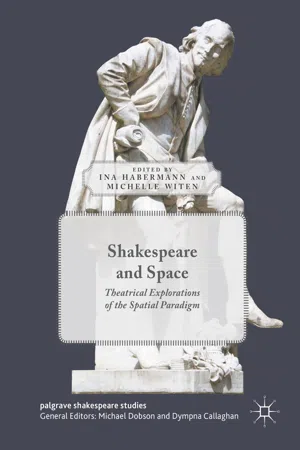
This collection offers an overview of the ways in which space has become relevant to the study of Shakespearean drama and theatre. It distinguishes various facets of space, such as structural aspects of dramatic composition, performance space and the evocation of place, linguistic, social and gendered spaces, early modern geographies, and the impact of theatrical mobility on cultural exchange and the material world. These facets of space are exemplified in individual essays. Throughout, the Shakespearean stage is conceived as a topological 'node', or interface between different times, places and people – an approach which also invokes Edward Soja's notion of 'Thirdspace' to describe the blend between the real and the imaginary characteristic of Shakespeare's multifaceted theatrical world. Part Two of the volume emphasises the theatrical mobility of Hamlet – conceptually from an anthropological perspective, and historically in the tragedy's migrations to Germany, Russia and NorthAmerica.
Information
Topic
LetteraturaSubtopic
Letteratura generale© The Editor(s) (if applicable) and The Author(s) 2016
Ina Habermann and Michelle Witen (eds.)Shakespeare and SpacePalgrave Shakespeare Studies10.1057/978-1-137-51835-4_11. Introduction
Ina Habermann1 and Michelle Witen1
(1)
University of Basel, Basel, Switzerland
1 Thinking Spatially in the New Millennium
‘Can this cock-pit hold/ the vasty fields of France?’ (H5, Prologue 11–12). The answer to this rhetorical question, famously asked by the Chorus in Shakespeare’s Henry V, is of course ‘Yes, it can!’ In very general terms, the issue in this quotation, as in our book, is the theatre’s ability to represent and to produce space. More precisely, this collection is about Shakespeare and space: about early modern theatre as an ‘ostentatiously spatial art-form’ (West 2002, 3), the Elizabethan and Jacobean playhouse, theatrical representations of place (both contemporary and historical) and social space, the dramatic representation of early modern geographies, and the migrations of Shakespeare, the configurations of Shakespeare’s reception in later times and distant places.
Ever since Aristotle, critics have acknowledged the importance of spatial representation in drama and theatre. As regards the early modern theatre specifically, Henry S. Turner sees it as a spatial art that developed in tandem with other contemporary developments in technology such as mapping. He distinguishes between the ‘arts of spatial structure (carpentry, masonry, fortification, architecture), the arts of spatial movement (navigation, ballistics, hydraulics), and the arts of spatial representation (surveying, mapping, painting, sculpture)’ (Turner 2006, 25–6). For Turner, the theatre ‘encompassed all three aspects of the spatial arts, and for this reason it formed the ideal site for a convergence between the techniques of the carpenter, the surveyor, the engineer, and the playwright’ (26). He introduces the term ‘topographeses’ to denote the ‘representation of place by texts of all kinds but also by maps, diagrams, paintings, or images, and even by built structures’ (30). Due to the complexity of spatial representation, the main issue is not the mimetic representation of place, but in the
Endorsing Turner’s sophisticated analysis of the ‘topographic’ play, we want to add topology as another analytical term, originally drawn from qualitative geometry. While the concept was only developed in the nineteenth century, we believe it to be helpful for a characterization of the early modern stage.‘topographic’ play, the fundamental images, symbols, ‘ideologemes’ (in Althusserian terminology), ‘philosophemes’ (that of Derrida), ‘myths’ (that of Barthes), or discursive ‘statements’ (that of Foucault) that characterized early-modern culture more broadly are articulated through the representation of place and become the primary way in which concrete places themselves emerge into representation. At this level of analysis, places become the vehicles through which problems of social class, political identity and belonging, status aspirations, modes of production and value, competing epistemologies about the social and political world, or attitudes towards urban order and urban experience can be scrutinized and dissected. (32–3)
Topology as a concept focuses on relational space, on continuity and connectivity. To give an example, the London tube map is a topological map, which shows the different lines and their points of connection, with only the most schematic reference to the actual geographical space, let alone the topography, of the city. Geometric shapes are seen as topologically equivalent, or homeomorphous, when they can be transformed into each other without cutting or gluing. Such topological structures can also have multiple dimensions, thus lending themselves to a description of complex phenomena.1 We suggest that the early modern stage can be seen as a topological ‘node’, an interface linking different times and spaces in a multidimensional theatrical experience. Thinking in terms of topology, we do not, for example, have to determine, in response to certain seemingly contradictory clues in the play, whether Shakespeare’s Tempest is set in the Mediterranean or in the ‘New World’, but we can try to relate to the ways in which Mediterranean, Atlantic and mythic references blend in the minds of Londoners around 1600 to form a complex imaginary whole. We can analyse how, in Shakespeare’s ‘spatial art’, places and people, both real and imaginary, as well as worlds with multiple cultural and historical resonances become linked with early modern London audiences, and, via cultural tradition, with us. In this way, many elements which might otherwise be conceived as incongruous become integrated in a spatial logic which has the flexibility, the complexity, and visceral persuasiveness of metaphor.
Even though the importance of space for the theatre has long been acknowledged, the ‘spatial turn’ in the latter part of the twentieth century with its concomitant extension of the notion of space has made it necessary to revisit it in a study of the theatre. In order to prevent the concept from becoming too fuzzy to be heuristically useful, we propose a taxonomy of spatial definitions, exemplifying their respective uses and connections in individual essays and thus showing how productive the spatial paradigm continues to be for the study of Shakespeare’s work. We hope that in this way, the collection can also serve as an introduction to the study of Shakespeare and space, a brief overview of the field so far, and an inspiration for further work along similar lines. Taking our cue from contemporary spatial theory, we conceive of space as political and relational, seeing it as a ‘sphere of the possibility of contemporaneous plurality’ (Massey 2005, 9).
2 Seven Types of Space
We suggest that in the study of Shakespeare’s drama it makes sense, for analytical purposes, to distinguish between seven types of space: (1) structural/topological space, (2) stage space/setting/locality, (3) linguistic/poetic space, (4) social/gendered space, (5) early modern geographies, (6) cultural spaces/contact zones, and (7) the material world/cultural imaginary. There is of course overlap between these different aspects, and while a differentiation is analytically helpful, it needs to be supplemented by an awareness of the whole spectrum.
1. Structural/Topological Space
Yuri Lotman famously used the concept of topology in his spatial semiotics, focusing on the typological analysis of literary works. As he argues, spaces are demarcated by boundaries, whose crossing constitutes an event within the story (Lotman 1974; Lotman1990).2 This conception of topological space is valid, though somewhat static, in line with the structuralist preoccupation with binary oppositions. Beyond this, Michel Serres drew attention to the importance of in-between spaces that express the dynamic aspect of topology, particularly in mythical discourse. Myth, and the literature which grew out of mythical discourse, should therefore be read in terms of its spatial constellations, connections and transformations (Serres 1977, 39). With regard to Shakespeare and drama, this aspect of space is thus concerned both with structural patterns in the plays themselves and with the ways in which these patterns are transferred onto the stage. At one level, this is an issue of ‘practical epistemologies’, as Henry Turner puts it with recourse to an etymological inquiry into the word ‘plot’: ‘During the sixteenth and early seventeenth centuries, the term ‘plot’ […] derived from the field of geometry as it developed in a practical context, where they designated the schematic diagrams or working drawings used by the mason, surveyor, or carpenter’ (Turner 2006, 21). The term is also used for the stage ‘as an extension of this artisanal use’ (21). The question is therefore which elements the play-wright joins together and how (a connection acknowledged in A Midsummer Night’s Dream in the theatrical activities of the ‘rude mechanicals’), what is represented, and what remains ob-scene. We argue that because of this emphasis on forging links, the early modern stage, most prominently that of public theatres such as the Globe, is particularly suited to topological analysis.
This also touches the question of what is genuinely dramatic in theatre as a spatial art. In his influential theory of language, Karl Bühler analysed various forms of deixis, paying particular attention to what he calls ‘Deixis am Phantasma’ (Bühler 1982, 123), which denotes the linguistic means we have of placing something in front of the ‘mind’s eye’ of another person, or an audience. For Bühler, in epic and (narrative) film, audiences and readers project themselves into the action, while in drama, the things to be imagined are drawn into the space that the audience shares with the performers (392). Ultimately, this is the topo-logical explanation why ‘this cockpit’ can hold ‘the vasty fields of France’.
2. Stage Space/Setting/Locality
This facet of space focuses on performance. Issues of interest here are the material space of the playhouse, the technical, social, economic and legal conditions of staging and the ways in which the theatre is embedded in its environment, in our case the urban space of London, and other institutions such as the court (De Sousa 2010; Dillon 2000, 2010, 2012; Fitzpatrick 2011; Gurr 1992; Hopkins 2007; Ichikawa 2013; Turner 2006). It also comprises setting and the ‘spatial semiosis’ (West 2002, 6) which determines how specific places and localities are evoked on stage.3 As Janette Dillon emphasizes, theatres are ‘real, physical spaces’, but also ‘places of “virtual reality”, literally staging in material form fictions and fantasies which offer an audience vicarious experiences. Their relationship to the wider physical space that surrounds them is therefore both mediated and provisional’ (Dillon 2000, 7). This specific connection between the real and the virtual has led Michel Foucault to see the theatre as a heterotopia (Foucault 1986). Related to this, we argue that t...
Table of contents
- Cover
- Frontmatter
- 1. Introduction
- 1. Shakespearean Spaces
- 2. Migrating Shakespeare, Migrating Hamlet
- Backmatter
Trusted by 375,005 students
Access to over 1.5 million titles for a fair monthly price.
Study more efficiently using our study tools.
Frequently asked questions
Yes, you can cancel anytime from the Subscription tab in your account settings on the Perlego website. Your subscription will stay active until the end of your current billing period. Learn how to cancel your subscription
No, books cannot be downloaded as external files, such as PDFs, for use outside of Perlego. However, you can download books within the Perlego app for offline reading on mobile or tablet. Learn how to download books offline
Perlego offers two plans: Essential and Complete
- Essential is ideal for learners and professionals who enjoy exploring a wide range of subjects. Access the Essential Library with 800,000+ trusted titles and best-sellers across business, personal growth, and the humanities. Includes unlimited reading time and Standard Read Aloud voice.
- Complete: Perfect for advanced learners and researchers needing full, unrestricted access. Unlock 1.5M+ books across hundreds of subjects, including academic and specialized titles. The Complete Plan also includes advanced features like Premium Read Aloud and Research Assistant.
We are an online textbook subscription service, where you can get access to an entire online library for less than the price of a single book per month. With over 1.5 million books across 990+ topics, we’ve got you covered! Learn about our mission
Look out for the read-aloud symbol on your next book to see if you can listen to it. The read-aloud tool reads text aloud for you, highlighting the text as it is being read. You can pause it, speed it up and slow it down. Learn more about Read Aloud
Yes! You can use the Perlego app on both iOS and Android devices to read anytime, anywhere — even offline. Perfect for commutes or when you’re on the go.
Please note we cannot support devices running on iOS 13 and Android 7 or earlier. Learn more about using the app
Please note we cannot support devices running on iOS 13 and Android 7 or earlier. Learn more about using the app
Yes, you can access Shakespeare and Space by Ina Habermann, Michelle Witen, Ina Habermann,Michelle Witen in PDF and/or ePUB format, as well as other popular books in Letteratura & Letteratura generale. We have over 1.5 million books available in our catalogue for you to explore.