eBook - ePub
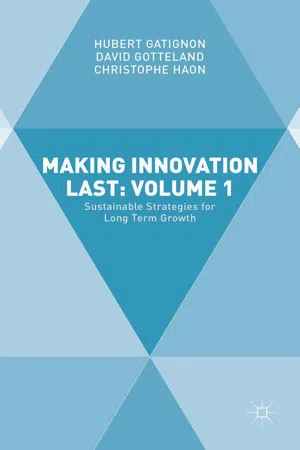
Making Innovation Last: Volume 1
Sustainable Strategies for Long Term Growth
- English
- ePUB (mobile friendly)
- Available on iOS & Android
eBook - ePub
Making Innovation Last: Volume 1
Sustainable Strategies for Long Term Growth
About this book
Making Innovation Las t considers the long term success of a firm. Authored by a trio of top international scholars who present pioneering new work on what it takes to create long term growth, the book examines the internal conditions that are likely to encourage sustainable innovation, as well as what a culture of innovation should look like.
Information
Topic
CommerceSubtopic
Stratégie commerciale1
Introduction
Innovate or die. No one today would disagree that firms that are seeking growth cannot realize that growth without creating new products or services; in short, they must innovate. Indeed, political economists and especially developmental economists do not question the role of innovation in the creation of wealth in both developing and industrialized economies.
But while nations have a role to play in fostering innovation through subsidies, regulations in favor of competition, education, and research, or the protection of intellectual property, the innovation process ultimately resides within the realm of individual firms if not of single individuals such as entrepreneurs. Innovation has long been thought of as originating outside the firm. This exogenous view of innovation raises the question of what firms should do in terms of whether and when to adopt process innovations for internal use, as well as in terms of whether and when to introduce new product and service innovations to the market.
However, another important research stream concerns the firm’s internal process for developing new products and services. This endogenous innovation mechanism generates vital organic growth that in turn generates the most value for firms, even after acquisitions (Favaro, Meer and Sharma 2012). Indeed, at times, this innovation process may require the acquisition of new knowledge and know-how that the firm does not possess. In this book, we consider innovation as a mechanism for sustaining the growth of a firm.
Firms must generate sustainable profits in order to remain viable. Greater profitability can result from an emphasis on cost reductions. The Six Sigma program is an example of a frequently adopted program that attempts to improve efficiencies and cut costs. However, Rust, Moorman and Dickson (2002) show that it is an inefficient strategy. Firms that focus on revenue expansion perform better than those that emphasize cost reduction, and even better still than those that emphasize both revenue expansion and cost reduction. In addition, firm performance, including stock market performance, must be considered over the long term. The objective should not be to increase profit in the short term but rather to develop a business that will maintain and grow its profitability in the long term. Because no competitive advantage lasts forever, only a constant effort to innovate can help sustain growth and performance.
The objective of this book is to reflect and build upon the current state of knowledge established not only in the marketing literature but also in the strategy and organizational behavior literatures that deal with innovation as well. Because innovation strategies are multidisciplinary in nature, it is necessary to take these different perspectives into account in order to provide a full analysis of such strategies. Therefore, in each chapter of the book, we review the relevant literature to date with the twofold objective of: (1) organizing and integrating theories relevant to innovation strategies for a comprehensive synthesis useful for researchers and (2) guiding those managers who wish to build organizations that are capable of sustained growth through successful innovation.
By innovation, we mean to include all types of innovations. Schumpeter (1934) distinguishes five types of innovations: (1) new products, (2) new methods of production, (3) new sources of supply, (4) new markets, and (5) new ways to organize business. This last type of innovation is often referred to as “business model innovation,” or “the search for new logics of the firm, new ways to create and capture value for its stakeholders, and focuses primarily on finding new ways to generate revenues and define value propositions for customers, suppliers, and partners” (Casadesus-Masanell and Zhu 2013, p. 464). Business model innovation often implies finding new methods of production, new sources of supply, and new manners to organize business. In some cases, new products or services promote business model innovation in the firm. It may also be the case that business model innovations require new products or services. Therefore, we consider innovations in all their dimensions, as developed especially in Chapters 2 and 3.
In this introductory chapter, we first provide the overall scientific evidence for the positive impact of innovations on firm performance. Given the still substantial failure rate of innovations, it is indeed useful to start with a reminder of the empirical evidence. In the second section of this introduction, we identify the key issues that must be analyzed in order to be able to generate sustained growth through innovation strategies. We then provide a structure for analyzing a firm’s strengths and weaknesses with regard to such objectives. The structure of the book corresponds to these key issues that we group into four parts. In Section 1.2 of this introduction, we describe these parts and provide an outline that summarizes each of their corresponding chapters.
1.1 | Innovation and performance |
For a firm to be innovative, it must have both the will and the capacity. Together these determine the level of its innovativeness, that is, its “receptivity and inclination to adopt new ideas that lead to the development and launch of new products” (Rubera and Kirca 2012, p. 130). Indeed, such innovativeness requires that a firm foster a particular type of culture within itself, one that is receptive to new ideas that can lead to a long-term competitive advantage not easily imitable by other firms. However, the process of transforming a firm’s culture is difficult and complex, and its success is not guaranteed. Yet building such a culture is an essential element of an innovation strategy for sustained growth.
The link between a firm’s innovativeness and its performance has been examined extensively for decades (e.g....
Table of contents
- Cover Page
- Half Title Page
- Title Page
- Copyright
- Dedication Page
- Contents
- List of Tables
- List of Figures
- Foreword
- Preface and Acknowledgments
- 1 Introduction
- Part I: Understanding Innovations
- Part II: Organizational Context for Innovations
- Index
Trusted by 375,005 students
Access to over 1.5 million titles for a fair monthly price.
Study more efficiently using our study tools.
Frequently asked questions
Yes, you can cancel anytime from the Subscription tab in your account settings on the Perlego website. Your subscription will stay active until the end of your current billing period. Learn how to cancel your subscription
No, books cannot be downloaded as external files, such as PDFs, for use outside of Perlego. However, you can download books within the Perlego app for offline reading on mobile or tablet. Learn how to download books offline
Perlego offers two plans: Essential and Complete
- Essential is ideal for learners and professionals who enjoy exploring a wide range of subjects. Access the Essential Library with 800,000+ trusted titles and best-sellers across business, personal growth, and the humanities. Includes unlimited reading time and Standard Read Aloud voice.
- Complete: Perfect for advanced learners and researchers needing full, unrestricted access. Unlock 1.5M+ books across hundreds of subjects, including academic and specialized titles. The Complete Plan also includes advanced features like Premium Read Aloud and Research Assistant.
We are an online textbook subscription service, where you can get access to an entire online library for less than the price of a single book per month. With over 1.5 million books across 990+ topics, we’ve got you covered! Learn about our mission
Look out for the read-aloud symbol on your next book to see if you can listen to it. The read-aloud tool reads text aloud for you, highlighting the text as it is being read. You can pause it, speed it up and slow it down. Learn more about Read Aloud
Yes! You can use the Perlego app on both iOS and Android devices to read anytime, anywhere — even offline. Perfect for commutes or when you’re on the go.
Please note we cannot support devices running on iOS 13 and Android 7 or earlier. Learn more about using the app
Please note we cannot support devices running on iOS 13 and Android 7 or earlier. Learn more about using the app
Yes, you can access Making Innovation Last: Volume 1 by Hubert GATIGNON,David Gotteland,Christophe Haon in PDF and/or ePUB format, as well as other popular books in Commerce & Stratégie commerciale. We have over 1.5 million books available in our catalogue for you to explore.