This book challenges the notion that economic crises are modern phenomena through its exploration of the tumultuous 'credit-crunch' of the later Middle Ages. It illustrates clearly how influences such as the Black Death, inter-European warfare, climate change and a bullion famine occasioned severe and prolonged economic decline across fifteenth century England. Early chapters discuss trends in lending and borrowing, and the use of credit to fund domestic trade through detailed analysis of the Statute Staple and rich primary sources. The author then adopts a broad-based geographic lens to examine provincial credit before focusing on London's development as the commercial powerhouse in late medieval business.
Academics and students of modern economic change and historic financial revolutions alike will see that the years from 1353 to 1532 encompassed immense upheaval and change, reminiscent of modern recessions. The author carefully guides the reader to see that these shifts arethe precursors of economic change in the early modern period, laying the foundations for the financial world as we know it today.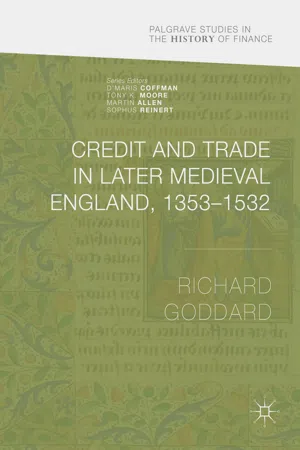
- English
- ePUB (mobile friendly)
- Available on iOS & Android
eBook - ePub
Credit and Trade in Later Medieval England, 1353-1532
About this book
Information
Topic
EconomíaSubtopic
Contabilidad financiera© The Editor(s) (if applicable) and The Author(s) 2016
Richard GoddardCredit and Trade in Later Medieval England, 1353-1532Palgrave Studies in the History of Finance10.1057/978-1-137-48987-6_11. The Statute Staple and Trade Finance in Later Medieval England
Richard Goddard1
(1)
Department of History, University of Nottingham, Nottingham, UK
Introduction
But now they [merchants] make mention of many thousands [of pounds]—and without doubt there are some who, if they paid their debts without bargaining (or deception), would not have any more than a florin with which to pay. (John Gower, Mirour de l’Omme, lines 25813–24 (c. 1376–9).1This worthy man [the Merchant] very well used his wits, there no man knew he was in debt, so dignified was he of his management, with his buying and selling and his borrowing. (Geoffrey Chaucer, ‘General Prologue’ of the Canterbury Tales, lines 270–84 [c. 1380–92])2
Credit (apprestum/prestitis) was ubiquitous in later medieval society.3 All medieval trade depended upon credit—the deferred part-payment for goods sold or advances for future delivery of goods. John Gower, the late fourteenth-century poet and moralist, certainly recognises in the above quote that merchants depended upon debt and perceptively identified the fragility of a commercial system that hinged upon credit. Chaucer, in a rather more positive tone, likewise clearly identifies the inseparability of merchants, buying and selling, and credit.4 The use of credit to purchase goods permeated all levels of later medieval society from the greatest magnates, like the Earl of Shrewsbury—buying goods on credit from a London mercer—and the Earl of Atholl in Scotland—purchasing merchandise from the owner of a tavern in Cock Row (Cokrowe), Norwich—to peasants, such as the shepherd John Rede of Soham (Cambridgeshire), who, at his death, was still owed 31s 11d in unpaid debts—and the husbandman, John Bygge of Stortford (Hertfordshire), who had purchased £6-worth of goods on credit from a haberdasher and a fishmonger in London.5 Credit was a pivotal component of English domestic trade. Wool merchants like John Heritage used credit to fund the various stages of their wool businesses.6 Many credit agreements were informal or oral, but by the fourteenth century, high-value debts were often documented and enrolled in special debt courts known as Staple courts. In 1423, Robert Belle, a merchant of Newcastle upon Tyne, travelled nearly 500 km to London and borrowed £40—deferred payment for goods he had bought—from William Stockdale, a draper of London.7 The amount was to be repaid eight months later, giving Belle time to sell the goods back in Newcastle and still have time to return to London and repay the money he owed. The agreement was enrolled at the Staple court in Westminster. This work examines the role of credit and debt agreements like this one in English trade between 1353 and 1532. This was a period of transformation, not least for the English economy, associated with climatic change, high mortality, endemic warfare, economic recession and bullion famines, all of which impacted upon trade and the merchants, like those described by Gower and Chaucer, men like Belle and Stockdale, who undertook it. The principal form of evidence used is the records of the Statute Staple, a royally sanctioned debt registration system which provided for the efficient recovery defaulted debts.
This work examines a number of key commercial and economic issues through the lens of Staple credit in the later Middle Ages. The remainder of this chapter examines Staple certificates as financial instruments, how they were used, by whom and their role within the medieval economy. It also discusses the many other forms of credit that were available to merchants and others in the period which, where the evidence is available, are used in conjunction with the Staple debt evidence to provide a more comprehensive picture of commercial borrowing at all levels of society across England. Chap. 2 considers the merchants themselves and their lives and businesses with a prosopographical study of a small group of businesspeople who used Staple credit extensively. It highlights the microeconomic and personal side of the debt evidence, and emphasises the adaptability and skill of those trading at this time. One of the key themes of the book is the question of the role of recession—a widely recognised element of the mid-fifteenth-century English economy—upon the availability of credit to finance pre-modern trade both nationally and regionally. It is argued in Chap. 3 that the multifarious economic problems of the fifteenth century resulted in a significant contraction in the volume of lending in this period. This, of course, resonates with experiences of the modern, Western economies of the early twenty-first century in what might be described as the ‘credit crunch’ of the fifteenth century. Chapter 3 also considers another important theme: the existence of ‘long wave’ cycles (over periods of 60 years or so) of borrowing using the evidence of Staple credit. These long cycles are considered to have a profound impact upon modern economies and this volume argues that there is evidence of tangible structural change, not just in trade finance but in the economy generally, at the end of the fifteenth century following a long, depressive cycle. It considers the role of human expectations and psychological factors in mercantile reactions to these shifting commercial circumstances. Chapter 4 explores the divergent economic trajectories of England’s regions in the later Middle Ages by contrasting the geographical or regional shifts in the availability and use of credit in provincial England with that experienced by London. These important geographical divergences, which are again reflected in recent periods of recession, are evaluated in terms of a restructuring of English trade in the fifteenth century that increasingly focused upon London. Chapter 5 investigates the development of London as the principal venue for obtaining trade finance, at the expense of regional centres, from the later fifteenth century and argues that this profound and enduring change was the result of merchants reacting to a deep and long-lasting recession. In doing so, this work seeks to answer the following question: what made the Newcastle merchant Robert Belle, like many of his contemporaries, travel all the way to London in 1424 to borrow £40 when he could have done so on his doorstep in a perfectly satisfactory, functioning Staple debt court in Newcastle? The answer to this question reveals much about credit and trade in later medieval England.
The Statute Staple
The Statute Staple debt registration system was a mechanism born of a government economic policy designed to profit from the lucrative wool export market. The Statute of the Staples was introduced in 1353. Staples were localities where merchants were obliged to centralise trade and where a particular body of merchants, in this case Merchants of the Staple, enjoyed exclusive privileges over that trade. All leather, lead and wool destined for export—although not wool that was to be used in domestic cloth production—had to be brought to a staple town for sale to exporters.8 Foreign export merchants were prohibited from buying wool directly from English growers and instead were required to buy wool from English Staple merchants at the designated staple towns.9 The first to be set up were Newcastle upon Tyne, York, Lincoln, Norwich, Westminster, Canterbury, Chichester, Winchester, Exeter and Bristol, but then this was extended to Kingston upon Hull by 1354. Domestic staples had been experimented with in 1326, when they were fixed at London, Bristol, York, Newcastle, Lincoln, Norwich, Winchester, Exeter and Shrewsbury. These arrangements had continued until 1328.10 The home staples remained the only centres to buy and sell wool for export until 1361—a mere eight years—after which, in 1362, the Calais staple was established as an overseas staple in their stead.11 However, the situation shifted uneasily as the government experimented with various options over the next few years. For example, the home staples were reinstated in 1365. All wool was required to pass through these centres, even if it was ultimately to be sold at the Calais staple. In 1368, Queenborough took over from Canterbury as the Kent staple.12 The overseas staple at Calais was temporarily abolished between June 1369 and August 1370, and those home staples that were also ports, plus Winchester and Westminster, were temporarily re-established. However, a year later, due to complaints by merchants about the costs of transporting their wool through a number of staples prior to export, the home staples for the export of wool were effectively abolished and, during the 1370s, the Calais staple was placed on a more permanent footing (except for brief periods when it was transferred to Middleburg or Dordrecht).13 Even in the absence of any monopolistic role in the wool trade, these towns and ports retained their title of home staples and the administrative machinery that went with it.
Whilst the Ordinance and then the Statute of the Staple implemented the home staples in the wool trade, they also regulated much mercantile, and later non-mercantile, activity in the kingdom. The apparatus created by the Staple, particularly the debt registration system, continued long after the home staples ceased being the only place where wool could be bought or sold. As Liddy quite rightly argues, the 1353 domestic staples should be seen as further evidence of the innovative legislation of the mid-fourteenth century t...
Table of contents
- Cover
- Frontmatter
- 1. The Statute Staple and Trade Finance in Later Medieval England
- 2. Merchants and Trade
- 3. Boom and Bust: Patterns of Borrowing in Later Medieval England
- 4. The Geography of Recession: Provincial Credit in Later Medieval England
- 5. London: The Commercial Powerhouse
- 6. Conclusion
- Backmatter
Trusted by 375,005 students
Access to over 1.5 million titles for a fair monthly price.
Study more efficiently using our study tools.
Frequently asked questions
Yes, you can cancel anytime from the Subscription tab in your account settings on the Perlego website. Your subscription will stay active until the end of your current billing period. Learn how to cancel your subscription
No, books cannot be downloaded as external files, such as PDFs, for use outside of Perlego. However, you can download books within the Perlego app for offline reading on mobile or tablet. Learn how to download books offline
Perlego offers two plans: Essential and Complete
- Essential is ideal for learners and professionals who enjoy exploring a wide range of subjects. Access the Essential Library with 800,000+ trusted titles and best-sellers across business, personal growth, and the humanities. Includes unlimited reading time and Standard Read Aloud voice.
- Complete: Perfect for advanced learners and researchers needing full, unrestricted access. Unlock 1.5M+ books across hundreds of subjects, including academic and specialized titles. The Complete Plan also includes advanced features like Premium Read Aloud and Research Assistant.
We are an online textbook subscription service, where you can get access to an entire online library for less than the price of a single book per month. With over 1.5 million books across 990+ topics, we’ve got you covered! Learn about our mission
Look out for the read-aloud symbol on your next book to see if you can listen to it. The read-aloud tool reads text aloud for you, highlighting the text as it is being read. You can pause it, speed it up and slow it down. Learn more about Read Aloud
Yes! You can use the Perlego app on both iOS and Android devices to read anytime, anywhere — even offline. Perfect for commutes or when you’re on the go.
Please note we cannot support devices running on iOS 13 and Android 7 or earlier. Learn more about using the app
Please note we cannot support devices running on iOS 13 and Android 7 or earlier. Learn more about using the app
Yes, you can access Credit and Trade in Later Medieval England, 1353-1532 by Richard Goddard in PDF and/or ePUB format, as well as other popular books in Economía & Contabilidad financiera. We have over 1.5 million books available in our catalogue for you to explore.