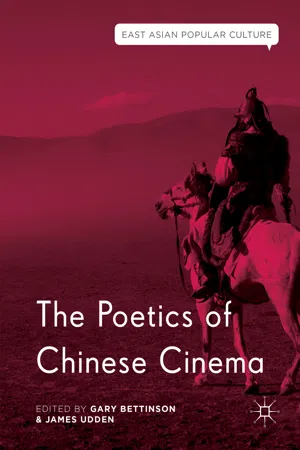
This book examines the aesthetic qualities of particular Chinese-language films and the rich artistic traditions from which they spring. It brings together leading experts in the field, and encompasses detailed and wide-ranging case studies of films such as Hero, House of Flying Daggers, Spring in a Small Town, 24 City, and The Grandmaster, and filmmakers including Hou Hsiao-hsien, Jia Zhangke, Chen Kaige, Fei Mu, Zhang Yimou, Johnnie To, and Wong Kar-wai. By illuminating the form and style of Chinese films from across cinema history, The Poetics of Chinese Cinema testifies to the artistic value and uniqueness of Chinese-language filmmaking.
- English
- ePUB (mobile friendly)
- Available on iOS & Android
eBook - ePub
The Poetics of Chinese Cinema
About this book
Information
Print ISBN
9781349720224
9781137566089
Subtopic
Art General© The Author(s) 2016
Gary Bettinson and James Udden (eds.)The Poetics of Chinese CinemaEast Asian Popular Culture10.1057/978-1-137-55309-6_11. Introduction: The Poetics of Chinese Cinema
Gary Bettinson1
(1)
Lancaster University, Lancaster, UK
From Russian Formalism and Prague Structuralism to neoformalism and cognitivism, the poetics approach to cinema has crucially advanced the study of popular film—and yet poetics has occupied a relatively marginal place in the study of Chinese-language cinema. Since the 1980s, Cultural Studies perspectives have dominated the field, and the art of Chinese cinema has fallen afoul of critical neglect. It is precisely the artistic dimension of movies that poetics—the major research program to which this book subscribes—seeks to illuminate. As schematized by David Bordwell,1 a poetics of cinema encompasses analytical inquiry (examining a film’s visual and aural style, narrative construction, and thematic expression), historical explication (tracing patterns of artistic continuity and change over time), and spectatorial theorizing (offering an account of the interface between a film’s compositional features and the viewer’s activity). This program has been fruitfully adopted in recent years by scholars of Hollywood cinema,2 in ways that enrich our understanding of Hollywood’s stylistic traditions. If we are to achieve a comparable grasp of Chinese cinema—a category encompassing the cinemas of Taiwan, Hong Kong, and the People’s Republic of China (PRC)—then we need to usher in a poetics of Chinese-language cinema. Such is the purview of this book.
Why is a poetics of Chinese cinema important? For critics of a culturalist stripe, Chinese cinema gains much of its interest by reference to social upheavals (e.g. the Cultural Revolution [PRC], the 1997 handover [Hong Kong], or the lifting of martial law [Taiwan]). Chinese films acquire salience for the culturalist by embodying such cultural landmarks. But by analyzing the films in “top-down” fashion, the culturalist subordinates a film’s aesthetic qualities to an a priori conceptual scheme; thus the film’s stylistic construction is of interest only insofar as it reflects or embodies sociological meaning. Poetics inverts this critical emphasis, such that the poetician examines the artwork from the “bottom up”—hence, the critic’s point of departure is not a broad sociological premise but “the principled regularities of form and style we can find in the films” (Bordwell 2001: 9). If existing scholarship on Chinese cinema has overwhelmingly prioritized aspects of culture and society, the poetics approach enables us to put the films themselves at center stage.
This is not to disdain culturalist research, or to deny that culture and society shape filmic construction in important ways. Indeed, culturalism and poetics are not mutually exclusive paradigms; it is feasible, for instance, that a film’s formal design can be usefully elucidated by reference to the social milieu from which it springs. But a film’s compositional features are not wholly determined by cultural factors. Other kinds of factors—technological, industrial, economic, artistic—may be at least as important as social cataclysms in shaping the finished work, and a poetics of Chinese cinema can bring these factors to light. Proceeding from the bottom up, the poetician examines the film’s formal and stylistic patterns, and then asks “what real-world activities could plausibly play causal roles in creating them” (Bordwell 2001 : 9). Without dismissing cultural concerns, poetics puts formal analysis at the heart of inquiry. As such, it shifts the field of Chinese cinema studies toward fundamental yet hitherto neglected or marginalized areas of research. Moreover, it provides new insights that are compatible with already existing studies of Chinese cinema.
At the same time, however, a poetics approach can redress many of the fallacies and misconceptions in the literature. One enduring fallacy is the essentialist notion of a distinctively “Chinese” film style, typically characterized by extended takes, distanced framings, and an alternatively sumptuous or austere emphasis on natural landscape. This characterization, I surmise, is chiefly informed by the Fifth Generation films of Mainland China, whose international profile in the 1980s and 1990s greatly shaped Western perceptions of Chinese-language cinema. Yet the notion of a quintessentially Chinese film language falters on several fronts. For one thing, it fails to distinguish among the cinemas of the three Chinas, each of which fostered quite distinct aesthetic programs (e.g. meditative editing is hardly a hallmark of Hong Kong’s popular cinema). Nor does it acknowledge the stylistic pluralism within each of the cinemas: a Mainland industry that produces both the chintzy Tiny Times 3.0 and the formally elliptical Black Coal, Thin Ice (both 2014) thwarts assumptions of a monolithic Chinese film style. The poetics perspective compels us to treat skeptically such univocal notions of national style and enables us to lay bare, by means of formal analysis, the aesthetic eclecticism of Chinese cinema.
One might counter that the increasing integration of China’s movie industries makes prospects for a dominant national style tenable. Whereas the three cinemas had once largely developed on separate tracks, the Mainland’s economic rise has borne witness to a surge in pan-Chinese collaborations and Asian talent migrating across Chinese borders. As pan-Chinese coproductions multiply, we might ask: are the cinemas of Taiwan, Hong Kong, and Mainland China still distinguishable as separate entities? Perhaps a homogenous Chinese aesthetic emerges in this burgeoning joint venture trend, a trend whereby PRC, Hong Kong, and Taiwanese filmmaking coalesces. Yet to argue that these Chinese coproductions evince a national style, one would need to show that they are stylistically of a piece, and this is no straightforward task. The Grandmaster (HK-China, 2013), The Rooftop (Taiwan-China, 2013), Love in the Buff (HK-China, 2012), Ip Man (HK-China, 2008), Red Cliff (China-HK-Taiwan, 2008), Kung Fu Hustle (HK-China, 2004)—which of these coproductions exemplifies Chinese film style? One might reply that they all embody a Chinese film aesthetic, but, given the aesthetic diversity on display even in this small sample of films, the concept of a “Chinese national style” becomes baggy, imprecise, and uninformative. Still, a poetics of cinema can bring to light recurring norms shared by some or most of these films; it can determine the extent to which those norms are culturally unique; and it can seek causal explanations for these norms, for instance, by tracing their repetition to practices standardized within the Chinese coproduction system.
The perspective of poetics lets us amend another essentialist fallacy, often tacit in the literature and much discussed in the filmmaking community. This fallacy holds that Chinese storytelling—its norms of narrative plotting, its schemas of visual narration, and, fundamentally, the kinds of stories it elects to tell—does not communicate cross-culturally to mass audiences in Western territories. (Hence, the efforts by Western distributors, such as The Weinstein Company, to render Chinese imports “accessible” by means of extensive reediting, expository intertitling, and other simplifying strategies.) Yet this view neglects salient counterexamples, including House of Flying Daggers (2004), Hero (2002), Infernal Affairs (2002), and Crouching Tiger, Hidden Dragon (2000), all of which found commercial success in the West. Worse, it recycles an Orientalist stereotype of Chinese opacity and inscrutability. If we are to demonstrate the cross-cultural intelligibility of Chinese cinema—and here we alight on the terrain of spectatorial poetics—then we would do well to undertake what Bordwell (2001) calls a “transcultural” comparison of Chinese and Western storytelling strategies. We might, for instance, identify transculturally shared stylistic patterns in a Chinese and a Hollywood movie of the same genre, the better to isolate those textual schemas familiar to and comprehended by culturally diverse audiences. In such ways, the poetician can qualify (or disqualify) the cultural essentialism that underlies widely held assumptions about Chinese storytelling and spectatorship.
Poetics can highlight aspects of Chinese cinema neglected in the literature. Slighted by the prevailing sociological hermeneutics is the precise nature of Chinese film practice, the variety of craft practices within and among the three Chinas, and the ways in which standardized work routines shape the Chinese film’s style and form. Under what production circumstances are Chinese films typically made? What institutional and economic constraints shape the finished work? What are the characteristic modes of production, and how have they changed over time? These are phenomena about which culturalism has had little to say, but a historical poetics of Chinese cinema can posit, at a broad level, both the institutional factors governing Chinese film production and the systematic craft techniques and traditions that underpin Chinese film style. These broad principles, in turn, constitute a ground of conventions against which the exceptional or maverick case—for instance, the aleatory work habits of Wong Kar-wai—stand out as legitimately distinctive.
Researching habitual practices and institutional norms may also enhance our understanding of different modes of production. The Sino-US coproduction model, for instance, has intensified in recent years, but precisely how this model is constituted remains opaque. (Indeed, there is no uniform coproduction strategy, but several available partnership options.) As the North American film market shrinks and the Mainland market blossoms, American studios court PRC producers for collaborations and a greater share of the foreign film quota. Consequently, a flurry of official Sino-US movies has emerged in recent years, and altered the landscape of Chinese film production—titles include The Karate Kid (2010), Looper (2012), Iron Man 3 (2013), Transformers: Age of Extinction (2014), Furious 7 (2015), Crouching Tiger, Hidden Dragon: The Green Legend (2016), Kung Fu Panda 3 (2016), and The Great Wall (2016). By contrasting Mainland Chinese and Hollywood institutional norms and working situations, and by examining the formal features of Sino-US films, a poetics approach is best placed to account for the synergies, as well as the points of tension or incoherence, characterizing both the various coproduction systems and the films they beget. Most generally, the formal properties of a Chinese-language film—no matter its mode of production—can be causally explicated, at least in part, by the institutional, economic, and practical specificities of its production.
Culturalists prioritize social reflection exegesis, but there may be other influences bearing on the work besides social ones. Moreover, these influences may inform the film’s aesthetic more directly than, say, the Tiananmen massacre, the lifting of martial law, or the severe acute respiratory syndrome (SARS) crisis. A poetics of Chinese cinema—by operating historically, comparatively, and from the bottom up—can expose the pertinent sources from which the work draws, explicating intertextual precursors (e.g. the preexisting filmic styles to which a particular Chinese film is indebted) or cross-media ones (e.g. the influence of landscape painting on Chinese filmmakers’ pictorial design). The transcultural dimension of poetics, meanwhile, can shed light on international as well as pan-Asian influences (e.g. Bordwell [2001] proposes that Chinese-language cinemas adopted Hollywood’s continuity system as a stylistic point of departure). The poetician’s standard set of heuristic devices—the tool of average shot length (ASL), the Formalist concepts of norms, deviations, and backgrounds—is apt to reveal the intercultural flow of cinematic influence and innovation. Further, transcultural analysis acquires additional importance in light of Hollywood’s appropriation of Chinese movies. American remakes such as The Departed (2006), The Eye (2008), and Tortilla Soup (2001) invite stylistic comparison with their Chinese-language sources (respectively, Infernal Affairs; The Eye, 2002; and Eat Drink Man Woman, 1994). Likewise, Chinese remakes of American movies—A Woman, a Gun, and a Noodle Shop, 2009 (Blood Simple, 1984), Connected, 2008 (Cellular, 2004), What Women Want (2011/2000), Bride Wars (2015/2009)—demand comparative analysis. As the remake trend flourishes, the poetician is provided neat opportunities to discover not only patterns of innovation and indebtedness but also—contrary to the cultural essentialist position limned above—stylistic and narrative schemas that are readily grasped across cultures.
The value of poetics for the study of Chinese cinema obtains, too, in this research program’s historical dimension. Though the existing literature contains historical discoveries of enduring import, the heritage of Mainland, Hong Kong, and Taiwanese cinemas is far from fully chronicled. The limited availability of certain Chinese films, some of which languish in archives, or lack subtitle tracks, has stymied the progress of Western historians. Many early Chinese-language films have not survived; some that existed may never have been documented. Still today, it is a matter of debate as to when Hong Kong filmmaking began. A historical poetics of Chinese cinema won’t resurrect lost films, but its formalist emphasis on historical backgrounds—one aspect of which involves viewing particular films against other related films—encourages scholars to go beyond the canon, examine less familiar artworks, and thereby “fill in” historical lacunas in the literature. Not that the poetician’s task is simply to spotlight neglected or forgotten movies. Rather, by charting the development of stylistic norms over time, the poetician can reveal patterns of continuity and change, identify innovations, and mount historical comparisons with other national cinemas (as well as among those of the three Chinas). In such ways, the poetics program makes an important contribution to the historiography of Chinese film.
Perhaps above all, poetics brings us to a clearer understanding and appreciation of the art of Chinese cinema. By placing questions of form and style at the center of inquiry, poetics undercuts the culturalist assumption that a film’s interest inheres chiefly in its manifestation of social anxieties and crises. The poetics approach allows us to contextualize Chinese cinema’s relation to international film style, laying bare those transcultural artistic conventions on which popular storytelling and cross-cultural comprehen...
Table of contents
- Cover
- Frontmatter
- 1. Introduction: The Poetics of Chinese Cinema
- 2. Five Lessons from Stealth Poetics
- 3. Red Poetics: The Films of the Chinese Cultural Revolution Revolutionary Model Operas
- 4. Renewal of Song Dynasty Landscape Painting Aesthetics Combined with a Contemplative Modernism in the Early Work of Chen Kaige
- 5. Poetics of Two Springs: Fei Mu versus Tian Zhuangzhuang
- 6. Remaking Ozu: Hou Hsiao-hsien’s Café Lumière
- 7. Hong Kong Puzzle Films: The Persistence of Tradition
- 8. Can Poetics Break Bricks?
- 9. Poetics of Parapraxis and Reeducation: The Hong Kong Cantonese Cinema in the 1950s
- 10. China as Documentary: Some Basic Questions (Inspired by Michelangelo Antonioni and Jia Zhangke)
- Backmatter
Trusted by 375,005 students
Access to over 1.5 million titles for a fair monthly price.
Study more efficiently using our study tools.
Frequently asked questions
Yes, you can cancel anytime from the Subscription tab in your account settings on the Perlego website. Your subscription will stay active until the end of your current billing period. Learn how to cancel your subscription
No, books cannot be downloaded as external files, such as PDFs, for use outside of Perlego. However, you can download books within the Perlego app for offline reading on mobile or tablet. Learn how to download books offline
Perlego offers two plans: Essential and Complete
- Essential is ideal for learners and professionals who enjoy exploring a wide range of subjects. Access the Essential Library with 800,000+ trusted titles and best-sellers across business, personal growth, and the humanities. Includes unlimited reading time and Standard Read Aloud voice.
- Complete: Perfect for advanced learners and researchers needing full, unrestricted access. Unlock 1.5M+ books across hundreds of subjects, including academic and specialized titles. The Complete Plan also includes advanced features like Premium Read Aloud and Research Assistant.
We are an online textbook subscription service, where you can get access to an entire online library for less than the price of a single book per month. With over 1.5 million books across 990+ topics, we’ve got you covered! Learn about our mission
Look out for the read-aloud symbol on your next book to see if you can listen to it. The read-aloud tool reads text aloud for you, highlighting the text as it is being read. You can pause it, speed it up and slow it down. Learn more about Read Aloud
Yes! You can use the Perlego app on both iOS and Android devices to read anytime, anywhere — even offline. Perfect for commutes or when you’re on the go.
Please note we cannot support devices running on iOS 13 and Android 7 or earlier. Learn more about using the app
Please note we cannot support devices running on iOS 13 and Android 7 or earlier. Learn more about using the app
Yes, you can access The Poetics of Chinese Cinema by Gary Bettinson, James Udden, Gary Bettinson,James Udden in PDF and/or ePUB format. We have over 1.5 million books available in our catalogue for you to explore.