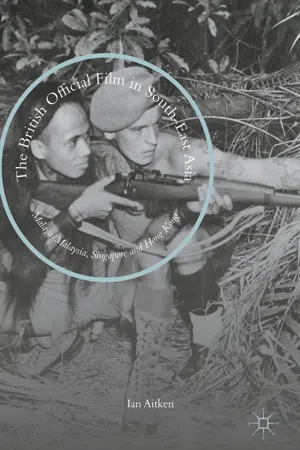
This book explores the ways in which the British official film was used in Malaya/Malaysia, Singapore and Hong Kong from 1945 to the 1970s. Aitken uncovers how the British official film, and British official information agencies, adapted to the epochal contexts of the Cold War and end of empire. In addition to an extensive introduction, which touches on a number of critical issues related to the post-war British official film, the book provides an account of how the tradition of film-making associated with the British documentary film movement spread into the region during the post-war period, and how that tradition was contested by a 'Colonial Office' tradition of film-making. The volume concludes by covering the rise of television in the region within the context of developing post-colonial authoritarian states in Singapore and Malaysia, and the continuation of colonial authoritarianism in Hong Kong.
eBook - ePub
The British Official Film in South-East Asia
Malaya/Malaysia, Singapore and Hong Kong
- English
- ePUB (mobile friendly)
- Available on iOS & Android
eBook - ePub
About this book
Information
Subtopic
Film & Video© The Author(s) 2016
Ian AitkenThe British Official Film in South-East Asia10.1057/978-1-137-49344-6_11. The Forms of the British Official/Sponsored Documentary Film
Ian Aitken1
(1)
Hong Kong Baptist University, Kowloon Tong, Hong Kong
In this chapter the term ‘form’ will be used to refer to certain types of documentary film which are also referred to associated historical contexts and complexes. This approach has its origins in the literary writings of Georg Lukács, and particularly his The Theory of the Novel (1916), in which Lukács outlines the various ‘forms’ of the novel which have appeared, the types of society which generated these, and for which the forms had also come into being to portray. In this work, Lukács also attempts to set out a ‘typology’ of these forms, and this will also be the approach adopted here. 1 The idea of the forms which is taken on here is both broad-based and specific, although not metaphysical, as it is in Lukács, and, in this chapter the forms are conceived of in two, more material senses. First, the forms are understood as the media expression of a particular social formation and as a type of film that emerged in order to meet the needs of that formation. There is, as argued, nothing metaphysical about this, and, instead, type of film is seen as an expression of the needs emanating from agents active within the social formation. Second, the forms are understood as something more instrumental: as driven by particular policies, agendas, organisations and institutions. 2 In this respect, and informed by recent work on ‘useful cinema’ and ‘useful culture’, the forms are seen as institutional tools associated with the ‘governmental management of culture’, and, in some of the cases considered here, in relation to various colonial, late colonial and post-colonial agendas. 3 In this instance of colonialism also, the forms may not so much amount to the media manifestation of a particular social formation as a foreign imposition upon that formation. The intention here, therefore, is to deploy this conception of the forms in order to rethink what happened to the British sponsored documentary film prior to and after World War Two, both in Britain and, given the primary subject-area of this book, in the British colonies of South-East Asia. The first form of the British sponsored and/or official documentary film to be identified is the ‘Griersonian form’. After that the ‘post-war expository form’ will be addressed, followed by the ‘colonial’, ‘late colonial’ and ‘post-colonial’ forms. 4
The Griersonian Form
The British documentary film movement and the ‘Griersonian’ films which emanated from it do not constitute the entirety of the British sponsored and official documentary film of 1930–70, and other traditions of such film-making also existed and flourished alongside it during this period and are known to have done so. It will, however, be argued here that the ‘Griersonian’ documentary film, as a particular type of communicative form, was characteristic of and related to important changes that took place in British society, and is important because of that. More specifically, the form and content of the Griersonian documentary film can be related to the formation of the progressive social-democratic welfare-capitalist society which began to emerge in Britain in the 1930s and which came to fulfillment after 1945. It will also be argued that the decline of the Griersonian form in the post-war period shaped the way that the documentary film developed both in Britain and in what has been described as the ‘British world’: the initial colonies of settlement which later came to constitute the Dominions of the Commonwealth of Nations—Australia, New Zealand, Canada and South Africa. 5
Yet, in addition to this white ‘British world’ there was also a set of colonies, mainly tropical, which removed themselves from British hegemony as soon as they were able to do so; and these included the colonies of British South-East Asia, which were never meant to be colonies of settlement in the first place, but occupied ‘colonies of rule’ or ‘colonies of trade’ in which the economic imperative was more often than not inseparable from the military one. 6 After decolonisation these colonies did not, additionally, develop as open social-democratic societies, whatever appearance might be made to the contrary in cases which give the impression of adopting the ‘Westminster’ model of parliamentary government; and this also meant that the Griersonian documentary film, as a communicative form, was not appropriate to them, and did not flourish within them. Here, the Griersonian form fell victim to what the Founding Prime Minister of the Republic of Singapore, Lee Kuan Yew, held up as so-called ‘Asian values’—in reality the one-party state and ‘authoritarian capitalism’ 7 —and was replaced by a more restricted form of postcolonial governmental public-relations film-making practice. Steeped in a rhetoric and vision of inclusive democracy and the enablement of the lower classes, the Griersonian form was not consonant with elitist Asian authoritarianism. Before proceeding with a discussion of that form, however, it will first be necessary to establish how the term ‘Griersonian’ is used here. 8
The phrase ‘British documentary film movement tradition’ is cumbrous and wordy whilst the abbreviation to ‘the movement’ is also potentially misrepresentative (there are many ‘movements’). These problems have led some to replace both with the more convenient phrase ‘Griersonian tradition’. However, although this catchphrase is accommodating because it offers a more specific indication of the subject, the term ‘Griersonian’ is also potentially confusing as it carries the risk that the movement may be subsumed under the persona of its founder, John Grierson. This would be problematic, given that, amongst other matters, some within the movement, including important figures such as the one-time head of the GPO Film Unit, 9 Alberto Cavalcanti, eventually came to distance themselves from Grierson and Grierson’s approach to documentary film-making. 10 Indeed, the notion of a substantial division within the movement, triggered by opposition to Grierson’s methods, has been written about at length, although the extent of that partition still remains a question of debate. 11 Nevertheless, in the absence of any suitable alternatives, and given the above caveats, the terms and phrases ‘Griersonian’ and ‘Griersonian tradition’ will be employed throughout this chapter, and also book; although these will normally be used in a broad sense to refer to all that might be associated with the British documentary film movement in its more liberal and progressive orientations. In addition, and in order to contain the tendency to associate such terms and phrases too closely with the iconic figure of Grierson, phrases such as ‘the movement’ and ‘the tradition’ will also be employed, although to a lesser extent.
As argued, the documentary film movement was associated with what eventually developed into the most important movement of political reform in Britain during the late 1930s: that of the ‘middle way’, a phrase which has its origins in the title of the 1938 book of the same name by Conservative Party politician and future Prime Minister (1957–63) Harold Macmillan. 12 The cross-party, centre-progressive middle-way movement, or, rather, expansive constellation which embraced an eclectic range of tendencies and orientations, generally lobbied for greater equality and a fairer distribution of resources within society and was a centrist movement which did not call for socialist transformation of society and the economy but was nonetheless opposed to the hierarchical, economic lasses-faire beliefs and practices which permeated the pre-war British establishment. The subtitle of Macmillan’s book, ‘A Study of the Problems of Economic and Social Progress in a Free and Democratic Society’, to some extent sums up the spirit and aims of the middle way. 13 After 1945, middle way policies, including increased public spending, the creation of the welfare state and National Health Service, and also the programme of economic nationalisation that Macmillan had proposed in The Middle Way, transformed British society and this alteration from a pre-war economic liberal to a post-war social-democratic society was one which the documentary film movement was associated with and played a part in bringing about. 14 Those who criticise the documentary film movement for not being radical enough often do not take into account sufficiently the historic scale of this documentary achievement, and also that of the middle way.
As argued, the Griersonian form considered here was associated with the drive to create this new society, and was also principally concerned with the extension of the informational public sphere within that society. During the 1920s, Grierson had turned to the sponsored documentary film because, unlike the commercial cinema, it was capable of existing outside of market forces, and so might be better able than the commercial cinema to participate in the task of establishing such an informational public sphere, or what Grierson referred to as the ‘informational state’. 15 Grierson believed that the creation of such a state was necessary in order to both stave of social unrest within a class-divided and inequitable society and promote a more equitable society, and his creation, the British documentary film movement, participated in the struggle to establish this informational domain within a new and more progressive social order. Grierson always had this role for the movement in mind, and the documentary film movement is best understood not only as a movement of film-making but also as a broad-based attempt to reform culture and society using films, journals, public talks, institutions and other means. To this end, the documentary film movement also formed associations with many well-known liberal intellectuals during the 1930s, including, to name but a few, W.H. Auden, Christopher Isherwood, Benjamin Britten, Julian Huxley, J.B. Priestley, T.S Eliot, H.G. Wells, Rebecca West and Grahame Greene.
The Griersonian form considered here, was, therefore, related to the struggle for reform over 1930–45. After 1945, the Griersonian form was, however, no longer so actively associated with a struggle for reform, because reform had been instituted, and, at least in Britain, the Griersonian form then merged with or became indistinguishable from the less activist ‘expository form’, which will be discussed later in this chapter. This occurred because of the co-existence of radical and conservative aspects within the Griersonian form, and within Grierson’s thought. The conservative aspect of that form and thought was concerned to outline the existing state of things. Grierson believed that the documentary film ought to describe and explain the necessity of the multifaceted relationships which constituted the existing social formation. According to Grierson, modern society was a matrix of ‘interdependent’ relations: ‘sleeping or waking, we are concerned each day in an interdependency … This is the fact of modern society;’ 16 and Grierson also believed that the documentary film was ‘the medium of all media born to express the living nature of inter-dependency [it] outlined the patterns of interdependency more distinctively and more deliberately than any other medium whatsoever’. 17 Because of this Grierson believed that the documentary film not only could but ought to express such patterns, and this can also be related to the conservative aspect of the neo-Hegelian theory which he was exposed to whilst a student at Glasgow University between 1919 and 1923, and which, additionally, led to his lifelong opposition to ‘revolution’. It will also be worth exploring this issue of Hegelianism briefly at this point in order to further illuminate this ‘conservative’ aspect of the Griersonian ‘documentary idea’ and also to distinguish that aspect from its more progressive facets.
A radical revolutionary interpretation of Hegelian thought is premised upon notions of change and freedom because of the movement of the dialectic. Here, every condition or notion, every ‘thesis’, contains within itself its own nascent ‘antithesis’, and these two eventually come together to form a new ‘synthesis’, which again produces its own embryonic antithesis; and so on, as one thing ‘develops out of the contradictions implicit in another’. 18 History is the result of the unfolding of this dialectic, and, if that is the case, then this process should be enabled as much as possible: if distinction and transformation are at the root of historical development, then what Hegel called the ‘strife of opposites’ must be enabled. 19 It is only this strife of opposites which can resolve contradictions and lead to progress and so the task of politics and the state should be to establish as much freedom as possible so that constant change is engendered, including historical-political change at the level of the overall social formation. In its essence, this is a revolutionary doctrine, which formed the basis of the ideology of the Enlightenment and then French Revolution; and, in his youth, Hegel was a firm supporter of both. 20
This was not, however, the Hegelian attitude that Grierson encountered when studying at Glasgow University. A conservative approach to the dialectic would emphasise its end-point, not a continual movement that has no such end-point. Hegel’s end-point is the Absolute: the final unity of all thesis and antithesis into final synthesis that may—theoretically—occur in the far distant future. However, each time a major historical synthesis is reached out of the ongoing strife of opposites, each time a seemingly stable social harmonium is effected, there is a tendency to see the Abso...
Table of contents
- Cover
- Frontmatter
- 1. The Forms of the British Official/Sponsored Documentary Film
- 2. Diverging Jurisdictions: The Influence of ‘Griersonian’ and ‘Civil Service’ Traditions of Official Film-making on the Malayan Film Unit (1946–57) and Hong Kong Film Unit (1959–73)
- 3. Delusions of Regional Superintendence at the End of Empire and the Case of the Singapore Regional Information Office, 1947–61
- 4. The Use of the Official Film in Malaya/Malaysia, Singapore and Hong Kong, 1957–1973, and the Role of the United Kingdom Information Services, British Information Services, British Council and Hong Kong Government Information Services (with Ka Yee Teresa Ho)
- 5. Berita Singapura (1963–9) and Hong Kong Today (1967–73)
- 6. The Rise of Television, Persistence of Authoritarianism, and Decline of the Official Film in Singapore, Malaya/Malaysia and Hong Kong, 1955–75
- Backmatter
Trusted by 375,005 students
Access to over 1.5 million titles for a fair monthly price.
Study more efficiently using our study tools.
Frequently asked questions
Yes, you can cancel anytime from the Subscription tab in your account settings on the Perlego website. Your subscription will stay active until the end of your current billing period. Learn how to cancel your subscription
No, books cannot be downloaded as external files, such as PDFs, for use outside of Perlego. However, you can download books within the Perlego app for offline reading on mobile or tablet. Learn how to download books offline
Perlego offers two plans: Essential and Complete
- Essential is ideal for learners and professionals who enjoy exploring a wide range of subjects. Access the Essential Library with 800,000+ trusted titles and best-sellers across business, personal growth, and the humanities. Includes unlimited reading time and Standard Read Aloud voice.
- Complete: Perfect for advanced learners and researchers needing full, unrestricted access. Unlock 1.5M+ books across hundreds of subjects, including academic and specialized titles. The Complete Plan also includes advanced features like Premium Read Aloud and Research Assistant.
We are an online textbook subscription service, where you can get access to an entire online library for less than the price of a single book per month. With over 1.5 million books across 990+ topics, we’ve got you covered! Learn about our mission
Look out for the read-aloud symbol on your next book to see if you can listen to it. The read-aloud tool reads text aloud for you, highlighting the text as it is being read. You can pause it, speed it up and slow it down. Learn more about Read Aloud
Yes! You can use the Perlego app on both iOS and Android devices to read anytime, anywhere — even offline. Perfect for commutes or when you’re on the go.
Please note we cannot support devices running on iOS 13 and Android 7 or earlier. Learn more about using the app
Please note we cannot support devices running on iOS 13 and Android 7 or earlier. Learn more about using the app
Yes, you can access The British Official Film in South-East Asia by Ian Aitken in PDF and/or ePUB format, as well as other popular books in Media & Performing Arts & Film & Video. We have over 1.5 million books available in our catalogue for you to explore.