eBook - ePub
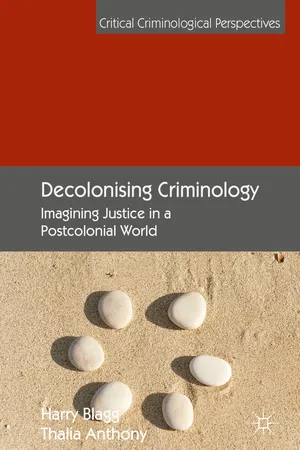
Decolonising Criminology
Imagining Justice in a Postcolonial World
- English
- ePUB (mobile friendly)
- Available on iOS & Android
eBook - ePub
About this book
This book undertakes an exploratory exercise in decolonizing criminology through engaging postcolonial and postdisciplinary perspectives and methodologies. Through its historical and political analysis and place-based case studies, it challenges criminological inquiry by installing colonial structures of power at the centre of the contemporary criminological debate. This work unseats the Western nation-state as the singular point of departure for comparative criminological and socio-legal research. Decolonising Criminology argues that postcolonial and postdisciplinary critique can open up new pathways for criminological investigation. It builds on recent debates in criminology from outside of the Anglosphere. The authors deploy a number of heuristic devices, perspectives and theories generally ignored by criminologists of the Global North and engage perspectives concerned with articulating new decolonised epistemologies of the Global South. This book disputes the view that colonisationis a thing of the past and provides lessons for the Global North.
Information
© The Author(s) 2019
H. Blagg, T. AnthonyDecolonising CriminologyCritical Criminological Perspectiveshttps://doi.org/10.1057/978-1-137-53247-3_11. Introduction: Turning Criminology Upside Down
Harry Blagg1 and Thalia Anthony2
(1)
Faculty of Law, University of Western Australia, Crawley, WA, Australia
(2)
Faculty of Law, University of Technology Sydney, Sydney, NSW, Australia
Harry Blagg (Corresponding author)
Thalia Anthony
Decolonising Criminology
This book undertakes an exploratory exercise in what we call postcolonial criminology; by which we mean criminology that places the colonial matrix of power at the centre of inquiry. While the substance of the book is concerned with criminal justice in settler colonies, the issues raised have wider relevance as they are concerned with the challenges posed for criminology, and kindred disciplines of the Anglo-sphere, by a new era where racialised forms of social control are reshaping criminal justice across the globe. This era, however, is also marked by the growing strength and resilience of countervailing forces from outside the Anglo-sphere who are intent on dismantling colonial structures of power.
We refer to postcolonial analysis in terms of moving beyond the Global North’s colonising analysis, predicated on regimes of imperial truths, claims to neutrality and universality and its focus on the state as the epicentre of power. We draw on epistemologies of the Global South, invigorated by postcolonial thinkers, to identify the pluriversality of power and laws, the active colonial project with its forms of oppression in everyday Indigenous lives and the location of Indigenous place as a site of colonial contest and Indigenous resistance and resurgence.
Criminology, and its kindred disciplines, is accustomed to viewing the Global South—the colonised places—as eternally subordinate to the ideas, innovations, mentalities and grand designs of the Euro-American Global North—the sites of the coloniser. In this frame, the Global South exists—chronologically and developmentally—after us. Its place in the world order—as a “fourth world”—is determined by its lateness and the imperative to “catch up” with the advanced Global North: a process inhibited by the fact that the Global North exists only because of the exploitation of the Global South and the expropriation of its lands, labour and resources. To talk of the Global South is to enter into a theatre of punishment, oppression and violence.
The expressions “Global North” and “Global South” do not relate to rigid geographical terrain, they signify two distinct though entwined and enmeshed worlds: one world colonised in violence and suffering acutely from forces of global capitalism and imperialism (de Sousa Santos 2008); and the other enjoying economic, social and cultural hegemony. There is a Global North in the geographic south (white settlers) and a Global South in the geographic north (migrants, ethnic minorities, Roma, the “precariat”) (Standing 2011), the hyper-marginalised, and the “interior Third World” (de Sousa Santos 2004, 315).
This relationship between North and South, while not exactly becoming inverted, is being tested by the emergence of competing centres of power and the (relative) decline of Western hegemonic authority. It is also being challenged in societies such as Australia, Canada, the United States and Aotearoa/New Zealand by forms of Indigenous1 resurgence which call into question the settler state’s claims to undisputed sovereignty.
Furthermore, Euro-modernity’s darker machinations manifest in its tendency to cynically shelve its normative commitment to the rule of law and human rights when confronted by “problem” populations overseas or, increasingly, at home. Discussing the “non-penal” detention of migrants and refugees in Europe, Dario Melossi sees a reconnection with a global “heritage of colonial domination” and fascism (Melossi 2012, 381). Melossi also acknowledges the relevance of Giorgio Agamben’s work on the genealogy of “the camp” and “the state of exception” (2012, 381) in understanding the trajectory of penal/judicial policy in the Global North (Agamben 1998). This neatly summarises a key thread in this book (see especially Chaps. 5 and 8).
As neo-liberalism continues to erode the foundations of the welfare state in the Global North and its hegemonic consensus, resulting in the increased casualisation of the labour market, sharpening disparities between rich and poor, and destruction of the living wage; it is creating the kinds of total destitution, insecurity and instability of life characteristic of the Global South. This era of insecurity has fuelled white supremacist politics in Europe and North America, which is gaining momentum in parliament and on the streets. The cities of the North host beggars and vagrants, the homeless and unwaged, the sick, the disabled and mentally unwell and, most despised of all, the undocumented alien. Marginalised children in the Brexiting UK (the movement itself fuelled by delusions of Imperialist grandeur) are fed from food banks.
Europe has also seen the rise of widespread anti-racist protest and resistance once a feature of the South. The rise of popular, anti-austerity movements in Europe and citizens coalitions against state violence (such as Momentum in the United Kingdom and Black Lives Matter in the United States) testify to the emergence of forms of grass-roots activist politics once synonymous with the Global South (Comaroff and Comaroff 2012a, 71). In recent years, issues raised by opponents of migration (due to the presence of the Global South in the geographic North) have seen “colonial hysteria” (Galeano 1997) about mixedness, boundaries and cultural miscegenation migrate from the imperial periphery to the metropolitan centre itself. This is reflected in the surge of anti-immigrant and anti-Muslim populist movements and parties, such as UKIP in England, Pegida in Germany, Golden Dawn in Greece and the Alt-right in the United States; the resurgence of virulent anti-Semitism (paradoxically promulgated by groups adamantly supportive of the state of Israel), widespread Islamophobia and systemic discrimination against Roma peoples, who remain subject to a form of internal colonisation (Ponzanesi and Blaagaard 2012). Europe, it seems, is not being spared its own “postcolonial moment” (Gilroy 2011).
Critics ominously observe “new forms of inclusion and exclusion based on linguistic, racial, ethnic and religious divisions” (Ponzanesi and Blaagaard 2012, 3), where the punitive instruments of criminal justice are used to manage unwanted populations who have committed no crimes (other than that of being subordinate in an Imperial-capitalist world), as much as to punish “offenders”. We suggest that none of this is new (just new to the internal machinations of the Global North) and what we have described here is strongly reminiscent of the use made of criminal justice institutions to warehouse the dispossessed of the Global South.
These developments should encourage critical intellectuals in the Global North to consider the colonial experience when attempting to theorise contemporary social conflict. Frantz Fanon (1991), Albert Memmi (1965) and Hanna Arendt (1966) reveal how techniques of repression were first tested out and perfected in the colonies, before being repatriated to Europe. Zygmunt Bauman (1991) illustrates how these repatriated techniques, combined with the most advanced forms of planning and technology then available, consummated the marriage of European racism and industrial modernity by exterminating Europe’s Others (Jews, Roma, homosexual people). The colonised world provided a set of master patterns for use in the metropolis: in this respect genocide and repression in the South prefigured that in the North.
As Bhambra and Holmwood (2018, 575) suggest, a “deeper historical sociology of coloniality can provide a more adequate understanding of the trajectory of European and other advanced welfare states than that which is provided by standard approaches”. They can equally inform us of the dangers of the nation state’s penal apparatus, including for so-called protective purposes. For instance, in Chap. 9, we point to carceral feminists attempting to apply this lens to men in order to save Aboriginal women. One unforeseen consequence is the imprisonment of Indigenous women for breaching Apprehended Violence or Protection Orders that were intended to “protect them”; another one is the diminution of local Indigenous women’s capacity to provide a place-based response to the wellbeing of their women and the relative empowerment of the state and law enforcers in the lives of Indigenous women.
That colonial modalities of social exclusion would re-emerge in the metropolitan centre rather than just the imperial periphery was foreshadowed in the works of Franz Fanon (1991) and Hannah Arendt (1966). Etienne Balibar spoke of a burgeoning “European apartheid” (2004, ix) where multiple borders are being constructed within, as well as on the boundaries of, nation-states, that are ideological, racialised and politicised. This continuous process of bordering involves an array of “affective and trans-formative material processes in which social and spatial orders and disorders are constantly reworked” (Woodward and Jones 2005, 239).
Increasingly, the capacity to be mobile and traverse borders is not uniformly distributed, but stratified between rich and poor, east and west, centre and periphery; with the mobility of particular groups restricted and/or criminalised (Pickering and Weber 2013a, b; Bosworth and Guild 2008). Mobility anxiety in the Global North has stimulated a “ubiquity” of new bor...
Table of contents
- Cover
- Front Matter
- 1. Introduction: Turning Criminology Upside Down
- 2. Postcolonial Criminology: “The Past Isn’t Over…”
- 3. “Who Speaks for Place?”
- 4. Decolonising Criminology Methodologies
- 5. Borders Are Strange Places: Borders of the State to Boundaries of the Prison
- 6. Restorative Justice or Indigenous Justice?
- 7. Disciplinary Power or Colonial Power?
- 8. Justice in the Shadow of the Camp
- 9. Carceral Feminism: Saving Indigenous Women from Indigenous Men
- 10. Hybrid Justice (i): Indigenous Sentencing and Justice Planning
- 11. Hybrid Justice (ii): Night Patrols and Place-Based Sovereignty
- 12. Conclusions: State of Exception and Bare Life in Criminology and Criminal “Justice”
- Back Matter
Trusted by 375,005 students
Access to over 1.5 million titles for a fair monthly price.
Study more efficiently using our study tools.
Frequently asked questions
Yes, you can cancel anytime from the Subscription tab in your account settings on the Perlego website. Your subscription will stay active until the end of your current billing period. Learn how to cancel your subscription
No, books cannot be downloaded as external files, such as PDFs, for use outside of Perlego. However, you can download books within the Perlego app for offline reading on mobile or tablet. Learn how to download books offline
Perlego offers two plans: Essential and Complete
- Essential is ideal for learners and professionals who enjoy exploring a wide range of subjects. Access the Essential Library with 800,000+ trusted titles and best-sellers across business, personal growth, and the humanities. Includes unlimited reading time and Standard Read Aloud voice.
- Complete: Perfect for advanced learners and researchers needing full, unrestricted access. Unlock 1.5M+ books across hundreds of subjects, including academic and specialized titles. The Complete Plan also includes advanced features like Premium Read Aloud and Research Assistant.
We are an online textbook subscription service, where you can get access to an entire online library for less than the price of a single book per month. With over 1.5 million books across 990+ topics, we’ve got you covered! Learn about our mission
Look out for the read-aloud symbol on your next book to see if you can listen to it. The read-aloud tool reads text aloud for you, highlighting the text as it is being read. You can pause it, speed it up and slow it down. Learn more about Read Aloud
Yes! You can use the Perlego app on both iOS and Android devices to read anytime, anywhere — even offline. Perfect for commutes or when you’re on the go.
Please note we cannot support devices running on iOS 13 and Android 7 or earlier. Learn more about using the app
Please note we cannot support devices running on iOS 13 and Android 7 or earlier. Learn more about using the app
Yes, you can access Decolonising Criminology by Harry Blagg,Thalia Anthony in PDF and/or ePUB format, as well as other popular books in Social Sciences & Civil Rights in Law. We have over 1.5 million books available in our catalogue for you to explore.