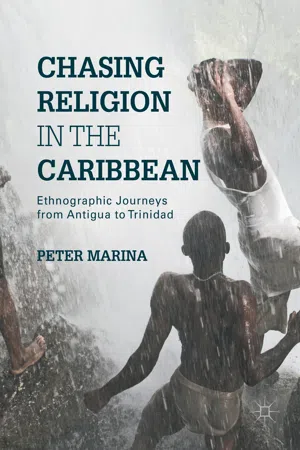
eBook - ePub
Chasing Religion in the Caribbean
Ethnographic Journeys from Antigua to Trinidad
- English
- ePUB (mobile friendly)
- Available on iOS & Android
eBook - ePub
About this book
Information
Topic
SozialwissenschaftenSubtopic
Soziologie© The Author(s) 2016
Peter MarinaChasing Religion in the Caribbean10.1057/978-1-137-56100-8_11. Spiritual Rumblings in the Caribbean
Peter Marina1
(1)
University of Wisconsin - La Crosse, La Crosse, Wisconsin, USA
Keywords
Charismatic movementPentecostalismTransnationalismReligion in the CaribbeanThe stifling humidity of the deep Caribbean wrestles in vain to hold down the perceived supernatural forces where God, Satan, demons, and Obeah forces battle to shape the outcome of this night’s events. 1 It starts with the usual calm “yah mahn” tranquility of Caribbean culture. Yet, this calm is unusually suspicious. Settled in the eastern arc of the Leeward Islands, the silence of the night makes a foreboding presence as we enter the empty million-dollar church on the outskirts of Antigua’s capital, St. John’s. The bishop exudes confidence, complete with a military-style wardrobe that includes a Catholic priest-like white collar, dark robe, and brilliant red buttons, as if he is a commander in God’s army. Indeed, to many of those who follow the bishop, he is a commander in God’s army.
And then light illuminates the bishop and his group of fellow travelers.
The bishop’s entourage traveled from far and away to witness what was later described as an unprecedented event in Caribbean history—a prayer revival intended to unite the historically divisive traditional, evangelical, and independent Christian churches in the Caribbean to become a more powerful force shaping the political, cultural, social, and economic landscape of the region.
For the bishop, the idea of uniting the divided Christian churches began with a vision; believers call it his divine mission from God. Success required strong communication skills and persuasive rhetoric, the stuff of charisma found in the Evangelical movement. He devised strategies, built strong friendships, traveled abroad, and communicated with religious leaders from all over the Caribbean. God may have provided the idea, but humans must bring ideas to fruition. Like most visions, the right amount of patience must balance with the right dosage of persistence. For the bishop, this moment was 15 years in the making. The long road finally returns to his homeland where—many years after immigrating to the USA—his vision to do the nearly impossible now finally becomes an objective reality.
“Let’s go, let’s go, let’s go, let’s just pray,” he says giving marching orders to his troops as he begins to walk around the church pews. The church musical team takes its place in the perfectly polished elevated wooden platform five steps above the church floor. The bishop and crew of about ten others begin to “prayer walk” around the interior of the church. Though the celebration is now in full progress, no outsiders have yet entered the church. But their being alone does not stop the intensity from building steam, a locomotive determined to reach its end.
Sitting in this church looking at subjective visions unfold to realized objective realities inspires one to think back to “the cradle of the worldwide Pentecostal movement” 2 in 1906 Azusa Street in faraway Los Angeles. It was a leaderless, Charismatic, and spontaneous wave with a raw energy so great that it set in motion a tide that would seemingly never crash. The momentum, the sheer spontaneity, the pure burst of emotion produced one of the greatest religious movements in the contemporary world. There was a sense that all the injustices of the world, all the wrongs, the evildoers, the oppressive institutions, and the trivial rulers of the world, would have to succumb to the great powerful tidal wave of God’s cleansing of the world’s sins. There was a sense of victory, an inevitable feeling of success, that the wronged world would turn right. It was, as Walt Whitman once said, “nature without check with original energy.” 3 They were riding a supernatural crest of what they believed as God’s love that would cover the Earth and expose all of humanity to this truth. The Pentecostal movement started as a powerful global force with the weight of the Gods behind it.
Now, over a 100 years later, many scholars argue that, at least in the Western cultures, the once mighty tide is now rolling back, hardening to a bureaucratic and cold institution losing its mojo. 4 But in the Caribbean, and during this night here in Antigua, where 15 years—what I will later call “Charismatic religious networking”—lead to a verbal agreement of Christian leaders to unite as one powerful force; here, there is no high water mark, and there is no rolling back of the tide. Unlike the USA, 1300 miles away, followers continue to ride a towering crest of a high and rising wave with the feeling that they—the soldiers of God—will triumph and prevail over all evil forces and obstacles and continue to flourish.
The prayer walk is a ritual that serves as a form of “spiritual warfare” intended to cleanse the church sanctuary of evil spirits and provide a veil of protection to the people of God to bring forth the will of their deity. It is not joyful prayer or a tender worship that describes this scene, but rather, an intense emotionally charged determinism. The bishop shouts, “In the name of God, we carry out your will today” as others shout, “We are not worthy, oh Lord, we are not worthy of the power you befall upon us.”
The first outsider eyes, shocked and bewildered, peak through the cracks of the church door to witness this religious decadence. They were expecting to attend a service for “National Prayer Day” as the bishop advertised on ABS radio 90.5 FM earlier that week. There was much more in store than advertised.
The huge church space gradually fills with audience members impressed with the unusually intense beginning of this night of prayer. The service follows the same basic structure of typical Charismatic Christian services with musical performances that blends worship and praise songs, bible readings, testimonies, and tithing leading up to the preaching. Even the preaching remains what one expects in many services with storytelling that reveals the wisdom and power of God. Everything seems relatively normal until the bishop pauses for a moment and then speaks. In prophetic tone he says, “The Lord showed me the principalities over this nation. And principalities, they’re prince demons. They are of high rank. They’re right under Satan.”
He makes connections between the spiritual and material world explaining that the material world is a direct manifestation of the spiritual world where demons and heavenly forces battle for the fate of humanity. These demonic spirits have a devastating impact on the social world of the Caribbean, especially on its political institutions. He declares, “These principalities go after presidents and prime ministers, the leaders of countries, and the highest rank in the nation. … They are wicked and powerful spirits. … The system that you have in this world is a satanic system.”
While religious worldviews no longer dominate our understanding of politics in today’s increasingly secularized late modern world, such views continue to dominate Caribbean life. These demonic spiritual forces are believed to influence the decision of political leaders that leads to institutional political corruption. The bishop explains to his listeners, “That’s why the system is so crooked, that’s why politicians are crooked. You can’t take what politicians say [as reliable], you need to take it with a grain of salt. And to be honest, you need to take it with many bags of salt.” Demonic spirits, he continues, have captured Antigua and the rest of the English-speaking Caribbean ushering in decades of poverty, corruption, stagnation, suffering, crime, disease, and social ills of every kind. A new era is dawning, a new time approaching to deliver the islands from these evils, these demonic forces and spirits that cause otherwise good people to carry out the will of evil.
The supernatural forces believed to shape social, political, economic, and cultural life prior to the enlightenment gave way to the principles of science and rationality. If the spirits remain sleeping in the modern Western world, they never slumbered here in the English-speaking Caribbean where they are awake and prospering. Religion permeates every aspect of social life in the region. Most scholarly accounts understand secularization using one or more of the following characteristics: (1) religion as no longer the dominant institution shaping world events; (2) religion as less influential within other institutions, (3) people as less religious today than in the past, and (4) religions themselves as becoming increasingly less religious. 5 It is clear though, that, at least in the English-speaking part of the Caribbean, religion dominates social life. In particular, religion remains a potent force in shaping the economic, political, social, and cultural world of the Caribbean and its people remain, since the days of slavery, religiously minded with strong Christian ties.
If evil is the cause of failed secular society, and if evil exists in spiritual form, then, at least to these believers, only God’s forces can combat the worldly wrongs. The bishop preaches, “God is talking to this nation right now about unity. It is for us to be one. This is the reason why you see a Catholic bishop, a Methodist pastor, a bishop from the Anglican church, and another from a Moravian bishop, with us. We have leaders from established churches and leaders from the evangelical churches.” The crowd looks around trying to place the location of all the religious leaders throughout the church. He goes on, “Do you know why? Because the Lord has said to me, ‘you cannot win the nation when the church is divided.’ The Lord said to me, ‘Satan has a plan and it is to keep the church divided,’ because once we are divided, we have no power.”
Power. Power. Power. That is a word that seems to describe, in many ways, Pentecostalism. Its adherents use it as a weapon to combat problems from the personal to the social, while its leaders use it to shape politics and world events. The poor use it to lift themselves out of poverty or use it as a theology of liberation, or as others argue, “Liberation theology opted for the poor, but the poor opted for Pentecostalism.” 6 It works well as a strong force to assimilate people into the status quo while it also has the potential to resist the structural forces that weigh heavily on us all. In some ways it simultaneously stifles its adherents while also proves to be a vehicle for agency and resistance. Its seemingly supernatural forces have scholars wondering with fascination about its empirical ability to radically shape politics in Latin America, especially Brazil. 7 While some scholars say its power is diminishing north of the equator, others—like I have pointed out elsewhere—show how it remains a big force in small places, like the small storefronts within our inner-city ghettos. 8 Others show its ebb and flow, succumbing to routinization, only to be jolted back to life with powerful revivals like the Toronto Blessing. 9 Still others, myself included, look at the movement’s power to impact the largely ignored (but not for long) Latino congregations, whose members seem to use Pentecostalism as a tool to reinvent themselves in a new and foreign country. 10 , 11 , 12 Even during interviews, Pentecostals frequently use the rhetoric of power as common in their vernacular. Power is the discourse of Pentecostals. That one word, power, defines, in part, this Pentecostal movement and its stubborn refusal to fade into obscurity.
The bishop requests, “I want all the pastors and church leaders, I want you to come. The church cannot be one with the world. If you’re a leader please come. The church cannot be one with the world.” About seventeen males and one female approach the elevated wooden platform and stand looking directly up to the towering bishop, who eyeballs each and every one of them as he tells them of the precarious future. With his piercing eyes glaring down upon the unsuspecting religious leaders, the bishop prophesizes, “The Lord said the principalities in Antigua and Barbuda are suckled spirits over our nation. They are dark sinister spirits … four powerful spirits that have been with us for hundreds of years. … One, the spirit of deception, two, a religious spirit, three, spirit of falsehood and four, the spirit of division. And the Lord said that those spirits have sealed our nation.” These spirits, he says, control the political and economic leaders of the country and have led the Caribbean people astray since the days of slavery to present-day poverty.
The bishop uses his body as a “vessel” for supernatural forces to break seals and cast off demons one at a time:
Now only one evil spirit remains. He uses the “Holy Ghost power” to strike this final spirit believed to be responsible for the centuries-long division of the Church. He declares, “Spirit of estrangement, I come against you, in Jesus’s name, and I bind you. I cast you off the people of God. We declare that no more will we be strangers, no more will be separated from one another, but we are bound together by Christ and His blood.”The seal of deception, religion, falsehood and division, in the name of Jesus, upon thee authority that you have vested in me, you have sent me at this time to do this. This is not something I took upon myself. But it is something that you have commissioned me to do in the name of Jesus. … I break the spirit of deception. I break the spirit of religion. I break the spirit of falsehood. I break the spirit of division. Over the spiritual leaders of this nation of Antigua and Barbuda and in the name of Jesus, I declare that the unholy seal is broken. I call upon the fire of God to bring those principalities, bind the principalities right now into the fire, bind them over your leaders, these men of Jesus, bind in Jesus name.
The leaders stare at the preaching bishop looking up to this towering ferocious man fighting the demons believed to be responsible for wreaking havoc in the Caribbean. The seals, he proclaims, are now broken and the demons cast out. A new path is set. Reminiscent of the biblical quote, “It has been written but now I say unto you,” the bishop decrees that the Church has been divided, but now, he says unto us, it will be united. This is charisma par excellence.
The first steps of his vision now begin to materialize. In this triumphant moment, he makes a final declaration, “In the name of Jesus, I declare that we are one; we are of the same following, under the same Shepard, the Lord Jesus Christ. … We have entered into this fellowship. Hear the Holy Ghost say, ‘embrace your brothers and your sisters.’ Embrace your brothers and your sisters.”
The leaders embrace each other and shake hands giving symbolic gesture to their unity. The leaders represent various traditions including the Anglican Church, Pentecostal Church, Moravian Church, Methodist Church, Seventh-Day Adventists, and other mainly Protestant groups. Together, these leaders promise to unite as one unified force to combat the demonically influenced secular political, social, econom...
Table of contents
- Cover
- Frontmatter
- 1. Spiritual Rumblings in the Caribbean
- 2. The Study of Charismatic Christianity in the English-Speaking Caribbean
- 3. Charismatic Ethnography in the Charismatic Caribbean
- 4. Antigua
- 5. Trinidad
- 6. St. Lucia, Barbados, and Dominica
- 7. St. Kitts and Montserrat
- 8. Summary and Final Thoughts
- 9. Epilogue: Haiti
- Backmatter
Trusted by 375,005 students
Access to over 1.5 million titles for a fair monthly price.
Study more efficiently using our study tools.
Frequently asked questions
Yes, you can cancel anytime from the Subscription tab in your account settings on the Perlego website. Your subscription will stay active until the end of your current billing period. Learn how to cancel your subscription
No, books cannot be downloaded as external files, such as PDFs, for use outside of Perlego. However, you can download books within the Perlego app for offline reading on mobile or tablet. Learn how to download books offline
Perlego offers two plans: Essential and Complete
- Essential is ideal for learners and professionals who enjoy exploring a wide range of subjects. Access the Essential Library with 800,000+ trusted titles and best-sellers across business, personal growth, and the humanities. Includes unlimited reading time and Standard Read Aloud voice.
- Complete: Perfect for advanced learners and researchers needing full, unrestricted access. Unlock 1.5M+ books across hundreds of subjects, including academic and specialized titles. The Complete Plan also includes advanced features like Premium Read Aloud and Research Assistant.
We are an online textbook subscription service, where you can get access to an entire online library for less than the price of a single book per month. With over 1.5 million books across 990+ topics, we’ve got you covered! Learn about our mission
Look out for the read-aloud symbol on your next book to see if you can listen to it. The read-aloud tool reads text aloud for you, highlighting the text as it is being read. You can pause it, speed it up and slow it down. Learn more about Read Aloud
Yes! You can use the Perlego app on both iOS and Android devices to read anytime, anywhere — even offline. Perfect for commutes or when you’re on the go.
Please note we cannot support devices running on iOS 13 and Android 7 or earlier. Learn more about using the app
Please note we cannot support devices running on iOS 13 and Android 7 or earlier. Learn more about using the app
Yes, you can access Chasing Religion in the Caribbean by Peter Marina in PDF and/or ePUB format, as well as other popular books in Sozialwissenschaften & Soziologie. We have over 1.5 million books available in our catalogue for you to explore.