- English
- ePUB (mobile friendly)
- Available on iOS & Android
eBook - ePub
About this book
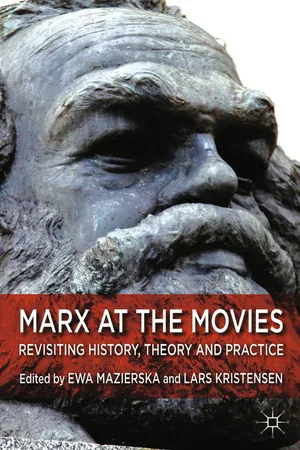
Marx and the Moving Image approaches cinema from a Marxist perspective. It argues that the supposed 'end of history', marked by the comprehensive triumph of capitalism and the 'end of cinema', calls for revisiting Marx's writings in order to analyse film theories, histories and practices.
Information
Subtopic
Art General1
The Dialectical Image: Kant, Marx and Adorno
Mike Wayne
For the intellectuals, the philosophers and the priests, the Word has always been favoured over the Image. Since Plato’s parable of the cave of shadows helping to enslave the credulous, the Image has been associated with in-authenticity, manipulation, the transient and contingent, the feeble-minded and the masses. There has been a theological dimension to this distaste for the Image. For Thomas Hobbes in Leviathan, the Image, which is by definition a finite thing, is singularly ill-equipped to represent something as infinite as God (Hobbes 2006: 34–35); hence the prohibition on Graven Images in the Jewish religion. The Word, by contrast, seemed to belong to the Mind, not matter that could decompose; it was Universal, not particular; its written manifestation belonged for a long time as the exclusive property of the ruling classes. In this context the Image threatened in effect to transfer the property of the ruling class – its cognitive concepts and moral ideas – to the masses in a form they could master. For Benjamin, this was one of the implications of the increasing mechanical reproduction of art in the 20th century: ‘the technique of reproduction detaches the reproduced object from the domain of tradition […] in permitting the reproduction to meet the beholder or listener in his own particular situation, it reactivates the object reproduced’ (Benjamin 1999a: 215). In the meantime, publishing, mass democracy and mass education changed the Word from a mere instrument of ruling class power to a site of struggle between classes. But it is still an uneven struggle in which the written Word especially continues to exude class conditions. Hans Magnus Enzensberger has given a wonderful summary of the written Word’s connection with authority. He notes the rigid body posture writing demands, the taboos associated with writing that are immaterial to communicating, the intimidation with which the written word is drenched, its links with institutionalised authority (for the subject, initially the school and later business and the law) and the way the written word smoothes over contradictions and facilitates rationalisation and unempathetic distanciation (Enzensberger 1982: 70–72). We may add that illiteracy and linguistic divisions amongst the people have made film an attractive medium for radicals in the developing world.
So it is perhaps odd that radical intellectuals have very often gone along with this tradition of valorising the Word over the Image. There are of course reasons for this valorisation, not all of them bad. Writers across the disciplines have found that with the emergence of capitalism we find ‘the ubiquity of vision as the master sense of the modern era’ (Jay 1988: 3). And the visual, dominated by the model of Cartesian perspectivalism, was hardly innocent. In French philosophical thought in particular, as Martin Jay has shown, the visual field, from Foucault’s panopticon, to Debord’s Society of the Spectacle, to Althusser and Lacan’s specular Imaginary to Metz’s cinematic apparatus, was associated with power, domination, illusion and manipulation (Jay 1994).
There is, however, another tradition, one largely associated with German philosophy that breaks down the hierarchical ordering in which the Word is uncritically valorised over the Image. Instead, in this tradition, we can discern a much more productive cross-fertilisation between the Word and the Image, one in which the Word returns to the aesthetic Image as a source for revivifying its own formulations, questioning its assumptions or even circumnavigating the aporias in its own philosophical structures (Buck-Morss 1989). This is the tradition from which the Dialectical Image emerges. I want to trace this emergence in the work of Kant, with reference to the Critique of Pure Reason and the Critique of Judgment. Kant provides the philosophical framework and roots of the Dialectical Image. Then we shall see how Marx takes up the Dialectical Image as cognitive metaphor for the purpose of social scientific critique within political economy. Finally, I want to give some indicators as to how the concept of the Dialectical Image informed the philosophy of cultural critique in the work of Adorno and Benjamin especially. One of the key ways that the Dialectical Image is dialectical is that it overcomes the fissures between the conceptual and the perceptual, the universal and the particular, the cognitive and the affective, the elite and the popular, the given and the ought. The Dialectical Image is much broader than a specific aesthetic strategy, for example, montage. Instead it takes us into a debate about the critical potential of the aesthetic within the visual field.
Kant and the origins of the dialectical image
Kant’s Critique of Pure Reason is a deeply contradictory text. For Adorno, the profundity of Kant’s text is that it brings ‘to the surface contradictions that are deeply embedded in the subject of investigation’ (Adorno 2001: 82). The Critique splits the Word into an antinomy which has its roots in the emerging capitalist order. The Word on the one hand develops the entire field of cognitive rationality by which consciousness maps the world according to the logical relations that concepts and the pure categories of the understanding impose. The pure categories refer to Quantity, Quality, Relation and Modality. For nothing can be thought that does not have some quantity, some qualities, some relations (to itself and other things) and some modality (does it exist objectively or is its status, as with the aesthetic, of a different ontological order from reality?). The problem, however, is that the logical relations that order subjectivity (the transcendental subject) are so pre-given, so a priori, that no social and historical consciousness can emerge from the first Critique. The self-active consciousness that Kant elucidates in the Critique of Pure Reason turns out to be imprisoned within a cage of reified understanding. As a result, the moral-political dimension of the Word is split off and protected from the massive edifice of reification that Kant constructs, but at the cost of consigning Reason to impotence with regard to our actual institutional life. In Kant’s Critique of Practical Reason, ethical practical activity is locked up in the private individual subject, self-generated, inwardly orientated and uncoupled from ‘external’ institutional practices that must obey the a priori laws of nature mapped out in the Critique of Pure Reason. Thus the ethical act, Lukács observed ‘collapses as soon as the first concrete content is to be created’ (Lukács 1971: 125).
The first Critique, however, as well as being structured around such paralyzing antinomies, also displays the pressure of a latent dialectic, as Adorno again noted in his masterful exposition of that work (Adorno 2001: 87). Two key examples of this latent dialectic are particularly relevant for thinking about the Dialectical Image. First, Kant’s concept of the noumenon. Kant argued that the subject’s mapping of the world was only a mapping of appearance-forms, that is to say only a mapping of those characteristics of the object world that can be known according to the logical-empirical limits of our subjectivity. What the object world may be, independent of our way of apprehending the real according to our logical-empirical machinery of consciousness, is to us an unknown object X or what Kant called a noumenon (Kant 1996: 159–160/A109). Kant’s concept of the noumenon, and its distinction from appearances, clearly points forward to Marx’s distinction between the phenomenal forms of life under capitalism – how, for example, the market and commodities appear to us in their immediacy – and the essential relations, that complex network of social relations that mediate and contextualise objects torn from their circumstances and conditions by the ways of seeing and behaving that commodity production imposes on us. The movement from phenomenal forms to essential relations is for Marx a question of critical social scientific research. But the limits and finitude of the image, of the world of appearances, and how the sensuous apprehension of the world might overcome those limits and register something of the domain of the noumenon, was precisely what motivated Kant to take his aesthetic turn and write the Critique of Judgment.
The latent dialectic between the empirical and the non-empirical, the immediately given and its mediated conditions, which the concepts of appearances and noumenon register, links to a second latent dialectical pressure pushing against Kant’s antinomous philosophical architecture. This is the relationship between the concepts and pure categories of the understanding, where logical relations are secured as universal and necessary, and what Kant calls the Transcendental Aesthetic. Kant recognises that in order for logical relations to have any cognitive power they must actually be applied to sense data coming to the subject from the outside world. This sense data (the world of appearances) can only be mapped conceptually if it is ordered according to principles of temporal and spatial mapping. Time and Space, however, are not derived from concepts, but from the pure forms of intuition that belong to the Transcendental Aesthetic. Before we can apprehend any actual sense data, the subject must have a ‘receptivity for being affected by objects’ and this ‘precedes necessarily all intuitions of these objects’ (Kant 1996: 81/B42). The Transcendental Aesthetic makes it possible for us to map objects according to the principles of time and space. Once the subject has assembled objects of sense data according to a process Kant calls synthesis, then these empirical objects can be stamped, as it were, with the objective universality of empirical concepts which are in turn governed by the pure categories. Thus, the empirical concept ‘dog’ can be stamped on a particular dog in concreto that comes to our senses (213–214/A141). A dog, like all things observable, will be a particular instantiation of the pure categories, being a certain quantity (e.g. size), and having certain qualities, relations and modality (a real dog or a representation of a dog). However, crucially, the entire thrust of the Critique of Pure Reason is to argue that concepts, whether abstract or empirical, can only be combined into combinations that generate new knowledge because they can be figured in pure forms of intuition (time and space). So the Transcendental Aesthetic not only plays a determinate role in relation to actual sense data, it also plays a crucial role in relation to the development of our conceptual and cognitive capacities. This lays the basis for overcoming Kant’s dichotomy between concepts and sensuousness.
[N]o geometric principles – e.g., the principle that in a triangle two sides together are greater than the third – are ever derived from universal concepts of line and triangle; rather, they are all derived from intuition, and are derived from it moreover a priori. (Kant 1996: 79/B40)
Line and triangle are concepts of the understanding, but it is pure intuition of spatial relations that allows us to combine such concepts as ‘line’, ‘length’ and ‘angle’ into geometric principles. Thus, some form of figuration becomes essential for the understanding to combine concepts and generate knowledge of principles, and this lays one of the bases for overcoming the otherwise sharp division Kant establishes between the Transcendental Aesthetic and the understanding, and, further, between the pure transcendental conditions of experience and its particular (socially and historically determinate) ‘contents’. What will happen with Kant’s aesthetic turn in the Critique of Judgment is that the aesthetic as an aid to thinking will be uncoupled from its role in providing a reified universe of concepts with sense data. Instead, the aesthetic will develop its own relatively autonomous play with sensuous forms, a figuring that will relativise universal concepts, call them into question, historicise them and open them up to critique. This in turn provokes the moral-political capacities of reason – hitherto locked up impotently in the private conscience, into re-engaging with the world, because its own principles have been made sensuously palpable in the aesthetic. Thus it is that the aesthetic Image comes to the rescue of the Word, helping it think past the blockages in Kant’s philosophical system.
In the Critique of Judgment Kant distinguishes between the determinative judgements that subsumed the particular (sense data) under universal concepts and categories in the first Critique, and a new mode of judging that he calls reflective judgment.
Determinative judgment, [which operates] under universal transcendental laws given by the understanding, is only subsumptive. The law is marked out for it a priori […] reflective judgment […] is obliged to ascend from the particular in nature to the universal. (Kant 1987: 19)
To reflect […] is to hold given presentations up to, and compare them with, either other presentations or one’s cognitive power [itself], in reference to a concept that this [comparison] makes possible. (400)
Reflective judgement thus recognises that the universal is not necessarily given, and this licenses a mode of judging that is far more open and exploratory. Here we have very clearly the origins of a German tradition of thought that mixed the aesthetic with philosophy. Rejecting the universal as given, Kant lays the basis for subjective, aesthetically tinged, ‘poetic’ juxtapositions that illuminate specific materialist truths of an epoch. Here we have the rationale for a critical procedure (analogy or metaphor) that makes it possible to think a concept through perception that it was difficult or not possible to think without that sensible operation. The critical procedure combines induction (starting with the particular) with analogy (comparing particulars in a play of forms) to generate new ways of thinking or thinking about things in new ways, that the reified universe of concepts had blocked (see graph below).
Typically in Kant’s third Critique, some particular of nature is used to reflect on our own cognitive powers, and implicitly, our social relationships. This should be contrasted with the determinative judgement of the first Critique, where nature is over-extended to the social world, with the result that our capacities for critical reflective reason atrophy.

Conceptual metaphors in Marx
Kant’s Critique of Pure Reason is an attempt to develop a philosophy of consciousness based on the new emerging natural sciences (especially Newton’s successes in astronomy). But this led to over-extending the logical and empirically observable laws of nature to the entire terrain of human endeavour. While we are natural creatures, we are by nature also social creatures and it is our social dimension that this over-extension of the natural science framework completely eclipses. This over-extension is of course quite typical, and across the disciplines the social sciences have adapted the models developed in the natural sciences. Economics, sociology, psychology and so forth have been dominated by the problem that first beset Kant in the Critique of Pure Reason. Social relations and practices acquire the quality of something given, something a priori, constituted, as if by nature, without our own participation in their making. Marx tracked the roots of this naturalisation process to the universalisation of commodity production that defines capitalism. The Critique of Pure Reason has a dualistic structure which bears the outlines of the commodity form. The commodity form brackets off the wider social relationships which are a condition of commodity exchange because private property is founded on the non-interference of popular control, conscious regulation and oversight of commodity operations. This is what gives the first Critique its emphasis on the empirical. Yet of course it is not the case that social imperatives are absent from discrete instances of commodity exchange – whether it is the buying and selling of labour power, the buying and selling of consumer goods, the buying and selling of technology, money and so on. In fact, here what imposes itself on these apparently discrete exchanges is the full force of the capitalist motive to accumulate capital. This abstract power and pressure attempts to subsume everything within its force field and this manifests itself in the first Critique as the subsumption of all empirical sense data by the logical rules of determinative judgement. Together, a generalised, abstract, a priori capitalist imperative to accumulate and empirical instances of market exchanges torn from their context (the struggle between capital and labour, for example) produce a naturalisation effect.
One cannot combat this naturalisation effect by simply abolishing nature and declaring that everything is a social convention. This has been the default strategy for theories of language and representation for much of the 20th century, starting with structuralism through to postmodernism. A better strategy can be found in Marx’s methodology, which attempt...
Table of contents
- Cover
- Title
- Copyright
- Contents
- List of Figures
- Notes on Contributors
- Introduction
- Chapter 1: The Dialectical Image: Kant, Marx and Adorno
- Chapter 2: The Utopian Function of Film Music
- Chapter 3: Bloch on Film as Utopia: Terence Davies’ Distant Voices, Still Lives
- Chapter 4: ‘But Joe, it’s “Hour of Ecstasy”’: A Materialist Re-evaluation of Fritz Lang’s You and Me
- Chapter 5: Laughing Matters: Four Marxist Takes on Film Comedy
- Chapter 6: Workerist Film Humour
- Chapter 7: Alienated Heroes: Marxism and the Czechoslovak New Wave
- Chapter 8: The Work and the Rights of the Documentary Protagonist
- Chapter 9: Amateur Digital Filmmaking and Capitalism
- Chapter 10: Citizen: Marx/Kane
- Chapter 11: The Meanings of History and the Uses of Translation in News from Ideological Antiquity – Marx/Eisenstein/The Capital (Video 2008) by Alexander Kluge
- Chapter 12: Marx for Children: Moor and the Ravens of Londonand Hans Röckle and the Devil
- Index
Trusted by 375,005 students
Access to over 1.5 million titles for a fair monthly price.
Study more efficiently using our study tools.
Frequently asked questions
Yes, you can cancel anytime from the Subscription tab in your account settings on the Perlego website. Your subscription will stay active until the end of your current billing period. Learn how to cancel your subscription
No, books cannot be downloaded as external files, such as PDFs, for use outside of Perlego. However, you can download books within the Perlego app for offline reading on mobile or tablet. Learn how to download books offline
Perlego offers two plans: Essential and Complete
- Essential is ideal for learners and professionals who enjoy exploring a wide range of subjects. Access the Essential Library with 800,000+ trusted titles and best-sellers across business, personal growth, and the humanities. Includes unlimited reading time and Standard Read Aloud voice.
- Complete: Perfect for advanced learners and researchers needing full, unrestricted access. Unlock 1.5M+ books across hundreds of subjects, including academic and specialized titles. The Complete Plan also includes advanced features like Premium Read Aloud and Research Assistant.
We are an online textbook subscription service, where you can get access to an entire online library for less than the price of a single book per month. With over 1.5 million books across 990+ topics, we’ve got you covered! Learn about our mission
Look out for the read-aloud symbol on your next book to see if you can listen to it. The read-aloud tool reads text aloud for you, highlighting the text as it is being read. You can pause it, speed it up and slow it down. Learn more about Read Aloud
Yes! You can use the Perlego app on both iOS and Android devices to read anytime, anywhere — even offline. Perfect for commutes or when you’re on the go.
Please note we cannot support devices running on iOS 13 and Android 7 or earlier. Learn more about using the app
Please note we cannot support devices running on iOS 13 and Android 7 or earlier. Learn more about using the app
Yes, you can access Marx at the Movies by Lars Kristensen, E. Mazierska in PDF and/or ePUB format, as well as other popular books in Media & Performing Arts & Art General. We have over 1.5 million books available in our catalogue for you to explore.