- English
- ePUB (mobile friendly)
- Available on iOS & Android
eBook - ePub
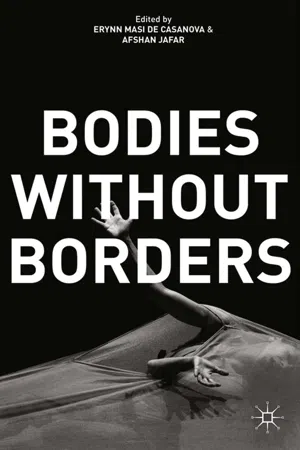
Bodies Without Borders
About this book
Globalization is often thought of as an abstract process that happens "out there" in the world. But people are ultimately the driving force of global change, and people have bodies that are absent from current conversations about globalization. The original scholarly research and first-person accounts of embodiment in this volume explore the role of bodies in the flows of people, money, commodities, and ideas across borders. From Zumba fitness classes to martial arts to fashion blogs and the meanings of tattooing, the contributors examine migrating body practices and ideals that stretch across national boundaries.
Information
1
THE GLOBAL MARTIAL CIRCUIT AND GLOBALIZED BODIES
Lionel Loh Han Loong
* * *
Already, bruises are starting to form on my right shin, the leg that I frequently use to execute roundhouse kicks. In a sense, I am modifying my body, making some parts of it, deemed by the martial arts community as essential to fighting, stronger and faster. I commented to Ivar, 39, Swede, security guard, whose shin is a whole mass of bruises how hard-core he is. He smiled and said, “At least you know you are hitting the right places.”
Fieldnotes
* * *
In Techniques of the Body, Mauss (2006, 83) expounds upon how “the body is man’s first and most natural instrument . . . man’s first and most natural technical object, and at the same time technical means, is his body” and that “techniques are thus human norms of training” (2006, 85). Culture mediates the way individuals come to think about the world vis-à-vis bodily knowledge and the way they utilize their bodies. As a case study of an explicit somatic culture, this ethnographic study of a mixed martial arts (MMA) gym in Thailand examines how martial arts are embedded within transnational flows and practices. I argue that these processes of globalization impact the discursive construction and practice of martial arts. The flow of individuals, televised images, and particular techniques of the body (Mauss 2006) across transnational boundaries results in individuals drawing upon an eclectic array of martial disciplines. This in turn influences the transmission and modification of sensorial knowledge and the commercialization of martial arts.
METHODOLOGY AND RESEARCH SITE
Researchers on somatic cultures such as dance and martial arts often stress the materiality of the body as being central to understanding the lived realities of these practices, given that language alone is often inadequate to convey and transmit embodied knowledge (Leigh Foster 2003; Potter 2008; Samudra 2008). Practice, constituted by “shared skills and understanding,” “tacit knowledge,” and “embodied, materially mediated arrays of human activity” (Schatzki et al. 2000, 2–3), is thus central to my research methodology. A number of similar generic terminologies are often used for this, such as “performance ethnography,” “practice-as-research,” and “performance-as-research.” In their review of the methodologies used in theater and performance studies, Kershaw et al. (2011, 63–65) argue that “practice-as-research” is characterized by “post-binary commitment to activity (rather than structure), process (rather than fixity), action (rather than representation), collectiveness (rather than individualism), reflexivity (rather than self-consciousness),” and the “unsustainable bifurcations between becoming and being.” As embodied knowledge is not easily transmitted except through learning a skill for yourself, this methodology attempts to bridge the chasm between “practical” and “discursive” consciousness. Polanyi (1983, 10) argues that this form of tacit knowing, whereby one knows the proximal (practical consciousness) only by attending to the distal (discursive consciousness), reflects how individuals “can know more than we can tell” (1983, 4). For Giddens, the former refers to “recall to which the agent has access in the durée of action without being able to express what he or she thereby ‘knows,’” while the latter refers to “recall which the actor is able to express verbally” (1984, 49).
Performance ethnography, as an embodied methodology, allows research to be conducted about and through bodies due to the embodied sensuous experiences that “create the conditions for understanding . . . [P]erformed experiences are the sites where felt emotion, memory, desire and understanding come together” (Denzin 2003, 13). Performance ethnography allows the researcher to comprehend how culturally specific meanings are generated and sustained through movements, the motivations by which particular movements are generated, and a yardstick by which to contextualize and situate these movements. Kaeppler (1999, 22) cautions against marginalizing the role of the audience because “movement sequences are analogous to utterances, and without knowledge of the movement conventions, a viewer will be unable to understand what is being conveyed.” My methodology reiterates Kaeppler’s (1999) advice because it captures the dynamics between the performer and audience. As a methodology in which my material body is intrinsically intertwined with the ongoing social processes, performance ethnography allows for the construction of experiential knowledge vis-à-vis my subjective experiences, observations, and perceptions (Dickson-Swift, et al. 2009; Okely 2007; Parker-Starbuck and Mock 2011; Seymour 2007). By subjecting my body to the rigors of the gym, by bodies interacting and communicating in the social drama that unfolds, at times nonverbally, important data are generated. The visual, verbal, sensual, olfactory, and kinaesthetic processes at the gym constitute important data sources (see Spencer 2013). As the way in which one’s senses are directed to perceive selective aspects of reality is influenced by one’s cultural, ontological, and epistemological paradigms (Howes 2003; 2004), self-reflexivity is necessary to translate that which is experiential and interpretive into the discursive dimension. Within this somatic culture, my body is “a tool of inquiry and vector for knowledge” (Wacquant 2004, viii).
For five weeks, I embedded myself in the social reality of Kwaan-saa-maat Gym [Might Gym], a Muay Thai (MT) and MMA gym in a rural province in Thailand, training, living, and interacting with the other participants at the gym. As accommodation is part of the training package, everyone stays and trains at the gym, making this field site one that is geographically bounded. While numerous martial arts gyms owned by both Thais and foreigners abound in places such as Bangkok, Phuket, Chiang Mai, and Koh Samui, I deliberately chose Kwaan-saa-maat Gym because of its relative isolation, situated far beyond these touristy locations. I was interested in the everyday realities of men who were passionate about martial arts and were willing to isolate themselves and devote their time to training. Unsurprisingly, individuals at the gym often attempt to differentiate themselves from other foreigners by vocalizing their disdain for the idea of training at gyms located near tourist hotspots. They prefer to subject themselves to the more strenuous martial arts training at Kwaan-saa-maat Gym, which is of a variety not found at those gyms. Michael is a Norwegian student, aged 18. His comment typifies the kind of responses given by the participants when asked why they decided to come all the way to rural Thailand to train:
How I heard about Kwaan-saa-maat Gym? I just Googled it and type Issan and MT. I wanted to get away from everything and Issan is far enough, away from tourist traps! At the World MT Council at Koh Samui, it is much more tourist focused . . . they don’t push you as hard like here.
A particular appeal of Kwaan-saa-maat Gym is the opportunity to train with its owner, described by Stefan, 22, a German student, as being “one of the top MT fighters. He was actually one of the best in the world!” Another is the lack of distractions due to Kwaan-saa-maat Gym’s location far away from popular tourist destinations. Karl, 22, a Scottish postgraduate, explains why it appeals to him:
I also wanted to get out of way from the touristy place like Pattaya, Phuket, Koh Samui, it’s just too much distractions. Too hectic and all. I wanted to be out here where it’s relaxed. Hectic as in it is just partying and people hustling you? It is just more stressful. More traffic, more bars that people go to, girls, so many things to distract you, put you off MT. Cheap alcohol, the beaches and stuff. Out here there is less to do, enough to keep you entertained but you just train and that is what you do. Don’t get to do anything else except train so it is good that way.
For the men, the relative isolation of the gym, away from tourists, is perceived to be one of the characteristics of the “authentic” Muay Thai experience. As the above extracts highlight, this is a point that the men constantly reiterate to outsiders.
Martial arts gyms in Thailand that cater to foreigners constitute a transient community. Most individuals, with the exception of the instructors, stay at the gym from between a week to a few months. Prior to my trip, I communicated with the owner of Kwaan-saa-maat Gym and obtained his consent to conduct my fieldwork there. Throughout my stay at Kwaan-saa-maat Gym, I became acquainted with 22 men, the majority coming from Scandinavian countries like Sweden and Norway. Excluding the Thai MT instructors, there were only three other Asians there during my stay. The men are mainly in their early twenties; the youngest is 18 and the oldest 39. Coming from diverse occupations, from law undergraduate to security guard, one commonality they share is their socioeconomic status and their passion for martial arts. Some motivations behind the men’s sojourn in Thailand are to pursue a hobby, to be physically fit, and for the few professional fighters at the gym, to recuperate or prepare for their upcoming fight. Most of the participants are of at least a middle-class background and so are able to afford the costs of training in Thailand for a prolonged period of time without worrying about their means of livelihood. I was informed that it is very rare for women to come and train at the gym.
In short, Kwaan-saa-maat Gym is a site where a community of individuals coming from diverse cultures and nationalities are united in their passion for martial arts, subjugating their bodies to the rigors of training. Communal moments are created when the guys talk about the fights they have seen or participated in. In addition, the training grounds have a dual functionality: they are at the same time a site where bodies get reconfigured as particular martial disciplines become embodied, and just a place to hang out. This sense of communitas is exemplified by Veron, 28, Indian, unemployed, who comments:
Aside from discipline and focus, meeting up with amazing people, amazing fighters and understanding their reasons for fighting and learning MT is also impressive. People come from all walks of life, there are electricians, there are street fighters, there are university graduates who learn MT. So you try understanding what works for them [and that] inspire[s] me . . . these are people who have a past and they decided to channel their energies, channel their focus in the right way. In doing something good in their life, they focus on MT.
Turner (1969) conceptualizes communitas as existential or spontaneous social groups that are forged through a sense of collective purpose, communion, and emotional bonds. As the previous extract demonstrates, the shared experiences of the participants engaging in martial arts training allow them to bond, despite their different sociostructural positions and nationalities, and focus on martial arts. Above anything else, one’s commitment to training hard and learning to be a good fighter is valued at the gym. The gym is a “short-lived society” (Foster 1986), where social interactions are intensified due to the men’s limited time there, a structured training schedule, language barrier, and mobility issues. Kwaan-saa-maat Gym is located about 15 minutes’ ride away from the town center and aside from a couple of restaurants and grocery stores, there is little in the way of entertainment. Unless one knows how to ride a motorbike and rents one from the gym, it is hard to partake in the province’s nightlife or get to know people outside the gym. There is also a language barrier that needs to be traversed. Mobility (or the lack thereof) becomes an important factor in shaping communal life at the gym, as most individuals often spent their time either resting within the privacy of their rooms or talking with the other men at particular sites in the gym.
THE GLOBAL SPORTING AND MARTIAL CIRCUIT
Sport, “in its dual role as a long-term motor and metric of transnational change,” provides a distinctive lens through which to analyze the forces of globalization (Giulianotti and Robertson 2007, 1). For example, sports historians analyzing the linkages between sports and globalization have shown how the globalization of sports is implicated in the colonial project. Sports such as cricket and football have been used as a medium to “civilize” indigenous people (Guttmann 1995; Mangan 1987) and both indigenous and nonindigenous sports have been subjected to the processes of adaptation, change, and commercialization (Appadurai 1996; Giulianotti 1999). Baseball in Cuba epitomizes how sports are linked to the maintenance of one’s national identity in a globalized world. Initially introduced to Cuba by Americans, baseball has been discursively reconstructed as a source of nationalistic and anticolonial pride (González 1999; Jamail 2000; Pérez 1994). In today’s milieu, sports have become institutions that are economically prominent, popular, and are able to unite and mobilize individual sentiments regardless of people’s cultural differences (Eco 1987; Smart 2007). The rise of sports as an institution in the global arena is the result of commercial interests (Aris 1990; Harvey and Houle 1994; Houlihan 1994; Jarvie 2006; Klein 2001; Miller et al. 2001; Smart 2005; 2007), multinational media corporations investing in sports, the institutionalization of inaugural international sporting events, and the rise of governing bodies (Maguire 1999) that have sought to standardize and institutionalize sporting rules and regulations (Van Bottenburg 2001). The institutionalization of sports results in the transnational movement and migration of sports personnel, the use of the media to deliver sporting events on a global scale, the flow of finances generated by the sports industry and ideas about sports across the globe, the emergence of transnational regulatory bodies and organizations for sports and new ways in which sports are interpreted and consumed by diverse cultures (Jarvie 2006). However, to polarize this “global-local nexus” is unnecessarily to attribute hegemony to one pole and exclude the other (Andrews and Ritzer 2007). Robertson (1995) argues for the need to recognize the interpenetrative and complementary relations that characterize this nexus: the local is complicit in the creation and perpetuation of the global, and vice versa. In making its presence felt in the global arena, the institution of sports is simultaneously furthering globalization processes in areas such as politics, culture, and the economy (see Friedman 1994; Jarvie 2006; Maguire 1999).
Utilizing my informants’ vignettes, I elucidate the ways in which these bi-directional global flows of ethnoscapes, mediascapes, technoscapes, financescapes, and ideoscapes (Appadurai 1996, 33) impact martial arts, paying particular attention to the relationship between techniques of the body and the commercialization of martial arts. I appropriate Appadurai’s concept of “-scapes” and offer the term “martialscape” to describe the dynamic interaction between discursive constructions of martial arts and the manner in which individuals conceive of and experience martial arts at the global level. Divorcing himself from a paradigm that seeks to comprehend globalization “in terms of existing center-periphery models” (1996, 2), Apparadurai argues that “at least as rapidly as forces from various metropolises are brought into new societies they tend to be indigenized in one or other way” (1996, 295). Apparadurai’s concept of “-scapes” is reflective of a deterritorialized, postmodern, and transnational milieu where myriad centers are involved in bidirectional processes of hybridization that calls into question an “authentic and original” culture. Similarly, martial arts traditions, having circumnavigated the globe, have been transformed into deterritorialized cultural practices. The term “martialscape” reflects these deterritorialized cultural practices, the hybridization process these cultural forms undergo by a receiving audience, and the transnational movement of fighters.
MARTIAL ARTS: A RECONFIGURATION OF THE SENSES AND KNOWING THE BODY
Through the men’s vignettes and my ethnographic data, I illustrate how Muay Thai involves an embodied socialization process that contests the men’s normative ideas reg...
Table of contents
- Cover
- Title
- 1 The Global Martial Circuit and Globalized Bodies
- 2 West Indian Immigrant Women, Body Politics, and Cultural Citizenship
- 3 Don’t You See? (Personal Reflection)
- 4 New Femininity, Neoliberalism, and Young Women’s Fashion Blogs in Singapore and Malaysia
- 5 Fashion of Fear: Securing the Body in an Unequal Global World
- 6 My Struggle with the Headscarf (Personal Reflection)
- 7 The Face Is the Mask: Global Modifications of the Body and Soul (Personal Reflection)
- 8 Images in Skin: Tattooed Performers in Germany in the Twentieth Century and Today
- 9 Fragments: Stories of An-Other Life (Personal Reflection)
- 10 “A Mover la Colita”: Zumba Dance-Fitness in Mexico and Beyond
- Bibliography
- Notes on Contributors
- Index
Trusted by 375,005 students
Access to over 1.5 million titles for a fair monthly price.
Study more efficiently using our study tools.
Frequently asked questions
Yes, you can cancel anytime from the Subscription tab in your account settings on the Perlego website. Your subscription will stay active until the end of your current billing period. Learn how to cancel your subscription
No, books cannot be downloaded as external files, such as PDFs, for use outside of Perlego. However, you can download books within the Perlego app for offline reading on mobile or tablet. Learn how to download books offline
Perlego offers two plans: Essential and Complete
- Essential is ideal for learners and professionals who enjoy exploring a wide range of subjects. Access the Essential Library with 800,000+ trusted titles and best-sellers across business, personal growth, and the humanities. Includes unlimited reading time and Standard Read Aloud voice.
- Complete: Perfect for advanced learners and researchers needing full, unrestricted access. Unlock 1.5M+ books across hundreds of subjects, including academic and specialized titles. The Complete Plan also includes advanced features like Premium Read Aloud and Research Assistant.
We are an online textbook subscription service, where you can get access to an entire online library for less than the price of a single book per month. With over 1.5 million books across 990+ topics, we’ve got you covered! Learn about our mission
Look out for the read-aloud symbol on your next book to see if you can listen to it. The read-aloud tool reads text aloud for you, highlighting the text as it is being read. You can pause it, speed it up and slow it down. Learn more about Read Aloud
Yes! You can use the Perlego app on both iOS and Android devices to read anytime, anywhere — even offline. Perfect for commutes or when you’re on the go.
Please note we cannot support devices running on iOS 13 and Android 7 or earlier. Learn more about using the app
Please note we cannot support devices running on iOS 13 and Android 7 or earlier. Learn more about using the app
Yes, you can access Bodies Without Borders by E. Casanova, A. Jafar, E. Casanova,A. Jafar in PDF and/or ePUB format, as well as other popular books in Social Sciences & Cultural & Social Anthropology. We have over 1.5 million books available in our catalogue for you to explore.