- English
- ePUB (mobile friendly)
- Available on iOS & Android
eBook - ePub
About this book
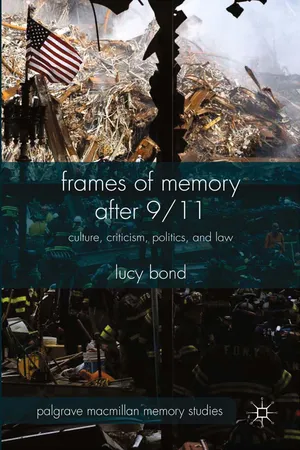
This book examines the commemoration of 9/11 in American memorial culture. It argues that the emergence of counter-memories of September 11 has been compromised by the dominance of certain narrative paradigms – or, frames of memory – that have mediated the representation of the attacks across cultural, critical, political, and juridical discourses.
Information
1
American Trauma Culture after 9/11
In just sixteen words, Hernán Poza III (a former volunteer firefighter and, at the time of 9/11, a social worker in New York City) encapsulates the central tropes that have framed reactions to September 11 across multiple discursive realms: firstly, in media coverage and political rhetoric immediately following the attacks; secondly, in early critical theory; thirdly, and must enduringly, in the corpus of 9/11 trauma fiction, which forms the main focus of this chapter. Poza writes:
this is for history
this is overwhelming
this is not real
this is the new world
(Poza 2003, 19)
In his emphasis on the overwhelming nature of the attacks, Poza places the events in the territory of the incomprehensible and unrepresentable. Describing the ‘unreal’ spectacle that unfolded, he recalls the likeness between the images of September 11 and apocalyptic scenes from Hollywood blockbusters. In his suggestion that the attacks heralded the dawn of a new world, Poza reinforces the notion that 9/11 manifested a historical divide so trenchant that there could be no negotiation, no dialogue, between ‘before’ and ‘after’. Poza’s short stanza thus consolidates a representational template premised upon incomprehension, unreality, and rupture. However, it is my contention that the predominance of these concepts has prevented the realisation of his primary impression: the sense that 9/11 was ‘for history’.
Taking literary representations of September 11 as its starting point, this chapter argues that much of the popular fiction relating to 9/11 exhibits a dehistoricising bent that eschews concentration on the geopolitical context and consequences of the attacks in favour of portrayals of disrupted domesticity.1 Whilst a number of critics have commented upon this over-personalisation of the attacks,2 I extend this analysis to interrogate the ways in which many of the most prominent 9/11 novels manifest an uncritical recycling of paradigms inherited from orthodox trauma theory. Critiquing the pervasiveness of trauma as a frame of memory, I examine how the concept has been framed and narrativised in the years since 2001, attending to its leakage between discursive realms and highlighting its political instrumentality. I suggest that, by failing to distinguish between different levels of traumatisation, or acknowledge alternative modes of response, memorial practitioners and theorists have unwittingly reinforced the impression of a collective, ‘American’, reaction to 9/11. This normative paradigm masks experiential differences, threatening to nationalise loss in problematic – and potentially appropriative – ways by collapsing diverse modes of response into an undifferentiated trauma culture.
1.1 Literature, memory, and trauma
Astrid Erll contends that literature might well be seen as the archetypal medium for the signification of memory – its ‘symbol system’, to be precise (Erll 2011a, 144). Literature is central to the study of memory for two key reasons: firstly, because literary texts do much to constitute the content of a culture’s memory (reflecting upon and negotiating between differing interpretations of historic events); secondly, because, as it functions at a cultural level, the process of remembrance appears to mimic the form of literary texts in its attention to narrativisation, temporality, and genre. The meaning-making qualities of literature and memory are imbued with the ability to conjoin disparate times and places in a more-or-less coherent narrative. Accordingly, Hayden White suggests that our approach to the past is premised on the ‘fantasy that real events are properly represented when they can be shown to display the formal coherency of a story’ (White 1980, 8).
Literature and memory thus appear as entwined entities, dependent upon the organising qualities of narrative to structure and explicate lived experience, however reductively or imperfectly. As Paul Ricoeur (2004) has argued, temporality (or rather, the ability to structure time) is fundamental to the formal qualities of narrative, which assigns causality to historical events by construing a particular relationship between past, present, and future. Because literature and memory are selective, such causalities (and the temporal coordinates around which they are constructed) are contingent and contestable. Both forms of representation therefore involve processes of mediation that not only reflect existing attitudes to the past, but also help to generate new perspectives on history. This process occurs at the intersection of private and public realms – negotiating between individual and collective experiences, personal and political agendas.
Literature and memory draw upon pre-existing generic forms as a means of ‘emplotting’ (to use White’s term) experience. Commonly understood, genres are conventionalised formats used to encode events and experiences, mediating them in a specific fashion to particular effect. When we remember, the manner in which we imagine events is informed by a body of cultural knowledge that individuals acquire through socialisation – customs, or traditions, passed through generations. As White argues, such structures render history familiar to us, ‘providing the “meaning” of a story by identifying the kind of story that has been told. [. . .] Emplotment is the way by which a series of events fashioned into a story is gradually revealed to be the story of a particular kind’ (White 1975, 7). Literature takes up such narrative patterns, shapes and transforms them, and feeds them back into a memory culture; however, literary genres do not only provide templates for the way we recall and relate our memories, these paradigms are also part of a culture’s memory, preserved and revised over time. Such processes are particularly important in the aftermath of traumatic occurrences that appear to defy established categories of understanding.
As has been widely noted, Western interest in trauma as a psychological condition first developed seriously in the late nineteenth century.3 Until this time, trauma (deriving from the Greek for ‘wound’) had predominantly been conceptualised as a physical impairment. In the 1800s, however, the term was redefined as a terminology in which to incorporate the various nervous ‘shocks’ that appeared to accompany the experience of modernity. Linking physical wounding to psychological damage caused by industrial accidents and railway disasters, neurologists identified a complex overlapping of internal and external disorders. Towards the end of the century, Jean-Martin Charcot’s famous study of hysterics at the Salpêtrière in Paris connected trauma to disturbances of memory. Charcot’s student, Pierre Janet, linked this idea to the concept of psychical disassociation, arguing that extreme events might produce a splitting in the self that engendered a ‘new system of personality independent of the first’ (Janet 1901, 492).
After taking a number of divergent approaches to trauma, Sigmund Freud (1914) developed this work via the concept of the ‘repetition compulsion’: the belated and obsessive return of past events not properly assimilated into memory; disturbing experiences that had been repressed (ineffectually) by the subject causing ‘memories’ from the unconscious to irrupt into the conscious mind. Following the First World War, Freud’s work converged with growing attention to the phenomenon of ‘shell shock’, a pathology which foreshadows contemporary understandings of traumatic experience.4 Exemplifying the implicitly political nature of such conditions (something that will have strong implications for the discussion of trauma in the context of 9/11), the concept of shell shock was not readily accepted, but resulted in lengthy and acrimonious negotiations over how to define apparently inexplicable reactions to the experience of modern warfare in terms that went beyond mere ‘cowardice’ or ‘weakness’. Shell shock was not formally categorised until the 1990s, when it was subsumed under the broader umbrella of post-traumatic stress disorder (PTSD).
In 1980, PTSD was classified by the American Psychological Association (APA) to explain the psychological symptoms exhibited by veterans of the Vietnam War, before being steadily extended to other forms of victimhood linked to both private and public histories. Some ten years after the APA’s classification of PTSD in 1980, literary critics at Yale University established the foundations of contemporary trauma theory – shifting attention from the specifically psychical to the more broadly cultural (and particularly literary) dimensions of the condition. The work of Geoffrey Hartman, Cathy Caruth, Shoshana Felman, and Dori Laub combined an interest in the memory of catastrophic historic experience (arising out of the study of Holocaust testimonies at the Yale Fortunoff Archive) with poststructuralist theories of representation (influenced by the work of Paul de Man, of whom Caruth and Felman were students and Hartman a colleague). Together, these critics couched the psychological dimensions of trauma as a problem of referentiality.
Caruth defines trauma as a pathology, consisting ‘solely in the structure of its experience or reception’, arising from an event that ‘is not assimilated or experienced fully at the time, but only belatedly, in its repeated possession of the one who experiences it’ (Caruth 1995, 4). The traumatic experience develops from ‘the delay or incompletion in knowing, or even in seeing, an overwhelming occurrence that then remains, in its insistent return, absolutely true to the event’ (Caruth 1995, 5). Trauma is symptomatic of ‘a gap that carries the force of the event and does so precisely at the expense of simple knowledge and memory’ (Caruth 1995, 7). The traumatic event can be experienced only vicariously, in the form of flashbacks, sensory impressions, or dreams. Whilst ever-present, it carries with it a form of emptiness – a void in understanding or a refusal of linguistic embodiment. In its persistent yet intangible return, and ‘its repeated imposition as both image and amnesia, the trauma thus seems to evoke the difficult truth of a history that is constituted by the very incomprehensibility of its occurrence’ (Caruth 1996, 153).
For Caruth, trauma is the experience of an event that elides both representation and remembrance. This experience is at once intrusive (repeated, disturbing, and involuntary) and elusive (the event itself is only available through indirect modes of cognition). The image that recurs in the experience of trauma appears to be a pure, unmediated event – an event, however, that remains void of substance. As Caruth qualifies, ‘the traumatic event is not experienced as it occurs, it is fully evident only in connection with another place, and in another time’ (Caruth 1995, 8). The traumatising event is incomprehensible because its belatedness and indirectness render it inaccessible. The structure of trauma is premised upon a moment of rupture – the instance at which memory and cognition fail and the subject becomes other to lived experience – following which the past will continue to intrude, unmediated, into the present.
Caruth’s work draws an explicit connection between trauma and representation that is key to the exploration of the relationship between memory and literature. Suggesting that the attempt to articulate horrific experience perpetuates the symptoms of trauma, Caruth’s work is essentially a discussion of historical experience as a form of referential collapse. The inability to ‘know’ the traumatic event manifests itself in the failure to bear witness to it. Caruth calls into question language’s ability to articulate trauma without distorting or corrupting its purity, arguing that ‘the transformation of the trauma into a narrative memory that allows the story to be verbalised and communicated, to be integrated into one’s, and other’s knowledge of the past, may lose both the precision and the forces that characterizes traumatic recall’ (Caruth 1995, 153). Caruth points to a referential aporia at the heart of language as the causal factor in the failure to fully encapsulate experience. The rending of word and world becomes the origin of a structural trauma that frustrates all attempts at historical understanding. Accordingly, history itself becomes a chronicle of trauma and trauma ‘a symptom of history’ (Caruth 1995, 5); ‘[f]or history to be a history of trauma means that it is referential precisely to the extent that it is not fully perceived as it occurs; or to put it somewhat differently, that a history that can be grasped only in the very inaccessibility of its occurrence’ (Caruth 1996, 18).5
In its aversion to articulation, Caruth’s work differs from other theorists, most notably Felman and Laub, who suggest that the experience of being traumatised demands that witness be borne. Laub comments:
The imperative to tell and to be heard can become itself an all-consuming life task. Yet no amount of telling seems ever to do justice to this inner compulsion. There are never enough words or the right words, there is never enough time or the right time, and never enough listening or the right listening to articulate the story that cannot be fully captured in thought, memory, and speech (Laub 1992, 63).
Whilst Caruth sees the act of articulating trauma as damaging and inherently impossible, Felman and Laub argue that it is essential. They posit ‘literature and art as a precocious model of witnessing – of accessing reality – when all other modes of knowledge are precluded’ (Felman and Laub 1992, xx). Felman describes this process as a form of ‘life testimony’, ‘a point of conflation between text and life, a textual testimony which can penetrate us like an actual life’ (Felman 1992, 2). Felman’s formulation has two central implications: firstly, it suggests that reading or listening to historical testimony produces symptoms in the witness similar to the original traumatic experience, allowing the text to function as a vehicle of trauma; secondly, it grants the text autonomy from its author – assuming, in effect, a life (and agency) of its own. Whilst such thinking arguably devalues (and displaces) the historical event as an object of interest,6 it nonetheless emphasises the unique centrality that literature holds in the understanding (and, the theorists above might argue, the construction and transmission) of trauma.
It comes as little surprise, therefore, that over the past thirty years trauma has formed an increasingly visible thematic in Western literary fiction, so much so that it has come to occupy a genre of its own. As defined by Anne Whitehead, ‘trauma fiction effectively articulates several issues that contribute to the current interest in memory: the recognition that representing the past raises complex ethical problems; the challenge posed to conventional narrative frameworks and epistemologies [. . .]; the difficulty of spatially locating the past and the hitherto unrecognised cultural diversity of historical representation’ (Whitehead 2004, 81). Michael Rothberg suggests that trauma fiction manifests two oppositional approaches to the problem of historical representation: a realist perspective, which generates an ‘epistemological claim that [trauma] is knowable and a representational claim that this knowledge can be translated into a familiar mimetic universe’ (Rothberg 2000, 3–4); and an antirealist position, which suggests that ‘[trauma] is not knowable or would be knowable only under radically new regimes of knowledge and that it cannot be explored in traditional representational schemata’ (Rothberg 2000, 4). Seeking to problematise this binary, Rothberg examines a genre he terms ‘traumatic realism’. Traumatic realism provides ‘an aesthetic and cognitive solution to the conflicting demands inherent in representing and understanding genocide’ (Rothberg 2000, 9). It searches ‘for a form of documentation beyond direct reference and coherent narrative but do[es] not fully abandon the possibility of some kind of reference and some kind of narrative’ (Rothberg 2000, 101). Challenging ‘the narrative form of realism as well as its conventional indexical function’ (Rothberg 2000, 104), traumatic realism posits the catastrophic event as a ‘necessary absence’, a ‘felt lack’ in the text, without attempting to ‘produce an imaginary resolution’ (Rothberg 2000, 104) in either narrative or experience.
Whilst many of the novels relating to 9/11 foreground the symptoms and effects of trauma, the texts analysed below eschew the suspended referentiality of traumatic realism in favo...
Table of contents
- Cover
- Title
- Copyright
- Contents
- Preface
- Acknowledgements
- Introduction
- 1 American Trauma Culture after 9/11
- 2 The New American Jeremiad after 9/11
- 3 Analogical Holocaust Memory after 9/11
- 4 Memory, Law, and Justice after 9/11
- Conclusion
- Notes
- Bibliography
- Index
Trusted by 375,005 students
Access to over 1.5 million titles for a fair monthly price.
Study more efficiently using our study tools.
Frequently asked questions
Yes, you can cancel anytime from the Subscription tab in your account settings on the Perlego website. Your subscription will stay active until the end of your current billing period. Learn how to cancel your subscription
No, books cannot be downloaded as external files, such as PDFs, for use outside of Perlego. However, you can download books within the Perlego app for offline reading on mobile or tablet. Learn how to download books offline
Perlego offers two plans: Essential and Complete
- Essential is ideal for learners and professionals who enjoy exploring a wide range of subjects. Access the Essential Library with 800,000+ trusted titles and best-sellers across business, personal growth, and the humanities. Includes unlimited reading time and Standard Read Aloud voice.
- Complete: Perfect for advanced learners and researchers needing full, unrestricted access. Unlock 1.5M+ books across hundreds of subjects, including academic and specialized titles. The Complete Plan also includes advanced features like Premium Read Aloud and Research Assistant.
We are an online textbook subscription service, where you can get access to an entire online library for less than the price of a single book per month. With over 1.5 million books across 990+ topics, we’ve got you covered! Learn about our mission
Look out for the read-aloud symbol on your next book to see if you can listen to it. The read-aloud tool reads text aloud for you, highlighting the text as it is being read. You can pause it, speed it up and slow it down. Learn more about Read Aloud
Yes! You can use the Perlego app on both iOS and Android devices to read anytime, anywhere — even offline. Perfect for commutes or when you’re on the go.
Please note we cannot support devices running on iOS 13 and Android 7 or earlier. Learn more about using the app
Please note we cannot support devices running on iOS 13 and Android 7 or earlier. Learn more about using the app
Yes, you can access Frames of Memory after 9/11 by L. Bond in PDF and/or ePUB format, as well as other popular books in History & Historiography. We have over 1.5 million books available in our catalogue for you to explore.