- English
- ePUB (mobile friendly)
- Available on iOS & Android
eBook - ePub
About this book
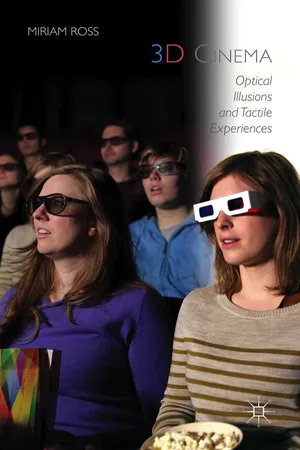
3D Cinema: Optical Illusions and Tactile Experiences questions the common frameworks used for discussing 3D cinema, realism and spectacle, in order to fully understand the embodied and sensory dimensions of 3D cinema's unique visuality.
Information
1
Hyper-Haptic Visuality
Haptic
The recent turn to phenomenology in film studies has, in the first instance, refocused attention on the role of the body and multifaceted sensory perception in spectatorship. In the second instance, it has been able to acknowledge the different qualities of moving image types, styles and genres and the role they play in the production of embodied perception so as to avoid a totalising system of cinematic viewership. Under this model, Jennifer Barker’s The Tactile Eye (2009) explores the potential for experimental films to elicit tactile exploration of their textural surfaces and the propensity for the chase film to produce heighted musculature and kinaesthetic reaction. Vivian Sobchack’s numerous essays in Carnal Thoughts: Embodiment and Moving Image Culture (2004) examine how diverse films and media texts are able to make meaning out of bodily sense. Elena del Río’s Deleuze and the Cinemas of Performance: Powers of Affection (2008) utilises a Deleuzean reading to explain the way films with performing bodies create affective intensity. In a similar vein is one of the most widely used texts, and most useful for this study of 3D cinema: Laura U. Marks’ The Skin of the Film (2000). She examines the way haptic visuality is produced by a specific mode of cinema which, in her book, she identifies as intercultural cinema: films which, when dealing with ‘the power-inflected spaces of diaspora, (post- or neo-) colonialism and cultural apartheid,’ are concerned with embodiment and sense perception (2000: 1). Marks explains how these films draw attention to the ‘skin’ of the screen and produce narrative modes only in conjunction with close consideration of the image’s constitution. She argues that these films disavow the possessive and controlling distance that is situated between audience and screen in traditional commercial films. Instead, aesthetic techniques such as pixelation, extreme close-ups on textures and the refusal to foreground action invite an involved and sensory response to the films’ images.
While many of the organisational principles of Western art from the last few centuries – in particular perspective – rely on the priority of vision, intercultural cinema dismantles this focus in favour of a return to engagement with all senses. This process makes use of haptic perception: ‘the combination of tactile, kinaesthetic, and proprioceptive functions, the way we experience touch both on the surface of and inside our bodies’ (Marks, 2000: 162). Furthermore,
haptic visuality is distinguished from optical visuality, which sees things from enough distance to perceive them as distinct forms in deep space: in other words, how we usually conceive of vision. Optical visuality depends on separation between the viewing subject and the object. Haptic looking tends to move over the surface of its object rather than plunge into illusionistic depth, not to distinguish form so much as to discern texture. It is more inclined to move than to focus, more inclined to graze than to gaze.
(Marks, 2000: 162)
Her work has been used to understand a variety of films beyond the intercultural cinema discussed in her study, and it is the differences she teases out between haptic and optical visuality that have implications for the way in which we can understand stereoscopic cinema’s operation. As this chapter will demonstrate, stereoscopy complicates any clear binary between the two.
On the one hand, the tendency to create extended illusionistic depth in commercial stereoscopic films couples with a dismantling of the screen plane so that the planar skin of the film is no longer discernible. In this way, the presentation of distinct forms in deep space occurs and an optical visuality is encouraged. The potential for separation from the film’s body is then further encouraged by the majority of stereoscopic display systems that ask viewers to use glasses, often with polarised filters that diminish the intensity of light reaching the eyes. Nonetheless, fundamental to stereoscopic cinema is the ability to bring content closer to the viewer (particularly with negative parallax placement) and the dismantling of the screen plane equally operates to destabilise a sense of fixed distance between viewer and film. The abundance of depth planes thus provokes an immersive effect, distinct from narrative immersion, through which the viewer’s body is located within and in relation to, rather than separated from, the film. In this way, ‘the body is implicit in the stereoscopic experience’ (Zone, 2012: 348).
Marks suggests that ‘vision itself can be tactile’ as ‘film (and video) may be thought of as impressionable and conductive, like skin’ and the screen becomes not so much a flat object as a membrane (2000: xi–xii). Her concept of a membrane is particularly valid for an understanding of stereoscopic moving images, as it helps contextualise the thick and permeable nature of the stereoscopic film that seems to operate in a malleable and porous screen space in which ‘the screen is no longer the barrier between the diegesis and the spectator, but merely a single technological point in a system that now extends both past the screen and into the theatre’ (Sandifer, 2011: 67). While other cinema exhibition practices have played with the screen’s physical boundaries, such as IMAX, Cinerama, VistaVision, and Cinema Scope’s widescreen systems (Belton, 1992), stereoscopy is the only format to suggest the impossibility of a stable surface for the moving images. By making the traditional screen surface violable and open to play, the 3D film allows the potential for a fundamental haptic affect, the sense of ‘touching not mastering’ (Marks, 2000: xii). For Juliana Bruno, haptic provides ‘a tangible, tactical role in our communicative “sense” of spatiality and motility, thus shaping the texture of habitable space and, ultimately, mapping our ways of being in touch with the environment’ (2002: 6). As will be discussed, 3D cinema is attuned to a sense of spatiality in a manner that is more intense than that found in flat cinema, and the texture of its habitable space has a corporeal quality that is heightened by the sculpting provided by stereoscopic depth cues.
The sense of to-be-touchedness is a quality in stereoscopy that has existed since its original incarnation in still photography during the nineteenth century. David Trotter has already applied Marks and Bruno’s use of haptic to Victorian era stereoviews, noting the way they encourage the mind to feel around the image: a process which involves ‘the visualisation of tangibility. That which we might want to touch takes shape in front of our eyes’ (2013: 48). When looking at the educational stereoviews that were popular at the turn of the century, Meredith A. Bak explains that their use value could be attributed to a pedagogical turn towards object lessons that focused on giving students access to tangible items that necessitated sensory perception (2012: 147). Although optically based, the stereoviews were privileged over flat photography for their ability to offer tactile and embodied exploration of the subject matter they contained. In a contemporary education context, Leonard Steinbach calls for greater use of stereoscopic technologies in museum displays. He draws on the tactility of the images highlighted by early pioneer Oliver Wendell Holmes, citing Holmes’ assertion that ‘the mind, as it were, feels round it and gets an idea of its solidity’ (2011: 43). By updating these qualities to moving images, Steinbach suggests, museums can provide a visualisation of objects and concepts that provoke engaged interaction and an increased sensory habitus.
Hyper-haptic
In 3D cinema, films from across the lengthy history of stereoscopic moving images demonstrate how tactility, palpable objects, tangible sensations, and other qualities central to haptic are recurrently evident. Two films from separate eras, Avatar (2009) and Dial M for Murder (1953), will be discussed in this chapter in order to understand how they employ both optical and embodied haptic visuality, incorporating cinematic tendencies prevalent in their cultural context but in such a way that they are renewed in innovative ways through the use of stereoscopic depth cues. Before doing so, it is useful to situate how stereoscopic cinema functions in relation to other cinematic forms. To fully understand stereoscopy’s optical and haptic qualities, a basic model can be developed to identify 3D cinema as one of three major forms: the traditional flat screen, the haptic cinema screen and the hyper-haptic 3D field screen. This is a broad model rather than a definitive taxonomy, but it is useful for pinpointing the uniqueness of stereoscopic moving images as well as their overlap with and relation to other types. First, there is the traditional screen that can be understood to produce a coherent statement: by ‘statement’ I imply that the film images impart organised information. Following Vivian Sobchack’s assertion that ‘cinema assumes and assures its own intelligibility’ (1992: 6), flat images are put into order with clear temporal relations and are aided by supportive mise-en-scène elements such as lighting and camera focus. The images can be easily read: the spatial and temporal location of characters and objects are clear; the importance of certain aspects of the image compared with others is made apparent. Furthermore, these images tend to support the plot’s narrative drive. This is not to deny various interpretations or complex identifications with elements of the screen content, but merely to affirm that the viewer is offered a separate screen space, set apart from themselves, which has structured intelligibility. In turn, this separation allows a distance-based contemplation of the onscreen action, and there is potential for mastery over and possession of the content (Cubitt, 2004: 67).1 Frequently utilising perspectival structures, the traditional flat screen draws upon the tendencies to separate viewer and observed objects that have been developed in Western art since the Renaissance. Philip Sandifer explains that in this context ‘the essential consequence of the frame and the creation of the implied viewer is that the actual viewer becomes decoupled from any necessary spatial relationship to the painting or its subject’ (2011: 65). It is this aspect that Marks references when she discusses the optical visuality found in more traditional cinema modes.
Films do not necessarily utilise a coherent visual statement in every scene, and perspectival structures of organisation can be completely disregarded (Bordwell, 1997). Nonetheless, these tendencies are the norm throughout many popular films and their popularity, according to Marks, is due to the fact that ‘the highly symbolic world in which we find ourselves nowadays is in part a function of the capitalist tendency to render meanings as easily consumable and translatable signs, a tendency that in turn finds its roots in Enlightenment idealism’ (2000: 139). In the production of unambiguous images, ocular viewing is encouraged with a focus on the primary sense of vision rather than an embodied engagement of all the senses. While classical Hollywood is the most obvious cinema to occupy this screen type, a variety of different cinemas from distinct geographical locations and temporal moments also utilise these modes.2
The haptic cinema screen, as defined by Marks, is distinct from the traditional screen in that it demands a different type of engagement. It constructs a fractured visual statement by refusing to position clear signs and relations between objects on its surface, which in turn draws attention to the images’ textured and tactile quality. The screen speaks out to the audience and invites participation by vexing and disturbing our understanding of its content, in this way drawing us closer to its surface. ‘Pointing to the limits of visual knowledge, [the films] frustrate the passive absorption of information, instead encouraging the viewer to engage more actively and self-critically with the image’ (Marks, 2000: 139). Films that utilise this type of screen refuse visual plenitude and instead engage other senses which react to the sense memories elicited by the content.
Haptic visuality may ‘fasten’ on its object (according to its etymology), but it cannot pretend fully to know the thing seen. Instead, haptic visuality inspires an acute awareness that the thing seen evades vision and must be approached through other senses – which are not literally available in cinema.
(Marks, 2000: 191)
Although Marks finds haptic visuality at its strongest in intercultural cinema, other films, such as action blockbusters and those involving chase scenes, engage multiple senses by invoking sustained bodily responses: for example, holding on to the edge of the seat, inclining the body into the action, tensing muscles and so on (Barker, 2009: 107). Horror films and others that request visceral sensations in relation to the content they display also make use of affect to draw out more than ocular vision. Special effects within films can ‘emphasize real time, shared space, perceptual activity, kinesthetic sensation, haptic engagement, and an emphatic sense of wonder’ (Bukatman, 2003: 164). In this way, films can mix their delivery of images with a flux between direct information in coherent visual statements and sensory impact that can overwhelm and exceed narrative flow. They thus exist somewhere between the traditional screen and the haptic screen, and the intensity of their affect is often dependent upon the viewers’ willingness to relinquish themselves to the processes produced on the flat screen.
Stereoscopic moving images, on the other hand, take place within a 3D field screen which exists alongside, and as an evolution of, the traditional and haptic screens. The 3D field screen can be understood to produce an overwhelming statement in which the audience is brought towards the screen space and taken through infinite depth planes. At times, use of negative parallax space suggests to the viewer that objects exist between them and the traditional plane of the screen. At other times, their eyes are drawn into positive parallax space that suggests objects and settings recede forever away from them. Both tendencies can be found in Dial M for Murder and Avatar, even though Dial M for Murder has often been characterised by its restrained use of negative parallax (Paul, 2004) and publicity for Avatar has focused on its subtle use of stereoscopic visuality (Cohen, 2008; Zone, 2012: 390). When viewing these films, rather than finding distance from the screen and a sense of mastery over the images, we consider and reconfigure our bodily placement in relation to the screen content. This factor, combined with the expansiveness of depth, means that, while their images may be optically clear and intelligible, they invite a more tactile exploration. Significantly, the proximity of objects in the field screen threatens to engulf the audience, and this affects both vision and other senses.
If the intercultural cinema that Marks examines plays upon and exploits the uncontrollable, tactile quality of images in the production of haptic visuality, then 3D cinema asserts an uncontrollable, infinite depth in its image, producing a hyper-haptic visuality. Stereoscopic images can be understood to exist in Giuliana Bruno’s field screen, but this 3D field screen is distinct from the flat screen space employed in Marks’ intercultural cinema. Drawing on Vivian Sobchack, Marks notes that haptic visuality ‘is distinguished from passive, apparently pre-given vision in that the viewer has to work to constitute the image, to bring it forth from latency’ (2000: 13). This factor is engaged by screen images that are frequently unclear, fragmented and blurred and thus rely on active viewing processes to make sense of them. Stereoscopic images, in contrast, tend to be clear, defined and, in the digital era, incredibly sharp.3 Nonetheless, the extra dimensions in the images often make them overwhelming and it becomes impossible to gain a full perspective on their constitution. The coherent visual statement that focuses attention on the characters in flat versions of the film is made unobtainable by spatial relationships that now draw attention to themselves.
Marks (2000) and Antonia Lant (1995) define ‘haptic’ as being horizontal, without depth. The hyper-haptic quality of stereoscopic films introduces depth: not the haptic depth that Noël Burch (1990) identified within flat films, but a depth that includes a sense of spatially configured texture and the desire to touch and be touched by this texture.4 In his work on early stereoscopic photography, David Trotter suggests that ‘two visual systems, optical and haptic, inform stereoscopy’ (2004: 41–42). It is the combination of the two – the deep space visual system employed in stereoscopic depth and the tactile, palpable quality in its seemingly material presence – that provide the 3D field screen with its particular, hyper-haptic aesthetic.
Overlaps between these screen types do, of course, occur, and each of the screen types has the potential for expanding its normative forms. Thus, films that utilise the traditional screen may make use of experimental styles that bring forth haptic visuality, while proficient use of depth of field can bring them close to stimulating the depth cues available in 3D cinema. Likewise, films that rely on their haptic quality can produce sequences that are visually lucid and unambiguous, and even 3D films will have parts where the stereoscopic effect is reduced to the two-dimensional so that there is the opportunity to read the content as a coherent statement. It is quite easy to test this in both Avatar and Dial M for Murder. If the viewer takes off their glasses when watching the films, it is possible to discern the extent to which stereoscopic depth planes have been utilised: the blurrier the image, the greater the difference between the two images that have been brought together and the greater the sense of stereoscopic depth. Conversely, when there is no blur to the image it is equivalent to flat versions of the film. Avatar and Dial M for Murder have a number of shots and even full scenes that operate in this more traditional way. In these instances a sense of hyper-haptic may prevail, as the viewer has been constituted within a depth-rich diegesis and can willingly imagine that the ‘flat’ depth cues have a heightened tangibility. However, extensive use of flat rather than stereoscopic depth reduces the capacity and affective modes of the hyper-haptic field screen.
It is within these contexts that my distinction between different screen types, and associated spectator...
Table of contents
- Cover
- Title Page
- Copyright
- Contents
- List of Figures
- Preface
- Acknowledgements
- Introduction: Stereoscopic Illusions
- 1. Hyper-Haptic Visuality
- 2. 3DCinema of Attractions
- 3. New Realisms
- 4. Depth and Emergence Construction
- 5. Arresting Forms
- 6. Bodies in Motion
- 7. CG Animation
- Conclusion
- Notes
- Bibliography
- Index
Trusted by 375,005 students
Access to over 1.5 million titles for a fair monthly price.
Study more efficiently using our study tools.
Frequently asked questions
Yes, you can cancel anytime from the Subscription tab in your account settings on the Perlego website. Your subscription will stay active until the end of your current billing period. Learn how to cancel your subscription
No, books cannot be downloaded as external files, such as PDFs, for use outside of Perlego. However, you can download books within the Perlego app for offline reading on mobile or tablet. Learn how to download books offline
Perlego offers two plans: Essential and Complete
- Essential is ideal for learners and professionals who enjoy exploring a wide range of subjects. Access the Essential Library with 800,000+ trusted titles and best-sellers across business, personal growth, and the humanities. Includes unlimited reading time and Standard Read Aloud voice.
- Complete: Perfect for advanced learners and researchers needing full, unrestricted access. Unlock 1.5M+ books across hundreds of subjects, including academic and specialized titles. The Complete Plan also includes advanced features like Premium Read Aloud and Research Assistant.
We are an online textbook subscription service, where you can get access to an entire online library for less than the price of a single book per month. With over 1.5 million books across 990+ topics, we’ve got you covered! Learn about our mission
Look out for the read-aloud symbol on your next book to see if you can listen to it. The read-aloud tool reads text aloud for you, highlighting the text as it is being read. You can pause it, speed it up and slow it down. Learn more about Read Aloud
Yes! You can use the Perlego app on both iOS and Android devices to read anytime, anywhere — even offline. Perfect for commutes or when you’re on the go.
Please note we cannot support devices running on iOS 13 and Android 7 or earlier. Learn more about using the app
Please note we cannot support devices running on iOS 13 and Android 7 or earlier. Learn more about using the app
Yes, you can access 3D Cinema by Miriam Ross in PDF and/or ePUB format, as well as other popular books in Social Sciences & Film & Video. We have over 1.5 million books available in our catalogue for you to explore.