eBook - ePub
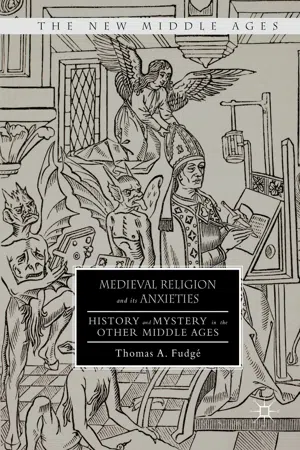
Medieval Religion and its Anxieties
History and Mystery in the Other Middle Ages
- English
- ePUB (mobile friendly)
- Available on iOS & Android
eBook - ePub
About this book
This book examines the broad varieties of religious belief, religious practices, and the influence of religion within medieval society. Religion in the Middle Ages was not monolithic. Medieval religion and the Latin Church are not synonymous. While theology and liturgy are important, an examination of animal trials, gargoyles, last judgments, various aspects of the medieval underworld, and the quest for salvation illuminate lesser known dimensions of religion in the Middle Ages. Several themes run throughout the book including visual culture, heresy and heretics, law and legal procedure, along with sexuality and an awareness of mentalities and anxieties. Although an expanse of 800 years has passed, the remains of those other Middle Ages can be seen today, forcing us to reassess our evaluations of this alluring and often overlooked past.
Information
© The Author(s) 2016
Thomas A. FudgéMedieval Religion and its AnxietiesThe New Middle Ages10.1057/978-1-137-56610-2_11. The Feast of the Ass: Medieval Faith, Fun, and Fear
Thomas A. Fudgé1
(1)
School of Humanities, University of New England, Armidale, New South Wales, Australia
Commenting on the scandalous carnivalesque “Feast of the Ass,” Richard of St. Victor, the twelfth-century prior of a famous Augustinian abbey in Paris, drew attention to another side of the Middle Ages. “But today, more than other days of the year, they concentrate on fortune-telling, divinations, deceptions, and feigned madness. Today they outdo each other in turn with offerings of observation of silly or superstitious intent. Today, having been seized up by the furies of their bacchant-like ravings and having been inflamed by the fires of diabolical instigation, they flock together to the church, and profane the house of God with vain and foolish rhythmic poetry in which sin is not wanting but by all means present, and with evil sayings, laughing and cacophony … and many applaud with the hands of priests, and the people love these things.” 1
One of the more popular medieval farces, the Feast of the Ass (festum asinorum) was originally held on Christmas Day but later celebrated on 14 January. Initially, the feast was a celebration of the beast that carried Mary and the infant Jesus to safety in the face of the massacre of the innocents ordered by King Herod. Later, it evolved into a raucous festival. The event was celebrated as a masquerade. Priests and clerks wore masks, dressed as minstrels, women, or pimps, and danced in the choir while singing dishonourable songs. They played games in sacred places. They ran and jumped shamefully throughout the churches without any embarrassment. They scuttled about town on carts and caused great laughter with their vulgar acts, scurrilous gestures, and immoral talk. Masks depicting biblical characters predominated. The most popular was Balaam on his famous talking ass. A monstrously dressed cleric would be chosen as bishop, placed on an ass, facing the tail and would be led into the church for Mass to the shout “Balaam comes” as the ass entered. Pseudo-Balaam spurred the ass, and on behalf of the beast, someone cried out, “why do you spur me so hard, you wretch?” whereupon someone else intoned the words, “Cease to obey the commands of King Balek.” Then the crowd implored the ass to prophesy. At Sens, the choirboys had a custom of calling their archbishop “Ass” during the festival. 2 Nominated persons carried a plate of broth before the ass and a jug or bowl of beer, and the ass was permitted to eat in the church. The ass incensed the altars and raising one leg, called out in a loud voice, “Boo.” The clerics carried large torches rather than the usual candles. The ass rode from altar to altar incensing as he went while everyone sang the “song of the ass.” 3
Today is the day of gladnessAway all thoughts of sadnessEnvy and grandeur awayWe will rejoice with heart and voiceFor we keep the Ass’s Feast todayFrom eastern lands once there came a modest assThis ass was fine and very strongNo burden was too heavyHee Haw Mr. Ass, Hee HawAll are taken into the churchBy the great strength of the assNow he pants before his cartDrags his heavy burdenNow with strongest teeth he bitesThe tough straw in pieces fineClean straw and dry chaffSharp thistles he eatsThrashing on the box floorFrom early morn till nightHey, Mr. Ass, you sing Hee HawWith his flapping ears and longLo the harnessed son of songHe is chosen; hear his callAss of asses, lord of allNow say amen, you little assYou are sated with your strawAmen, amen, over againFly from that which wasHee Haw, Mr. Ass, Hee Haw. 4
The ass was then led to the high altar, having been taught to kneel at the proper place while the priest-pretender chanted the refrain: “Hee Haw, Mr. Ass, Hee Haw.” Then the entire congregation joined in the chorus, with the speaker for the ass taking up the refrain: “Hee Haw, Mr. Ass, Hee Haw. This is the famous day, the most famous of all famous days. This is the festive day, the most festive of all festive days.” The clerics then turned their garments inside out and danced in the church while all the people looked on and laughed. When the ceremony came to an end, instead of the usual words of dismissal, the priest brayed three times like an ass and in place of the usual, “we bless the Lord,” the people responded by braying three times in the same manner. These mock religious festivals prevailed from the twelfth through the fifteenth centuries. By the end of the Middle Ages, the church increasingly began to legislate against them. Quite apart from special events like the Feast of the Ass, we find many examples of medieval church visitations wherein gross and blatant irregularities among the religious were notorious. 5 The Feast of the Ass reveals both medieval mentalities as well as anxieties.
The later medieval church made efforts to suppress these activities and their mandates echo the objections raised 300 years earlier by Richard of St. Victor. During session 21, on 9 June 1435, the Council of Basel passed a resolution “against performing spectacles in churches.”
These activities and efforts at their suppression reflect aspects of medieval religion and various levels of thinking around religious practice.In some churches, during certain annual celebrations, there are carried on various scandalous practices. Some people with miter, crozier and pontifical vestments give blessings after the manner of bishops. Others are robed like kings and dukes. In some regions this is called the Feast of Fools or innocents, or of children. Some put on masked and theatrical comedies, others organize dances for men and women, attracting people to amusement and buffoonery. Others prepare meals and banquets there. This Holy Synod detests these abuses. It forbids ordinaries as well as deans and rectors of churches, under pain of being deprived of all ecclesiastical revenues for three months, to allow these and similar frivolities, or even markets and fairs, in churches, which ought to be houses of prayer, or even in cemeteries. They are to punish transgressors by ecclesiastical censures and other remedies of the law. The holy synod decrees that all customs, statutes and privileges which do not accord with these decrees, unless they add greater penalties, are null. 6
The world of the Middle Ages was one filled with devils, witches, horrific demons, flying animals, spirits in the trees and grass, monsters, weird visions, magic, superstition, anticipation of the coming of the antichrist, the danger of an incubus or succubus in one’s bed, strange things occurring without explanation, diseases like the Black Death that swept Europe with long deadly strokes, natural disasters, the brevity of life, high infant mortality, cynicism and despair, conflict, crisis, and the coming and terrible end of the world embodied in the haunting lyrics of the thirteenth-century dirge Dies Irae. 7 The ideas compressed into the words of the “day of wrath” suggest a world of insecurity and fear but this, as we have suggested, was also an essentially religious world. The great fortress churches of Languedoc were erected as bulwarks against the rising tide of dissent and heresy. 8 All of this related intimately to the problems of life at the end of the Middle Ages: food shortages, the need for shelter, illness, death, divine punishment, and the advance of hostile enemies. Around these concerns arose popular beliefs that sought to explain the unexplainable and provide meaning to an otherwise meaningless existence. 9 This is not to suggest that life in the late medieval period was devoid of meaning. It has been shown that, even with the steep ascent of heretical inclination and the European reformations in the sixteenth century, there was an increase in piety and religious observance in different parts of Europe. 10 Official religion and popular beliefs mingled freely and, on the edges of the church world, cultural categories of popular religion evolved and we find glimpses of this in the other Middle Ages.
The definition of medieval popular religion is a fluid one, but it is possible to identify certain common themes and characteristics, namely, that the ideas were most often transmitted orally, that its observance was regulated by particular rituals, that it received its essential identity from the community that embraced it, and finally, that it existed in varying degrees of opposition to the prevalent forms and patterns of “official” religion. This is not to suggest that popular religion had no meaningful connection to literate, written, institutional, or official forms of religion. Popular religion did not necessarily exclude social élites, nor is it necessarily only the provenance of the lower classes. Indeed, it is purely arbitrary and artificial to attempt to divide either culture or religion into separate categories. 11 What the church did not or could not explain was taken up by the imagination of common people (e.g. barmaids and blacksmiths) and shaped into the numerous rituals and rites of purification and transition that characterize popular culture. Religion in its official, ecclesiastically sanctioned forms, emphasized faith in the unseen. Popular beliefs, on the other hand, constituted an unending quest for certainty and assurance. Popular beliefs and religion frequently acknowledged human inability to control the crises of the late medieval world, and thus, sought either to obtain or control higher power. Popular religion may be regarded in certain ways as a manipulation of power. These power struggles caused popular religion to undergo tremendous metamorphoses by the later Middle Ages.
The material and supernatural worlds were fundamentally significant for medieval culture. The supernatural world interfaced with the material world in many ways. Actions and activities in the natural world were believed to have ripple effects in the supernatural. Witchcraft iconography showing women stirring water and causing rain reflected the popular belief in similarity. 12 The celebration of the Eucharist and the mysterious transformation in the sacrament of the altar underscores the same conviction among the intelligentsia and official structures of belief. Both sacramentalism and magic had at its core the belief that ritual actions performed in the material world had relevance in the supernatural realm. It is not surprising to read medieval tales wherein all the water would be emptied from containers in a house after someone died therein lest the soul of the dearly departed drown. Windows in that dwelling were opened to allow the soul to escape. Neighbours closed theirs for obvious reasons. The material world also penetrated the supernatural, and in certain contexts, was considered an alien, contaminating intrusion. Therefore, heretics and other defiling undesirables might be ordered disinterred and removed from church cemeteries. The unpredictability, the capriciousness of these colliding worlds prompted a whole range of beliefs, ceremonies, rituals, popular religious observances, and physical boundaries. These included eaves, the threshold, fences, crossroads, gargoyles, and other arbitrary lines of demarcation that indicated the nebulous space between the natural and supernatural, spaces and lines where the supernatural crossed into the material realm. 13 These lines co...
Table of contents
- Cover
- Frontmatter
- 1. The Feast of the Ass: Medieval Faith, Fun, and Fear
- 2. Prosecuting Animals as Criminals in Medieval Europe
- 3. Piety, Perversion, and Serial Killing: The Strange Case of Gilles de Rais
- 4. Gargoyles and Glimpses of Forgotten Worlds
- 5. To Hell with the Theologians: Doctrines of Damnation in “Last Judgements” in the Medieval Latin West
- 6. Sensuality, Spirituality, and Sexuality in the Religious Experience of Female Mystics
- 7. Demonizing Dissenters: Patterns of Propaganda and Persecution
- 8. The Stripping and the Shaming of Heretics
- 9. Surviving the Middle Ages: The Extraordinary Pursuit of Salvation
- 10. The Fickle Hand of Fate
- Backmatter
Trusted by 375,005 students
Access to over 1.5 million titles for a fair monthly price.
Study more efficiently using our study tools.
Frequently asked questions
Yes, you can cancel anytime from the Subscription tab in your account settings on the Perlego website. Your subscription will stay active until the end of your current billing period. Learn how to cancel your subscription
No, books cannot be downloaded as external files, such as PDFs, for use outside of Perlego. However, you can download books within the Perlego app for offline reading on mobile or tablet. Learn how to download books offline
Perlego offers two plans: Essential and Complete
- Essential is ideal for learners and professionals who enjoy exploring a wide range of subjects. Access the Essential Library with 800,000+ trusted titles and best-sellers across business, personal growth, and the humanities. Includes unlimited reading time and Standard Read Aloud voice.
- Complete: Perfect for advanced learners and researchers needing full, unrestricted access. Unlock 1.5M+ books across hundreds of subjects, including academic and specialized titles. The Complete Plan also includes advanced features like Premium Read Aloud and Research Assistant.
We are an online textbook subscription service, where you can get access to an entire online library for less than the price of a single book per month. With over 1.5 million books across 990+ topics, we’ve got you covered! Learn about our mission
Look out for the read-aloud symbol on your next book to see if you can listen to it. The read-aloud tool reads text aloud for you, highlighting the text as it is being read. You can pause it, speed it up and slow it down. Learn more about Read Aloud
Yes! You can use the Perlego app on both iOS and Android devices to read anytime, anywhere — even offline. Perfect for commutes or when you’re on the go.
Please note we cannot support devices running on iOS 13 and Android 7 or earlier. Learn more about using the app
Please note we cannot support devices running on iOS 13 and Android 7 or earlier. Learn more about using the app
Yes, you can access Medieval Religion and its Anxieties by Thomas A. Fudgé in PDF and/or ePUB format, as well as other popular books in History & European Medieval History. We have over 1.5 million books available in our catalogue for you to explore.