- English
- ePUB (mobile friendly)
- Available on iOS & Android
eBook - ePub
Staging Romantic Chameleons and Imposters
About this book
Examining chameleonic identities as seen in theatrical performances and literary texts during the Romantic period, this study explores cultural attitudes toward imposture and how it reveals important and much-debated issues about this time period. Brewer shows chameleonism evoked anxieties about both social instability and British selfhood.
Information
C h a p t e r 1

The Case of the Pretended Duke of Ormond
Prologue: The Pretended Duke’s Predecessors
On June 4, 1663, Mary Carleton, nicknamed “the German Princess” by a fascinated public, and also known as Maria von Wolway from Cologne, Mary Modders from Canterbury, and Mary Steadman, stood trial for bigamy in the Justice Hall of the Old Bailey. Her husband, John Carleton, and his family maintained that she was the daughter of a Canterbury fiddler, had been previously married, and had tricked them into believing that she was a foreign noblewoman. In court, Mary Carleton’s performance as Maria von Wolway confounded prosecution witnesses, charmed spectators, and resulted in her acquittal (Kietzman 61–63). Soon after the trial, however, she published a short autobiography in which she conceded that she may have posed as a German aristocrat. In The Case of Madam Mary Carleton (1663), she claims that her imposture was justifiable: “What harme [sic],” she asks, “have I done in pretending to great Titles?” (36).1 According to her, it was not “unjust” for her “to contrive [her] own advancement by such illustrious pretences as they say [she] made use of, to grant the Question, that [she is] not so honourably descended as [she] insinuated to the Catch-dolt [her] Father in Law” (36–37).2 She explains that her performance was intended to “counterplot” those who had a “design” to take advantage of her and argues that “to deceive the deceiver, is no deceit” (38). Carleton’s story was dramatized in a play titled A Witty Combat: Or, the Female Victor (1663) in which she played the role of “Mary Moders” and recited the epilogue:
You think me a bold Cheat, put case ’twere so,
Which of you are not? now you’d swear I know;
But do not least [lest] that you deserve to be
Censur’d worse than you yet can censure me.
The Worlds a Cheat, and we that move in it
In our degrees do exercise our Wit:
And better ’tis to get a glorious Name
However got; then live by common Fame. (Porter n. pag.)3
For Carleton, the world is a masquerade in which everyone plays a role. She misrepresented herself to thwart deceivers and was rewarded with the “glorious Name” of German Princess. Her acquittal at the bigamy trial was, however, a fleeting triumph. She became a professional thief and was sentenced to transportation to Barbados as an indentured servant. After violating the conditions of her sentence by returning to England, she resumed her criminal career under various aliases, including the German Princess, and on January 22, 1673 she was executed at Tyburn for stealing “a silver cup and spoon” (Kietzman 225, 209).
As Mary Jo Kietzman has demonstrated, Carleton’s bravura performance as the German Princess “appealed to London’s non-elite populace because it democratized self-fashioning for both men and women of the lower classes” (6).4 Imposters like Carleton were viewed as skillful participants in the “universal masquerade.”5 According to Dror Wahrman, imposture developed a “bad reputation” (259) in the late eighteenth century as the modern conception of the stable and internalized self became normative. In certain cases, however, Romantic-era responses to imposters and disguises were ambivalent or even sympathetic. In 1817, for example, another counterfeit princess appeared in England: a servant named Mary Baker convincingly masqueraded as “Caraboo, the princess of an island called Javasu” (Russett 115).6 Unlike the German Princess, Princess Caraboo refrained from bigamy and larceny. As Margaret Russett has shown, after Baker’s fraud was discovered, “her ‘talents’ evoked ambivalent admiration” (114), and a contemporary observer wondered at “the imposter’s inventive genius” and her “consummate art” (Gutch 5n, 54).7 The unmasked Baker sailed for America, returned to England in 1824, and “died in late 1864 or early 1865, after a long and comparatively prosperous life during which she married and raised a daughter” (Russett 135).
This chapter focuses on a Romantic-era male imposter who posed as several English aristocrats and elicited respect and sympathy as well as condemnation from his contemporaries: the American-born James Molesworth Hobart (or Hub[b]ard) (1765?–1793), whose aliases included the Duke of Ormond, Lord Massey, and the Duke of Manchester.8 Like Carleton, Hobart was an eloquent speaker and astute performer who won acquittal in a highly publicized trial and whose criminal career ended on the scaffold. Moreover, both Carleton and Hobart became celebrities and inspired literary characters. Daniel Defoe modeled the protagonist of his novel Roxana (1724) partly on the German Princess, and a review from the Morning Chronicle asserts that Tippy, a charming rogue in Hannah Cowley’s comedy The Town before You, “is obviously drawn from the Duke of Ormond, whose feats, as the counterfeit of different men of rank, are on record” (December 8, 1794).9 I will argue that the public responses to Hobart’s impostures reflect a widespread fascination with criminal chameleonism and an uncertainty about how to understand and evaluate the phenomenon. The case of the soi-disant Duke could be used to support either the egalitarian notion that the nobility are indistinguishable from genteel and well-dressed commoners or the conservative fear that imposters who pose as aristocrats and assume their prerogatives threaten social order. While contemporaneous accounts deplored Hobart’s illicit actions, they often praised his acting ability, charm, attractive appearance, sangfroid, and excellent manners. In a culture that prized theatrical spectacle, his flawless impersonations of aristocrats and charisma in the courtroom and on the scaffold inspired wonder and admiration. The Life and Extraordinary Adventures of James Molesworth Hobart, Alias Henry Griffin, Alias Lord Massey, the Newmarket Duke of Ormond, &c. (1794) asserts that “he possessed many excellent qualities, both natural and acquired” and attributes his corruption to his lack of “moral discipline,” immoral mentors, and “little circumstances which gradually debase the mind” (Dralloc 247, iii).
Among Hobart’s chameleonic precursors were two notorious eighteenth-century serial imposters, Charles Price (1730?–1786), nicknamed “The Social Monster” (Figure 1.1), and James George Semple (1759–1815), dubbed “The Northern Imposter,” whose life stories were recounted in popular 1786 biographies. In Memoirs of a Social Monster; or, The History of Charles Price, Price is demonized as the “twin-brother” (ix) of Lucifer, and the work’s author declares that “with a thousand bad qualities, those who knew him most intimately cannot recollect, that he had even one good one” (38). A talented polymorph, Price assumed innumerable aliases, frequently wore disguises, and posed as a Methodist minister to rob “an old methodistical lady . . . of near 3000 pounds” (89). As his biography points out, “he, who knew so well how to become all things to all men, could as easily become a Methodist preacher, as any other profession he had before” (87–88, italics in original). Memoirs of a Social Monster explains that Price’s upbringing as the son of a tailor and clothes salesman informed his criminal career: “the idea of disguising himself, which he has practised for so many years past, was suggested to him by the circumstance of having been brought up where he had opportunities to shift his cloaths as he pleased” (32). In 1780, Price masqueraded as Mr. Brank, the elderly and infirm guardian of a “young nobleman of great fortune” (208), and hired a naive youth named Samuel to pass counterfeit banknotes. His unwitting accomplice
saw an apparent old man affecting the foreigner, seemingly very gouty, wrapped up with five or six yards of flannel about his legs, a camblet [sic] surtout buttoned up over his chin, close to his mouth, a large patch over his left eye, and every part of his face so hid, that the young fellow could not see any part of it, except his nose, his right eye, and a small part of that cheek. To carry on the deception still better, Mr. Price thought proper to place the man on his left side, on which eye the patch was, so that the old gentleman could take an askance look at the young man with his right eye, and by that means discover only a small portion of his face. He appeared, by this disguise, to be between sixty and seventy years of age; and . . . not much under six feet high, owing to boots or shoes, with heels very little less than three inches high . . . Mr. Price affected great age, much bodily infirmity, and a faint hectic cough, with a disability of almost getting out of the coach. (207–208)
After the unfortunate Samuel “obtained cash, and other valid securities, to the amount of fourteen hundred pounds, on [Price’s] forged notes” (215), he was arrested and spent 11 months in prison. The Social Monster’s elaborate disguise prevented him from being identified, and he absconded with the money. He was, however, arrested in early 1786, identified as a forger, and averted execution by hanging himself. According to The Complete Newgate Calendar, “The depredations of this villain amounted in the whole to upwards of one hundred thousand pounds” (Crook 164), making Price the most successful swindler of his era.10
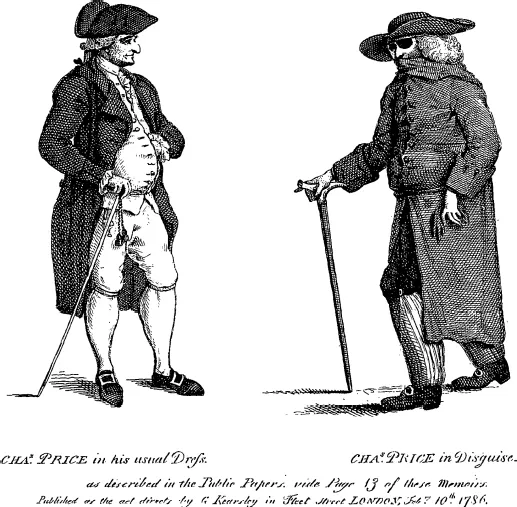
Figure 1.1 “Charles Price in his usual Dress. Charles Price in Disguise.”
“CHAs. PRICE in his usual Dress. CHAs. PRICE in Disguise as described in the Public Papers vide Page 13 of these Memoirs.” Frontispiece to The Fourth Edition Much Improved: Being a More Minute and Particular Account of that Arch Imposter, Charles Price (1786). Reproduced courtesy of the Social Law Library in Boston, Massachusetts.
Although Price’s biographer admires his subject’s ingenuity, he condemns him as an inhuman “monster” whose suicide indicated “that his cowardice was as great as his cunning” (Memoirs of a Social Monster 343). The biographer worries, however, that the reader might be more amused than outraged by the forger’s impersonation of a pious philanthropist: “What we are most afraid of is, that the narrative will be read with a smile, and a warmth of imagination, when it ought to throw the human frame into an ague fit” (263). If the scoundrel’s impostures are sufficiently entertaining, there is a danger that he will be perceived as a comic rather than a vicious character. Unlike Hobart, who flaunted his good looks, youth, and polished manners, Price masked his appearance, pretended to be old and diseased, and seems to have been bereft of gentility. Whereas The Life and Extraordinary Adventures of James Molesworth Hobart insists that Hobart possessed “many excellent qualities,” Memoirs of a Social Monster declares that Price’s “road from his cradle to his grave, was the road of vice and dishonesty, of fraud, rapine, and plunder, of dissimulation and hypocrisy” (304). These biographical accounts, published eight years apart, offer very different portraits of criminal chameleons: Hobart’s charisma and urbanity contrast sharply with Price’s effrontery and grotesque masquerades. What seems to separate the humanlike from the monstrous chameleon is the ability to deliver a sympathetic and gentlemanly performance. While The Life and Extraordinary Adventures characterizes Hobart as a promising and well-bred youth corrupted by intemperance and circumstances, Price’s biography portrays its subject as a lifelong rogue whose appearance frequently changed but whose duplicity and ruthlessness were innate and immutable.
Hobart more closely resembled Semple, who possessed “an elegant figure, a person exceeding[ly] well made, and a genteel deportment [that] gave him a pre-eminency in point of attraction” (19) and frequently claimed to be related to or associated with the highborn and powerful. The “compiler” of The Northern Imposter; Being a Faithful Narrative of the Adventures, and Deceptions, of James George Semple (1786) proclaims that “the GREAT CHARLES PRICE” and Semple were the leading figures in an unprecedented upsurge of swindlers: “a very few years have eclipsed the transactions of ages, and . . . England can boast of more renowned exploits in that short period of time, than ever were signalized throughout all Europe during the last century” (13–14). According to the compiler, this crime wave was caused by inadequate legislation: “whilst the absurdity of our penal statutes have opened doors of invitation to ingenious chicanery, the scandalous and contemptible artifices of dirty pettifogging attornies [sic], and Old Bailey bar-orators, have given a loose and encouragement to every species of fraud and imposition” (14). Sponsored by Semple’s alleged victims, The Northern Imposter presents him as a mock-heroic reprobate claiming descent from the Lisles, “a noble family in Scotland” (28). In his autobiography, The Life of Major J. G. Semple Lisle (1799), Semple protests against the “anonymous libels” (vii) published in earlier accounts of his life, but while The Northern Imposter is clearly biased against its subject, the information it presents is corroborated by contemporary news stories, and Semple’s memoir is vindicatory and frequently improbable.
The Northern Imposter informs the reader that Semple was born and educated in Scotland, where “he was soon made conversant in Latin and Greek” and developed “an understanding capable of every improvement, and an affability of temper, so consonant to the things that be, that he was a most engaging companion, wherever he could introduce himself” (19, italics in original). Semple’s autobiography contends that his vicissitudes resulted from his privileged upbringing: “Born of an antient and noble race, but not possessed of riches equal to their rank, I naturally imbibed ideas of a too lofty kind; flattered in my youth by my rich and powerful friends, I formed to myself plans of future grandeur; plans, which my impetuosity of disposition prevented me from realizing” (363). His autobiography also claims that Semple’s “military debût was made in America, in the year 1775, at the age of sixteen” (3) and that after being captured and wounded in the conflict, he returned to England in 1777. According to this account, Semple, like Hobart, was a veteran of the American Revolution who turned to crime after leaving the military. As J. M. Beattie points out, demobilization “brought back to England large numbers of disreputable men who had spent several years being further brutalized by service in the armed forces, without any provision being made for their re-entry into the work force” (226). Both Semple and Hobart employed military aliases: Semple posed as Major Harrold, Major Maxwell, Major Grant, Major Cunningham, Colonel Crawford, and Major Winter, and Hobart pretended to be “an officer in the Coldstream regiment to the Duke of York” (Authentic Memoirs 13), Captain Blundell, and Captain Monson of the Dragoons. Another factor in the rising crime rate during the eighteenth century was urbanization (Gladfelder 159–161), and The Northern Imposter attributes Semple’s corruption to his residence in London: “It was to [the] inadvertent step in the elder Semple, of intrusting his son as his own master in a town, where the utmost resolution and fortitude are too often ineffectual security against vice and debauchery, that the younger Semple owes his ruin. It was more highly criminal in him, as he knew the natural bent of his son’s inclinations. Let us pity, therefore, whilst we condemn” (24). Although this life of Semple denounces his crimes and argues that swindling should be made a capital offence (96), it portrays him as a rogue corrupted by metropolitan temptations rather than as a social monster like Price.
The compiler of The Northern Imposter explains the swindler’s modus operandi:
Wherever Mr. Semple attempted to obtain, or was successful in obtaining either money or goods, the imposition was founded on his real or pretended knowledge of some respectable character who he knew was acquainted with, or was a customer to, the person he applied to, either to borrow cash, or take up goods upon credit.—This artifice was seconded by the deception of his own personal appearance, which, added to the natural plausibility of his language, was as specious and as alluring as the Grand Deceiver’s . . . This will, once and for all, account for his success in that line of Swindling, at which he was so complete an adept[.] (43)
The Northern Imposter provides numerous instances of Semple’s name-dropping and fraudulent networking. While in Cologne, Semple allegedly befriended a German baron: “He stiled himself a Major in his Britannic Majesty’s service, described himself of a noble family in Scotland, and boasted his great intimacy with the first of the English nobility” (28). He then falsely claimed that he was in exile from England after killing two gentlemen in separate duels and in dire financial straits. Moved by this gentlemanly performance, the baron invited Semple to live “on [his] bounty as a man of consequence and fashion” (30). The Northern Imposter testifies that on another occasion Semple was brought before a magistrate for absconding without paying a fare to a post-chaise driver. Unabashed, the culprit “ran through his lineage and history, even from the year 1547, when the title of Lord Viscount Lisle became extinct, . . . harangued on his importance to government[,] . . . declared himself the bosom friend of Mr. Pitt; [and] said he was on his Majesty’s service with the expresses of the most important and serious nature to this kingdom” (76). The magistrate was so impressed that he paid Semple’s fare and supplied him with cash.
Along with William Pitt (then Chancellor of the Exchequer), Semple pretended to have connections with Lord Salisbury, ...
Table of contents
- Cover
- Title
- Introduction
- 1 The Case of the Pretended Duke of Ormond
- 2 Richard Cumberland’s Imposters
- 3 Thomas Holcroft’s Politicized Imposter and Sycophantic Chameleon
- 4 Fluid Identities in Hannah Cowley’s Universal Masquerade
- 5 Mary Robinson’s Polygraphs
- 6 James Kenney’s Opportunistic, Reformative, and Imitative Chameleons
- Epilogue: The Perkin Warbeck Debate
- Notes
- Works Cited
- Index
Trusted by 375,005 students
Access to over 1.5 million titles for a fair monthly price.
Study more efficiently using our study tools.
Frequently asked questions
Yes, you can cancel anytime from the Subscription tab in your account settings on the Perlego website. Your subscription will stay active until the end of your current billing period. Learn how to cancel your subscription
No, books cannot be downloaded as external files, such as PDFs, for use outside of Perlego. However, you can download books within the Perlego app for offline reading on mobile or tablet. Learn how to download books offline
Perlego offers two plans: Essential and Complete
- Essential is ideal for learners and professionals who enjoy exploring a wide range of subjects. Access the Essential Library with 800,000+ trusted titles and best-sellers across business, personal growth, and the humanities. Includes unlimited reading time and Standard Read Aloud voice.
- Complete: Perfect for advanced learners and researchers needing full, unrestricted access. Unlock 1.5M+ books across hundreds of subjects, including academic and specialized titles. The Complete Plan also includes advanced features like Premium Read Aloud and Research Assistant.
We are an online textbook subscription service, where you can get access to an entire online library for less than the price of a single book per month. With over 1.5 million books across 990+ topics, we’ve got you covered! Learn about our mission
Look out for the read-aloud symbol on your next book to see if you can listen to it. The read-aloud tool reads text aloud for you, highlighting the text as it is being read. You can pause it, speed it up and slow it down. Learn more about Read Aloud
Yes! You can use the Perlego app on both iOS and Android devices to read anytime, anywhere — even offline. Perfect for commutes or when you’re on the go.
Please note we cannot support devices running on iOS 13 and Android 7 or earlier. Learn more about using the app
Please note we cannot support devices running on iOS 13 and Android 7 or earlier. Learn more about using the app
Yes, you can access Staging Romantic Chameleons and Imposters by William D. Brewer in PDF and/or ePUB format, as well as other popular books in Literature & British History. We have over 1.5 million books available in our catalogue for you to explore.