- English
- ePUB (mobile friendly)
- Available on iOS & Android
eBook - ePub
About this book
Based on a decade of study, this book provides a scholarly overview of organic dairy politics, showing how politics, policy, and protest both inside and outside of agriculture can determine a future of pastoral landscapes resembling an earlier time in the western world or, alternatively, one made of dystopian ruralities.
Information
1
Introduction: What Is Organic Dairying?
What is organic dairying? Idyllic visions of cows chewing wildflowers in verdant meadows vie with factory farms in answering that question. It is a tough question because the priorities of people engaged in dairying vary along food chains according to the focus of stockholders on financial profit, and amid the mix of concerns of stakeholders (including family farmers, rural communities, and urban consumers) for social justice, environmental sustainability, and animal welfare. With so much at stake, metaphors of pasture wars are apt.
The words of a Dutch American uncle ring in my memory. Over coffee one day in the 1980s, he laughed ruefully, saying, “Once a farmer could make a living with twenty cows. Now you can’t make it with two hundred.” The decline in real milk prices has not been kind to farmers or to cows, whose longevity has fallen. Certified organic dairying was planned to fix those problems, but it is a tale of mixed success.
This book chronicles clashes in organic politics in the context of its past and its possible futures. In his book Liquid Materialities: A History of Milk, Science and the Law (2010), Peter Atkins relates how geographers and other social scientists have followed political struggles over quality and safety definitions of milk, which in its natural variability of fats, solids, and microorganisms manifests a sort of material resistance to easy classification, sanitation, or preservation. Atkins (159) notes Zygmunt Baumann’s view of the classification of foods such as milk as important to modernity, and he notes that Michel Foucault (1975) goes further, deeming measurement a part of government. Thus have politicians and the media joined battle over organic rules at home and abroad. Our focus is the United States, which exports only about 12 percent of its dairy output but can greatly influence best practices around the world. Therefore, as America harmonizes rules with its transatlantic and transpacific trading partners, it is vital to optimize them to ensure fairness to farmers, processors, traders, and the biosphere.
Reviewing 30 years of organics, Garth Youngberg and Suzanne P. DeMuth (2013: 30) observe, “While many conventional agriculturists continue to reject and disparage organic farming, distorting its image and limiting its broader application, the American consumer has enthusiastically embraced organic products and much of its ideology.” Consumers cling to the nebulous but comforting notion of “nature” in organic farming. But business seeks to control or appropriate natural forces in time and space, and substitute more predictable industrial processes when practical, in order to bolster stockholders’ profits (Fine, Heasman, and Wright 1996: 150).
Competing priorities confront people from farm to plate, with consequences for animals, the environment, and society. Multiple perspectives are illustrated by competition between family-scale farmers and agribusiness. The U.S. Department of Agriculture (USDA 1999; 2007) defines agribusiness as “industries involved with manufacture, processing, and distribution of farm products” and describes an “escalating concentration of agribusiness . . . into fewer and fewer hands.” Farmers’ control of markets and their share of consumer spending on food products have diminished. Consolidation brought the loss of over 155,000 farms from 1987 to 1997, while 30 million acres of farmland were lost to urban and suburban sprawl from 1970 to 1997. The trend continues.
The term agribusiness overlaps—and is about as old as—our era of intensive dairying (Davis and Goldberg 1957). In his abstract for “Case Studies in Agribusiness: An Interview with Ray Goldberg,” Grandon Gill (2013: 203–12) writes, “Agribusiness refers to the collection of global systems involved in the production, distribution and consumption of food and fiber . . . The term was first coined by Harvard Business School (HBS) professors Ray Goldberg and John Davis in the 1950s.” Gill’s abstract (203, 204) describes agribusiness as “the complex relationships between agricultural products, trade, technology, and public policy.” In the interview, Goldberg, who still teaches at Harvard, explains that “the farmer was just as much a businessman as anybody else,” and they “really should encompass the whole value-added chain. So we . . . called it agribusiness.” Davis and Goldberg “included the subsistence farm as well as the commercial farmer because they were an integral part of the whole system.” Unlike many econometrists, they considered the social effects of agribusiness, shown in the following example of the world’s largest dairy development program, which increased smallholder incomes in India.
Through junior colleague Michael Halse, Goldberg acted as a guru to the Food and Agricultural Organization of the United Nations (FAO-UN) and farmers’ cooperative leader Verghese Kurien in planning India’s “White Revolution” in milk (Kurien 2005: 107; Scholten 2010: 185, 221). Despite massive demand for high-protein milk, Indian production in the 1960s dipped as low as 20 million tons per year. This was linked to the sporadic donations of dairy aid from Europe’s surplus “Butter Mountain,” which amounted to dumping and disincentivized India’s farmers. Dumping can harm food security in postconflict environments, such as India’s postcolonial transition, or after the Bangladesh war of independence in 1971, and Uganda’s conflicts of the 1970s and 1980s (Scholten and Dugdill 2012: 148, 156, 253). India’s landless, smallholder, and marginal cooperative farmers averted further dumping in a program called “Operation Flood” (1970–96), which monetized European butter oil and milk powder to fund India’s own dairy infrastructure. When domestic processors and traders attempted to substitute cheap dairy aid, the 1984 Jha Committee Report mandated that they pay more for domestic milk, which incentivized smallholders and eventually boosted India’s output past that of America’s with 81.4 million tons in 1998 (Scholten 1999: 287).
This illustrates Goldberg’s understanding of the unequal power relationship between subsistence farmers in India and domestic dairy processors and retailers, who were willing to ignore domestic farmers if they could profit a few more rupees by using cheaper, dumped European commodities. It also parallels, as C. S. Sundaresan suggests in the foreword to this book, the asymmetrical power relations between family-scale organic farmers and major American processors and traders who have access to cheaper organic products on world markets.
Technological advances in the Second World War spurred postwar trade with improved command and control of global food chains and transport tracked by, eventually, digital satellite communications. Just as profound were supranational political changes. Since the Uruguay Round Agricultural Agreement (URAA 1994) brought farm trade under the aegis of the embryonic World Trade Organization (WTO 1995), U.S. family-scale organic farmers have faced greater pressure from global agribusiness. Freer trade under the WTO puts farmers in developed countries, such as the United States, at a disadvantage to processors and retailers who can access cheaper foreign food sources.
On one hand, small organic farmers fear free riders taking unfair shortcuts (such as not pasturing cows) that besmirch the integrity of time-honored practices. On the other hand, they fear appropriationism via agribusiness’s lobbying for regulations that allow for the industrialization of traditional processes, such as substituting feedlots for pasture or permitting cheap synthetic ingredients such as chemically-derived omega-3 fatty acids to be added during processing of milk products certified as USDA organic. Due to the many forms of appropriationism, purists worry that organics are being adulterated around the edges.
Chapter 3 notes a report by The Cornucopia Institute (2006a; c) titled Maintaining the Integrity of Organic Milk and its accompanying “Dairy Scorecard.” Along with that chapter’s “Organic Timeline,” they help readers assess the relative positions or competitors in what may be called “pasture wars” (hearkening to the ‘range wars’ of the nineteenth century). While any farm may be said to be part of agribusiness, the use of that term in this book generally connotes large-scale intensive operations, some with transnational power. In Chapter 7 this book offers anonymized, multiscale case studies, and opinions from respondents to a survey designed and conducted expressly for it. These are supplemented by information from farm visits around the country, some of them pictured herein. Lifting the veil on much of U.S. organics is Michigan State University’s Philip Howard (2014), whose flow chart “Organic Industry Structures” maps some of the acquisitions, mergers, and spin-offs documented in this book. Considering the varying priorities and motivations driving actors across scales, Julie Guthman articulates the paradoxes of appropriationism and substitutionism that mark organic dreams and commercial realities in California’s organics in her book Agrarian Dreams (2004: 209; see also Goodman, Sorj, and Wilkinson 1987). This is why, as Youngberg and DeMuth explain, there has also been tension between advocates of “certified organic” and “sustainable” farming.
There are also ongoing battles between advocates of strictly certified-organic foods and manufacturers and retailers who market products euphemistically labeled “natural” even though they may contain synthetic ingredients and genetically modified organisms (GMOs). So-called natural products are cheaper than organic to make, so there are financial motivations to persuade shoppers they are just as good as or better than organics. The nonprofit Anglo-American publication Academics Review (2014: 1–2) compares the relative sizes of the organics and natural sectors: “The global market for organic foods has reached $63 billion while the extended ‘natural’ products marketplace exceeds $290 billion in the U.S. alone.”
At the USDA (2013; 2014) economist Catherine Greene notes that organics already accounted for more than 4 percent of total U.S. food sales in 2012 and were expected to reach $35 billion in 2014 (compare to USDA 2002a by Dimitri and Greene). Greene explains that the government does not disaggregate national organic sales, but that industry estimates of $31 billion in organic sales in 2013 were led by produce (fruit and vegetable) and dairy representing about 43 and 15 percent of total organic sales, respectively, in a pattern that has lasted years.
Background
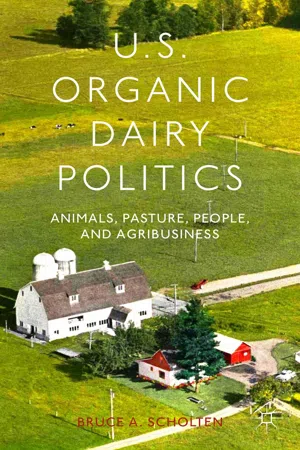
Social scientists might say the present author’s positionality is embedded in years of experience with small-, medium-, and large-scale farms. The author grew up on a family dairy farm in Washington State, and this text is based on decades of observation of dairy politics. Much has changed since the 1960s when the cover picture was taken and when such a barn, plus capital investments in equipment, 40 to 80 acres of land, 40 cows (a bull, plus heifers), with a house sufficient for a typical farm family was estimated at around $250,000. Today that figure is in the millions, due to the greater investments needed to maintain net incomes against rising input costs and lower conventional milk prices.
The classic response to such conditions is to increase economies of scale. In the twentieth century, conventional U.S. farmers and agribusiness suppliers tried to control biological cycles, improve yield, and fight disease with off-farm chemical inputs. But some American dairy families choose the organic way. In individual contracts or via cooperatives, they sell certified-organic milk for higher prices than conventional. But the premium they receive for organic milk has been whittled down by competitors, whom Michael Pollan, a professor of journalism at the University of California, Berkeley and popular writer on food and farming, dubbed the “organic-industrial complex” in a 2001 article in the New York Times Magazine.
This book builds on the author’s research conducted for various freelance journalism articles on the global farm trade since 1988 and on graduate studies, including a doctoral dissertation comparing consumer risk reflections on conventional, organic, and local food in Seattle to those in Newcastle upon Tyne in the United Kingdom. Most consumers in both localities stated a preference for local food but were open to organic experimentation, especially when weaning children from human breast milk. Mixed research methods included surveys, focus groups with academics, firefighters, motorcyclists, and others, and interviews with people along food chains.
The dissertation featured a case study of an “organic Pasture War” (Scholten 2007: iii), including discussion of a mid-2000s boycott of organic-industrial milk brands by consumers who feared that factory farms’ violations of “access to pasture” grazing rules contradicted a rural idyll falsely suggested in their advertising. It was submitted three years before the U.S. Department of Agriculture (USDA) issued a long-delayed final “Pasture Rule” in 2010 (Sustainable Food News 2007). But research continued with participant observation in electronic dairy forums, farm visits, USDA meetings, and a 2013 survey on dairy politics.
Chapters
This book’s objective is to explore the views of agribusiness, consumers, farmers, and other actors on salient issues, such as the Pasture Rule and the use of antibiotics, in the hope of optimal outcomes for all involved.
Chapter 1: Introduction: What Is Organic Dairying?
This chapter introduces the “wars” thread in the narrative. From the perspective of human geography, competition for land and resources is a problematic—that is, it is a problem that never goes away. Such struggles, political or by other means, over the distribution of economic wealth recur in time and space according to local conditions and—as this book details—to government rules on organic dairying.
Chapter 2: Agricultural Revolutions: Winter Was Bleak before Haymaking
This chapter summarizes agricultural revolutions since prehistory. The history of farming and food systems is traced in the United States, which, as in Europe, accelerated an intensive productionist paradigm after the Second World War. Negative externalities of productionism, such as environmental degradation and food scares, drive current policy choices, between biotechnologically medicalized approaches (using GMOs and nanotechnology) in agribusiness and Big Pharma–driven food systems, versus organic systems from family-scale farms to consumers’ tables.
Chapter 3: USDA Organic Pasture War: Where Have All the Cow Herds Gone?
This chapter examines the origins of the USDA Pasture War, as extensive pasture grazing gave way to intensive confinement systems in the twentieth century. Benchmarks include the Organic Foods Production Act in 1990, debate over synthetic ingredients permitted in organic foods, and a consumer boycott of megadairy brands in the 2000s (which shoppers suspected of violating the letter and spirit of organic dairying by denying their cows access to pasture—an egregious error that negatively affected animals, the environment, and the livelihoods of family-scale farmers skilled in keeping them). Chapter 3 runs through the final Pasture Rule of 2010. Despite being an apparent victory for grazers, hostilities continue amid charges of underfunded monitoring of megadairies and lax enforcement by the National Organic Program (NOP).
Chapter 4: Animal Welfare: From Rudolf Steiner to the St. Paul Declaration
The focus is on cow longevity marked by their age at culling and slaughter. Organic dairying is traced from the Austrian Rudolf Steiner, to the British organic movement, the Rodale Institute in America, and the International Federation of Organic Agricultural Movements, whose St. Paul Declaration demands that sentient animals be allowed to perform natural behaviors, such as grazing (IFOAM 2006).
Chapter 5: Stewardship in the Northwest: Dutch Stewards, Vets, and Researchers Discuss U.S., Canadian, and European Rules
Anthropologist Joyce LeCompte-Mastenbrook’s ethnography of Whatcom County dairying examines care for cattle and land from dynamic perspectives of Christian stewardship.
Chapter 6: An...
Table of contents
- Cover
- Title
- Copyright
- Contents
- List of Photos and Illustrations
- Foreword
- Preface
- Acknowledgments
- Acronyms and Glossary
- 1 Introduction: What Is Organic Dairying?
- 2 Agricultural Revolutions: Winter Was Bleak before Haymaking
- 3 USDA Organic Pasture War: Where Have All the Cow Herds Gone?
- 4 Animal Welfare: From Rudolf Steiner to the St. Paul Declaration
- 5 Stewardship in the Northwest: Dutch Stewards, Vets, and Researchers Discuss U.S., Canadian, and European Rules
- 6 Antibiotics and Health in the Northeast and Beyond: Experts on U.S., Canadian, and European Rules
- 7 Family Farms and Megadairies: Effects on Cows, Land, and Society
- 8 Conclusions and Outlook: Agribusiness, Cooperatives, and Power to 2050
- Bibliography
- Index
Trusted by 375,005 students
Access to over 1.5 million titles for a fair monthly price.
Study more efficiently using our study tools.
Frequently asked questions
Yes, you can cancel anytime from the Subscription tab in your account settings on the Perlego website. Your subscription will stay active until the end of your current billing period. Learn how to cancel your subscription
No, books cannot be downloaded as external files, such as PDFs, for use outside of Perlego. However, you can download books within the Perlego app for offline reading on mobile or tablet. Learn how to download books offline
Perlego offers two plans: Essential and Complete
- Essential is ideal for learners and professionals who enjoy exploring a wide range of subjects. Access the Essential Library with 800,000+ trusted titles and best-sellers across business, personal growth, and the humanities. Includes unlimited reading time and Standard Read Aloud voice.
- Complete: Perfect for advanced learners and researchers needing full, unrestricted access. Unlock 1.5M+ books across hundreds of subjects, including academic and specialized titles. The Complete Plan also includes advanced features like Premium Read Aloud and Research Assistant.
We are an online textbook subscription service, where you can get access to an entire online library for less than the price of a single book per month. With over 1.5 million books across 990+ topics, we’ve got you covered! Learn about our mission
Look out for the read-aloud symbol on your next book to see if you can listen to it. The read-aloud tool reads text aloud for you, highlighting the text as it is being read. You can pause it, speed it up and slow it down. Learn more about Read Aloud
Yes! You can use the Perlego app on both iOS and Android devices to read anytime, anywhere — even offline. Perfect for commutes or when you’re on the go.
Please note we cannot support devices running on iOS 13 and Android 7 or earlier. Learn more about using the app
Please note we cannot support devices running on iOS 13 and Android 7 or earlier. Learn more about using the app
Yes, you can access U.S. Organic Dairy Politics by B. Scholten in PDF and/or ePUB format, as well as other popular books in Biological Sciences & Ecology. We have over 1.5 million books available in our catalogue for you to explore.