- English
- ePUB (mobile friendly)
- Available on iOS & Android
eBook - ePub
About this book
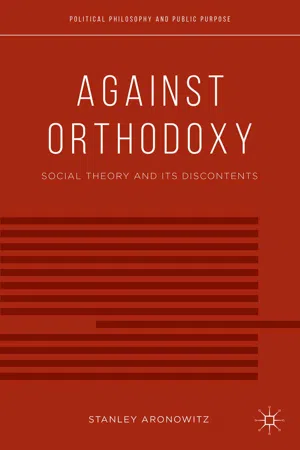
The book contains groundbreaking and immersive essays on crucial 20th Century scholars on social theory, discussed and analyzed from a radical, critical theory perspective. Aronowitz provides his unique and lauded critical eye toward the leading thinkers of our age, crafting an immersive set of essays on radical thought.
Information
Topic
PhilosophySubtopic
Critical TheoryCHAPTER 1
The Unknown Herbert Marcuse
The year 1998 is the hundredth anniversary of Herbert Marcuse’s birth. After decades of teaching and writing for relatively limited, mostly academic audiences, in the 1960s he became a figure of international renown, and some of his books became bestsellers. But it seems that he had just fifteen minutes of fame; his work is now out of fashion and virtually unread by students, activists, and academics, save for the narrow circle of those who work and teach in the tradition of the Critical Theory of the Frankfurt School. Nevertheless, due to one of those mysterious conjunctions of history and thought, Marcuse was one of the figures from which Russell Jacoby derived his model of the “public” intellectual. A philosopher who never ceased to remind his readers that he was an “orthodox Marxist,” he borrowed freely from the phenomenological tradition, especially its Heideggerian spin; from sociology, mainly Max Weber’s; and, most famously, from the metatheories of Sigmund Freud regarding the relation of the individual to society.1
His conception of theoretical and political “orthodoxy” was in the direct line from Marx to Rosa Luxemburg and, except for a brief period immediately after World War II, did not extend to the Leninist tradition. His political position was consonant with the small anti-Leninist communist movement that broke from the German and Dutch Communist Parties in the 1920s known as “councilists,” so named because their conception of the new society was based on workers’ councils.2 In this respect, Marcuse once remarked that the best critique of his work came from one of the movement’s anti-Leninist founders, Paul Mattick, whose virtually unknown book Critique of Marcuse (1971) takes Marcuse to task for failing to pay sufficient attention to the contradictions of the processes of capital accumulation, and for ignoring the implications of capitalism’s crisis tendencies. Marcuse was always opposed to the revolutionary goal of seizing “state power” and, in this respect, was closer to his critic Mattick than to many of his admirers. His conception of a new society was one in which the producers controlled production and popular organs such as councils exercised power over public life. And he scorned notions of revolutionary “dictatorship” even as a transitional measure.
Even as many complained that Marcuse’s prose was difficult to read, his writing and his political interventions animated the generation of 1968 like no other social theorist’s. He was celebrated and widely read by New Left activists throughout the advanced capitalist world, but also in countries like Mexico and Brazil where student movements challenged the status quo. Vilified by communists and social democrats alike for the libertarianism of his Marxism and its lack of programmatic specifications, students and others in the once massive independent Left somehow knew that he meant for them to flesh out the solutions for which he could only suggest problems. Perhaps more importantly, together with Henri Lefebvre and the Situationists in France, and C. Wright Mills and Paul Goodman in the United States, he held up a mirror to their lives by articulating the banality and boredom endemic to late capitalist everyday life. While he was closely identified with Critical Theory—the version of Marxism associated with the so-called Frankfurt School—unlike the two other prominent figures in the movement, Theodor Adorno and Max Horkheimer, the object of his investigation and reflection was praxis, a perspective eventually renounced on empirical/historical grounds by the others.
Marcuse was a student of Soviet ideology and a severe critic of Stalinism—indeed, his Soviet Marxism (1953) may be the most insightful study of the subject—but he never took the road chosen by some of his contemporaries, whose anti-Stalinism often led them to veer rightward toward liberalism and beyond. Both Marcuse and the group of Americans known as the New York Intellectuals began from political premises informed by their judgment of the Soviet Union as the leader of an authoritarian power bloc within the system of world domination. There the similarity ends. He wrote in some of the leading journals of anti-Stalinist liberalism, including Partisan Review, the most influential among them, but he never associated with those ex-radicals who, after World War II, traveled together to the center, at different paces. For unlike Daniel Bell and others whose anti-Stalinism ended in despair and, eventually, in the ambivalence of neoconservatism (an ambivalence that led Bell, for example, to disdain the chance that, in a period of unparalleled capitalist prosperity, anything was possible save more of the present), Marcuse exemplified Gramsci’s dictum: pessimism of the intellect, optimism of the spirit. More to the point, while his hopes were utopian, unlike the party Marxists and those whose radicalism gave way to a grudging or blinkered reconciliation with the liberal democratic capitalist order, his specification of the conditions of advanced capitalist societies was brutally concrete and his commitment to ending capitalist domination unwavering.
Marcuse’s remains a “name,” but one that is distinctly of the past. To the extent that the Frankfurt School still enjoys some cachet, attention focuses on Adorno for reasons that are entirely understandable. Adorno’s work on literature and on aesthetic theory remains compelling, and he is, arguably, the best theorist of twentieth-century music. And the plain fact is that the term Gramsci applied to Marxism in a period of political terror, “the philosophy of praxis,” has fallen on bad times, even disrepute, since the collapse of the Berlin Wall and the consequential political disasters for state socialist regimes that ruled “under the banner of Marxism.”3
A second factor that has produced indifference is the ascendancy, in academic circles, of diverse post-Marxist discourses, roughly corresponding to the crack-up of the ideological hegemony of the communist movement. On the one side, some, including a number of erstwhile Marcuse admirers, have seized on Jürgen Habermas to provide permission to abandon what C. Wright Mills once called the “labor metaphysic”4 in favor of a much less precise search for the possibility of perfect communication in a mythic “civil society.” For class struggle they have substituted communicative action. On the other side, there remain the mélange of literary critics and philosophers who followed Michel Foucault, Jacques Derrida, and Jean-François Lyotard into the territory characterized as poststructuralism, which, among other moves, renounced all possible master discourses, especially Marxism, and marked the project of emancipation as hopelessly essentialist.
It is true that some in this camp attempted a radical renewal from within a Nietzschean/Derridian framework and based their hopes on the vitality of the “new” social movements of sex, gender, and ecology. But notions of structured social relations were jettisoned or collapsed into discourse or, following Foucault, discursive formations. While some gave lip service to the mantra of “class, race, and gender,” class was, for practical purposes, left by the wayside along with historical materialism, which in turn was condemned as an a priori and metaphysical ideology. Imagine their surprise when Derrida wrote of the “specter” of Marx, and when Gilles Deleuze, who although anti-Hegelian was neither poststructuralist nor post-Marxist, was found to have almost finished a book about Marx before his death in 1997. One wonders whether Derrida’s book on Marx will, in academic literary circles, receive the attention lavished on the rest of his work or whether it will provoke the embarrassed silence that has attended the political writings of Deleuze and Guattari. Nor have Foucault’s numerous acolytes explored the implications of his comment of 1983: “If I had known about the Frankfurt School in time, I would have saved a great deal of work. I would not have said a certain amount of nonsense and would not have taken so many false trails trying not to get lost, when the Frankfurt School cleared the way.”5
Another reason for Marcuse’s declining influence is that the post-communist era has witnessed not merely the virtual disappearance of movements and ideologies that, despite their reformist practice, declared systemic opposition to capitalism, but also the catastrophic decline of trade unions, the feminist movement, and the integration of environmentalism into social democracy as its loyal “left wing,” especially in Germany, Italy, and France. Witness, too, the political diminution of the great Italian Communist Party, which, shortly following the collapse of the Soviet Union, not only changed its name to the Democratic Party of the Left but also watered down its program to get votes. The party gets more votes but has less intellectual and spiritual influence in Italian society. No longer committed to socialist transformation, it has abandoned the traditional distinction between immediate demands and the socialist goal and has, instead, merged with democratic republicanism. Following the pattern of European social democracy, it became a “party of government,” a term that signals the Left is prepared to manage the capitalist state and to respect liberal democracy as a permanent and irrevocable achievement. First proposed by Eduard Bernstein in 1899, the parties of the European communists have universally followed this example. Lacking the framework once provided by Soviet state socialism and by revolutionary Leninism, let alone the Luxemburgist conception of workers’ self-management, their long-term practical resemblance to postwar social democracy has now been inscribed in their doctrines as well.
In sum, it may have turned out that Marcuse’s political philosophy was ensconced in conditions that are now surpassed, especially the regulation era of world capitalism and its companions, consumer society and the welfare state. Whereas Marcuse announced that capitalism had solved most material needs for those he called “the underlying populations” of advanced capitalist societies, the reappearance of manufactured scarcity, with a vengeance, has resuscitated not only free market ideology but also the nostalgia for a return to what cannot be resuscitated, the welfare state. Hence the resurgence of social democratic parties, which, paradoxically, seem to have lost their reformist voice. In a period of rapid disaggregation of nation-states and the emergence of three major global economic power blocs to partially replace them, is Critical Theory obsolete?
What Marcuse himself had posited—the disappearance of the political dialectic, if not systemic contradictions in advanced capitalist societies—may be the chief reason his philosophy no longer resonates with the Left and its intellectual minions, which mainly have disdained any politics save those of reform. (Today this politics generally takes the form of rearguard actions in defense of past gains. Or, in its degraded manifestation, for many, this politics consists of the internecine warfare of academic departments and disciplines.) For the question he posed at the end of World War II and reiterated with searing force in the early 1960s is whether we may still speak of a viable movement of political opposition. Or, as Paul Piccone once asked, is what passes for oppositional politics merely so many forms of “artificial” negativity?6
Some of the American generation of 1968 have rediscovered liberal democracy, the virtues of incremental reform, as a political ideal. They have urged those still loyal to the “new” social movements, especially those fighting for freedom, sexual and otherwise, to abandon their frivolity and return to the fold of plain white middle-class justice. Between the second demise of intellectual radicalism (the first, embodied in the New York Intellectuals, followed World War II) and the disappearance of the rhetoric, if not the practice, of the opposition, what Marcuse has to say may be viewed as irrelevant by those who have reconciled themselves to the “given” and who only seek to improve or fine-tune it. If his words sound strange to a new generation trained to adapt to the prevailing social order and its technological apparatus, those who have not surrendered might still find his work compelling.
There is, of course, one more reason for his relative obscurity: the tendency by what remains of radical politics to focus on single issues, identity domains, and intra-institutional combat. This observation should not be interpreted as an attack on the inevitable, and generally healthy, dictum that all politics is local. The sites are not in question, nor is the imperative to, as one writer has urged, “dig where you stand.”7 But the distance many activists and intellectuals alike have taken from “theory”—to find the categories that enable us to grasp the dynamic of the world system, the links between the contradictions of capital accumulation, culture, and politics—vitiates radical possibility. Sometimes this refusal takes the form of blatant anti-intellectualism. Since Marcuse was a consummate intellectual, he is readily identified with the enemy. This is a factor but not the main response to the project of which he was a most eloquent tribune. Instead, I suspect that some who choose to remain politically engaged, but only at the level of immediacy, have abandoned hope that the intention of theory, to find the basis for global solidarity, is possible. But if we are condemned to work in our backyards without forging ideological and political links with others, and if we have foregone the search for solidarity and for historical alternatives, is this not a backhanded version of the social-democratic compromise of the postwar era? Does this not expose the newer movements to nationalist incorporation, just as the trade unions were brought to heel in the 1940s?
Marcuse’s Collected Essays
The publication of the first of a projected six-volume collection of Marcuse’s mostly uncollected essays is an opportunity for a new generation of readers, and some of his older interlocutors as well, to make acquaintance with his writings.8 These pieces, written in the decade between the late 1930s and 1949, are almost all “occasional.” They were composed for specific purposes, some of which had to do with Marcuse’s role as an analyst for the Office of Strategic Services during the war, concerning the nature of the Nazi economic and political system and its mentality, and for the State Department in the immediate postwar years where he began his studies of the Cold War. The volume also contains, among other articles, “Some Social Implications of Modern Technology,” the precursor to One-Dimensional Man, and a remarkable summa of his aesthetic theory, “Some Remarks on Aragon,” where the theme of the subversive nature of romantic love is evoked, later to be expanded in his Eros and Civilization (1955) and his final book, The Aesthetic Dimension. In addition, the reader will find two essays, coauthored with Franz Neumann, on theories of social change, which may be the most cogent and concise history of modern political theory available.
Also reproduced here are letters to Max Horkheimer where Marcuse, futilely, as it turns out, seeks a permanent position in the relocated Institute for Social Research, and a brief correspondence with his former teacher Martin Heidegger, in which Marcuse reflects on Heidegger’s refusal to renounce his association and complicity with the Nazi regime. To Marcuse’s reminder that “you never renounced any of the actions or ideologies of the regime,” wondering how his mentor could be silent in the wake of a regime that murdered millions of Jews, Heidegger replies that after 1934 he “recognized his error” in regarding Nazism as a means to “spiritual renewal” but admittedly refrained from taking issue with the regime. Then there is this astounding comment on Nazi murders:
[T]o the charge of “dubious validity” that you express about a regime that “murdered millions of Jews, that made terror into an everyday phenomenon, and that turned everything that pertains to the ideas of spirit, freedom and truth into its bloody opposite” I can merely add that if instead of “Jews” you had written “East Germans” [i.e., Germans of Eastern territories] then the same holds true for one of the allies. (266)
Of course, the “ally” in question was the Soviet Union.
Two points: Heidegger’s statement of the “dubious validity” of Marcuse’s remark concerning Nazi terror has been a refrain of the European Right since the war and is a fairly solid indication of his enduring sympathies. And here is Heidegger’s equation of some Soviet atrocities against Germans, which undoubtedly occurred in conquered territories, with the Holocaust. Moreover, in the same paragraph, Heidegger repeats the well-known contention that the “bloody terror of the Nazis in point of fact had been kept secret from the German people.” This was a major bone of contention among postwar intellectuals, especially between those who would hold the whole of the German people responsible for the terror and those, like Dwight Macdonald, who argued that the terror was an aspect of a war spirit for which human life had become expendable and of a new system of technological and bureaucratic power that routinely hides information from the people and deprives them of sovereignty, but also of responsibility. Chances are, according to this point of view, most did not know of the Holocaust, and the rank-and-file perpetrators of the Nazi crimes, down to the technicians who operated the ovens, could, with some justice, claim they were merely following orders. Hannah Arendt was to call this outcome the “banality of evil.” However, in their silence, those capable of escaping banality, especially the intellectuals, bear some responsibility for what transpired. In a letter dated May 12, 1948, using Heidegger’s own categories—Logos, Dasein, and so forth—Marcuse decisively convicts him of betraying his own phi...
Table of contents
- Cover
- Title
- Copyright
- Contents
- Preface
- 1 The Unknown Herbert Marcuse
- 2 Between Criticism and Ethnography:Raymond Williams and the Inventionof Cultural Studies
- 3 A Critique of Methodological Reason
- 4 Georg Lukács’s Destruction of Reason
- 5 Henri Lefebvre: The Ignored Philosopher and Social Theorist
- 6 Gramsci’s Theory of Political Organization
- 7 Max Horkheimer’s Critical Theory
- 8 Paulo Freire’s Radical Democratic Humanism
- 9 Herbert Marcuse’s Concept of Eros
- 10 Marx, Braverman, and the Logic of Capital
- Notes
Trusted by 375,005 students
Access to over 1.5 million titles for a fair monthly price.
Study more efficiently using our study tools.
Frequently asked questions
Yes, you can cancel anytime from the Subscription tab in your account settings on the Perlego website. Your subscription will stay active until the end of your current billing period. Learn how to cancel your subscription
No, books cannot be downloaded as external files, such as PDFs, for use outside of Perlego. However, you can download books within the Perlego app for offline reading on mobile or tablet. Learn how to download books offline
Perlego offers two plans: Essential and Complete
- Essential is ideal for learners and professionals who enjoy exploring a wide range of subjects. Access the Essential Library with 800,000+ trusted titles and best-sellers across business, personal growth, and the humanities. Includes unlimited reading time and Standard Read Aloud voice.
- Complete: Perfect for advanced learners and researchers needing full, unrestricted access. Unlock 1.5M+ books across hundreds of subjects, including academic and specialized titles. The Complete Plan also includes advanced features like Premium Read Aloud and Research Assistant.
We are an online textbook subscription service, where you can get access to an entire online library for less than the price of a single book per month. With over 1.5 million books across 990+ topics, we’ve got you covered! Learn about our mission
Look out for the read-aloud symbol on your next book to see if you can listen to it. The read-aloud tool reads text aloud for you, highlighting the text as it is being read. You can pause it, speed it up and slow it down. Learn more about Read Aloud
Yes! You can use the Perlego app on both iOS and Android devices to read anytime, anywhere — even offline. Perfect for commutes or when you’re on the go.
Please note we cannot support devices running on iOS 13 and Android 7 or earlier. Learn more about using the app
Please note we cannot support devices running on iOS 13 and Android 7 or earlier. Learn more about using the app
Yes, you can access Against Orthodoxy by S. Aronowitz in PDF and/or ePUB format, as well as other popular books in Philosophy & Critical Theory. We have over 1.5 million books available in our catalogue for you to explore.