eBook - ePub
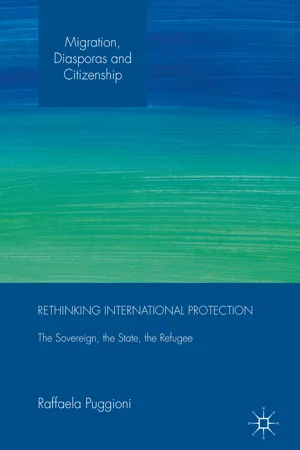
Rethinking International Protection
The Sovereign, the State, the Refugee
- English
- ePUB (mobile friendly)
- Available on iOS & Android
eBook - ePub
About this book
This book provides a critical account of the concept of international protection. The author questions the boundaries between protection and assistance, and challenges the dominant focus on state sovereignty. Drawing upon a broad range of sources, she scrutinises the central role played by the state in providing legal, social and economic protection, which entails positive obligations upon the state. Protection, in this context, does not simply mean protection from persecution, threats, and sustained violence, but emancipation. By focusing on the local and national contexts wherein protection is enacted, created and also contested, she combines the politics of protection with the practices of protection, with a special focus on Italy. The resulting arguments clarify the difference between the public responsibility to protect and the private desire to assist, between treating refugees as bearers of rights and considering them as objects of assistance. The author argues that the absenceof protection in Italy has encouraged many to leave and find protection in other EU countries. This timely work is essential reading for students and scholars of migration, international relations and asylum politics as well as policy-makers.
Information
© The Author(s) 2016
Raffaela PuggioniRethinking International ProtectionMigration, Diasporas and Citizenship10.1057/978-1-137-48310-2_11. Introduction: Rethinking Protection
Raffaela Puggioni1
(1)
ADA University, Baku, Azerbaijan
The concept of refugee protection, generally referred to as international protection, tends to be evoked every time there are big influxes of forced migrants, irrespectively of the specific policies enacted. The most recent influxes along the southern and southern-eastern Mediterranean frontiers, especially since April 2015, are not an exception. International protection is evoked even if it is other issues that receive greater attention—including border controls, sea patrolling, humanitarian assistance, border death, cooperation agreements and detention (Kjaerum 2002; Bigo and Guild 2005; Klepp 2010; Guia et al. 2016)—to the point that refugee protection is often marginalised and/or left unspecified. Despite its wide use, the meaning of protection remains open to interpretation. The lack of clarity is especially due to the fact that the concept of protection is often conflated with the concept of assistance to the point that refugee protection tends to refer to any policies for refugees, irrespectively of the ultimate outcome. The aim of this book is precisely to distinguish the politics of protection from the politics of assistance by highlighting the different rationale upon which each concept is articulated. In particular, it will be highlighted the difference between the public responsibility to protect and the private desire to assist, between guaranteeing rights and satisfying basic needs. It will be argued that there is a need to depart from the concept of (negative) protection that entails protection from—that is, protection from persecution, violence and life-threatening events—and embrace a concept of (positive) protection, a protection towards emancipation, which requires the direct involvement of the state, and particularly of the liberal/constitutional state. Instead of looking at protection from the sovereign states’ perspective—a perspective which privileges border controls and citizens’ safety—this book will discuss the key role of the state in providing protection. More specifically, the book will adopt a national perspective and move away from the idea that ‘without an international states system there would be no refugees’ (Haddad 2008, p. 4). Because protection always already presupposes a national protection—that is a state that takes care of refugees as opposed to humanitarian assistance devolved to charities—it is here, at the national level, that our analysis will start by investigating, in particular, the specific role that the state is asked to perform as protector and guarantor of rights towards its own citizens and the aliens residing in its territory. The first step will be to separate the analysis of the state from the analysis of sovereignty. Though recognising that the state is by definition sovereign, by focusing on the state—and on the key role of the state in providing protection—this work will hopefully provide an alternative starting point from which to look at protection. While the focus on state sovereignty tends to lead us to look outward—to project the state towards the outside world by looking at borders, international obligations and state security—an inward-looking on the state privileges a perspective in which the question of protection is no longer observed from the sovereign perspective but from the effective politics of protection developed at the regional/national level. Such a focus does not disconnect the international from the local (Campbell 1996, p. 23), but it allows exploring protection also through the eyes of refugees, by scrutinising how refugees themselves react to local politics of (non-)protection. In other words, in this book, the question of protection is not limited to an analysis of the state’s politics but also considers how official politics are de facto influenced by its key beneficiaries: refugees.
By rearticulating the distinction between protection and assistance—along the public/private divide—this book will highlight the difference between a politics of protection in which states are the sole guarantor for allocating and respecting rights and a politics of assistance in which charities and international agencies are tasked with the delivery of goods and the satisfaction of basic needs. In this latter case, the concept of assistance no longer involves public responsibility but, on the contrary, private care. Thus, what this book will address is: what kind of protection does international protection really entail? What is the relation between protection and assistance? Does the concept of protection presuppose assistance also? And vice versa, does the concept of assistance presuppose also protection? What is the space of protection? Is it the public sphere of rights or is it the private sphere of charity? And last but not least, who is the subject upon which protection is articulated? Is s/he an active subject who participates in the process of protection or simply a passive receiver?
The need to focus on the meaning of protection is especially relevant for International Relations (IR) discipline, which has traditionally focussed not on protection per se but on the limits of protection, that is, on those mechanisms that states introduce in order to make access to protection extremely difficult, if not impossible. More specifically, dominant IR literature have mostly focussed on states’ sovereignty and admission policies (Joppke 1999; Weiner 1995), their interpretation of international law (Hathaway 1991b; Gowland and Samson 1992; Goodwin-Gill 1996), on their security and on refugees’ ‘solutions’ (Gordenker 1987; Adamson 2006; Newman and van Selm 2003), on their cooperation during refugee crises (Loescher 1993, 2003; Cronin 2003; Betts 2009), on globalization and humanitarianism (Chimni 2000), as well as on global governance and international refugee regime (Barnett 2002). The question of what protection is has so far received little attention. As Jef Huysmans argues, traditionally the politics of protection have been articulated around three key questions: ‘(a) Who can legitimately claim a need for protection?; (b) Against which dangers can they legitimately make these claims?; and (c) Who is going to do the protecting?’ (2006a, p. 2). For IR scholars what matters—from the sovereign perspective—is the question of ‘who’ and ‘why’, that is, which entity should provide protection and on what grounds. What is missing from this picture is ‘what’. What kind of protection does a politics of protection entail? What is the meaning of legal protection which the 1951 Geneva Convention articulated? How to distinguish between providing a safe haven and protecting refugees? How do refugees respond to states’ politics of (non-)protection? Should refugees search for an alternative state of protection if they feel unprotected in the first safe (EU) country? These questions are especially relevant when investigating the Italian politics of (non-)protection, and wider European asylum framework as the events of 2015–2016 along the EU southern frontiers have demonstrated.
Rethinking Protection
The terms ‘refugee protection’ or ‘international protection’ have never been properly clarified. As Guy Goodwin-Gill puts it, ‘“protection” was never defined. Sometimes it was referred to as “legal” protection, or “political and legal” protection, or, as in the UNHCR Statute, “international protection”’ (2001, p. 130). However, for Goodwin-Gill, there was no need for clarification as the ‘sense of protection was always clear’ (p. 130), clear in light of the international setting. Because ‘[r]efugees no longer enjoyed the normal relationship of citizen to State’, being outside their country, ‘they were to be assisted by the international community through its representative agency’ (p. 130). This is precisely the common starting point for IR scholars. Refugees are people of concern for the international community because it is the international community which should fulfil the protection gap opened up by the country of origin. As Alexander Betts and Gil Loescher have put it:
The lack of national protection is coupled with another core assumption: refugees need compensation. More specifically, the idea that refugees need to be compensated for having lost the protection of their own state has been traditionally articulated upon the assumption that there exists a unique, and irreplaceable, political relation between each state and its citizens. By failing to fulfil ‘their responsibilities of normal good governance, states fail to ensure respect for the state-citizen contract’ (Haddad 2008, p. 59), that is, states break a relation—a contract—that is considered unbreakable, if not the very essence of politics. The forced condition of departure excludes the refugee from what Nevzat Soguk identifies as the ‘citizen/nation/state hierarchy’ (1999, p. 9). Soguk’s States and Strangers provides precisely the analytical framework for problematizing orthodox refugee discourse. Such an analysis is already articulated upon a discourse of the ‘marginalized and of otherness’ (1999, p. 51), an otherness who is, however, instrumental for reproducing and reaffirming citizens’ agentic capacity to act. IR conventional discourse is, thus, constructed onBecause refugees find themselves in a situation in which their own government is unable or unwilling to ensure their physical safety and most fundamental human rights, they are forced to seek protection from the international community (2011, p. 1).
By constructing a circular relationship between the state and its citizens, the existence of the refugee is perceived as a ‘scandal for politics’, as a scandal for a politics premised upon the idea that its raison d’être is ‘the realization of the sovereign identity’ (Dillon 1999, p. 95).the premise that the modern citizen, occupying a bounded territorial community of citizens, is the proper subject of political life: the principal agent of action, the source of all meaning of value, and the point of decision to which, ultimately, all matters of political uncertainty must recur (Soguk 1999, p. 9).
According to the legal formula, there are two core elements that identify refugees: the condition of non-protection and a well-founded fear of being persecuted (Hathaway 2005). A refugee is thus someone who
The notion of non-protection—that is, refugees’ inability or unwillingness to avail themselves of the protection of their country of nationality—has traditionally contributed to the image of refugees as aliens deprived of the protection of their country. But what exactly is the protection to which refugees have been deprived and what is the protection that should compensate such a deprivation? The answer is not straightforward as neither the concept of protection nor the concept of asylum have been defined in international documents. According to Arthur Helton, the concept of protection has traditionally meantowing to well-founded fear of being persecuted for reasons of race, religion, nationality, membership of a particular social group or political opinion, is outside the country of his nationality and is unable or, owing to such a fear, unwilling to avail himself of the protection of that country; or who, not having a nationality and being outside the country of his former habitual residence as result of such events, is unable or, owing to such fear, is unwilling to return to it (article 1A[2] of the 1951 Refugee Convention1).
maintaining physical security and providing redress under law. For refugees, protection traditionally means life-saving interventions, fair treatment upon reception, compliance with essent...
Table of contents
- Cover
- Frontmatter
- 1. Introduction: Rethinking Protection
- 2. The Sovereign of (Non)protection
- 3. The State of Protection
- 4. The Refugee of Protection
- 5. Refugees’ Encampment in Italy
- 6. Rethinking International Protection
- Backmatter
Trusted by 375,005 students
Access to over 1.5 million titles for a fair monthly price.
Study more efficiently using our study tools.
Frequently asked questions
Yes, you can cancel anytime from the Subscription tab in your account settings on the Perlego website. Your subscription will stay active until the end of your current billing period. Learn how to cancel your subscription
No, books cannot be downloaded as external files, such as PDFs, for use outside of Perlego. However, you can download books within the Perlego app for offline reading on mobile or tablet. Learn how to download books offline
Perlego offers two plans: Essential and Complete
- Essential is ideal for learners and professionals who enjoy exploring a wide range of subjects. Access the Essential Library with 800,000+ trusted titles and best-sellers across business, personal growth, and the humanities. Includes unlimited reading time and Standard Read Aloud voice.
- Complete: Perfect for advanced learners and researchers needing full, unrestricted access. Unlock 1.5M+ books across hundreds of subjects, including academic and specialized titles. The Complete Plan also includes advanced features like Premium Read Aloud and Research Assistant.
We are an online textbook subscription service, where you can get access to an entire online library for less than the price of a single book per month. With over 1.5 million books across 990+ topics, we’ve got you covered! Learn about our mission
Look out for the read-aloud symbol on your next book to see if you can listen to it. The read-aloud tool reads text aloud for you, highlighting the text as it is being read. You can pause it, speed it up and slow it down. Learn more about Read Aloud
Yes! You can use the Perlego app on both iOS and Android devices to read anytime, anywhere — even offline. Perfect for commutes or when you’re on the go.
Please note we cannot support devices running on iOS 13 and Android 7 or earlier. Learn more about using the app
Please note we cannot support devices running on iOS 13 and Android 7 or earlier. Learn more about using the app
Yes, you can access Rethinking International Protection by Raffaela Puggioni in PDF and/or ePUB format, as well as other popular books in Social Sciences & Civil Rights in Law. We have over 1.5 million books available in our catalogue for you to explore.