- English
- ePUB (mobile friendly)
- Available on iOS & Android
eBook - ePub
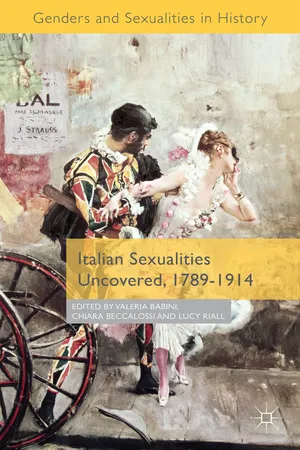
Italian Sexualities Uncovered, 1789-1914
About this book
Bringing together an interdisciplinary group of scholars, this volume explores nineteenth-century Italian sexualities from a variety of viewpoints, illuminating in particular personal and political relationships, same-sex desires, gender roles that defy societal norms, sexual behaviours of different classes and transnational encounters.
Information
1
Introduction
Valeria P. Babini, Chiara Beccalossi and Lucy Riall∗
The history of sexuality defies easy categorisation; as Matt Houlbrook states, its vitality derives from its pluralism.1 It explores men and women in the past as sexual beings, the ways they understood and experienced their sexual desires, and how their sexual behaviour was organised, regulated and constrained. There is little that cannot be included in this field. Social and cultural histories, political and economic histories, nation-building and welfare, and gender relations – all are marked by sex and sexuality. The field has porous boundaries and connects to a number of areas such as gender history, women’s history, the history of the body, the history of science, and political and legal history.
For historians of sexuality, the nineteenth century has been a crucial period. One needs only to reflect on the fact that Michel Foucault’s History of Sexuality: The Will to Knowledge has the nineteenth century at the core of its analysis to understand the importance of this period. Yet scholars exploring the history of sexuality in Italy would seem to have been more drawn to ancient history, the early modern period or the twentieth century than to the nineteenth. Thus, the history of sexuality in nineteenth-century Italy has been marginalised within historiography, often in parenthesis to other ‘official’ histories, such as that of the family.2 By contrast, historians of other European countries and of North America stress the paramount significance of the nineteenth century as a watershed in the history of sexuality. New ways of thinking about sexual behaviours and desires came into being; sexual identities and subcultures appeared and expanded; governments increased the regulation of sexual behaviour; and sexology emerged as a new field of enquiry. Given how critical the nineteenth century is for all such questions, and given that Italy produced some of the most significant theorists of the modern idea of sexuality (for example, Cesare Lombroso and Paolo Mantegazza), the lacuna is indeed remarkable.
Some late nineteenth-century commentators questioned the assumption that sexual customs were fixed by nature, and they historicised sexual behaviour long before late twentieth-century developments in the history of sexuality. Most notably, Havelock Ellis’ and John Addington Symonds’ work Sexual Inversion (1897) opens with a historical overview of the manifestations of same-sex desires; Ellis and Symonds show that non-normative sexual behaviours can be found across the globe and at virtually any date, from ancient history to the present, and in doing so explore how specific historical contexts have shaped different approaches to sexual conduct.3 In this same period, in the context of Italian legal debates on the regulation of sexual behaviours and medico-criminal anthropological research on sexual deviancies, a number of writers drew attention to the manner in which sexual customs had changed throughout history, not least in Italian history. It was within an evolutionary perspective that these late nineteenth-century Italian writers turned their attention to the diversities of sexual conduct, inaugurating, perhaps despite their original intentions, an essentially historical approach to sexual mindsets and behaviours. The evolution of sexual customs is depicted in these accounts in terms of linear progress: from a past characterised by endemic sexual corruption, when prostitution, pederasty, orgies and even incest and bestiality prevailed, to an enlightened present which, although not rid of all sexual vices, was perceived as civilised and restrained, thanks above all to the institution of the monogamous family. Such accounts often contrasted the moral and respectable nineteenth century with ancient Greek and Roman sexual depravities, and saw grotesques such as Caligula and Messalina as the epitome of sexual debauchery in the past.
Only a few decades later, this portrait of the self-controlled and decorous nineteenth century was undermined by the Italian literary critic Mario Praz. In his 1930 book La carne, la morte e il diavolo nella letteratura romantica, Praz showed the other side of the nineteenth century.4 In his study of romantic sensibility and of its unfolding decadence, he also analysed Italian literature and its ‘erotic sensibility’. He pointed to the obsession with sexual perversions that permeated nineteenth-century literature. As he suggested, in no earlier period had sex been at the centre of literary work; instead, in the nineteenth century, sexual perversions were everywhere. Once again, however, in spite of such intense scholarly interest in the evolution of sexual customs, historians of Italy have been slow to explore the history of sexuality in the nineteenth century and have particularly neglected the theme of non-normative sexualities.
Interpretations of the history of sexuality advanced by late nineteenth-century positivists were cast in terms of a gradual ascent from the lewdness of ancient sexual customs to a less coarse and more civilised sexuality, a teleology replicated by some historians in the 1960s. These more recent accounts, for their part, posited an advance from sexual repression in the ‘Dark Ages’ (repression as the result of the cultural influence of Christian religion) towards a more enlightened moral climate that culminated in the sexual liberation realised during the second half of the twentieth century.5 A political outlook thus replaced the earlier biological and evolutionary perspective on the development of sexual behaviours.
It was in the 1970s that professional historians working on nineteenth-century Italy started to explore the history of men and women as sexual beings within the history of the family and demography.6 Inspired by works such as Michel Foucault’s History of Sexuality: The Will to Knowledge (1976) and George L. Mosse’s Nationalism and Sexuality: Respectability and Abnormal Sexuality in Modern Europe (1985), three main trends emerged in the 1980s, each of them challenging earlier, linear accounts. First, a new generation of historians working on women’s history began to explore changes in sexual attitudes, criticising the supposedly gender-neutral approach of their precursors. Contributors to Italian journals such as Donna Woman Femme and Memoria, founded in 1975 and 1981 respectively, thus promoted a history from below and focused on women as victims of a male-dominated society.7 Much attention was devoted to marginal groups and prostitution.8 Other historians started to explore the role of law and science in constructing the notion of a healthy and normative sexuality, and the relevant gendered preconceptions that dominated public discourses.9 A third trend, best represented in the work of Bruno Wanrooij, further expanded the scope of analysis and explored the social construction of sexuality in multiple fields such as mass media, popular medical treatises, religious tracts, novels, and moralistic and pedagogic works.10 Wanrooij’s earlier research was further elaborated in his book, Storia del pudore. La questione sessuale in Italia (1990), which remains a reference point for any scholar interested in the history of sexuality in nineteenth-century Italy.
Monographs multiplied in the 1990s with historians such as Margherita Pelaja continuing to explore the interconnection between women’s history and the history of sexuality, while other scholars such as Giorgio Rifelli and Corrado Ziglio, developing the tradition inaugurated by Wanrooij, considered the role of popular medical treatises and moralistic and pedagogic pamphlets and tracts in shaping perceptions of acceptable sexual behaviours.11 The foundation of the Società italiana delle storiche in 1989 and the launch of its journal, Genesis, also helped to promote research in the field.12 In the 1990s women’s history in Italy increasingly moved away from the emphasis on women as victims and started to promote research into women’s subjectivity.13 With the dawn of the new millennium, while some historians began to specialise in issues of gender and sexuality,14 the history of masculinity has entered the field15 and cultural historians have started to include sexuality as an important element in their analysis.16 This is perhaps best illustrated by the work of Alberto Mario Banti. While in his La nazione del Risorgimento (2000), sexuality appears alongside gender as a secondary frame of analysis, in his L’onore della nazione. Identità sessuali e violenza nel nazionalismo europeo dal XVIII secolo alla Grande Guerra (2005), it assumes greater prominence.17 Here, however, Banti is not so much concerned with how sexual behaviour has been experienced by individuals or regulated by governments and by various fields of knowledge, but with how the symbolic production of the nation has its roots in sexuality.
There is a remarkable gap in the Italian historiography – publications on gay and lesbian histories and studies that explore the construction of sexual ‘deviancies’ in general remain scarce. For almost two decades from the 1990s, not only Anglophone scholars but also European historians, in particular the Germans and the Dutch, have been exploring the history of homosexuality in the nineteenth century, discussing the significance of the emergence of sexual identities and engaging in the heated social constructionism versus essentialism debate. Italian historians, for their part, have not followed suit.18 Indeed, in Italy, the history of homosexuality has been mainly explored by gay activists such as Giovanni Dall’Orto and it is only in the last decade that academic historians have started to explore this field.19 These studies by Italian scholars focus on legal, medical and journalistic discourses, and historians still do not know much about the life and experiences of homosexuals living in Italy in the nineteenth century. While in other countries historians have revealed how a distinct homosexual subculture took shape in cities like London, Paris and Berlin, Italian historians lag behind and there is no substantial analysis of the formation of homosexual subcultures in nineteenth-century cities like Milan or Rome. Laura Schettini, in her recent work on transvestism at the turn of the nineteenth century, has unearthed evidence that points to the existence of homosexual communities in some Italian cities like Milan and Naples,20 but much remains to be done in this area.
Until now, the Italian historiography of the nineteenth century has focused on specific topics such as the history of prostitution and the history of the family. Indeed, there is no overarching research into the continuities and discontinuities of the history of sexuality in the long nineteenth century, and most research has been carried out on the period from 1860 onwards. Certainly, the unification of Italy affected Italian sexual customs: the drafting and promulgation of the Pisanelli and Zanardelli Codes, which regulated sexual and familial relationships on a national scale, constitute an obvious break. Yet we still lack a broader view of the long nineteenth century and we cannot simply assume that legal uniformity did not meet with resistance or that past practices and sexual attitudes disappeared overnight. Moreover, more work has been undertaken on legal, medical and cultural discourses than on the experiences of the individual or of groups. Another characteristic of the available Italian historiography is its general focus on regional history. In part this emphasis derives from the variety of cultural traditions existing on the Italian peninsula before unification and persisting afterwards. Historical accounts of prostitution are a clear example of such a historiographical fragmentation.21 Finally, while there is an abundance of works on the history of Italian sexuality published in English for periods like the Renaissance, there are only a handful of monographs available in English to students and scholars interested in nineteenth-century Italy.
Despite the proliferation of monographs on the history of sexuality published in Italian from the 1990s onwards, institutional recognition of the discipline has been slow in Italy. By contrast with the Anglophone world, the publication of academic works in this field has not been matched by academic formal recognition. There are a few universities that promote this area of enquiry, such as the l’Orientale in Naples, which has a PhD programme in women’s history and gender identities, but they are very much the exception. In Italy there are only a handful of programmes in the history of sexuality and, to date, not a single academic post has been created. Perhaps it is for this reason that, from the perspective of an outsider, the history of sexuality seems never really to have taken off in Italy.
∗ ∗ ∗
It is hard enough for contemporaries to give accounts of sexual encounters and desires, and perhaps exhaustively to historicise intimacy is impossible; even in those exceptional cases when substantial records are available, such experiences cannot be fully recovered. The rare traces of personal accounts relating to the private sphere that historians have found in diaries, memoirs and letters offer only fleeting or fragmentary glimpses of individuals’ desires and sexuality, because these kinds of sources are burdened with prudishness, self-censorship, exhibitionism or else waver between reality and fantasy. What people reveal is often simply what social conventions, moral codes and a sense of decorum allow them to reveal. Interpretative uncertainty never disappears when historians analyse individuals’ records of their subjective and erotic experiences. A number of essays contained in this volume, for example, the contributions of Pietro Gibellini and Edoardo Ripari, Lucy Riall, and Mark Seymour, explicitly discuss the methodological problems that sources pose for...
Table of contents
- Cover
- Title Page
- Copyright
- Contents
- List of Figures
- Acknowledgements
- Notes on Contributors
- List of Abbreviations
- 1. Introduction
- Part I: Sexuality, Politics and Family
- Part II: Sexuality, Classes and Social Groups
- Part III: Women between the Public and the Private
- Part IV: Same-Sex Desires
- Part V: Marriages and Sexuality
- Bibliography
- Index
Trusted by 375,005 students
Access to over 1.5 million titles for a fair monthly price.
Study more efficiently using our study tools.
Frequently asked questions
Yes, you can cancel anytime from the Subscription tab in your account settings on the Perlego website. Your subscription will stay active until the end of your current billing period. Learn how to cancel your subscription
No, books cannot be downloaded as external files, such as PDFs, for use outside of Perlego. However, you can download books within the Perlego app for offline reading on mobile or tablet. Learn how to download books offline
Perlego offers two plans: Essential and Complete
- Essential is ideal for learners and professionals who enjoy exploring a wide range of subjects. Access the Essential Library with 800,000+ trusted titles and best-sellers across business, personal growth, and the humanities. Includes unlimited reading time and Standard Read Aloud voice.
- Complete: Perfect for advanced learners and researchers needing full, unrestricted access. Unlock 1.5M+ books across hundreds of subjects, including academic and specialized titles. The Complete Plan also includes advanced features like Premium Read Aloud and Research Assistant.
We are an online textbook subscription service, where you can get access to an entire online library for less than the price of a single book per month. With over 1.5 million books across 990+ topics, we’ve got you covered! Learn about our mission
Look out for the read-aloud symbol on your next book to see if you can listen to it. The read-aloud tool reads text aloud for you, highlighting the text as it is being read. You can pause it, speed it up and slow it down. Learn more about Read Aloud
Yes! You can use the Perlego app on both iOS and Android devices to read anytime, anywhere — even offline. Perfect for commutes or when you’re on the go.
Please note we cannot support devices running on iOS 13 and Android 7 or earlier. Learn more about using the app
Please note we cannot support devices running on iOS 13 and Android 7 or earlier. Learn more about using the app
Yes, you can access Italian Sexualities Uncovered, 1789-1914 by Valeria P. Babini,Chiara Beccalossi,Lucy Riall in PDF and/or ePUB format, as well as other popular books in Social Sciences & Italian History. We have over 1.5 million books available in our catalogue for you to explore.