- English
- ePUB (mobile friendly)
- Available on iOS & Android
eBook - ePub
About this book
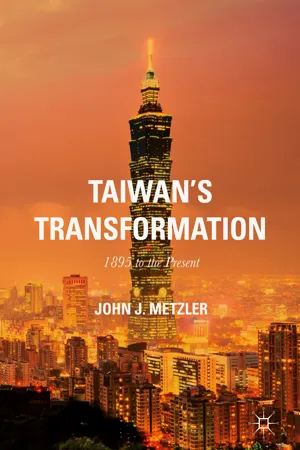
This book presents a cogent but comprehensive review of Taiwan's socio-economic transformation from a Japanese colony to a thriving East Asian mini-state. Since the 1980's, Taiwan has primarily been viewed as a thriving economic model. Though certainly true, this assessment belies the amazing social and political success story for 23 million people on a small New Hampshire-sized island just off the China coast. Metzler highlights the engaging political narrative of democratization as well as Taiwan's noteworthy accomplishments despite the proximity and opposition of communist China. Further, the result of the 2016 elections and its implication are analyzed. Scholars studying East Asia and policy makers will gain a greater appreciation for the island's dynamic, prosperous resilience, despite pressure from China.
Information
© The Author(s) 2017
John J. MetzlerTaiwan's Transformationhttps://doi.org/10.1057/978-1-137-56442-9_11. Japanese Interlude 1895–1945
John J. Metzler1
(1)
St. John’s University, Jamaica, USA
Introduction
Known as Ilha Formosa by Portuguese mariners, later settled by the Dutch, and then emerging as a Ming loyalist stronghold after collapse of China’s most brilliant Dynasty, the island of Taiwan was long coveted for its geography, being both on the doorstep of China and on the crossroads of East Asian commerce.
By the nineteenth century, the island assumed new prominence as Western powers ambitiously and methodically encroached upon Qing China’s sovereignty. The Opium War saw a British victory which soon translated into Queen Victoria’s Empire extending into a string of Treaty Ports on the China coast ranging from Shanghai and Ningpo in the north, Amoy and Foochow in the center, to Hong Kong in the south. The French, not to be outdone, and after a short but sharp conflict with China in 1884, would gain a foothold in Taiwan’s ports of Keelung and Tainan as well as the Pescadores Islands in the Taiwan Strait. Equally, France, along with many other European powers, had “concession rights” in the important city of Shanghai.
Not far away in Japan, an American naval squadron led by Commodore Matthew Perry had arrived in Tokyo Bay. Perry’s formidable steam-powered “Black Ships” were viewed by the Japanese as “giant dragons puffing smoke” sent to pry open the doors of commerce in a closed and insulated Japan. The ruling Tokugawa shogunate, fully aware of what had transpired across the sea in China after the Opium War and nervous over their own vulnerability to the powerful guns on the US Navy ships, concluded that it was better to deal with the distant barbarians than to try to oppose them, at least for the time being. Treaties of Peace and Friendship were later signed between the Americans and Japan’s rulers in 1854 and 1858, opening additional trading ports, which would set the template for Washington’s relations with the still isolated Japan.
The China coast was being carved up into “concessions” where the European powers would gain commercial access to markets, opportunities for missionary activities, all backed up by unapologetic gunboat diplomacy. By the early 1890s, the map of China was nearly spoken for; the European powers had taken what they wanted.
Across the waters in Japan, an extraordinary political event had occurred in 1868. The Meiji Restoration had toppled the old Tokugawa military shogunate, forcibly united over 300 small feudal fiefdoms, had reinstated the Emperor and thus Imperial rule, and as importantly had set a modernizing path for the Land of the Rising Sun. Modernization, “westernization,” and a zealous desire to learn from and to imitate the West would soon put Japan on a trajectory to success. Meiji’s modernization had many positive aspects, which saw the once isolated country transform itself from a staid island nation into a late-nineteenth-century powerhouse.
Meiji’s meteoric rise in Japan’s socio-economic situation equally saw the new government seeking foreign political models and systems from which to borrow. The government’s missions ventured abroad to Britain, France, Germany, and the USA to get a firsthand experience of how foreign governmental and constitutional systems worked. Before long, the study missions concluded that Prussia’s constitution would be best suited to Japan.
Contrary to China’s Qing Dynasty, and its rather more timid and reserved Self-Strengthening Movement, the Japanese embraced Westernization, especially its technology, industrialization, and universal public educational standards. Military modernization was not far behind and the old post-Perry slogan “Respect the Emperor, expel the barbarians” took on a new meaning.
Meiji’s modernizers also, according to Ian Buruma, “Managed to pick some of the worst, most bellicose aspects of the Western world for emulation in Japan. One of them was colonialism.” Honda Toshiaki, one of the more prominent reformers who was particularly enchanted with Great Britain, argued that without a colonial empire, a nation could not achieve greatness. “His visions of Japan’s colonial enterprise were, like his politics, both progressive and ruthless, rather like his favorite model Britain,” states Buruma. Honda’s philosophy exhibited the dualistic paternalism which would soon descend upon Formosa. “It is the task of the ruler-father to direct and educate the natives in such a manner that there will not be a single one of them who spends even one unproductive day.” 1
The Meiji court, which had moved from the ancient city of Kyoto to the new imperial capital Edo (Tokyo), was smitten by the powers of the West as well as its creature comforts and cultural mores. Japanese would dress in Western clothing, eat Western food, dance to the tunes of the day, and display the benefits of the modern era. Unknown to many, Edo was already a thriving metropolis with a population larger than London or New York.
Japan would now showcase to Asia and the world what and how fast they were learning.
The famed woodblock Ukiyo-e prints, through which Japan graphically portrayed its samurai heroes, courtesans, and Kabuki plays through stunning color and detail were gradually replaced with such themes as modern city life with street scenes clogged with a maze of electric and telegraph lines, trolley cars, and strolling couples in overstated nineteenth-century garb. By 1895, the woodblocks would chronicle the saga of Japan’s war with China, and a decade after that in 1905, they would reflect the hyper-patriotism of the Russo-Japanese War. Woodblock prints made the General Staff look distinctly Prussian in uniforms and demeanor. The Japanese were becoming comfortable with their role as a “modern country” as importantly with their national status.
Set in the political geography of the Pacific in the mid-1890s, Japan remained the anxious onlooker. Great Britain, France, and the Netherlands all had staked their claims from Malaya, the Dutch East Indies, and Indochina in the south to a string of port concessions on the China coast. Spain controlled the Philippine islands. Qing China held political sway on the Korean peninsula. Russia, through its controlling interests in the Manchurian railroads and ties to the Korean kingdom, was equally a regional player.
“By the end of the 19th century, East Asia had become a stage of imperial competition among the great powers. With regards to the Korean peninsula, Japan, Ching (Qing) China, and Russia waged a fierce competition to place the weak kingdom under their control,” writes Seung-young Kim. He adds, “Though a declining empire, China (Qing) tried to strengthen its traditional suzerainty over Korea. Japan had regarded Korea as a ‘dagger against the heart of Japan,’ and constantly tried to strengthen its influence on the peninsula. Russia also tried to secure ice-free ports on the Korean coast and its construction of the trans-Siberian railroad made Japan worry about the future threat from Russia,” adds Prof. Kim. 2
The Sino-Japanese War of 1894–1895 largely reflected Japan’s strategic desire to pull Korea from a near millennium of Chinese influence and into the grip of a militarily and economically ascendant Japan. Yet as Kim opines, “But the broader origin of the war had to do with the construction of the trans-Siberian railroad which began in May 1891. Japan had already been regarding Russia as its primary enemy. … In this context, a war against China was to a certain degree a preemptive move by Japan to prepare for the coming confrontation with Russia.” 3
Japan’s Colonial Temptations
Objectively speaking, the Sino-Japanese War created a new political order in East Asia and, importantly, created new positive perceptions of Meiji Japan. “A new balance of power had emerged. China’s millennia-long unquestioned dominance had abruptly ended. Japan was on the rise with momentous consequences in store for the East and the West,” writes Prof. S. C. M. Paine of the US Naval War College. “The Western perception of Japan as a great power was born in September of 1894. Over a three-day period, Japan used modern arms so professionally and defeated China on land and sea so decisively, that quite suddenly the Western world perceived Japan as a modern power. … If this first Sino/Japanese War catapulted Japan into the ranks of the powers, it hurtled China on a long downward spiral,” adds Prof. Paine. 4
In a series of land and sea battles across the Korean peninsula in 1894, the Japanese conclusively defeated the Qing Chinese forces and as importantly sealed the fate of Korea for the next half century. Stunningly, the fall of Port Arthur on the Liaodong Peninsula brought Japanese forces into Mainland China proper and dangerously close to the Qing Imperial capital at Peking. Again, Japan’s popular media expressed in colorful if exaggerated views of the Ukiyo-e prints, extolled hyper-patriotism which would serve as a political narcotic for the next decade and then again in the 1930s.
The final act of the war would be staged in Shimonoseki, a small Japanese port facing Korea. Here, the Imperial Chinese delegation led by Viceroy Li Hung Chang would spar for peace terms with the legendary Meiji reformer Count Ito Hirobumi. In March and April of 1895, the two East Asian powers, Qing China and Meiji Japan would debate peace and discuss its terms in a draft treaty.
We are reminded that the Japanese Navy wanted access to Taiwan while the Army demanded the Liaodong Peninsula. “Premier Ito was a great admirer of Otto von Bismarck. He hoped to emulate Germany’s victory over France in the Franco Prussian war of 1870–71. That war had served to both unify Germany internally and to raise its prestige internationally,” writes Paine. Importantly, “Just as Ito has modeled the Meiji Constitution on that of Prussia, so he wanted the Treaty of Shimonoseki to mirror key features of the 1871 Treaty of Frankfurt; territorial annexation, a large indemnity, occupation of an enemy city to ensure payment of the indemnity, and so on.” 5
The Treaty of Shimonoseki was worded in the flowery nineteenth-century diplomatic prose of the era: “His Majesty the Emperor of China and His Majesty the Emperor of Japan desiring to restore the blessings of peace to the countries and subjects and to remove all cause for future complications,” have agreed to the following articles; Article 1 “China recognizes definitely the full and complete independence and autonomy of Corea.” Article 2 “China cedes to Japan in perpetuity and full sovereignty of the following territories together with their fortifications. … The island of Formosa, together with all the islands appertaining or belonging to the said island of Formosa.” Japan equally would gain the strategic Liaodong Peninsula. Eleven other articles would further serve to codify Qing China’s humiliation. On 17 April 1895, Viceroy Li Hung Chang signed for China and Count Ito Hirobumi for Japan. 6
Thus, in the 28 years of Meiji rule, Japan had forced itself onto the East Asian stage as a regional power. But Tokyo had pushed too far. Less than a week after the signing of the Treaty, Ministers of Russia, Germany, and France called on the Japanese Foreign Ministry to offer some “friendly advice.” They recommended that Japan return the Liaodong Peninsula to China. What became known as the Triple Intervention by the European powers put a damper on Japan’s regional designs for the next decade. In November of the same year, Viceroy Li Hung Chang presided over the return of Liaodong to China but with a further indemnity to Japan. 7
While the Western European powers were not necessarily opposed to Japan taking some East Asian spoils, it became abundantly clear that the same powers were not going to let Japan pick its territorial claims carte blanche in any way which may remotely impinge upon European plans, perceptions, or desires. Part of the “friendly advice” from Russia, Germany, and France came in the form of warships to help Japan come to a decision.
Consequently, Japan’s plan to hold the Liaodong Peninsula in China was viewed by Russia, Germany, and France as getting just a bit too close for strategic comfort. After all, Meiji Japan was hardly a full-fledged member of the “club” and would have to accept its associate status until such a time as the other powers could enforce it.
China’s young Emperor Guangxu, barely out of the shadows of the Dowager Empress, was as politically tarnished by having his diplomatic plenipotentiary place the Imperial Seal on the Treaty as by the unremarkable performance of the Chinese troops in battle against Japan.
Shortly after signing the Treaty of Shimonoseki, the US Secretary of the Navy Hilary Herbert wrote, “Japan has leaped, almost at one bound, to a place among the great nations of the earth. Her recent exploits in the war in China have focused all eyes upon her.” 8
Lafcadio Hearn, an American author living in Japan, expounded, “the real birthday of New Japan, began with the conquest of China.” 9
Formosa
Ilha Formosa, or beautiful island, as named by Portuguese mariners in the 1500s, had been under the sway of the Dutch, Ming Chinese loyalists attempting to use this offshore island as a springboard to re-conquer the Mainland, and various buccaneers. But it was during the Qing Dynasty that the Emperor Kangxsi brought Formosa under Chinese control as part of neighboring Fukien Province...
Table of contents
- Cover
- Front Matter
- 1. Japanese Interlude 1895–1945
- 2. Return to Chinese Rule 1945–1950
- 3. Free China; Cold War Fortress 1951–1971
- 4. The Republic of China 1972–1992
- 5. The Republic of China on Taiwan 1993–1999
- 6. Taiwan (The Republic of China) 2000–2008
- 7. Taiwan/Republic of China 2008–2016
- 8. Conclusions: Prospects and Portents
- Back Matter
Trusted by 375,005 students
Access to over 1.5 million titles for a fair monthly price.
Study more efficiently using our study tools.
Frequently asked questions
Yes, you can cancel anytime from the Subscription tab in your account settings on the Perlego website. Your subscription will stay active until the end of your current billing period. Learn how to cancel your subscription
No, books cannot be downloaded as external files, such as PDFs, for use outside of Perlego. However, you can download books within the Perlego app for offline reading on mobile or tablet. Learn how to download books offline
Perlego offers two plans: Essential and Complete
- Essential is ideal for learners and professionals who enjoy exploring a wide range of subjects. Access the Essential Library with 800,000+ trusted titles and best-sellers across business, personal growth, and the humanities. Includes unlimited reading time and Standard Read Aloud voice.
- Complete: Perfect for advanced learners and researchers needing full, unrestricted access. Unlock 1.5M+ books across hundreds of subjects, including academic and specialized titles. The Complete Plan also includes advanced features like Premium Read Aloud and Research Assistant.
We are an online textbook subscription service, where you can get access to an entire online library for less than the price of a single book per month. With over 1.5 million books across 990+ topics, we’ve got you covered! Learn about our mission
Look out for the read-aloud symbol on your next book to see if you can listen to it. The read-aloud tool reads text aloud for you, highlighting the text as it is being read. You can pause it, speed it up and slow it down. Learn more about Read Aloud
Yes! You can use the Perlego app on both iOS and Android devices to read anytime, anywhere — even offline. Perfect for commutes or when you’re on the go.
Please note we cannot support devices running on iOS 13 and Android 7 or earlier. Learn more about using the app
Please note we cannot support devices running on iOS 13 and Android 7 or earlier. Learn more about using the app
Yes, you can access Taiwan's Transformation by John J. Metzler in PDF and/or ePUB format, as well as other popular books in Politics & International Relations & Japanese History. We have over 1.5 million books available in our catalogue for you to explore.