eBook - ePub
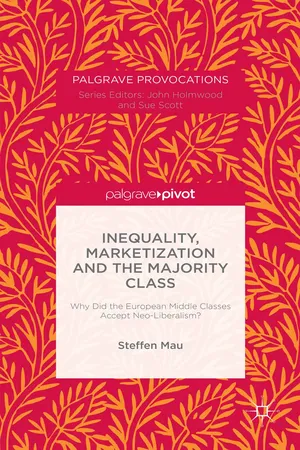
Inequality, Marketization and the Majority Class
Why Did the European Middle Classes Accept Neo-Liberalism?
- English
- ePUB (mobile friendly)
- Available on iOS & Android
eBook - ePub
Inequality, Marketization and the Majority Class
Why Did the European Middle Classes Accept Neo-Liberalism?
About this book
Why were the European middle classes ready to acquiesce in neo-liberalism? This book argues that upward mobility, the growth of individual and family assets, the growing significance of private provision, and processes of individualization contributed to a major transformation of the middle classes, making them more prone to embrace inequality and market principles. It shows how the self-interest of large sections of the middle classes undermined social democracy and paved the way for neo-liberal reforms, making their socio-economic positioning ever more precarious and reducing their political power. Central to the debate is the question of how the middle classes can rebalance the relationship between the Market and state intervention, so as to establish a new social equilibrium.
Information
1
Middle Classes and the European Social Model
Abstract: The emergence of broad and economically secure middle classes constitutes an important characteristic of Western European societies. The chapter shows that growth, a balanced income distribution, democratic participation and social protection are the foundations of this model, which was developed above all in the period after the Second World War. Today, it is not just the market that is responsible for the social positioning of the middle classes, but equally the interventions of the state with regard to social equilibration, risk compensation and social security. Mau argues that incorporating the middle classes into the welfare-state benefit system was an important factor in winning political support and legitimacy for arrangements of collective solidarity. At the same time, he poses the question of whether the elective affinity between the welfare state and the middle class was not eroded in advance of and in conjunction with neo-liberal reform policies.
Mau, Steffen. Inequality, Marketization and the Majority Class: Why Did the European Middle Classes Accept Neo-Liberalism? Basingstoke: Palgrave Macmillan, 2015. DOI: 10.1057/9781137511614.0003.
The social-structural formation and size of the middle class
The formation of stable and socially integrated middle classes can be considered an essential structural feature of Western European societies. While in the early phase of industrialization ‘the condition of the working class’ stood at the centre of attention, today it is ‘the condition of the middle class’. While Marx characterized the petite bourgeoisie as a distinct class, he assumed that it would ultimately be destroyed by the main conflict between capital and labour. He predicted the development of a society consisting of two main classes, wherein the majority of petty artisans and merchants become proletarianized, and only a small portion of them manage to rise into the class of capitalists. Today we know that Marx was wrong, and that capitalism led not to class polarization, but to the development of a broad middle class. When middle classes grow and share in the fruits of prosperity, or when the inequality gap narrows rather than widens, then there are good reasons to assume that capitalism is capable not only of increasing prosperity, but also of distributing it broadly, and even justly.
Historians have identified the emergence of a broad middle class – with education, prosperity and mass consumption – as one of the most important feature of (Western) European societies. The containment of markets by the state with the goal of social equilibrium is part of the feature set of Western European societies (Kaelble, 2007). The institutional pairing of a market economy with democratic participation ultimately led to the emergence of a ‘majority class’ (Dahrendorf, 1992, p. 162) of those who could expect to partake in the blessings of economic growth. Moreover, in Western European societies today, the hegemonic social and cultural values and norms were developed and nurtured in segments of the middle class. This group has been able to further enhance its own socio-economic position and to broadly anchor its way of life in society (Kocka, 2004, p. 34; Schimank et al., 2014). That said, the socio-cultural ‘expansion of the middle’ does not mean that a homogenous population segment has formed; rather, diverse subcultures and milieus with their own respective lifestyles and ways of life have developed alongside one another (Mau, 2012; Münkler, 2010).
For most Western European societies, the period after the Second World War was one of exceptional growth caused by catch-up development with respect to the United States, the formation of a ‘social market economy’ and the re-organization of the world economy through the Bretton-Woods regime. After world wars and world economic crises that destroyed asset values and enduringly compromised the living standards of broad segments of the population, a period of substantial growth followed between the Second World War and the first oil crisis of 1973. The average annual growth rate of Western European economies in the 1960s was between 5 and 7 per cent. This benefited not only small groups at the top of the income distribution, but radiated throughout the entire society, so that a shared collective upward mobility occurred among broad social strata.
Sharp inequalities which had still shaped society in the early 20th century and in the inter-war period lessened somewhat. The social structure underwent a fundamental transformation, characterized by educational expansion, decline in agricultural employment, growth in skilled employment, a progressive weakening of the long, formative distinction between ‘blue collar’ and ‘white collar’ workers, and the greater significance of knowledge for production and employment. The Keynesian-inspired ‘mid-century social compromise’ (Crouch, 1999) was based on a period of relatively strong growth, the establishment of institutions of welfare-state solidarity, and a pact between the differing interests of capital and labour. It was not only the growth spurt that led to a general increase in income, living standards, security and opportunities for consumption, but also a model of social policy oriented toward social balance and participation. The specific constellation of Western Europe in the post-war period thus entailed a shift in social power relations in favour of employees and their interest groups, while the interests of capital were tamed and contained. The emerging European social model with comprehensive public services, redistribution and risk protection aimed to combine economic dynamism with social equilibrium. It can be considered the essential institutional foundation for the development of the middle classes.
The expansion of the middle classes has come to epitomize the upwardly oriented, integrative and permeable post-war society. This discourse is found above all in the Federal Republic of Germany, Austria, the Benelux countries and Scandinavia, and to a lesser extent in Italy, France and Great Britain, that is countries with greater continuity in their social order. In these countries, the question of middle class expansion has been discussed increasingly in the context of a more stable class-based structuration of society (e.g. Goldthorpe, 1980). In Southern European countries like Greece, Portugal and Spain, after their dictatorships ended in the 1970s and they joined the EU in the 1980s, a modernization spurt was unleashed which brought social-structural modernization. Now the middle class grew here as well and was able to achieve gains in prosperity. Still, compared to the ‘old’ member states, marked gaps remained in the economic structure and in wage and productivity levels, and the middle classes were concentrated primarily in urban centres. At the latest with their accession to the EU, the expectation spread in these countries that they would be able to narrow the gap in the foreseeable future.
From the middle of the 1980s onward, in nearly all Western European countries, considerably more than 50 per cent of the population could be found in the middle classes (Allum, 1995). This was due above all to the lessening of asset and income inequalities, expansion of access to higher education, and changes in the labour market and occupational structure. The famous Kuznets curve (1955) describes the increase in income and asset inequality at the beginning of industrialization with large increases in wealth for the select few. Over time a reverse trend takes hold, toward equalization of incomes. The second part of this development in particular is well supported with data. Thus for Denmark, West Germany, Finland, France, Great Britain, the Netherlands, Norway, Austria and Switzerland, Kaelble (2007, p. 208ff.) shows a marked reduction in inequalities into the 1970s. In these countries, the share of national income going to the top 10 per cent of earners shrank considerably, meaning that lower and middle earners were able to increase their share of the pie. Today, we find the largest middle class in the Scandinavian countries. Germany, the Netherlands and Switzerland are average, and Great Britain and the Southern European countries bring up the rear (Burkhardt et al., 2012; Pressman, 2007). A trend toward equalization also occurred in asset ownership: Here, the share of total assets (which increased overall) owned by the top one per cent or the top 5 per cent shrank in some cases dramatically from the beginning of the 20th century to the 1970s. An example: A century ago, in Sweden and France the richest 1 per cent of asset owners owned 50 per cent of total assets, but by the 1970s their share had declined to 21 and 26 per cent respectively (Kaelble, 2007, p. 223). According to Thomas Piketty (2014), this development can be attributed to the destruction of large asset holdings by the war as well as well as higher taxes on the wealthy.
The positioning of the middle class in Europe is formatively shaped by the acquisition of education and training, which facilitate the attainment of certain status positions and their associated returns. Here, an occupational concept based on training, well-defined mobility paths and inner commitment and identification has developed, which provides typical status positions in the social hierarchy. Through processes of social closure (the role of credentials, labour market regulation etc.) it also promises a certain stability and permanence. In line with Max Weber’s (1985 [1922], p. 531) distinction between commercial and property classes, the broad middle class derives its social position primarily from market income. This means that status, participation and security are achieved primarily through the connection between training and labour market positioning. With regard to the middle-class indicators ‘education’ and ‘occupation’, we observe in all Western European countries a marked increase in general educational attainment and a decline in the share of those without a school-leaving certificate or occupational training. In the past, this trend toward more education and changes in the occupational structure has led to an ever broader segment of the population entering typical middle-class positions. The message to the lower classes was very simple: If you work hard and demonstrate a willingness to be productive, you can anchor yourself in the middle class. For the bulk of society, appropriated human capital paid off in the form of status gains.
Social policy intervention as constitutive of the middle class
As implied already, the labour market is not the only reference point for the existence of the middle class; the role of the state and its interventions is also constitutive. State institutions provide, on the one hand, the infrastructure and institutional pathways which make reproduction, child-rearing and education possible for the bulk of society. On the other hand, provision of access to social security and the fostering of social equilibrium are extraordinarily important spheres of action in Western European societies. The welfare state acts to compensate and redistribute, mitigating market inequalities and insecurities and responding to the middle class’s needs for social provision, income stability and security. Based on a comparison of pure market incomes with incomes after taxes and social transfers, one can estimate very accurately how significantly the tax and welfare state is contributing to the constitution and stabilization of middle-income groups. In our study of the development of the middle classes, on the basis of EU-SILC data (EU Statistics on Income and Living Conditions), we were able to show that the size and development of the middle class depends heavily on state interventions (Burkhardt et al., 2012, p. 99ff.; see also Dallinger, 2011; Pressman, 2009). If one defines the middle class as all those who dispose of between 70 and 150 per cent of equivalence-weighted median income, then one finds the following: Without taxes and transfers, in many European countries the middle class would be only half as large. Without progressive taxation, many households would be considerably more affluent, but without regular social transfers many would also fall into poverty. In this regard, we find the most significant role of the welfare state in Denmark, the Netherlands, Germany and Belgium. For example in Denmark, one of the highest welfare spenders in Europe, defined solely by market income the size of the middle class is less than 30 per cent. After counting taxation and all social transfers flowing to households, such as pensions, benefits for the unemployed or families, housing assistance etc., the middle-income group makes up 67 per cent of society. Very simply, this means that without these tax and social-policy interventions by the state, we would not have the middle classes we do.
In this group, there is a not inconsiderable share which receives the majority of their income from state transfers – consider, for example, the large group of pensioners. Given the state’s responsibility for income security in old age and the prevention of old-age poverty, seniors’ income situation and living standards are determined primarily by social-policy arrangements and by income streams between employees and those in retirement. For Germany, Manfred Schmidt (2013) has calculated that for 40 per cent of all voters, the welfare state constitutes their primary source of support, the largest group of course being pensioners. It is with good reason that one speaks of ‘transfer classes’, which the German sociologist M. Rainer Lepsius (1979, p. 179, my translation) – building on Max Weber’s famous class definition – defined thusly: ‘A “transfer class” is a class to the extent that differences in people’s welfare-state transfer income and in access to public goods and services determine their class position, that is their level of consumption, position in society, and personal destiny.’ In this view, portions of the transfer classes – to the extent they receive income not only from the secondary, lower-tier safety-net programmes – belong to the middle class. The more developed, the more targeted to the middle class, and the more predicated on previous contributions and on income stabilization over the life course a welfare state is, the greater its significance for the constitution and stabilization of the middle class. In a recent book John Hills (2015) gave a comprehensive and succinct account of how even in the British welfare state, which is notoriously viewed as targeting benefits mainly to the poor, well-off families are major beneficiaries of the welfare system. Though they often think that they are paying much more in than they are getting out, they are in fact getting a good deal as NHS users, as receivers of state pensions and through hidden benefits like tax relief on home mortgages and pensions. Hills shows convincingly that rather than being a Robin Hood which benefits only the poor, the welfare state primarily redistributes resources across life cycles, and this within social classes rather than from rich to poor.
If one takes a more historical view of the socio-genesis of the European social model, it becomes evident that its effects are by no means limited to redistribution. The creation and expansion of the welfare state spawned essential conceptions and practices of social action, ways of dealing with social problems, and interactions between social insurance schemes, teachers, therapists and social workers, on the one hand, and clients, users and beneficiaries on the other (cf. de Swaan, 1988). Not least, the public sector is a very important employment segment including typical middle-class professions and activities – think only of the state administrations and public health, education and social services (Heinze, 2011). Without exaggeration, the collective provision of public services and the comprehensive state role therein can be seen as one of the constitutive element of the middle class formation.
Mass democracy and the welfare state
In a democracy, the middle class has considerable capacity to influence the extent and form of social-policy intervention. Politics is directly bound to the preferences and expressions of interest of the general public and can ignore these only at the risk of being punished by the voters. Wherever these possibilities exist – ultimately in all mature democracies – distributive interests come into play and influence channels open up to impact social inequalities. The principle of political equality (‘one man, one vote’) is in tension with the principle of market-generated material or socio-economic inequality. The equality of democracy can thus limit the inequality of markets, if political majorities can be found for this – which is all the more likely, the greater the generally perceived utility of state equalizing interventions is. We can assume that the institutionalization and expansion of the welfare state has built on this connection and was a consequence, among other things, of the expansion of the franchise (even if there are certainly other paths to welfare-state growth) (Flora/Alber, 1981). The resulting model, which is particularly prominent in Western Europe, is often called social-democratic welfare capitalism (SDWC).
Against this background it appears that policy cannot be formulated against or past the middle class, as suggested by the median-voter approach (Downs, 1957). At its core, this approach contends that in the spectrum of political ideas, those which succeed are those oriented to the median voter, that is the ideal-typical voter in the middle. Assuming one has a choice of only two parties and these are fighting for a majority, the parties can succeed only if they address the deciding voter in the middle and not the left or the right spectrum (or above or below). Centripetal forces are thus at work in political competition, and major political parties address majorities around the centre of the voter spectrum. The simplest assumption of political preference formation is that people want to maximize their income and hence have overriding economic interests. Whether they approve of a certain type of government policy thus depends on whether that policy will lower their income, for example through tax increases, or tempts them with income gains, for example through redistribution. This suggests that one could assume that tax and transfer systems are designed in such a way that they serve the middle class most of all.
Research has found considerable empirical evidence to support the notion that the legitimacy and popularity of the welfare state are high above all when broad segments of the population benefit from social policies. The guiding hypothesis is the following: ‘the larger the number of groups who benefit from the welfare state in some tangible and salient way (...), the less likely it is that people will come to oppose government intervention to reduce inequalities’ (Kluegel/Miyano, 1995, p. 87). Empirical studies reveal that there is a correlation between welfare state expansion and welfare state support. Thus for quite some decades, the following appeared to be true: The more extensive and comprehensive the social-policy activities of the state, the more positive public attitudes were (e.g. Coughlin, 1980; Goodin/Le Grand, 1987; Kluegel/Miyano, 1995). Esping-Andersen (1990, p. 33) even claimed that ‘anti-welfare state sentiments over the past decade have generally been weakest where welfare spending has been heaviest, and vice versa’. Moreover, it has been suggested that comprehensive welfare states not only involve the larger segments of the population as beneficiaries, they also amplify egalitarian norms (Brooks/Manza, 2007; Sachweh/Olafsdottir, 2010).
A particularly prominent group here is indeed the middle class, who due to their sheer numbers and important place within public, political and civil-societal discourse can greatly influence political actors (Baldwin, 1990; de Swaan, 1988). Some have argued that the primary motive for middle class support of the welfare state was not altruism but bourgeois self-interest, which, in turn, made the middle classes ‘most directly advantaged by the welfare state’ (Baldwin, 1990, p. 26). Others have underlined that the welfare state, and the way it incorporates the middle classes, has created its own momentum such that the collectivizing process has become self-perpetuating (de Swann, 1988). The inclusion of the middle classes in the welfare state therefore suggests itself not only for electoral reasons; to the extent that the middle class itself becomes a beneficiary of the welfare state and sees itself as such, it also becomes a potential bulwark defending the welfare state: ‘The idea here is that if the middle classes benefit from programmes, then they will use their not inconsiderable political skills to obtain more resources for those programmes or to defend them in periods of decline’ (Goodin/LeGrand, 1987, p. 210). Recent analysis shows that there was a ‘middle-class shift’ in welfare support with a decline in welfare support among the traditional working class and sizeable electoral support of the welfare state by the expanding middle classes (Gingrich/Häusermann, 2015). Consequently, it has been emphasized that when welfare states address not only the poor population or the lower classes, but also the middle class, they can then be expected to have a particularly large legitimacy buffer. When the middle classes are ‘wooed from the market to the state’ (Esping-Andersen, 1990, p...
Table of contents
- Cover
- Title
- 1 Middle Classes and the European Social Model
- 2 Individualization and Tolerance for Inequality
- 3 Middle-Class Investors in Affluent Societies
- 4 Privatized Old-Age Provision, Privatized Future
- 5 Home Ownership and Home Voting
- 6 The New Culture of Indebtedness
- 7 Self-Enhancement: Investing in Education
- 8 Economic Problems and Political Dilemmas
- 9 Light at the End of the Tunnel?
- Bibliography
- Index
Trusted by 375,005 students
Access to over 1.5 million titles for a fair monthly price.
Study more efficiently using our study tools.
Frequently asked questions
Yes, you can cancel anytime from the Subscription tab in your account settings on the Perlego website. Your subscription will stay active until the end of your current billing period. Learn how to cancel your subscription
No, books cannot be downloaded as external files, such as PDFs, for use outside of Perlego. However, you can download books within the Perlego app for offline reading on mobile or tablet. Learn how to download books offline
Perlego offers two plans: Essential and Complete
- Essential is ideal for learners and professionals who enjoy exploring a wide range of subjects. Access the Essential Library with 800,000+ trusted titles and best-sellers across business, personal growth, and the humanities. Includes unlimited reading time and Standard Read Aloud voice.
- Complete: Perfect for advanced learners and researchers needing full, unrestricted access. Unlock 1.5M+ books across hundreds of subjects, including academic and specialized titles. The Complete Plan also includes advanced features like Premium Read Aloud and Research Assistant.
We are an online textbook subscription service, where you can get access to an entire online library for less than the price of a single book per month. With over 1.5 million books across 990+ topics, we’ve got you covered! Learn about our mission
Look out for the read-aloud symbol on your next book to see if you can listen to it. The read-aloud tool reads text aloud for you, highlighting the text as it is being read. You can pause it, speed it up and slow it down. Learn more about Read Aloud
Yes! You can use the Perlego app on both iOS and Android devices to read anytime, anywhere — even offline. Perfect for commutes or when you’re on the go.
Please note we cannot support devices running on iOS 13 and Android 7 or earlier. Learn more about using the app
Please note we cannot support devices running on iOS 13 and Android 7 or earlier. Learn more about using the app
Yes, you can access Inequality, Marketization and the Majority Class by S. Mau in PDF and/or ePUB format, as well as other popular books in Politics & International Relations & Management. We have over 1.5 million books available in our catalogue for you to explore.