- English
- ePUB (mobile friendly)
- Available on iOS & Android
eBook - ePub
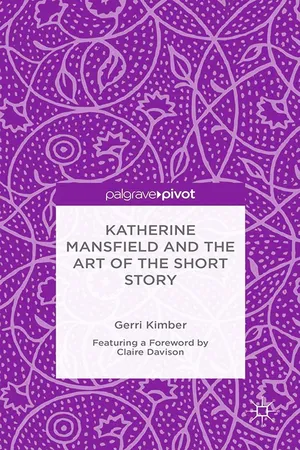
Katherine Mansfield and the Art of the Short Story
About this book
This volume offers an introductory overview to the short stories of Katherine Mansfield, discussing a wide range of her most famous stories from different viewpoints. The book elaborates on Mansfield's themes and techniques, thereby guiding the reader - via close textual analysis - to an understanding of the author's modernist techniques.
Information
1
Mansfield as Innovator of the Modernist Short Story
Like painting in watercolours, short story writing may seem a deceptively easy task for those who have not attempted it, and this goes part way to explain the dismissive tone taken by so many critics towards the genre. H. E. Bates was an early critic who understood this difficulty: ‘[t]he short story is the most difficult and exacting of all prose forms; it cannot be treated as a spare-time occupation; and above all it must not be allowed to foster the illusion [ ... ] that its very brevity makes it easy to do’.1 Clare Hanson makes the claim that the short story has often been the ‘chosen form of the exile [ ... ] who longs to return to a home country which is denied him/her’, Mansfield’s work being an obvious example of this tenet.2 She continues:
I would suggest that the short story has been from its inception a particularly appropriate vehicle for the expression of the ex-centric, alienated vision of women. It is striking, for example to see the way in which the early ‘modern’ short story, in the form of the psychological sketch was taken over by women writers during the era of the New Women of the 1880s and 1890s.3
Lorna Sage emphasises how Mansfield ‘put even more into the story form than her contemporaries, however, since it was really her only form’, reiterating once more how unusual was Mansfield’s position in utilising the short story as her sole narrative art form.4 Of course, the short story, by its very nature, imposes different criteria on the writer to that of the novel. Cherry Hankin illuminates the differences thus:
While the novel, with its expansive treatment of character, can afford to imitate the open-endedness of life in its conclusion, the linguistic economy of the short story imposes a more rigorous pattern. The closure or ending of the narrative is integral, not only to our sense of the work’s completeness but to our perception of the design as a whole.5
Added to this, Bates reflects how, ‘as in a great drawing, so in a great short story: it is the lines that are left out that are of paramount importance. Not that this is all; it is knowing what lines to leave out that is of the greatest importance, too’.6 Sage comments that for Mansfield, this editing out of superfluous subject matter would evolve into ‘short stories [ ... as] intensely crafted and evocative objects on the page, sometimes with nearly no plot at all in the conventional sense’.7 Concurring with this notion, Kathleen Wheeler elucidates further on how this rejection of a conventional plot structure and ensuing dramatic action yields to, ‘impressionistic evocations of epiphanic moments’.8 I shall demonstrate the importance of the epiphanic moment in Mansfield’s narrative art in another section of this study.
Wheeler encapsulates all the definitions of the modernist short story which have evolved over the years and sets Mansfield’s work into this body of evidence:
Modernist fiction largely dispensed with (or even de-emphasised) plot, action, drama, structure, shape, development, and so on [ ... ].These conventions are used in the service of the greater expression of the interior life, though not at the expense of social relations and externalised dramatics which provide a social-realist context. Mansfield’s stories and many other modernist fictions, then, are not quite accurately described as rejecting such conventions, so much as for wrenching them away from traditional emphasis on the realistic representation of external, social, public relations, which relegate interiority to the sidelines or even into virtual non-existence. One could argue that Mansfield artfully hid the ‘mechanics’ of her stories, as artists need to do.9
It is therefore possible to place Mansfield firmly within the modernist movement, because of the body of work she produced, together with the philosophy behind her narrative art. Writing in the 1990s, Sydney Janet Kaplan comments further:
To insist on Mansfield’s significance to the development of modernist fiction might surprise some of the current revisionary critics of modernism, who have nearly erased her from the history of the movement, but it would not have surprised critics during the 1920s or 1930s, when Mansfield was widely imitated, discussed, and revered. In 1934, for example, T.S. Eliot selected Mansfield’s ‘Bliss’ as an illustration of the dominant experimental tendency of contemporary fiction.10
And yet in 1987, as an example of this erasure from the movement, Gillian Hanscombe, in a book entitled Writing for their Lives: The Modernist Women, 1910–1940, failed to make any mention of Mansfield.11
Of course, being ‘merely’ a short story writer does not aid Mansfield’s cause. For Hanson, being a woman writer also explains Mansfield’s marginalisation, since her choice of form determines the status of her art, as does her sex.12 She goes on to explain that since the short story, by its very nature, has a form of exclusion together with an implied tendency towards the expression of that which is marginal, for many women writers it became their most important – and in some cases their only – literary form.13 Kaplan takes this feminist viewpoint further, claiming that central to Mansfield’s development as a modernist writer is ‘her deconstruction of traditional conventions of fiction which restrict the roles of women’.14
Mansfield’s fiction – and literary modernism as a whole – is associated with a rejection of conventional plot structure and dramatic action in favour of the presentation of character through narrative voice.15 For Dominic Head, ‘the plotted story, of which Maupassant is seen as figurehead, is set against the less well structured, often psychological story; the “slice-of-life” Chekhovian tradition. It is to this tradition that the stories of the Modernists (those of Joyce, Woolf and Mansfield in particular) are usually said to belong’.16 In describing the qualities of the new modernist literature, Michael Levenson describes how
[n]othing was beyond the reach of technical concern: not the frame of a picture, not the shape of a stage, not the choice of a subject, not the status of a rhyme. [ ... ] Novels of the period continually enacted strenuous negotiations between new formal strategies and the unprecedented social matter that they sought to absorb.17
Mansfield is present at the beginning of this movement as one of its most exciting and cutting-edge protagonists, according her a prominent place in the literary modernist movement as a whole, with modernist tendencies present throughout her fiction.
Many different influences would come together to create Mansfield’s own personal aesthetic philosophy, continually evolving and developing throughout her life. It remains one aspect of her work treated in a particularly subjective way by critics in general, since the disparity between viewpoints is so marked. For Rhoda Nathan, ‘the key to Mansfield’s carefully finished stories lies in her essential personal difference from modernists. [ ... ] Her fiction simply does not concern itself with the anxiety, guilt, and anomie associated with modernism’.18 Kaplan, on the other hand, writing only three years later, feels that Mansfield, ‘through her critical writings as well as her brilliant innovations in fiction [ ... ] influenced, reflected, and conveyed modernist aesthetic principles’.19 Nowadays, Mansfield’s position as a major modernist writer is assured. Peter Childs comments, for example, that she is ‘the most important modernist author who only wrote short stories’.20
There is, in addition, a Wildean undercurrent present in so much of her writing; the sardonic, humorous Mansfield – the shor...
Table of contents
- Cover
- Title
- Introduction
- 1 Mansfield as Innovator of the Modernist Short Story
- 2 Mansfields Narrative Technique
- 3 Dramatic Techniques
- 4 The Epiphanic Moment
- 5 Use of Literary Impressionism
- 6 The Incorporation of Symbolism
- 7 Sexuality as a Theme
- 8 Feminist Issues
- 9 Relationships
- 10 Portrayal of Children
- 11 Use of Humour
- 12 Sun, Moon and Sea Imagery
- 13 War and Death
- 14 Mansfield in Detail
- Bibliography
- Index
Trusted by 375,005 students
Access to over 1.5 million titles for a fair monthly price.
Study more efficiently using our study tools.
Frequently asked questions
Yes, you can cancel anytime from the Subscription tab in your account settings on the Perlego website. Your subscription will stay active until the end of your current billing period. Learn how to cancel your subscription
No, books cannot be downloaded as external files, such as PDFs, for use outside of Perlego. However, you can download books within the Perlego app for offline reading on mobile or tablet. Learn how to download books offline
Perlego offers two plans: Essential and Complete
- Essential is ideal for learners and professionals who enjoy exploring a wide range of subjects. Access the Essential Library with 800,000+ trusted titles and best-sellers across business, personal growth, and the humanities. Includes unlimited reading time and Standard Read Aloud voice.
- Complete: Perfect for advanced learners and researchers needing full, unrestricted access. Unlock 1.5M+ books across hundreds of subjects, including academic and specialized titles. The Complete Plan also includes advanced features like Premium Read Aloud and Research Assistant.
We are an online textbook subscription service, where you can get access to an entire online library for less than the price of a single book per month. With over 1.5 million books across 990+ topics, we’ve got you covered! Learn about our mission
Look out for the read-aloud symbol on your next book to see if you can listen to it. The read-aloud tool reads text aloud for you, highlighting the text as it is being read. You can pause it, speed it up and slow it down. Learn more about Read Aloud
Yes! You can use the Perlego app on both iOS and Android devices to read anytime, anywhere — even offline. Perfect for commutes or when you’re on the go.
Please note we cannot support devices running on iOS 13 and Android 7 or earlier. Learn more about using the app
Please note we cannot support devices running on iOS 13 and Android 7 or earlier. Learn more about using the app
Yes, you can access Katherine Mansfield and the Art of the Short Story by Gerri Kimber in PDF and/or ePUB format, as well as other popular books in Literature & Literature General. We have over 1.5 million books available in our catalogue for you to explore.