eBook - ePub
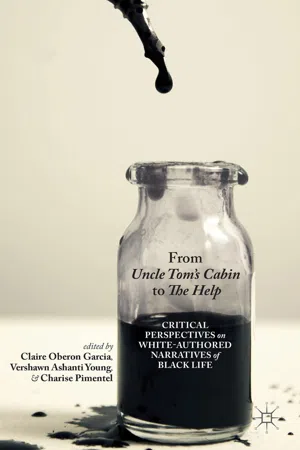
From Uncle Tom's Cabin to The Help
Critical Perspectives on White-Authored Narratives of Black Life
- English
- ePUB (mobile friendly)
- Available on iOS & Android
eBook - ePub
From Uncle Tom's Cabin to The Help
Critical Perspectives on White-Authored Narratives of Black Life
About this book
This book surveys the cultural, literary, and cinematic impact of white-authored films and imaginative literature on American society from Harriet Beecher Stowe's Uncle Tom's Cabin to Kathryn Stockett's Th e Hel p .
Information
Subtopic
Film & VideoChapter 1
Bearing Witness?
The Problem with the White Cross-Racial (Mis)Portrayals of History
Luminita M. Dragulescu
Within the racial anxieties fixed in the black-white paradigm, cross-racial representations of the Other—to wit, a white author assuming an African American persona or an African American author assuming a white persona—are relevant for either race’s beliefs and views on the American racial status quo. Throughout the United States’ racial history, whites and nonwhites have negotiated a complicated rapport, constantly challenging their respective power positions. The Baconian principle scientia potentia est applies in one race’s effort to understand and portray the Other as a means either to control and manipulate or to preclude and defend against the Other more efficiently. More recently, white authors’ interest in knowing and representing black life and history stems from their need to lay bare the complexities of racial interactions and to negotiate their many points of discord. Literary imagination, as always, works at the forefront of change when it comes to the appreciation and the readjustment of one racial group’s perspective over another, and of racial relations in general. Writers that venture to imagine intimately the racial Other’s individual and group consciousness illustrate the sensitive process of rising above racial stereotypes in order to address a conflicted and largely unresolved common history. But, as Kathryn Stockett’s The Help (2009) has demonstrated more recently, such ventures could subtly reify the racist status quo and only pay lip service to the cause of accurately and honestly representing black history.
With certain important caveats, I uphold the value of cross-racial penning. It suggests a desire to get to know the Other, and thus it could contribute to interracial understanding and reconciliation. However, this chapter identifies some of the concerns with white cross-racial portrayals of history that The Help, as one of the latest enterprises of this nature, exemplifies. The novel displays an insufficient, if not perfunctory, knowledge of black history and life. This appears in the author’s stereotypical depiction of mid-twentieth-century black life and psyche, according to a twenty-first-century “politically correct” white construction of “blackness.”1 For this reason, The Help bears witness to the contemporary racial status quo rather than the status quo ante. There is a conspicuous vilification of most white characters in contrast to the beatification of the black ones. Yet the whites’ offenses are quite minor, considering the historic background of the Jim Crow laws and of the civil rights movement’s brutal racial clashes. Frustratingly, Stockett portrays the white protagonist as the “savior,” confidante, and, most worryingly, the spokesperson for the black characters: a problematic stance in the context of the much-beleaguered black historiography. As such, The Help does not depart much from a long tradition of white misrepresentations of the common racial history.
Historically, white imagination has consistently spoken for the racial Other and took it upon itself to “bear witness” to racial history. Writing with a “black” voice is neither new nor exceptional in American literature. Toni Morrison notes that the very characteristics of American literature are in fact responses to the dark, abiding, signing “Africanist presence” that has affected and shaped the development of the American literary canon (5). But beyond the more subtle, all-pervading Africanist presence, there are instances of direct white voicing (white writers undertaking a black persona by writing a first-person narrative) of the black psyche and history that have increased over time. It is well known that runaway slaves’ lack of literacy skills often necessitated direct white intervention, and their stories were written by amanuenses. White collectors of folklore, such as Joel Chandler Harris at the end of the nineteenth century, also used a black persona—Uncle Remus—to relay stories. Most noticeably, in 1967, William Styron published The Confessions of Nat Turner, a first-person fictional narrative of the 1831 leader of the Virginia slave rebellion. At the time, Styron was one of the first white writers who attempted to undertake an event in American history with a more reverently constructed voice of the racial Other. Albeit well intended, his enterprise met with a critical response that reflected the passionate and incompatible standpoints of whites and African Americans on their common history, particularly interracial clashes such as the Turner Insurrection. The critical upheaval generated by Styron’s novel brought to the forefront the chaotic history of race relations in the United States, as well as the precarious racial compromise after the Civil Rights Act of 1964. The black audiences’ protest of Styron’s take on a most significant event in black history defined certain irreconcilable positions whites and blacks have on appraising their shared past. In regard to ethics of representation, John Henrik Clarke’s collection William Styron’s Nat Turner: Ten Black Writers Respond (1968) was the first of many acerbic reactions to Confessions and to reckless, white-authored representations of the black psyche and history. The Styron controversy became the cause célèbre by which we measure the cross-racial politics and ethics of representing the past. Stockett’s The Help continues to emphasize the problem with white cross-racial representations of US history.
Writing racial history in the “postracial” era implies a complex negotiation between past and present—that is, present views on multifarious and contending representations of a shared history. In effect, it results in the effort to preserve rather than the attempt to obliterate or revise the often competing narratives of blacks and whites. Although contemporary literature that undertakes cross-racial representations of the Other is wary of racial sensitivities and mostly attempts to smooth the asperities of the racial divide when writing US history, it does not succeed in erasing them altogether. The social dynamics of US race relations postulates that it is the burden of racial minorities to navigate, survive, and prosper in a system controlled by whites and not vice versa. Charles Mills is one of the scholars who dismantles the “racial contract” by which the Western world is structured, which favors whites’ privilege, whether the beneficiaries acknowledge it or not. Pertinently, Mills observes that “the only people who can find it psychologically possible to deny the centrality of race are those who are racially privileged, for whom race is invisible precisely because the world is structured around them, whiteness as the ground against which the figures of other races . . . appear” (76). Colorblindness and postracialism undeniably serve whites when, pretending to look beyond race in order to overcome racism, they implicitly attempt to erase historical memory. David Theo Goldberg distinguishes between antiracism and what he calls “antiracialism”—a trend that argues for an erasure of racial terms of reference and promotes colorblindness under the pretense of joining the antiracist movement. Goldberg notes that antiracism, on the one hand, “requires historical memory, recalling the conditions of racial degradation and relating contemporary to historical and local to global conditions.” Antiracialism, on the other hand, “suggests forgetting, getting over, moving on, wiping away the terms of reference, at best (or worst) a commercial memorialization rather than a recounting and redressing of the terms of humiliation and devaluation” (21). Needless to say, antiracialism is associated with whites or, as Goldberg remarks, “for the most part . . . is whiteness by another name” (21). “Conciliatory” literature such as The Help appears as a revisionist, “commercial memorialization” rather than an educated, restorative depiction of race relations in Mississippi at the beginning of the sixties. The promotion of the book and its film adaptation despite disgruntled voices in the black community hints at the hierarchies of racial power that still linger in postracial America. This calls to mind historian Fitzhugh Brundage’s assessment that the racial competition for “historical ‘truth’ cannot be separated from an appraisal of the unequal power that competing groups and individuals exercise over the interpretation of the past.” Consequently, we need “to acknowledge that history cannot be separated from practices of domination” (344).
Like Confessions, which amid a storm of black criticism enjoyed surprising endorsements from James Baldwin, John Hope Franklin, and J. Saunders Redding, The Help got accolades from influential black personalities such as Oprah Winfrey and the movie adaptation was screened at the Obama White House. The Pulitzer Prize with which Confessions was awarded in 1968 and the commercial success The Help enjoys more than forty years later signal that white America still welcomes a white-authored black history that validates stereotypes of blackness and sugarcoats the painful common past. But among black audiences, the book, as well as the movie, mostly found detractors who were concerned with Stockett’s ethics of representation. Stockett’s novel displays the long-standing white misapprehension of the Other despite a declared intent to understand and do justice to blacks. To Styron, writing Nat Turner was “at least partially the accomplishment of a moral duty: to get to know the blacks” (Rewald 81). Like Styron, Stockett declares that she wrote her book because she wanted to grasp the life of her maid, Demetrie. However, black audiences’ reaction to both books testifies to the authors’ failure in “knowing” the blacks and in relevantly portraying a black view of history. Stockett’s novel brought to the forefront several sensitive issues with representing the racial Other.
When writers draw from white conventions of race identity to personify the racial Other, they inevitably vex those who are targeted by these representations. The white author’s effort to depict the past by vicariously identifying with the racial Other through narrative imagination is a problematic undertaking that reflects competing, irreconcilable stances on race relations and a disputed history. American literary history displays a long-standing practice of white censorship and of misrepresenting racial minorities’ histories. The problem is not one of principle (i.e., that whites should not write across race); rather, the problem lies in white authors’ displaying shallow knowledge of other races’ culture and history. It is relevant to mention here Wayne J. Urban’s experience as a white author writing a biography of the African American educational historian and college president Horace Mann Bond. In 1998, more than a decade before the publication of The Help, Urban advises that “any White American writing about an African-American in the late twentieth century must do so with some trepidation. It is a time when African-Americans are reclaiming themselves in a variety of ways from the shackles of their White oppressors. One of the sites of this reclamation project is the scholarly arena where Whites who study Blacks run an increased risk of alienating Black audiences by misunderstanding and misrepresenting their subjects” (105).
Nevertheless, there are a great number of white scholars in black studies, race theory, historical studies, anthropology, sociology, and so on who pertinently and successfully assess and represent black life and history, while white fiction authors who have attempted to delve into black consciousness and represent black perspectives on history and society usually generate controversy.2 Writing across race is a necessary step in getting to know the Other, but such sensitive ventures require extensive and rigorous research and, most importantly, respectful portrayals. From this point of view, Stockett appears insufficiently fluent in black life, culture, and history to give justice to the community she attempts to represent. Her knowledge of the setting, characters, and history she plots seems perfunctory, and her portrayal is, at times, patronizing.3
As the critical and popular response to Styron’s Confessions demonstrated, even when well intended, a white author assuming a black voice runs the risk of misrepresenting it. More often than not, the white author exhibits conscious and unconscious habits of white privilege, and his or her racial consciousness has been (mis)shaped by a white-constructed “blackness.” The Help is unsatisfying because it does not deliver either the narrative’s premise or the title’s promise (unless the title mainly suggests that Stockett’s narrative persona, Miss Eugenia “Skeeter” Phelan, is helping the maids voices be heard?). The novel merely skates through the social turmoil of the civil rights era to nitpick on petty domestic fights and society gossip. The author’s insistence on portraying whites as inordinately flawed and blacks as saintly resonates with a manipulation of decorum, which, by way of exaggerated racial self-deprecation, subtly reinforces white preeminence. The white party is only guilty of petty crimes in The Help; the movement’s landmark tragedies, such as the brutal killings of Emmett Till and Medgar Evers, are remote occurrences from the novel’s white community. Embarrassingly oblivious to historical record, Stockett mentions Evers being “bludgeoned in [his] front yard” (277). By way of analogy, Stockett subtly declares her allegiance to her race and the Southern racial status quo when she states, “Mississippi is like my mother. I am allowed to complain about her all I want, but God help the person who raises an ill word about her around me, unless she is their mother too” (450). The book’s surprisingly mild criticism of white brutality in the time and place it claims to portray indicates the author’s loyalty to her race rather than an attempt to reach across the color line. Stockett presents black domestic life through the synecdochal chicken-frying mammy, the angry black woman, and the hackneyed archetype of the absent or drunkard and abusive black man (most notable, Leroy Jackson, Minny’s husband) and describes an overall chaotic, terrified black community. Whites, on the other hand, are self-sufficient, catty suburban wives, and white men are benevolent but mostly absent figures in the narrative (like Johnny Foote, Miss Celia’s husband and Minny’s unknowing employer). Miss Leefolt’s desire to conform to the Home Health Sanitation Initiative and build a separate bathroom for the “colored help” looks more like a social climbing maneuver and an attempt to please her bridge buddies than a real concern that blacks are a danger to her health. Disturbingly, the racism of the Jim Crow era appears individualized—a result of peer pressure—rather than systemic; one would wonder what the civil rights activists were fighting for. Stockett certainly “came to bury Caesar, not to praise him.”
The hybridized voice that Stockett devises prompts racial dissension, since she defines life experiences and literature along racial lines—an endeavor that is both impractical and damaging. Stockett’s enterprise to delve into black consciousness would require that she tap into the unifying features of racial diversity while depicting the struggle to understand and accommodate the position of the racial Other. But the hard line that differentiates between skin colors in the narrative suggests otherwise. Aibileen and Minny remain not only pitiable, granted dignified, characters but also conspicuously alien. Despite the author’s disclaimer in the “Too Little, Too Late” afterword that the “point of the book” was “for women to realize, We are just two people. Not that much separates us. Not nearly as much as I’d thought,” there is much that draws a firm color line in the novel (451). Stockett preserves her idealistic childhood spectacles, filtered by a contemporary politically correct approach to race relations in order to portray the help.4 Aibileen, Constantine, and Minny are the sacrificial—almost beatific—maids who display extraordinary domestic and nursing skills, making them as endearing and asexual as fairy godmothers. In fact, the same unrealistic perspective applies to Stockett’s depiction of the historical and social setting. She admits that her attempt to understand the black maids’ life in the 1960s was not “something any white woman on the other end of a black woman’s paycheck” could accomplish (451). Ultimately, that “black woman” to whom the writer refers constitutes a different species for the impromptu anthropological experiment that Skeeter undertakes. The author’s linguistic choices are just as baffling. Black women speak in a thick, black Southern vernacular, but they easily switch to the unaccented (why?), grammatically correct language of their employers when they recall the latter’s conversations.
Perhaps the most grating aspect of the novel is Skeeter’s portrayal as the white savior who takes personal risks (while risking her subjects far worse) to make the downtrodden black life known to Northern white audiences. Assessing the ripple effects of the white savior theme in Hollywood, Julio Cammarota warns that in such “treatments of race, people of color appear to lack the agency necessary to enact positive changes in their own lives. The underlying assumption is that people of color, on their own, fail to enact resilience, resistance, and success” (245). Furthermore, that black servants would allow a white mistress into the inner sanctum of the black community—the literal and symbolic black kitchen—and would trust their personal stories to a white employer, particularly in a time and place when race relations were so tense, is a problematic premise. That would have gone against a long-standing and historically justified fear and distrust of whites even in what appeared as pro bono endeavors. Moreover, Skeeter is hardly a William Lloyd Garrison, Lydia Maria Child, or Samuel J. May, particularly as she leaves behind her “sources” to fend for themselves once she achieves her end goal to escape home to New York. With a plot set on the background—though somewhat remote—of the civil rights movement, it seems proprietary that the protagonist, the heroine, is Miss Skeeter and not the help, Aibileen or Minny. Equally irksome is Skeeter’s transferring Aibileen’s written narrative (albeit with Aibileen’s permission in the novel, who, again, conveniently overcomes the black servant atav...
Table of contents
- Title Page
- Copyright Page
- Dedication
- Contents
- Acknowledgments
- Introduction: What’s at Stake When White Writes Black?
- 1. Bearing Witness? The Problem with the White Cross-Racial (Mis)Portrayals of History
- 2. “Must the Novelist Ask Permission?”: Authority and Authenticity of the Black Voice in the Works of Eudora Welty and Kathryn Stockett’s The Help
- 3. Blackness as Medium: Envisioning White Southern Womanhood in Eudora Welty’s “A Worn Path” and Delta Wedding and Kathryn Stockett’s The Help
- 4. “Taking Care a White Babies, That’s What I Do”: The Help and Americans’ Obsession with the Mammy
- 5. “When Folks Is Real Friends, There Ain’t No Such Thing as Place”: Feminist Sisterhood and the Politics of Social Hierarchy in The Help
- 6. Black Girlhood and The Help: Constructing Black Girlhood in a “Post”-Racial, -Gender, and -Welfare State
- 7. Second (and Third, and Fourth . . .) Helpings: Black Women, Size, and Spectacle in The Help
- 8. Mae Mallory and “The Southern Belle Fantasy Trope” at the Cuyahoga County Jail, 21st and Payne/“Pain”
- 9. Bleeping Mark Twain? Censorship, Huckleberry Finn, and the Functions of Literature
- 10. White Lies and Black Consequences: Margaret Jones and the Complex Dynamics of the Publishing Industry
- 11. “A Secondhand Kind of Terror”: Grace Halsell, Kathryn Stockett, and the Ironies of Empathy
- 12. “Savior,” Good Mother, Jezebel, Tom, Trickster: The Blind Side Myth
- 13. Blindsided by Racism: A Critical Racial Analysis of The Blind Side
- 14. Django Unchained: An Analysis
- 15. Are the Kids All Right? A Look at Postracial Presentations in The Kids Are All Right
- Afterword: Manufactured Maids, Mammies, and Falsified History: No White Help Wanted or Needed
Trusted by 375,005 students
Access to over 1.5 million titles for a fair monthly price.
Study more efficiently using our study tools.
Frequently asked questions
Yes, you can cancel anytime from the Subscription tab in your account settings on the Perlego website. Your subscription will stay active until the end of your current billing period. Learn how to cancel your subscription
No, books cannot be downloaded as external files, such as PDFs, for use outside of Perlego. However, you can download books within the Perlego app for offline reading on mobile or tablet. Learn how to download books offline
Perlego offers two plans: Essential and Complete
- Essential is ideal for learners and professionals who enjoy exploring a wide range of subjects. Access the Essential Library with 800,000+ trusted titles and best-sellers across business, personal growth, and the humanities. Includes unlimited reading time and Standard Read Aloud voice.
- Complete: Perfect for advanced learners and researchers needing full, unrestricted access. Unlock 1.5M+ books across hundreds of subjects, including academic and specialized titles. The Complete Plan also includes advanced features like Premium Read Aloud and Research Assistant.
We are an online textbook subscription service, where you can get access to an entire online library for less than the price of a single book per month. With over 1.5 million books across 990+ topics, we’ve got you covered! Learn about our mission
Look out for the read-aloud symbol on your next book to see if you can listen to it. The read-aloud tool reads text aloud for you, highlighting the text as it is being read. You can pause it, speed it up and slow it down. Learn more about Read Aloud
Yes! You can use the Perlego app on both iOS and Android devices to read anytime, anywhere — even offline. Perfect for commutes or when you’re on the go.
Please note we cannot support devices running on iOS 13 and Android 7 or earlier. Learn more about using the app
Please note we cannot support devices running on iOS 13 and Android 7 or earlier. Learn more about using the app
Yes, you can access From Uncle Tom's Cabin to The Help by C. Garcia, V. Young, C. Pimentel, C. Garcia,V. Young,C. Pimentel in PDF and/or ePUB format, as well as other popular books in Media & Performing Arts & Film & Video. We have over 1.5 million books available in our catalogue for you to explore.