eBook - ePub
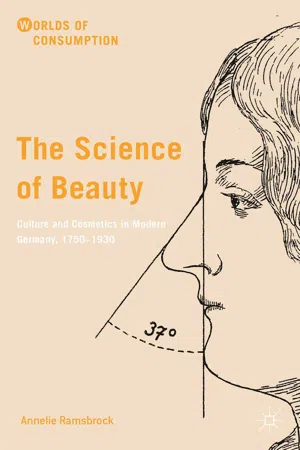
The Science of Beauty
Culture and Cosmetics in Modern Germany, 1750–1930
- English
- ePUB (mobile friendly)
- Available on iOS & Android
eBook - ePub
About this book
What did the cosmetic practices of middle-class women in the nineteenth century have in common with the repair of men's bodies mutilated in war? What did the New Woman of the Weimar years have to do with the field of social medicine that emerged in the same period? They were all part of a conversation about the cosmetic modification of bodies, a debate shaped by scientific knowledge and normative social models. Conceived as a cultural history, this book examines the history of artificially created beauty in Germany from the late Enlightenment to the early days of National Socialist rule.
Information
CHAPTER 1
From Wisdom to Knowledge: Bodies and Artificial Beauty in the Eighteenth Century
The Hannoverisches Intelligenzblatt, or “Hanover Intelligencer,” was an English-style advertising bulletin that published official notices such as court dates, bankruptcies, sales and leases, as well as marriages, births, and deaths. The term “intelligence” in this case had nothing to do with the readers’ mental faculties, but instead was used in the sense of news or information.1 In 1756, the paper began publishing a supplement entitled Nützliche Sammlungen (Useful Micellany), which included discussions of so-called exercises (Aufgaben). Some of these activities tested readers’ knowledge and others solicited their opinions. Sometimes the topics were socially relevant and other times less so. For example, they included the origins of proverbs, the preservation of food, how the forces of nature work, and—in the item on October 15, 1756—attitudes to makeup. “Is painting the face or the so-called application of rouge [Anlegen der rothen Schönfarbe] by the female sex sinful or not? To what degree is this comparable to the use of hair powder, and which is the worst offense [am strafbarsten]? [What is] the cause of this masquerading [Verlarvung]?”2
These questions become meaningful when viewed against their historical backdrop. The author was writing in the midst of fundamental changes in political thought and societal concepts that the historian Reinhard Koselleck has termed the Sattelzeit or “saddle period.” Koselleck was invoking the low point on a ridge between two mountains as a metaphor to focus attention on the specific qualities of the transitional period that linked one preeminent cognitive space to the next.3 The development of enlightened absolutism in Germany saw the end of a concept of state in which the formation of social elites was ascribed only to the nobility. This process was accompanied by the end of “self-fakery” (selbsteigene Verfälschung), an expression Daniel Caspar von Lohenstein (1635–1683) had employed to characterize the aristocracy’s outward appearance.4 Their artificial beauty ideal was confronted by the seemingly natural beauty ideal of the enlightened nobility and emerging bourgeoisie. This was more than a mere aesthetic preference. Naturalness was synonymous with the values of the Enlightenment, that is, virtue, morality, and reason, whereas artificiality was associated with haughtiness, pride, extravagance, and mendacity—qualities that the painted faces of courtly society seemed to symbolize.
Nützliche Sammlungen, too, turned makeup into a moral issue. It did not discuss whether the painted face was beautiful, but whether makeup was sinful. Although the question was tendentious, not all readers rejected rouging. Most did in fact subscribe to the paper’s point of view, rejecting makeup for religious, moral, or political reasons, but there were also voices that defended cosmetics by referring to philosophical concepts of perfection or images of the body derived from natural history.
Because judgments on makeup were pronounced from within a dichotomous framework of artifact and masquerade versus authenticity and sincerity, they focused on social and cultural values rooted mainly in theological and philosophical aphorisms, not scientific knowledge. This perspective would only change at the end of the eighteenth century, with the triumph of modern science.
The Concept of “Inner Beauty”: Religious and Moral Arguments against Makeup
Although the Age of Enlightenment was marked by an increasing secularization of society, the Christian church did not completely lose its interpretive power over the body. The debate on makeup was subject to religious anthropologies, as evidenced not only in the questions raised by Nützliche Sammlungen but also in its readers’ replies. Thus, some turned the issue of rouge into a “theological, or merely a moral decision” to be made by those “whose years, office, or relationship” to God allowed them “to instruct [the public] in moral philosophy.” By this they meant clergymen and theologians who could prove “definitively the inadmissibility, indeed the sinfulness of such foolish vanity” with no lack of “incontrovertible arguments.”5 These readers had no doubt that “learned men of God” would have their objections to makeup. After all, the Christian faith followed certain “tenets” that deemed it a “hyperbolic conceit.”6 These precepts included the doctrine of creationism and the resulting theomorphic concept of humankind. In the first book of the Pentateuch, Genesis, it was written that “God created man in his own image, in the image of God created he him.”7 Since the human being’s external appearance was thought to be analogous to that of God, cosmetic correction of the body amounted to a criticism of Creation and even of the Creator’s image.
Ever since its founding, the Christian church criticized the artificial creation of beauty as an offense against the imago Dei. According to a beauty catechism of the late seventeenth century, even Bishop Cyprian of Carthage (200–258) had argued to this effect. He pointed out that people who used cosmetics were laying “their hands on God,” “re-forming” what God had “formed.”8 Ludwig Kotelmann, in his 1890 Gesundheitspflege im Mittelalter (Health and Hygiene in the Middle Ages), pointed out that the Franciscan monk Berthold von Regensburg (1210–1272) had identified “two kinds of people chasing after the devil [Jäger des Teufels] in Christianity,” the “painted” and the “dyed,” both of whom would find no mercy on the Day of Judgment. “If ye are ashamed of the face that the Almighty God hath given thee, the beautiful face, so God shall be ashamed of thee for ever and ever in His eternal kingdom and cast thee into the depths of hell.”9 Thus, those readers of the Nützliche Sammlungen who considered makeup sinful were informed by a literal interpretation of the Bible, although Enlightenment biblical exegesis that aspired to rigorous scientific standards advocated distinguishing between the Bible’s literal meaning and the true “Word of God.”10
Whereas cosmetic alterations to the hair were considered a form of blasphemy well into the late seventeenth century, it is evident in Nützliche Sammlungen that by the mid-eighteenth century only rouging was considered morally reprehensible.11 It made a “great difference,” one female reader concluded, if one powdered the hair or painted the face because the “hair contributed little to the physiognomy of a person.” The eyebrows, which were generally “of ordinary color” like the “other hair,” would reveal “what kind of hair a person was wearing” anyway. That’s why powder “[could] never deceive one into mistaking blonde hair for brown and black for white.” Makeup, on the other hand, prevented one from “seeing the true form [Gestalt] that a human being [had] received from Nature.”12
Although this reader spoke of “physiognomy,” her criticism of cosmetics had nothing to do with the “science” of physiognomy later developed by Johann Caspar Lavater (1741–1801) and popularized in his 1775 Physiognomische Fragmente.13 Even so, Lavater’s view that “the beauty and deformity of the countenance is in a just and determinate proportion to the moral beauty and deformity of the man” was also being advocated in moral discussions of cosmetics, albeit from a different angle.14 At issue were not the bone structure and the muscle system, which physiognomists used to deduce the character of an individual, but the “emergence [Einbruch] of the authentic,” as Henning Ritter puts it. The “game of artificiality had been taken so far that its opposite, the natural, was assuming new power.”15 Ancien régime society was condemned in the name of nature, the new universal ideal that symbolized virtue, morality, and reason. At the same time, the “nature of the human being” was construed as reflecting a correspondence between appearance and essence, whereby a “natural” appearance indicated a decent and rational person.16 “The natural is always preferable to the artificial,” the same female reader emphasized, because the art of cosmetics was “deceit” and made the individual appear deceitful.17 Such “artifice” was reprehensible, another reader asserted, as the person using cosmetics had a “selfish and withal false heart.”18
Such prejudices comported with a beauty ideal that classical aesthetics called “inner beauty.” According to that standard, the beautiful appearance of nature and artifacts corresponded to the sensorily perceptible appearance of a good and properly disposed character. Since fundamentally greater value attached to essence than to façade, the better person also counted as the more beautiful.19 Along these very lines, an anonymous author in Nützliche Sammlungen identified “virtue,” “intelligence,” “unaffected cleanliness,” a “modest nature mixed with decent amicability,” and a talent for “thriftiness” as the hallmarks of beauty.20
It was not just in the eighteenth century, though, that these qualities were turned into the marks of ideal femininity and contrasted with those who wore makeup. Theological arguments against cosmetics had employed “the topos of female vices from the very beginning, especially lustfulness and the natural tendency toward sins such as vainglory, immoderateness, wantonness, and waste.”21 This theme was also manifest in the eighteenth-century cosmetics debate. Thus, an anonymous reader of Nützliche Sammlungen surmised that women who wore makeup were “indulging” a particular “desire” that extended well “beyond the bounds of ethics and reason” and excluded virtuous womanhood.22 The reader concluded that wearing makeup was symptomatic of a licentious and dissolute love life, which he associated with whores and the ladies of courtly society.
No explanation of this comparison is needed in the case of the whore, whose sexual life so clearly deviated from bourgeois morals. Things are more obscure in the case of the aristocratic woman. Although normally married for political and strategic reasons, not for love, she was nevertheless a married woman. She bore children and exposed herself to the dangers of childbirth, which meant that the coordinates of her life overlapped with those of bourgeois women. The ladies of courtly society likewise had to obey their husbands, but household chores, childcare, and parenting were not among their duties. They could rely on a courtly household, on nannies and governesses, on tutors and additional servants so that they seemed to have one thing in abundance: time. Moreover, some married aristocratic couples did not even live together. They only met for official functions and to procreate. Otherwise, he pursued his political commitments and she traveled. Although such lifestyles were certainly not a given even in these circles, aristocratic women suffered a reputation of spending hours and days outside the family, involved in countless relationships and constantly surrounded by amorous passion.23
Notwithstanding such disparaging clichés, not all German women were convinced by the concept of inner beauty, just as not every woman believed that her beauty stemmed from her character. In fact, Nützliche Sammlungen had female readers who were “not satisfied with their natural beauty,” but who wanted to marry and not “take the veil.” They asked, “how can one be pleasing if wearing makeup is not allowed?”24 They received plenty of answers, but these were hardly satisfactory. Cosmetics, one male reader wrote, had not yet made “any woman beautiful”; “at best,” they disguised the “flaws of an ugly one.” Moreover, a person “with an unpleasant appearance [Gestalt]” who possessed “the strength of character [Gemüth] to compensate with more essential qualities of the spirit” would be “much too sublime” to stoop “to the level of cosmetics.”25 Thus, what the Church Father Tertullian had preached to women still held: “go forth already arrayed in the cosmetics and ornaments of prophets and apostles; drawing your whiteness from simplicity, your ruddy hue from modesty; painting your eyes with bashfulness, and your mouth with silence.”26 No alternatives to this prescription appeared until the beauty manuals of the nineteenth century, which in the context of new images of good health proclaimed changed notions of beauty too.
The question raised in Nützliche Sammlungen about the “cause of this masquerade” was likewise answered by readers. Like “many other forms of moral corruption,” the “impudence of cosmetics,” some believed, had its “origins” in France.27 In fact, the art of cosmetics had already existed in ancient Egypt, among the Assyrians, in the Hellenis...
Table of contents
- Cover
- Title Page
- Copyright
- Contents
- List of Figures
- Acknowledgments
- Introduction
- 1. From Wisdom to Knowledge: Bodies and Artificial Beauty in the Eighteenth Century
- 2. Regulated Bodies: Cosmetics and Hygiene in the Nineteenth Century
- 3. Renovated Bodies: Medical Cosmetics from the Fin de Siècle to the Weimar Republic
- 4. Simulated Bodies: Cosmetics and Consumption in the Interwar Period
- 5. Knowledge and Political Conscience: Social Cosmetics during the Great Depression
- Conclusion
- Notes
- Bibliography
- Index
Trusted by 375,005 students
Access to over 1.5 million titles for a fair monthly price.
Study more efficiently using our study tools.
Frequently asked questions
Yes, you can cancel anytime from the Subscription tab in your account settings on the Perlego website. Your subscription will stay active until the end of your current billing period. Learn how to cancel your subscription
No, books cannot be downloaded as external files, such as PDFs, for use outside of Perlego. However, you can download books within the Perlego app for offline reading on mobile or tablet. Learn how to download books offline
Perlego offers two plans: Essential and Complete
- Essential is ideal for learners and professionals who enjoy exploring a wide range of subjects. Access the Essential Library with 800,000+ trusted titles and best-sellers across business, personal growth, and the humanities. Includes unlimited reading time and Standard Read Aloud voice.
- Complete: Perfect for advanced learners and researchers needing full, unrestricted access. Unlock 1.5M+ books across hundreds of subjects, including academic and specialized titles. The Complete Plan also includes advanced features like Premium Read Aloud and Research Assistant.
We are an online textbook subscription service, where you can get access to an entire online library for less than the price of a single book per month. With over 1.5 million books across 990+ topics, we’ve got you covered! Learn about our mission
Look out for the read-aloud symbol on your next book to see if you can listen to it. The read-aloud tool reads text aloud for you, highlighting the text as it is being read. You can pause it, speed it up and slow it down. Learn more about Read Aloud
Yes! You can use the Perlego app on both iOS and Android devices to read anytime, anywhere — even offline. Perfect for commutes or when you’re on the go.
Please note we cannot support devices running on iOS 13 and Android 7 or earlier. Learn more about using the app
Please note we cannot support devices running on iOS 13 and Android 7 or earlier. Learn more about using the app
Yes, you can access The Science of Beauty by Annelie Ramsbrock in PDF and/or ePUB format, as well as other popular books in Social Sciences & European History. We have over 1.5 million books available in our catalogue for you to explore.