- English
- ePUB (mobile friendly)
- Available on iOS & Android
eBook - ePub
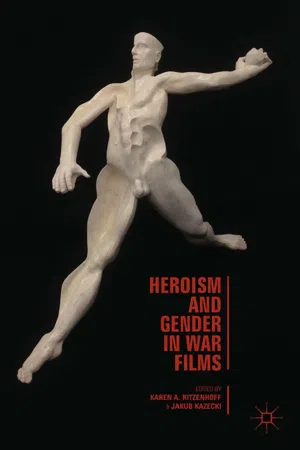
Heroism and Gender in War Films
About this book
Filmic constructions of war heroism have a profound impact on public perceptions of conflicts. Here, contributors examine the ways motifs of gender and heroism in war films are used to justify ideological positions, shape the understanding of the military conflicts, support political agendas and institutions, and influence collective memory.
Information
Topic
Ciencias socialesSubtopic
Películas y vídeosPart I

Historical Leaders and Celebrities: Their Role in Mythmaking in the Cinema
Chapter 1
Mary Pickford’s WWI Patriotism
A Feminine Approach to Wartime Mythical Americanness
Clémentine Tholas-Disset
The cinematic tales of World War One (WWI) in the United States needed to unify the politics of the industry and the US government: any creative work tended to go even beyond the intended propaganda message it was supposed to convey. The motion pictures industry, thought to be assuming a rather pacifist stance in the early years of the war,1 decided to embrace the governmental ideological combat in the movies it produced. Hollywood’s position regarding the war can be generally considered as a form of “practical patriotism,”2 under the threat of the newly passed 1917 Espionage Act and 1918 Sedition Act.
If many actors participated in the actions initiated by the NAMPI (National Association of the Motion Pictures Industry, created in 1916) and its War Cooperation Committee,3 some stars played a crucial role as war effort spokespersons, believing that America was the champion of Democracy: Charles Chaplin, Douglas Fairbanks, William S. Hart, and, in particular, Mary Pickford. Among her manifold interventions, Pickford took an active role in the Liberty Loan Drives, made vibrant public speeches, sold some of her curls to support the war effort, organized collections of cigarettes for the soldiers, planned charity balls to raise funds for the Red Cross, and became the Godmother of the 143rd Field Artillery Regiment.4 In the eye of the public, she turned into the emblem of Brave America at war. Pickford’s public persona as a fervent war supporter also addressed the issue of women’s participation in the Great War and how, in the 1910s, the portrayal of national heroism became inclusive enough to turn young women into new embodiments of American courage. The imagery of female active presence on the front and the home front extended beyond Pickford’s movies as it was extensively used in national propaganda. Yet, the actress crystallized the representation of early American female fortitude in war times and disseminated it massively and internationally through cinema.
This chapter analyzes how Mary Pickford’s war movies, The Little American by Cecil B. DeMille and Joseph Levering (1917), Johanna Enlists by William Desmond Taylor (1918), and her liberty bonds short advertising film, One Hundred Percent American by Arthur Rosson (1918), use narrative devices to raise questions about the actions of the United States. These films also illustrate the self-image North America wanted to create in the wake of the twentieth century. Pickford used several film genres as different as the slapstick comedy and the romantic melodrama, thus debunking the idea that war films could only painfully unfold the “hellish aspect of the conflict.”5 These movies offered a female-oriented narrative of the Great War, bearing testimony to the social changes in the late 1910s.6 In order to understand Pickford’s contribution to the definition of a US gender-blind heroism during WWI and to women’s conditions, this chapter focuses on how cinema became the most treasured media for propaganda and for shaping of a national sentiment seemingly reuniting men and women as well as different ethnic groups. It also examines the nature of war films and illustrates how Pickford’s movies offered an unusual treatment of the conflict thanks to the mingling of various film genres. Finally, this chapter explains how Pickford’s independent heroines reject the role of passive victims to become empowered warriors in a world paradoxically violent and progressive.
Power of the Cinema as Propaganda Tool
President Woodrow Wilson was reelected after vowing he would keep the country out of the war,7 as the country was reluctant to participate in the conflict. Yet after a German U-boat torpedoed the British passenger ship Lusitania in 1915, and the British intelligence intercepted Zimmermann’s telegram8 unveiling Germany’s plans to ally with Mexico against the United States, the nation officially entered the war on April 6, 1917.9 Soon after the declaration of war, on April 15, Wilson presented his motto, “Do Your Bit for America,” to entice and motivate people’s participation in the war effort.
To channel the official message of the presidency and regulate wartime propaganda, the CPI, Committee on Public Information, was created on April 13, 1917, and directed by former journalist George Creel. The CPI was in charge of delivering stimulating and educative information and convincing the public of the rightness of American action by converting people to the “Gospel of Americanism.”10 Among the various activities led by the Committee, both Wilson and Creel quickly expressed their firm belief in the power of cinema, as George Creel (1920) has put it in his memoirs, to lead “a fight for the minds of men, for the conquest of their convictions, and the battle-line ran through every home in every country.”11 He also explains that “through the medium of the motion picture, America’s war progress, as well as the meanings and purposes of democracy, were carried to every community in the United States and to every corner of the world.”12 Wilson stated in June 1917:
The film has come to rank as a very high medium for the dissemination of public intelligence and since it speaks a universal language it lends itself importantly to the presentation of America’s plans and purposes.13
Images were acknowledged to be “potentially powerful as bullets in defeating the enemy” and motion pictures were compared to the “the right sort of cartridges.”14 As scholar Michael Paris explains (1999), the Great War “was not the first war to be recorded on film . . . but it was the first war in which cinema was used as an agent of mass persuasion by the governments of the combatant nations.”15
One significant aspect of Mary Pickford’s participation in the war effort was her role in various patriotic movies answering the demands of the CPI who needed Hollywood to create visual narratives of the war: entertainment motion pictures that would help the United States gain national and international backing more efficiently than the documentaries made by the CPI film section. The partnership between the government and the private sector, underscored by the distribution of Hollywood fictions by the CPI and the Office of War,16 seemed to be the best way to seduce moviegoers and awaken their sense of citizenship.
As Mitzi Myers (2000) explains, certain classical recipes for war stories are to be found in books and films: the themes of escape and survival;17 the issue of confusions of national identity;18 the perception of a violent world and the necessity to teach peace, in order to “shape the new millennium’s global, multicultural society”;19 the transgression of certain social norms, for instance, the transfer of “moral authority and decision making from adults to younger protagonists”; the advent of new protagonists, such as “strong heroines instead of soldiers”; and finally “the moral dilemmas posed by more modern wars, with no simplistic accounts of good guys versus bad.”20 Mary Pickford’s war movies engage with these themes, thus creating a unique version of war heroines.
The Role of the United States and the Meaning of Americanness
Mary Pickford started to shoot her first war movie when she moved to California to work with movie directors Adolph Zukor and Cecil B. DeMille. In her autobiography, she declared it was a great honor to participate in the making of high-standard motion pictures for the sake of the nation.21 The plot of The Little American begins on July 4, 1914, and refers to the sinking of the Lusitania as well as to the Battle of the Marne, providing some interesting insight about the life on the battlefield. The heroine Angela More (Mary Pickford) is presented as “the Little American,” born on same day as the nation. She is the very personification of America: young, fearless, valiant, ready to do anything to rescue other people.
The generosity and sense of sacrifice of the American people is also underlined in One Hundred Percent American, an official short propaganda film promoting the need to buy liberty bonds to support the troops financially. In that 14-minute film, the main character, Mayme (Mary Pickford), is convinced by a Four Minute Man (Ted Reed) delivering a speech in a fair to become “a bond spendthrift” and to show some strong “will power” and “self-denial” to “[battle] temptation” and obtain “victory.” The movie echoes Wilson’s words in his “Do Your Bit for America” address about the need for every citizen “to assume the duty of careful, provident use and expenditure as public duty, and as a dictate of patriotism” and for America “to correct her unpardonable fault of wastefulness and extravagance.”22 With Mayme saving carefully every cent she earns, One Hundred Percent American reasserts the mythical Altruism of the United States, this “City upon a Hill,”23 generously guiding other nations out of darkness.
The Little American also deals with tricky issues such as the German origins of part of the US population and the problems faced by a country composed of a multiplicity of European immigrants when Europe is now at war. The main characters, Angela More (Mary Pickford), Karl von Austreim (Jack Holt), and Count Jules de Destin (Raymond Hatton), embody the major belligerent powers (America, Germany, and France) and the movie underlines the fact that America, the nation of immigrants, is torn between its allegiances to its various European roots.24 More and her two suitors, despite their foreign origins, are as brave as exemplary because of their shared American identity, and the film juggles with discrediting and perpetuating the common cinematic stereotypes about the French or the Germans to offer a more nuanced portrayal of Europe. Contrary to America, whose citizens are all undaunted heroes, in Germany and France live courageous and trustworthy people as well as barbarians and cowards.
The Little American mingles some deep Manichaeism with a realistic approach to rehabilitate the European ancestry of the American people. The constitution of the American population and its overseas origins is also debated in Johanna Enlists, illustrating the preparation of the troops in the United States and the behavior of people on the home front. Even far away from the combat, the question of Americanness is central to Johanna Ranssallar’s (Mary Pickford) romantic relationships with the soldiers station...
Table of contents
- Cover
- Title
- Introduction
- Part I Historical Leaders and Celebrities: Their Role in Mythmaking in the Cinema
- Part II Hollywood’s War Myths in the 1940s and 1950s
- Part III Ideologies, Nationality, and War Memory
- Part IV Men, Women, and Trauma: Heroes and Anti-Heroes
- Part V Historical Reality, Authenticity of Experience, and Cinematic Representation
- Notes on Contributors
- Index
Trusted by 375,005 students
Access to over 1.5 million titles for a fair monthly price.
Study more efficiently using our study tools.
Frequently asked questions
Yes, you can cancel anytime from the Subscription tab in your account settings on the Perlego website. Your subscription will stay active until the end of your current billing period. Learn how to cancel your subscription
No, books cannot be downloaded as external files, such as PDFs, for use outside of Perlego. However, you can download books within the Perlego app for offline reading on mobile or tablet. Learn how to download books offline
Perlego offers two plans: Essential and Complete
- Essential is ideal for learners and professionals who enjoy exploring a wide range of subjects. Access the Essential Library with 800,000+ trusted titles and best-sellers across business, personal growth, and the humanities. Includes unlimited reading time and Standard Read Aloud voice.
- Complete: Perfect for advanced learners and researchers needing full, unrestricted access. Unlock 1.5M+ books across hundreds of subjects, including academic and specialized titles. The Complete Plan also includes advanced features like Premium Read Aloud and Research Assistant.
We are an online textbook subscription service, where you can get access to an entire online library for less than the price of a single book per month. With over 1.5 million books across 990+ topics, we’ve got you covered! Learn about our mission
Look out for the read-aloud symbol on your next book to see if you can listen to it. The read-aloud tool reads text aloud for you, highlighting the text as it is being read. You can pause it, speed it up and slow it down. Learn more about Read Aloud
Yes! You can use the Perlego app on both iOS and Android devices to read anytime, anywhere — even offline. Perfect for commutes or when you’re on the go.
Please note we cannot support devices running on iOS 13 and Android 7 or earlier. Learn more about using the app
Please note we cannot support devices running on iOS 13 and Android 7 or earlier. Learn more about using the app
Yes, you can access Heroism and Gender in War Films by Karen A. Ritzenhoff, J. Kazecki in PDF and/or ePUB format, as well as other popular books in Ciencias sociales & Películas y vídeos. We have over 1.5 million books available in our catalogue for you to explore.