eBook - ePub
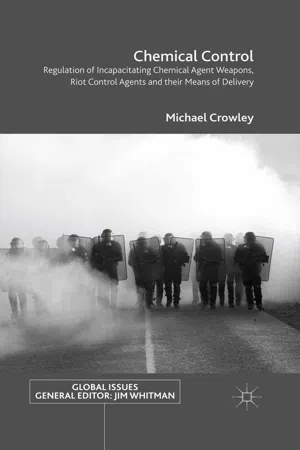
Chemical Control
Regulation of Incapacitating Chemical Agent Weapons, Riot Control Agents and their Means of Delivery
- English
- ePUB (mobile friendly)
- Available on iOS & Android
eBook - ePub
Chemical Control
Regulation of Incapacitating Chemical Agent Weapons, Riot Control Agents and their Means of Delivery
About this book
This thoroughly researched study highlights the international community's failure to regulate contemporary state research, development, marketing and/or deployment of riot control agents and incapacitating chemical agent weapons.
Information
1
Introduction
1.1. Introduction
On 10 December 2013, the Organisation for the Prohibition of Chemical Weapons (OPCW) received the Nobel Peace Prize for its ongoing activities overseeing the destruction of chemical weapons in Syria and for its continuing efforts supporting implementation of the Chemical Weapons Convention (CWC) and the global effort to eradicate all such weapons.
In his Nobel Lecture, the OPCW Director General, Ambassador Ahmet Üzümcü, described the remarkable success of the Chemical Weapons Convention and the attendant control regime:
For sixteen years now, the OPCW has been overseeing the elimination of an entire category of weapons of mass destruction. Our task is to consign chemical weapons to history, forever. A task we have been carrying out with quiet determination, and no small measure of success. Under the terms of the Chemical Weapons Convention, the OPCW has so far verified the destruction of more than 80% of all declared chemical weapons. We have also implemented a wide range of measures to prevent such weapons from re-emerging. And with 190 states now members of this global ban, we are hastening the vision of a world free of chemical weapons to reality.1
The CWC stands as an important bulwark, preventing the use of chemical weapons against both military personnel and civilian populations, under any circumstances. Through the tireless work of the OPCW and its Member States, real advances have been and are continuing to be made to identify and destroy all existing arsenals of chemical weapons across the world. These accomplishments are critically important for safeguarding international peace and security and to be truly comprehensive and permanent must be fully supported by the international community in word and deed.
To date, however, the international community has been unwilling or unable to effectively address the real and growing dangers to human security posed by the failure of States to adequately regulate two classes of weapon employing chemical agents, namely incapacitating chemical agent (ICA) weapons and riot control agents (RCAs). This publication attempts to highlight the consequences of this ongoing failure, and through a holistic arms control (HAC) framework seeks to explore the full range of applicable regulatory mechanisms and international law that either constrains or prohibits the use of these weapons.
1.2. Incapacitating chemical agent weapons
At around 5 a.m. on 26 October 2002, Russian security forces, in their attempt to save 900 hostages held in a Moscow theatre by armed Chechen fighters, employed a secret ICA weapon believed to affect the central nervous system. Although the bulk of the hostages were freed, more than 120 of them were killed by the chemical agent and many more continue to suffer long-term health problems.
To this day, the Russian authorities refuse to publicly disclose the weapon they employed, nor will they provide any details of the nature and levels of ICA weapons they may have developed or stockpiled. Despite the official silence, there is evidence, documented by the author, of continued research in relevant fields by Russian scientists, including computer modelling of so-called “calmative” “gas flows” in enclosed spaces, as well as exploration of the interaction of potential ICAs with human receptor sites. And Russia is not alone; China and Israel have also developed ICA weapons targeting individuals, while a number of other States have conducted research that is potentially applicable to the study or development of such weapons.
ICA weapons can be described as weapons employing a disparate range of substances – potentially including pharmaceutical chemicals, bioregulators and toxins – that are purportedly intended to act on the body’s core biochemical and physiological systems (such as the central nervous system) to cause prolonged but non-permanent disability. They include centrally acting agents producing loss of consciousness, sedation, hallucination, incoherence, disorientation, or paralysis. At inappropriate doses, however, death can result.
Proponents of ICA weapons have long promoted their development and use in certain extreme law enforcement scenarios, where there is a need to rapidly and completely incapacitate an individual or a group without causing permanent disability or fatality. They have also been raised as a possible tool in a variety of military operations, especially in locations where fighters and civilians are in close proximity or intermingled.
In contrast, a broad range of observers, including scientific and medical professionals, arms control organizations, international legal experts and human rights and humanitarian organizations, as well as a number of countries, have criticized ICA weapons, contending that their use presents potentially grave dangers to health and well-being.
Critics have expressed a variety of additional concerns, including the risk of “creeping legitimization” of ICA weapons as the norm against the weaponization of toxicity is eroded; the dangers of ICA weapons proliferation to both State and non-State actors; the employment of ICA weapons to facilitate torture and other human rights violations; the further misuse and militarization of the life sciences; the potential for States to use law enforcement ICA weapons development as a cover for covert offensive chemical weapons programmes; and the danger of creating a “slippery slope” that could lead in the end to chemical warfare. Disquiet about unregulated State research into ICA weapons is further exacerbated by the rapid advances in relevant science and technology, particularly genomics, synthetic biology, medical pharmacology and neuroscience.
1.3. Riot control agents and related means of delivery
Riot control agents (RCAs), commonly known as tear gases, are typically potent sensory chemical irritants normally with low lethality. They are regularly employed by law enforcement officials throughout the world for activities such as the dispersal of assemblies posing an imminent threat of serious injury, and the incapacitation of violent individuals. When utilized in accordance with manufacturers’ instructions and in line with international human rights standards, RCAs can provide an important alternative to other applications of force more likely to result in injury or death, such as firearms. However, they are also open to misuse. And such misuse appears to be widespread and serious.
Research conducted by the author has uncovered reports from United Nations (UN) and regional human rights bodies and international nongovernmental human rights organizations of human rights violations committed by law enforcement officials utilizing RCAs in at least 95 countries or territories from 1 January 2009 to 31 December 2013. RCAs have reportedly been used to suppress the right to assembly, in the excessive use of force, and to cause ill-treatment and torture. In some instances the misuse of RCAs, particularly in enclosed spaces, has reportedly resulted in serious injury or death. In other instances, RCAs have reportedly been employed together with firearms by police or security forces in massacres of unarmed people.
A further area of concern is the current development and marketing of a range of large calibre munitions and other delivery systems that can be utilized for dispersing significant amounts of RCA over wide areas or over extended distances. Research undertaken by the author has uncovered the development, testing, production, possession or promotion by State or commercial entities in at least 15 countries of some 40 “wide area” RCA means of delivery. These “wide area” RCA means of delivery have included large RCA “smoke” generators and irritant sprayers; multiple munition launchers; automatic grenade launchers; rocket propelled grenades; mortar munitions; large calibre aerial munitions; heliborne munition dispensers; cluster bombs; and RCA launchers fitted to unmanned aerial and ground vehicles. Certain forms of “wide area” RCA means of delivery may have restricted utility in large-scale law enforcement situations provided they meet and are used in strict conformity with human rights standards. Other forms of “wide area” RCA means of delivery that have been developed – such as artillery shells, aerial bombs, large calibre mortar shells and cluster munitions – are completely inappropriate for any form of law enforcement, having possible utility instead in large-scale human rights abuses or armed conflict. They should be considered to be chemical weapons and treated accordingly.
1.4. Holistic arms control (HAC)
For many years the governmental and non-governmental arms control communities have sought to develop strategies to combat the proliferation of chemical and biological weapons to State and non-State actors. Recognizing that reliance upon a single disarmament or arms control agreement alone would not guarantee success, scholars have explored a number of concepts, seeking to broaden the range of possible regulatory mechanisms. Utilizing and building upon such work, particularly the concepts of “preventative arms control”2 and “webs of prevention (or protection)”,3 the author has developed a “holistic arms control” (HAC) framework for regulation, and has sought to apply it to ICA weapons, RCAs, and related means of delivery.
Although the proposed HAC analytical framework concentrates upon existing arms control and disarmament measures, it attempts to widen the range of applicable mechanisms for regulation, and also the nature of the actors involved in such regulatory measures.
Consequently, HAC can be thought of as a framework for analysis to aid the development of a comprehensive, layered and flexible approach to arms control that:
• Is tailored for and unique to the specific type of weapon or technology under consideration rather than for a broad grouping of weapons;
• Is not necessarily limited to a single existing arms control or disarmament treaty, but actively explores and seeks to incorporate States’ existing responsibilities under the full range of relevant international law and applicable agreements;
• Potentially covers all stages of a weapon’s existence, i.e., research, development, mass production, stockpiling, deployment, use, transfer and destruction;
• Seeks to clearly identify the types of permitted and prohibited weapons, acknowledges where existing ambiguity lies and highlights potential mechanisms for resolving such ambiguities;
• Seeks to clearly identify existing constraints upon the permitted use of weapons, i.e., legitimate targets (e.g. whether this would include armed combatants, terrorist organisations, criminals, civilians), legitimate types of operations (e.g. whether this would include law enforcement, military operations other than war, armed conflict) and how such operations should be conducted (rules of engagement); acknowledges where existing ambiguity lies and highlights potential mechanisms for resolving such ambiguities;
• Seeks to identify measures to facilitate effective national implementation as well as reporting, transparency, verification and enforcement mechanisms;
• Seeks to identify measures for regular “feedback”, both “official” (e.g. annual State reporting) and “unofficial” (e.g. civil society briefings to State Parties or regime secretariats, media reports), and comprehensive review of the relevant control regime(s);
• Explores mechanisms to facilitate regime adaptation to ensure continued effectiveness and relevancy in response to developments including in:
• the nature of the use/misuse of weapons in practice;
• science and technology (so that the regime is able to regulate weapons and technologies that have not yet been invented);
• international law, particularly that limiting types and use of weapons;
• Recognizing that States are the prime actors in existing regulatory regimes, allows for and encourages participation by the full range of relevant stakeholders.
HAC consists of the following three-stage process:
• Stage one: an examination of the nature of the weapons and technology to be controlled and exploration of the current and potential future scenarios of application, together with the attendant national and human security concerns of inappropriate use. During this stage, the potential relevance of advances in science and technology is assessed.
• Stage two: an analysis of the full range of potentially applicable international law, (arms control, disarmament and other) instruments and attendant control regimes; highlighting strengths, weaknesses and ambiguities in these mechanisms. The potential roles of relevant non-State actors are also explored.
• Stage three: following an analysis of information derived from stages one and two, a comprehensive strategy is developed to strengthen existing mechanisms and/or introduce new mechanisms to facilitate effective regulation or prohibition of the weapon or weapons-related technology of concern.
The manner in which HAC is employed will be dependent upon the expertise, experience and resources that a researcher or research body can call upon, as well as the nature of the weapon or weapons-related technology being investigated. Consequently, given time and resource constraints, the application of HAC will necessarily be a compromise between:
• Breadth – range of potentially applicable instruments and control regimes, international law and other potential regulatory actors [mechanisms] examined;
• Depth – level to which each relevant mechanism is examined.
In order to achieve the optimal balance between breadth and depth, a two-step research process is followed. Firstly, an initial, brief, impressionistic, “wide area” overview of the existing regulatory terrain is undertaken. This survey should not examine potentially applicable mechanisms in great depth and should not be restricted to “traditional” arms control and disarmament mechanisms, but at a minimum should also include relevant international law, as well as other “outlier” mechanisms.
Following this scene-setting survey, the researcher will be able to determine which mechanisms show the greatest potential for regulating the weapon or technology of concern, and consequently where the main focus of subsequent in-depth research should be concentrated. The following factors are to be taken into account when determining the potential relevance and effectiveness of each regulatory mechanism during the subsequent in-depth research process and in the development of a HAC strategy:
• range and nature of items currently regulated;
• scope of State and non-State actors regulated;
• scope of activities regulated (whether the mechanism covers research, development, production, stockpiling, transfer, deployment and use of the weapon or just certain aspects of this cycle);
• number, nature...
Table of contents
- Cover
- Title Page
- Copyright
- Contents
- List of Figures and Tables
- Foreword by Alastair Hay
- Acknowledgements
- List of Abbreviations
- 1. Introduction
- 2. Incapacitating Chemical Agent Weapons
- 3. Riot Control Agents
- 4. Means of Delivering or Dispersing Riot Control Agents
- 5. Application of the Chemical Weapons Convention to ICA Weapons, Riot Control Agents and Related Means of Delivery
- 6. Arms Control and Disarmament Agreements Applicable to ICA Weapons and Riot Control Agents
- 7. International Humanitarian Law Applicable to ICA Weapons and Riot Control Agents
- 8. Human Rights Law Applicable to ICA Weapons and Riot Control Agents
- 9. International Criminal Law Applicable to ICA Weapons and Riot Control Agents
- 10. Mechanisms to Regulate the Transfer of ICA Weapons, Riot Control Agents and Related Means of Delivery
- 11. Application of the United Nations Drug Control Conventions to ICA Weapons
- 12. The Role of Civil Society in Combating the Misuse of Incapacitating Chemical Agents and Riot Control Agents
- 13. Conclusions and Recommendations
- Notes
- Index
Trusted by 375,005 students
Access to over 1.5 million titles for a fair monthly price.
Study more efficiently using our study tools.
Frequently asked questions
Yes, you can cancel anytime from the Subscription tab in your account settings on the Perlego website. Your subscription will stay active until the end of your current billing period. Learn how to cancel your subscription
No, books cannot be downloaded as external files, such as PDFs, for use outside of Perlego. However, you can download books within the Perlego app for offline reading on mobile or tablet. Learn how to download books offline
Perlego offers two plans: Essential and Complete
- Essential is ideal for learners and professionals who enjoy exploring a wide range of subjects. Access the Essential Library with 800,000+ trusted titles and best-sellers across business, personal growth, and the humanities. Includes unlimited reading time and Standard Read Aloud voice.
- Complete: Perfect for advanced learners and researchers needing full, unrestricted access. Unlock 1.5M+ books across hundreds of subjects, including academic and specialized titles. The Complete Plan also includes advanced features like Premium Read Aloud and Research Assistant.
We are an online textbook subscription service, where you can get access to an entire online library for less than the price of a single book per month. With over 1.5 million books across 990+ topics, we’ve got you covered! Learn about our mission
Look out for the read-aloud symbol on your next book to see if you can listen to it. The read-aloud tool reads text aloud for you, highlighting the text as it is being read. You can pause it, speed it up and slow it down. Learn more about Read Aloud
Yes! You can use the Perlego app on both iOS and Android devices to read anytime, anywhere — even offline. Perfect for commutes or when you’re on the go.
Please note we cannot support devices running on iOS 13 and Android 7 or earlier. Learn more about using the app
Please note we cannot support devices running on iOS 13 and Android 7 or earlier. Learn more about using the app
Yes, you can access Chemical Control by Michael Crowley in PDF and/or ePUB format, as well as other popular books in Politics & International Relations & International Relations. We have over 1.5 million books available in our catalogue for you to explore.