Has a commercial ever brought you to tears? Has a movie ever inspired you so much you change your way of life? Has the series finale of a television show ever broken your heart? Has a video game ever altered your perception of reality?
If you're like most consumers, you answered 'yes' to at least one of those questions. Whether you remember it or not, the music of that ad, film, show or game probably played a big role in influencing your emotional response during that experience. In fact, music is included in media specifically for the purpose of connecting with audiences on a deeper level that visuals alone cannot access.
A strong music strategy is fundamental to the success of television, film, brands and video games. Because of higher expectations for audiovisual content, it will take more than clever animation or a celebrity cameo to connect with consumers in an authentic, organic way. By providing audiences with a genuine music experience, whether with an exclusive song through an artist partnership or by featuring new music from an emerging band, you can build a bond that extends far beyond product experience.
Music touches us emotionally in a way that words seldom do. We feel it – we remember it.
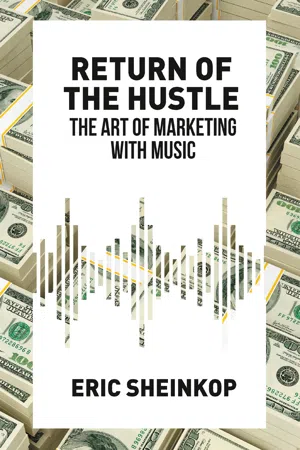
In Return of The Hustle, a leading music and marketing industry insider discusses the diverse audio touchpoints for four key industries and shows how marketers, storytellers, and advertisers can use music to effectively guide audiencesalong the customer journey from passive consumers to brand advocates. Return of The Hustle provides readers with a blueprint for music strategy that professionals at any level in any industry can use to attract consumers, immerse them into the content, and extend relationships between them and the brand long after the commercial ends or the credits roll.
With detailed case studies, exhaustive interviews, and thorough research, Return of the Hustle gives readers the playbook to use the marketing power of music to drive business results.
- English
- ePUB (mobile friendly)
- Available on iOS & Android
eBook - ePub
About this book
Information
chapter 1
Introduction
Every generation in every society in every industry experiences revolution in one way or another, and the music and media industries are no different.
When you look at it on a global scale, revolution happens fairly frequently. You might then think their novelty would be lost, that their coming would be much less dramatic by now, that their impact would be more of a simmer than a boil. But that’s not the case, thankfully. When revolution strikes, it hits like the first current of a river that’s been long dammed. Some credit Napster’s peer-to-peer file-sharing platform with the revolution that hit the music industry. Others say that the first crack in the dam emerged when the iconic Tower Records store on the Sunset Strip closed its doors in 2006. Still others say they first heard the grumblings of revolution when the sale of blank CDs for burning music outstripped the sale of music CDs by more than a two-to-one margin.
The music industry went through hell and back with the digitization of content
It is hard to say which one drop of water caused the dam to break. But through committing my life this industry, I can personally attest to this: The music industry went through hell and back with the digitization of content, and artists of all levels of popularity struggled to sustain their careers in an era of illegal piracy, unmonetizable downloads, and negligible streaming royalties.
As a result, artists have had to hustle more than ever before to grab consumers’ attention among the flood of music that hit the market, forcing the whole music industry to look for new ways to commoditize their art. The bottom completely fell out from under what was previously considered a lucrative revenue stream.
Although devastation hit the music industry first, those same technologies that decimated the music industry don’t exist in a vacuum. Today, the TV, Film, Video Game, and Brand industries are all fighting the same battle for attention and engagement. They too have to hustle more than ever to create real business impact.
A limitless choice of music, content, and media. This is the landscape of modern consumerism because of this digitization. Consumers have become more particular with the products they purchase, the brands they interact with, and the content they consume. They demand something of greater value beyond just the product and service of a brand. Brands of all industries – TV, film, advertising, and video games – need to find creative ways to provide consumers with that additional value lest they lose their business to a competitor that better understands the passions of their target demographic.
Music is the world’s number one passion. It transcends language, gender, age, and geographic borders, making it one of the most powerful marketing tools for the Brand, TV, Film, and Video Game industries.
Music is the world’s number one passion
In this book, Return of the Hustle: The Art of Marketing with Music, we explore this idea of using music to increase value to the consumer, demonstrating how the marketing power of music is helping drive better business results: selling more products, attracting more viewers, creating consumer advocates. Meanwhile, all of this is also helping empower the music industry to deliver value and return to the artists.
Many music supervisors have long understood this power, and many brand managers and creative advertisers have as well. But through the many interviews conducted for this book, what became clear is that successful music integration in marketing often happens more by chance than by design. Simply understanding the power of music to drive business is not enough. To be successful, you have to understand how to unlock that power to greatest effect.
By breaking down the elements from over twenty case studies developed from exclusive interviews with the industry’s leading music supervisors, advertising creatives, and artists, and drawing from hands-on learnings with hundreds of our own experiences working with industry experts, we have identified within this book a formula that can be replicated time and again to drive optimal results. The same way a musician, regardless of genre or style, has a formula in the Verse, Chorus, and Bridge to guide them on creating a meaningful song, we have identified a formula for the successful integration of music in marketing. As with songwriting, this formula also has three parts – Attraction, Immersion, Extension – and can be applied as a universal strategy to ensure a meaningful music integration that delivers optimal business results to brands, TV shows, films, and video games.
It’s my hope that by having a formula as a guide to achieve music marketing and supervision success, you will see more predictable business results and we can begin to better understand the tangible value of music in marketing, and that by doing so we can also deliver more value back to artists. Through understanding the real, direct results that emerge from effective use of music in marketing, we can demonstrate how this value cycle benefits brands, artists, and the music industry as a whole.
I’ve spent the last 15 years of my life integrating music into marketing initiatives. I’ve worked with over 500 clients to help them better connect with their consumers, thereby earning them more viewers and helping them sell more products. In the process, with my team at Music Dealers, we have helped thousands of artists – established and emerging – earning them tens of millions of dollars from their art. I see the potential that exists to deliver even greater value to all parties, but it’s going to take a lot more hustle.
The music, media, and content industries need hustlers to push the envelope. If you’re in these fields or aspiring to be, use these pages to hone your passion, to develop your skills, and afterwards you’ll be better prepared to join a community of creative professionals who are all together helping resurrect the music industry.
This is the return of the hustle.
The music, media, and content industries need hustlers to push the envelope
chapter 2
The Marketing Power of Music
“Being a music supervisor is like being an A&R for a label, but the extra layer is telling a story with the music.” – Tracy McKnight, Music Supervisor (McKnight, Music Supervisor, 2015)
A hustler, according to Merriam Webster, is an ambitious person who eagerly goes after what is desired (“Hustler,” n.d.). According to dictionary.com, this is an enterprising person determined to succeed (“Hustler,” n.d.). According to Urban Dictionary, this is someone who knows how to get money from others (“Hustler,” n.d.).
According to us, hustlers are those who fight the uphill battle of bringing change to an outdated system in order to give the people what they want.
In the context of this book, hustlers are the artists who create music that redefines traditional genres and employ emerging technology like social media to blast it to the world. Hustlers are the music executives on platforms like television, film, video games, and commercial brands who are integrating music into their content in ways that were never possible before. Hustlers are the storytellers who understand that music is a global passion for consumers and are creating, promoting, and sharing stories with music as a driving force in their narrative. Hustlers are the consumers demanding more value from content, pushing the content creators to use music across mediums even more. Hustlers are the ones fighting the uphill battle of bringing change to the outdated music and content industries in order to give the people what they want – better experiences and more engaging conversations.
Historically, the music industry has been chock full of hustlers who championed each new era of music, pushing against the boundaries of what was considered acceptable in pursuit of the next great idea. However, when digitization fueled a saturation of music, the model of success – discovery, promotion, distribution – disintegrated. Piracy, file-sharing, and the ubiquitous internet equalized all music. Simultaneously, content evolved. Services such as Netflix and Hulu allowed consumers to choose à la carte which television shows to watch, opposed to subscribing through a cable package to a vast umbrella of shows and channels, the majority of which would probably go unseen. Films could be funded, released, and distributed online rather than pass through the former gatekeeping studios. Video games catapulted from an arcade novelty to a dominant form of entertainment for virtually every type of consumer. With the proliferation of screens – televisions, computers, tablets, phones – and the inundation of content by the TV, film, and games industries spread across them, brands and advertisers could no longer rely on traditional marketing to attract consumers.
Too much content was being created, at the expense of quality. The music and media industries needed innovators to guide them through this sudden shift – visionaries who understood the implications of this new multimedia landscape were sought to lead the charge rather than fight against the changing times. The industries needed a return of the hustle.
The Consumer Journey
Story, according to Merriam Webster, is an account of incidents or events (“Story,” n.d.). According to dictionary.com, this is a narrative, either true or fictitious, in prose or verse, designed to interest, amuse or instruct the hearer or reader (“Story,” n.d.). According to Urban Dictionary, this is a Cork, Ireland word for wassup (“Story,” n.d.).
According to us, storytelling is the art of not simply conceiving the story, but also communicating that story in the most effective, most evocative ways possible through myriad mediums, from conversational dialogue to smartphone apps. Stories used to exist only between the pages of a book or in the airspace between an oral teller and the listener; now, with the global connectivity that technology and creativity have accelerated, storytellers have an array of mediums through which they can communicate with their audiences. Now, storytelling is changing the landscape of marketing.
For example, last weekend I was at a pop-up trip-hop party in a remodeled apartment on Chicago’s west side to check out a glitch-grime DJ whose SoundCloud a friend had DM’d me on the preceding Friday.
I stood beside a precariously stacked column of speakers, watching my fellow trap lords Snap the technicolor stage, and I thought to myself, “The times they are a-changin’.” No, literally. To the carnivorous delight of the surprisingly cultured crowd, the DJ remixed Bob Dylan’s iconic “The Times They Are A-Changin’” with an overdub of drum and synth with violent, dramatic bass drops.
That moment – the Instagramming Millennials, the revolutionized oldie, even the DIY music-space – represented something much greater than just another ordinance violation and neighborhood nuisance. It is the new face of the media industry.
Consumers are virally sharing the stories of their real-life experiences. Content is repurposed and personalized to fit individual tastes. Places of engagement and interaction (whether that’s online like social media or offline like the migratory Trap House of last weekend) are blossoming where consumers can cultivate their own experience without the intrusion of advertisements.
Currently, the media and content world is defined by communication. Through the proliferation of social media, brands of all kinds have been forced to evolve from traditional product-marketing practices to open and creative conversation with consumers. That conversation doesn’t rely on annoying jingles and buy-one-get-one-free advertisements anymore. It’s comprised of content that is authentic, that is story-based. Creators of all content types, whether they’re brands, video games, television, or film, use story to guide consumers along the customer experience (CX) journey from awareness to advocacy.
The customer experience journey is the eight-step relationship between a brand and a consumer that takes place over multiple touchpoints. These eight steps are awareness, discovery, interest, interaction, purchase, use, cultivation, and advocacy. Awareness is generally knowing of a brand, though not fully understanding its products, services, or culture. Discovery is learning more details of the brand, which often happens through advertising or marketing initiatives. Interest is becoming intrigued with the brand, whether that’s the brand’s products and services or the culture and personality of the brand. Interaction is engaging with or researching on the brand. Purchase is the point of buying or subscribing to the product or service of the brand. Use is the using of the product or service. Cultivation is engaging with the brand after the product experience, such as through social media. Advocacy is being a fan of the brand, at which point consumers promote the brand by word-of-mouth referrals or even by creating user-generated content (UGC) for the brand, as often happens on brands’ social media channels or even in some video games.
It’s important to note how expansive the definition of “brands” has become. A brand is not simply the manufacturer of a product. Video games, television shows, films, and apps all qualify as brands, in the same way that Coca-Cola or Sharpie are brands. Despite the different consumer experiences across these varying industries, all travel through the same eight-step customer journey. The diversity of modern marketing, from TV commercials to onsite activations, has created innumerable touchpoints along that journey – the story of the brand fuels the evolution of the consumer experience through each step.
The more consumer passions that a brand can access in each step of the customer experience journey means it will result in a greater chance of converting passive consumers into brand advocates. Passion points are intrinsically valuable parts of the human experience – they bring value to consumers’ lives in and of themselves. Because consumers face so much content every day of their lives, they have become choosier about which types of content they interact with; accordingly, they now have a higher expectation from brands and anticipate only the best quality of content in order to interact with it at all. In order to maintain the attention of their consumers, brands, video games, television shows, and films must create content that reflects their passion points.
In my previous book, Hit Brands: How Music Builds Value for the World’s Smartest Brands, I define this theory as Social Empowerment. The outpouring of content has empowered consumers to become choosier with the brands they interact with – if they are not receiving something of value from the brand, they will simply change the channel. Swipe left. Close the browser. Social empowerment postulates that brands must reflect consumer passion points with every piece of content they produce in order to remain relevant in the marketplace.
Advertisers and media channels today must look to their consumers, truly understand what they are passionate about, and make an effort to enhance their...
Table of contents
- Cover
- Title
- Copyright
- About the Author
- Contents
- Acknowledgments
- Chapter: 1 Introduction
- Chapter: 2 The Marketing Power of Music
- Chapter: 3 Brands
- Chapter: 4 Video Games
- Chapter: 5 Television
- Chapter: 6 Film
- Chapter: 7 Conclusion
- Bibliography
- Index
Trusted by 375,005 students
Access to over 1.5 million titles for a fair monthly price.
Study more efficiently using our study tools.
Frequently asked questions
Yes, you can cancel anytime from the Subscription tab in your account settings on the Perlego website. Your subscription will stay active until the end of your current billing period. Learn how to cancel your subscription
No, books cannot be downloaded as external files, such as PDFs, for use outside of Perlego. However, you can download books within the Perlego app for offline reading on mobile or tablet. Learn how to download books offline
Perlego offers two plans: Essential and Complete
- Essential is ideal for learners and professionals who enjoy exploring a wide range of subjects. Access the Essential Library with 800,000+ trusted titles and best-sellers across business, personal growth, and the humanities. Includes unlimited reading time and Standard Read Aloud voice.
- Complete: Perfect for advanced learners and researchers needing full, unrestricted access. Unlock 1.5M+ books across hundreds of subjects, including academic and specialized titles. The Complete Plan also includes advanced features like Premium Read Aloud and Research Assistant.
We are an online textbook subscription service, where you can get access to an entire online library for less than the price of a single book per month. With over 1.5 million books across 990+ topics, we’ve got you covered! Learn about our mission
Look out for the read-aloud symbol on your next book to see if you can listen to it. The read-aloud tool reads text aloud for you, highlighting the text as it is being read. You can pause it, speed it up and slow it down. Learn more about Read Aloud
Yes! You can use the Perlego app on both iOS and Android devices to read anytime, anywhere — even offline. Perfect for commutes or when you’re on the go.
Please note we cannot support devices running on iOS 13 and Android 7 or earlier. Learn more about using the app
Please note we cannot support devices running on iOS 13 and Android 7 or earlier. Learn more about using the app
Yes, you can access Return of the Hustle by Eric Sheinkop in PDF and/or ePUB format, as well as other popular books in Business & Business Communication. We have over 1.5 million books available in our catalogue for you to explore.