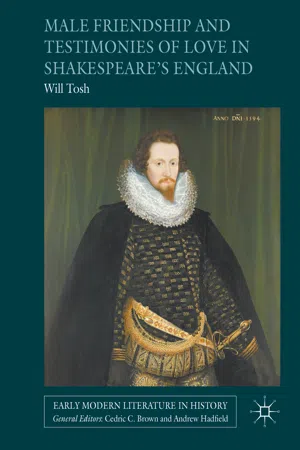
Male Friendship and Testimonies of Love in Shakespeare's England reveals the complex and unfamiliar forms of friendship that existed between men in the late sixteenth century. Using the unpublished letter archive of the Elizabethan spy Anthony Bacon (1558-1601), it shows how Bacon negotiated a path through life that relied on the support of his friends, rather than the advantages and status that came with marriage. Through a set of case-studies focusing on the Inns of Court, the prison, the aristocratic great house and the spiritual connection between young and ardent Protestants, this book argues that the 'friendship spaces' of early modern England permitted the expression of male same-sex intimacy to a greater extent than has previously been acknowledged.
- English
- ePUB (mobile friendly)
- Available on iOS & Android
eBook - ePub
Male Friendship and Testimonies of Love in Shakespeare’s England
About this book
Information
© The Editor(s) (if applicable) and The Author(s) 2016
Will ToshMale Friendship and Testimonies of Love in Shakespeare’s EnglandEarly Modern Literature in History10.1057/978-1-137-49497-9_11. Introduction: Anthony Bacon and the Uses of Friendship
Will Tosh1
(1)
Globe Education, London, UK
Far from home and charged with a shocking crime, an expatriate English gentleman faced a brutal punishment. He lived in the autonomous Protestant community of Montauban in south-west France, where he was on intimate terms with the town’s Huguenot leadership and with the region’s political heavyweight, Henri, the Bourbon king of Navarre. Since 1579, Anthony Bacon had been on an extended tour through France, relaying political and military intelligence to friends and patrons in England, who included his brother, Francis Bacon, his uncle, William Cecil, Lord Burghley, and Sir Francis Walsingham, Queen Elizabeth I’s Principal Secretary of State. Now, in August 1586, the well-connected young man was the unofficial English envoy to the Protestant Henri, heir to the French throne. Few diplomatic positions were of greater importance or greater sensitivity in the middle of that decade, as England’s Catholic neighbour and erstwhile enemy appeared on the verge of a Protestant succession after the turmoil of the civil wars. It was therefore with the worst possible timing that Anthony was convicted by the seneschal of Quercy at the bench in Montauban of sexual relations with a male servant. In sixteenth-century France, the penalty for sodomy was to be burned at the stake.
The evidence for Anthony Bacon’s conviction, stored today in the Archives Départmentales of Tarn-et-Garonne, is incomplete. Comprising a set of interrogations of some of the persons involved, conducted a year after the alleged incidents, the depositions tell a story of domestic mismanagement, jealousy and favouritism. Two of Anthony’s numerous servants, a father and son pair named Jean and Paul de la Fontaine, who had been in his service for about nine months, testified that their employer showed excessive favour to one of his pages, Isaac Bougades, frequently kissing and embracing him and bestowing upon the boy gifts of sweets and money. Paul de la Fontaine said that another of the servants swore that Anthony had sex with Isaac, and had seen them sharing a bed together in broad daylight. Isaac had scoffed at their concerns: Anthony apparently dismissed sodomy as no sin, claiming that even Theodore Beza (leader of the Calvinist wing of the Reformed church) and the senior Montauban minister enjoyed it. Jean de la Fontaine further testified that Isaac had sexually assaulted a junior lackey in the household named David Brysson. When Jean complained of this behaviour to Anthony, their master sacked David rather than chastise Isaac. Isaac then sought out David to buy his silence with a few coins (something corroborated by the lackey in his own interview).1
These surviving testimonies record a set of interviews that took place in November 1587, a year after the first round of interrogations in August 1586 (the transcriptions of which have been lost). The voices of Anthony and Isaac are conspicuously absent from the archive. Even more peculiar is the fact that Anthony had appealed to the king of Navarre’s council as soon as he received his conviction from the Montauban bench. In September 1586, Henri sent an uncompromising letter to one of his councillors insisting that Anthony be immediately freed without charge, as ‘the merit of those to whom he belongs is great; we owe many obligations to the queen, his sovereign’.2 By November 1587, the case should have been long closed. But the threat of the stake—the bûcher—was evidently still in force. No personal letters survive to record Anthony’s feelings at this difficult time, or the final resolution of the case. He remained in Montauban for some years after the scandal before returning home via Bordeaux in the early 1590s. He never made mention of his experience at the hands of the Montalbanais judiciary. No one in England ever knew, and certainly never wrote of, the charges he had faced. The affair remained hidden from history until 1974, when the archival records were unearthed by the novelist and biographer Daphne du Maurier, author of Golden Lads: A Study of Anthony Bacon, Francis and their Friends. Du Maurier made Anthony’s crisis in Montauban the central drama of her book, deducing that his fear of exposure drove his departure from France and subsequent avoidance of court life when he returned to England in the 1590s. Du Maurier’s discovery placed Anthony in the ranks of famous ‘homosexuals in history’ (in A. L. Rowse’s phrase), a category that expanded throughout the twentieth century as biographers sought to undo decades of pious and sexless life writing.3 In Anthony’s case, the intersection of scandal, spying and same-sex love served to produce an irresistible conclusion for scholars of espionage: the homosexual affair in France was, the historian Alan Haynes observed, ‘a historic first in the prodigious annals of such activity in the British secret service’.4
Writers like du Maurier and Rowse, working in the context of a post-war liberalism that had not yet been affected by the challenges of feminist or queer historiography, produced their work in a sort of intellectual twilight zone for the history of sexuality: the study of same-sex eroticism stood to benefit from the new openness of a permissive culture (anything to do with sex was up for discussion), but it was intellectually reliant on the structures put in place by nineteenth-century historians and sexologists. Their concern was therefore to identify and taxonomize, and speculate as to whether the evidence of Anthony Bacon’s sodomy trial proved that he was homosexual, bisexual or besotted with young boys.5 Work was already underway in the 1970s that would render this classifying specious in an early modern context, and when Lisa Jardine and Alan Stewart examined the same material for their major biography of Anthony’s brother in 1998, Hostage to Fortune: The Troubled Life of Francis Bacon 1561–1626, they came to a rather different conclusion, one that took into account the political and domestic context of the accusation: ‘Perhaps all we can glean from these incomplete records is that somebody accused Anthony Bacon of sodomy—possibly disgruntled servants attempting to extort money, possibly political or religious opponents attempting to disgrace a rival.’ As Jardine and Stewart demonstrated, Anthony’s accusation came at a time when he was involved in numerous diplomatic and confessional disputes in war-torn France, any of which would have been sufficient to explain the politically-motivated slander of a man who was a foreigner in a beleaguered city.6
Much changed in the twenty years between Daphne du Maurier’s revelation and the publication of Lisa Jardine and Alan Stewart’s biography. In 1976, Michel Foucault was the first to argue that sexual identity was a modern evolution, and that to speak of hetero- or homosexuality in the pre-modern era was anachronistic.7 Alan Bray similarly challenged the idea that sexuality was an ‘essentially unchanging entity’ and instead offered in his Homosexuality in Renaissance England a history of ‘an aspect of sexuality whose expression has varied radically across different cultures and societies’. He later went on to make the point that in the sixteenth and seventeenth centuries, ‘accusations [of sodomy] … are not evidence of it’: the charge appears with as much frequency as a political weapon as it does as an attack on sexual manners, and the all-pervasive physical intimacy that characterised relations between men of every background in the Renaissance meant that the behavioural indications of a homosexual attachment are not necessarily legible to a modern researcher. Bray acknowledged the irony of a history of homosexuality that discounted judicial evidence of its expression: ‘[t]his was evidently the detective story where the clue was that the dog did not bark’, he wrote, in a nod to the curious incident of the silent watchdog at the heart of Arthur Conan Doyle’s short story ‘Silver Blaze’.8 The combined force of scholarship like this was to do away with what the classicist David Halperin called the ‘dreary labelling’ of historical persons as homosexual or otherwise.9 Instead, cultural historians and literary critics turned their attention to the wide-ranging ways in which homoerotic desire manifested itself in past contexts, which as Eve Kosofsky Sedgwick showed in her 1985 study, Between Men, were often strikingly pervasive and very different to today: what she called ‘male homosocial desire’ was a constituent ingredient in patriarchal power animated by a ‘highly conflicted but intensively structured combination’ of ‘ideological homophobia’ and ‘ideological homosexuality’.10 As Jonathan Goldberg argued, the ‘continuum of male-male relations’ that characterised the early modern public sphere was ‘capable of being sexualised, though where and how such sexualisation occurs cannot be assumed a priori’.11 In other words, nothing is more likely than that Anthony Bacon had sexual relations with men. But his sodomy accusation is not evidence of it. Jardine and Stewart took this into consideration when they discussed the scandal in Montauban:
Like most young men moving around the continent, ‘they wrote’, Anthony’s immediate environment was almost exclusively male. In cramped lodgings, master and servant were forced into conditions of great intimacy, and shared beds. The situation was simultaneously absolutely commonplace and frighteningly vulnerable to accusations of malpractice—especially sodomy.12
Same-sex contact between men was part of the fabric of everyday life. But to raise a hue and cry about such contact was also a weapon in the arsenal of the slanderer, the fabulist and the blackmailer.
This aspect of early modern culture creates something of an impasse for scholars of queer lives in the past. Goran Stanivuković has observed that with the realisation that evidence of erotic ‘transgressions’ does not constitute evidence for historic sexual identities, the task of trawling the archives for ‘new homoerotic scenarios’ has fallen out of favour among historians of sexuality. The alternative—analysis of queerness in historical terms—is a much trickier proposition, because homoeroticism (culturally endorsed) is twined into a range of discourses and it is never clear when, or if, those discourses blend into queerness (culturally proscribed). ‘How difficult is it … to cast a backward gaze on the early modern history of sexuality and identify desires and practices that we call queer, if we are considering a period that predates definitions of homosexuality?’ asks Stanivuković.13 One response has been to re-frame the exploration of past sexualities as a study of intimacy, affect and friendship, modes that carried significant potential in early modern contexts (a time of ‘ubiquitous homosociality’, in Cynthia Herrup’s phrase) for an eroticism that we understand today as homosexual. Laura Gowing, Michael Hunter and Miri Rubin, writing in response to Alan Bray’s posthumously-published The Friend, called for a new investigation of the ‘affectional transactions’ that supported relationships between men in pre-modernity. Unlike Bray, whose intention in The Friend was as far as possible to de-eroticise the friendly connections he observed, Gowing, Hunter and Rubin were eager to acknowledge the ‘shadow of homosexual intimacies’ that these transactions cast.14
In this book, therefore, I take Anthony Bacon’s likely interest in and experience of sex with men for granted, and focus instead on the evidence of same-sex emotional intimacy—the ‘life of queer affect’—that is contained in his extensive personal archive.15 Anthony deserves a re-appraisal that allows him to claim a significant and acknowledged place in late Elizabethan society. Despite the advances in the study of sexuality, his modern-day reputation is not a good one. With the exceptions of du Maurier, Jardine and Stewart, biographers and scholars have been too willing to draw him in lurid terms as an archetypal homosexual spy, a malcontent who rejected both ‘natural’ allegiance to queen and country, and ‘normal’ attraction to women and the dynastic security of marriage. Charles Nicholl stated categorically that ‘[t]he Bacon brothers were homosexual … [t]heir private circle was gay, filled with dubious young dandies.’ He also pictured Anthony as something out of Krafft-Ebing, with ‘pinched pallor’, ‘thin, over-refined features’ and ‘the brooding energy of the invalid’.16 More vituperative was Wallace MacCaffrey, who termed Anthony a ‘recluse’ and a ‘psychotic invalid’.17 As we will see, Anthony’s life might have been unconventional, but his emotional inclinations did not shut him away from society. His love rarely had difficulty speaking its name.
This book tells the story of Antony’s close friendship with four men, relationships that played out in the final years of the sixteenth century: with the devout civil servant Nic...
Table of contents
- Cover
- Frontmatter
- 1. Introduction: Anthony Bacon and the Uses of Friendship
- 2. Intimacy: Nicholas Faunt, Faith and the Consolations of Friendship
- 3. Instrumentality: The Prison, Liberty and Writing Friendship in the Space in Between
- 4. Institutionality: Nicholas Trott, the Inns of Court and the Value of Friendship
- 5. Instability: Service, Love and Jealousy in the Essex Circle
- Backmatter
Trusted by 375,005 students
Access to over 1.5 million titles for a fair monthly price.
Study more efficiently using our study tools.
Frequently asked questions
Yes, you can cancel anytime from the Subscription tab in your account settings on the Perlego website. Your subscription will stay active until the end of your current billing period. Learn how to cancel your subscription
No, books cannot be downloaded as external files, such as PDFs, for use outside of Perlego. However, you can download books within the Perlego app for offline reading on mobile or tablet. Learn how to download books offline
We are an online textbook subscription service, where you can get access to an entire online library for less than the price of a single book per month. With over 1.5 million books across 990+ topics, we’ve got you covered! Learn about our mission
Look out for the read-aloud symbol on your next book to see if you can listen to it. The read-aloud tool reads text aloud for you, highlighting the text as it is being read. You can pause it, speed it up and slow it down. Learn more about Read Aloud
Yes! You can use the Perlego app on both iOS and Android devices to read anytime, anywhere — even offline. Perfect for commutes or when you’re on the go.
Please note we cannot support devices running on iOS 13 and Android 7 or earlier. Learn more about using the app
Please note we cannot support devices running on iOS 13 and Android 7 or earlier. Learn more about using the app
Yes, you can access Male Friendship and Testimonies of Love in Shakespeare’s England by Will Tosh in PDF and/or ePUB format, as well as other popular books in Literature & World History. We have over 1.5 million books available in our catalogue for you to explore.