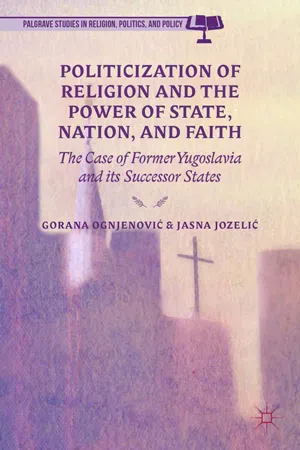
eBook - ePub
Politicization of Religion, the Power of State, Nation, and Faith
The Case of Former Yugoslavia and its Successor States
- English
- ePUB (mobile friendly)
- Available on iOS & Android
eBook - ePub
Politicization of Religion, the Power of State, Nation, and Faith
The Case of Former Yugoslavia and its Successor States
About this book
(Ab)use of religion as a political means to an end: the achievement of nationalist political goals, analyzing 'how' through which mechanisms this phenomenon has been and still is practiced in South-Eastern Europe.
Information
1
Politicization of Religion: The Case of Bosnia-Herzegovina
Jasna Jozelić
It is generally believed that the denial of the Muslim identity in Bosnia-Herzegovina is a recent phenomenon because it was not until the 1970s that the Muslims in former Yugoslavia were allowed to officially declare their Muslim identity. What this chapter will show is that there is a long and painful history of this denial, which is only reaching its climax in the present day within the European political context.
This article focuses on “when” and “how” the politicization of religion was used in Bosnia-Herzegovina as a basic mechanism for the development of nationalist ideologies and dogmas. The “when” is presented in a historical overview whereas ‘how’ is analyzed in two respects: (1) How the transformation of the religious institutions led to the building of nationalist political organizations with a clearly religious denouncement and (2) how such (mis)use of religion as a practice in this historic setting played a significant role in the creation of a political platform for constructing both: the nationalist pretension from the neighboring states to the territory of Bosnia–Herzegovina and the formation of the Bosnian Muslim national identity.
After the fall of the Yugoslav republic during the 1990s, and as a result of this systematic politicization, a newly awakened religious observance flourished in Bosnia-Herzegovina.
The three-term trend “revival–reaction–politicization”1 is, today, clearly reflected in Bosnia-Herzegovina, where a link between religious life and political nationalism is now firmly established. The nationalists mobilized forces and pushed the country in the direction of national “allocation” and the development of the modern Bosnian state. Such mobilization appears to be at the expense of the Bosnian Muslims and, especially, at the expense of an independent Bosnian state. This development is expressed in two ways: (1) the politicization of religion for the purpose of promoting nationalist extremism and the prosecution of Bosnian Muslims (Bošnjaks) before and after the 1990s and (b) Bosnian Muslim’s (benevolent) politicization of history and religion as a form of response to the extremism and genocide they were exposed to during the 1990s. In order to see the extent to which these processes have gone, and to get a complete picture of these processes, one has to be aware of the history of the Bosnian statehood in the Middle Ages. Therefore, first, in brief, certain historic events and processes vital to the question around politicization of religion will be discussed together with the impact that have on today’s situation in Bosnia–Herzegovina.
There are four key elements to understanding how religion, specifically Islam, in the case of Bosnia–Herzegovina was used in order to achieve substantial nationalist goals.
1.The Bogumil2 question and the question of the independent Bosnian Church; both questions used and abused for the purpose of denying the continuity and existence of the Bosnian State
2.The islamization of Bosnia-Herzegovina.
3.The politicization and use of religion in the wake of the war in former Yugoslavia in the 1990s that resulted in the genocide and war crimes committed against Bosniaks in Bosnia–Herzegovina.
4.Islam as a common basis for the identity construction of a national identity.
Historical background: Medieval Islam and Bosnia’s entry into history
The Bosnian state is mentioned, for the first time, in history in 900 AD. The Bosnian state formed around the river Bosnia, the center of today’s Bosnia-Herzegovina.3 The population primarily consisted of Southern Slavs who moved to the area in the seventh century, at the time when the supremacy over Bosnia shifted between the Roman Empire, the Hungarians, and the Byzantines. Bosnia, as a feudal state, is mentioned in historical sources for the first time in 1180.4 The Golden Age of Bosnian history is the Kulin Bans reign (1180–1204), when Bosnia was at the intersection between Roman and Byzantine influences—a time of conflict and rivalry between the Roman Catholic and the Orthodox Church. This conflict was, according to historians, the background for the creation and distribution of the Bosnian Church, although this claim is often denied due to scarcity of historical sources on the Bosnian Church.5 According to historians, Bosnians created their own version of indigenous Christianity and the independent Bosnian Church identity based on the Bosnian feudal state.6 Their identity as an independent Bosnian Church was a foundation for the resistance against the growing pressure from the Byzantine and the Roman Catholic Church.7 In return, the reaction, especially from the Vatican, was persecution, Crusades, and increased missionary activity. Under the rule of king Stjepan Kotromanić’s Bosnian dynasty (1322–1353), the Bosnian medieval kingdom, as the Bosnian state, expanded toward the Adriatic and Herzegovina and incorporated these areas as a part of Bosnia. When the Kotromanić dynasty later converted to Catholicism, the Bosnian Church lost its position of power in relation to the ruling class and its political influence.
During the rule of king Tvrtko I (1353–1391), Bosnia became a strong medieval state with a population divided into three denominations: Catholics, Orthodox, and Bogumil (members of the Bosnian Church). Catholics lived in central and western Bosnia, the Orthodox Christians lived in the east, and Bogumils lived in northern and central Bosnia. After the death of king Tvrtko I in 1391, Hungary and the Vatican forced Bosnia to pursue the Bogumils because they were regarded as heretics and, as such, were a danger to the powerful Vatican. The subsequent power struggle between the Bosnian nobles for the political and economic influences led the Bosnian kingdom into a chaos that lasted until the Ottoman Empire’s occupation of Bosnia.
The long and complex process of islamization of medieval Bosnia started at the beginning of the fourteenth century as the result of the Ottoman Empire’s military triumphs.8 At that time, the majority of the Bosnian population were Christians. Catholicism dominated most of the kingdom’s territory. Orthodox Christians dominated the eastern parts of Bosnia, whereas the rest of the population belonged to the Bosnian Bogumil Church. During the islamization period, a large number of the Catholic population escaped to the northern parts of Bosnia and, further on, to the territory of Croatia. The Bogumil and the Orthodox population, however, showed interest in conversion to Islam.9 One of the possible explanations as to why this part of the population showed an interest in conversion to Islam was also that the Ottoman Empire guaranteed the right to exercise religion (as well as in Serbia and Bulgaria) in the occupied territory. In return, the Ottoman Empire demanded loyalty. As a result, despite conversion, most of the population managed to retain some of their own traditions, including the language. The Christians’ religious rules and traditions that survived this conversion were predominantly the rules and traditions regarding marriage, inheritance, mourning of the dead, and similar cases.10
Another explanation as to why the population showed interest in conversion to Islam was that Islam also fused well with other local religious forms in the area. Today, still, one can see similarities in various religious rituals that have remained preserved in all groups, regardless of religious affiliation.
As a result of the Turkish occupation, Bosnia—previously characterized by poverty and fragmentation—suddenly experienced prosperity and growth. “In Bosnia we had a unique situation, the political and economic power was with a Slavic, Muslim upper classes that had hereditary nobility privileges and were allowed to keep their goods.”11 The “good will” of the people toward religious conversion played a key role for Bosnia–Herzegovina’s prosperous future in the Ottoman Empire. The process of occupation was considered as successful by the occupying power and, in return, Bosnia received a special status within the Ottoman Empire, which was bestowed by Sultan Mehmed El-Fatih.12
During the Ottoman period in Bosnia, Islam was a state religion, and the local authorities were mainly recruited from the local population. This was a form of “inclusion” of the local community in the leading structure that was not seen in other parts of the area occupied by the Ottoman Empire. In other words, those who converted to Islam received status and power beyond that of their Christian co-citizens. Moreover, this resulted in a kind of “juridicial discrimination” that was expressed in forbidding Christians from carrying weapons or riding horses, both of which were considered status symbols in society, or from the possibility of Christians taking a Muslim to court.13
Bogumils and Islamization
The Bogumil question in Bosnia is, without doubt, a case of more alleged facts and interpretations than in any other part of Bosnian history.
Bosnia...
Table of contents
- Cover
- Title
- Introduction: State, Nation, and Faith
- 1 Politicization of Religion: The Case of Bosnia-Herzegovina
- 2 Was the Bosnian War (1992–1995) a Full-fledged Religious War?
- 3 The Role of the Catholic Church in the Bosnian Conflict 1992–1995: A Historical Approach
- 4 The Gospel and Politics: Transforming Grace for Transformed Society?
- 5 Ecclesiastical Involvement in Serbian Politics: Post-2000 Period
- 6 The Political Dynamics of Intra-Orthodox Conflict in Montenegro
- 7 The Separation between Church and State in Slovenia: A Political Fiasco
- 8 Religion and Politics in Kosovo
- Conclusion: State, Nation, Faith
- Notes on Contributors
- Index
Trusted by 375,005 students
Access to over 1.5 million titles for a fair monthly price.
Study more efficiently using our study tools.
Frequently asked questions
Yes, you can cancel anytime from the Subscription tab in your account settings on the Perlego website. Your subscription will stay active until the end of your current billing period. Learn how to cancel your subscription
No, books cannot be downloaded as external files, such as PDFs, for use outside of Perlego. However, you can download books within the Perlego app for offline reading on mobile or tablet. Learn how to download books offline
Perlego offers two plans: Essential and Complete
- Essential is ideal for learners and professionals who enjoy exploring a wide range of subjects. Access the Essential Library with 800,000+ trusted titles and best-sellers across business, personal growth, and the humanities. Includes unlimited reading time and Standard Read Aloud voice.
- Complete: Perfect for advanced learners and researchers needing full, unrestricted access. Unlock 1.5M+ books across hundreds of subjects, including academic and specialized titles. The Complete Plan also includes advanced features like Premium Read Aloud and Research Assistant.
We are an online textbook subscription service, where you can get access to an entire online library for less than the price of a single book per month. With over 1.5 million books across 990+ topics, we’ve got you covered! Learn about our mission
Look out for the read-aloud symbol on your next book to see if you can listen to it. The read-aloud tool reads text aloud for you, highlighting the text as it is being read. You can pause it, speed it up and slow it down. Learn more about Read Aloud
Yes! You can use the Perlego app on both iOS and Android devices to read anytime, anywhere — even offline. Perfect for commutes or when you’re on the go.
Please note we cannot support devices running on iOS 13 and Android 7 or earlier. Learn more about using the app
Please note we cannot support devices running on iOS 13 and Android 7 or earlier. Learn more about using the app
Yes, you can access Politicization of Religion, the Power of State, Nation, and Faith by G. Ognjenovic, J. Jozelic, G. Ognjenovic,J. Jozelic, G. Ognjenovic, J. Jozelic, Gorana Ognjenovi?, Jasna Jozeli? in PDF and/or ePUB format, as well as other popular books in Social Sciences & European History. We have over 1.5 million books available in our catalogue for you to explore.