- English
- ePUB (mobile friendly)
- Available on iOS & Android
eBook - ePub
Apocalypse in Contemporary Japanese Science Fiction
About this book
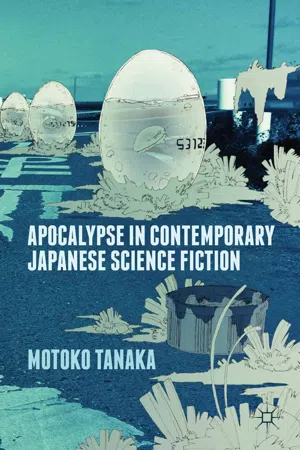
Starting with the history of apocalyptic tradition in the West and focusing on modern Japanese apocalyptic science fiction in manga, anime, and novels, Motoko Tanaka shows how science fiction reflected and coped with the devastation in Japanese national identity after 1945.
Information
Subtopic
Literary CriticismI
The Trajectory of Apocalyptic Discourse
“Apocalypse,” “the end of the world,” “millennialism,” “millenarianism,” and “fin de siècle” are all terminologies of ending: of life, epochs, the world, and the universe.1 Among these end-related terms, apocalypse in contemporary usage connotes the most complex ideas and violent, decadent, large-scale endings, while the others suggest more specific, limited meanings, often lack destructive elements, and frequently focus on hope for the ultimate renewal of the world; with “apocalypse” what matters is when and how it comes and what triggers the end.
The original meaning of apocalypse—apokálypsis in Greek, literally “lifting of the veil”—has to do with revealing, uncovering, and disclosing. Apokálypsis originally signified the disclosure to certain chosen people of something new or unseen/unseeable by others. In early Jewish and Christian traditions, apocalypse came to mean the revelation of secrets by God to worthy layfolk and apostles. Rather than something related to the end of time or the destruction of the world, it denoted the privilege of certain believers in God to know specific secrets.2
Premodern Apocalypse
From the second century AD onward, the meaning of the term “apocalypse” gradually changed from the revelation of things hidden to the crisis of the destructive end of an age or of the world as we know it. In the New Testament’s Book of Revelation, also known as the Apocalypse of John, “apocalypse” is used to mean the “unveiling” of Jesus Christ as Messiah. In the second century, however, the word “apocalypse” came to be used to describe a specific literary genre with characteristics similar to those found in the Apocalypse of John: resurrection of the dead, the final war between good and evil, judgment day, eternal life, and perdition.3 These final events are considered to happen only once; they never repeat, for Jesus died for the sins of humanity only once.4 Images of crisis and finality in apocalyptic literature were connected with the idea of the end, but at first this meant not merely the end of the world, but rather the end of an age. For some, “the end of the age” implied that the elect would escape the confines of the given reality. However, others understood it as the literal destruction of the Earth and/or all living things, ending the present age of human existence. In this context, apocalypse came to mean an end that was both spatial and temporal.
Thus the term “apocalypse” lost its original meaning. Apocalyptic narratives came to represent large-scale crises of the end of the world leading to the perfection of eternal life. At the same time, apocalypse became the central ideology for surviving the oppression brought by the Antichrist. As the Roman Empire became more unstable between the second and the fifth centuries, apocalyptic discourse became increasingly popular among those who longed for salvation from injustice and oppression. However, when Christianity was eventually adopted as the religion of the Empire and established its authority in the fifth century, the Church began to disapprove of apocalyptic literature. This is unsurprising: apocalyptic and millenarian ideals, representing longing for a new kingdom, are a threat to the maintenance of the status quo. Therefore, the Church approved St. Augustine’s claim in The City of God that the Apocalypse of John should be understood as an allegory, and that the millenarian kingdom had already come into existence when Christianity was born.5
The earliest Christians longed for the actual moment of the end, yet these predictions were repeatedly disconfirmed. They hoped that the present was the time between “this moment” and the Second Coming, but gradually the present came instead to mean the time between “this moment” and each person’s personal death. In other words, as Frank Kermode says, the end became not imminent but immanent; already in St. Paul and St. John we can discern a tendency to understand the end as happening at every moment.6 This understanding of the immanent end puts the weight of the end-feeling onto the present moment, and we discover crisis not only in the larger world but also in our personal lives; human death comes to bear more importance and religious significance through the teaching of apocalyptic crisis.
Even though the imminent end of the world and the establishment of the millenarian kingdom of God on Earth were repeatedly rejected by Christian dogma, the idea of apocalypse still survived in early Christian tradition.7 The immanent aspect of apocalypse survived among those in the lowest strata, to erupt as an ideology of insurgence in times of invasion, natural disaster, famine, and plague. When the Roman Empire collapsed in the fifth century, apocalyptic ideals not only in religious doctrine but also in occultism and heretical prophecies—such as astrology and augury—became increasingly influential. For example, the Sibylline Oracles, which collected the apocalyptic words of prophetesses, came to be common among ordinary people, becoming more influential than the Book of Revelation in the fourth century.8
That the end will come is certain, and to believe in the immanence of apocalypse made the solid goal of creating a holy kingdom in the future seem achievable; the appeal of apocalyptic belief was that it made sense of the confusion of the present. As we have seen, apocalyptic narratives in the period of the Roman Empire (27–476 AD) were shaped against enemies such as Emperor Nero and the pagans. Apocalyptic discourse at the end of the ancient period came to reflect the sense of crisis and anxiety of the times, and it could be encountered in various events from the end of an individual life to the end of the entire universe.
In the early medieval period, from the fifth century to as late as the eleventh, apocalyptic discourse was muted, for the pope came to have powers equal to those of the emperor. The Church did not desire to destroy the world over which it had dominion, so it maintained an ambiguous stance toward the end-time: the specific date on which the world would end could not be predicted by human beings, it ruled, yet the end was always nigh and therefore people were to prepare for it by living virtuously. Apocalypse thus constituted a powerful menace to the commoners: the notion that it could come at any time was used to cow the masses into doing as they were told. The Church also used apocalyptic ideology to fight the “Muslim Antichrists” in the Crusades. Later, when medieval settlements experienced dramatic changes such as population explosion, the growth of cities and trade, and shortage of arable land in the twelfth century, the traditional social structure was shaken. Discord spread among landless farmers, the unemployed in cities, jobless soldiers, poor aristocrats, and clergy without position, and the marginalized a dopted expectation of apocalypse as a revolutionary ideology of protest, and formed insurgencies against their oppressors.9
Norman Cohn’s The Pursuit of the Millennium explores the apocalyptic movements that flourished in Europe between the eleventh and sixteenth centuries. Covering the full range of revolutionary and anarchic sects and movements, Cohn demonstrates how prophecies of a final struggle, between the hosts of Christ and the hosts of the Antichrist, melded with the desire of the poor to improve their own condition, resulting in a flourishing of apocalyptic fantasies. Cohn explains that in situations of anxiety and unrest, apocalyptic discourse comes to serve as a vehicle for social aspirations and animosities.10 During the medieval period, commoners came to use apocalyptic discourse against various “Antichrists” such as Muslims, Jews, and even churches. Visions of an apocalypse came to encompass the revolutionary movements led by the lowest strata that protested against the social hierarchy, uneven distribution of wealth, and their own social constraints. Apocalypticism was no longer a hidden doctrine of the chosen, or even of the uncertain end of an age or a particular space: it functioned now for the “un-chosen.” It came to bear the concrete purpose of effecting change in real social conditions for the lowest-ranked.
During the Renaissance period, it is commonly understood that Western society shifted to affirm humanity and to overcome superstition. Humanism questioned the absolute authority of Christianity and, as a result, apocalyptic discourse seemed to lose some of its power. However, the Renaissance was also an age of Inquisition, as well as witchcraft, astrology, occultism, and religious wars, a period in which social unease and apocalyptic belief were still dominant or became stronger.11 Boia claims that we need to consider the period from the thirteenth to the seventeenth centuries as one continuum: there was little difference between the medieval period and the Renaissance in terms of the apocalyptic phenomenon. This was a time of drastic and unsettling change: from the collapse of the feudal system to the establishment of the early modern world through the development of cities and commerce, the rise of the citizen, the formation of nation-states, the beginning of the colonial period, and major wars, as well as plagues and famines.12 The reorganization and alienation of certain social classes, and the confusion and instability in social transition, made apocalypticism yet more colorful and appealing.
Modern Apocalypse
With the Enlightenment and modernization came major breakthroughs in technology, science, industry, and ideologies. There was still apocalyptic discourse, and prophets and astronomers were still predicting that the end was near, but the fear of apocalypse was gone, replaced by new ideas of progress and the future. Boia and Nagayama insist that there had been no idea of “the future” or of “progress” in the contemporary sense before this. Before the modern period, the future was seen as a time when the world would return to the original and archetypal; the future described in the Bible is a return to Eden, and for Jean-Jacques Rousseau, the ideal was to go back to nature. The premodern world did not assume that the totally unexperienced or unknown was of value.13 Instead, people viewed the past, especially Greek and Roman traditions, as more advanced than their own period, and hoped for a return to this ideal. Once people realized that modernization and its byproducts could bring a totally new and unique history, the new dimension of “the future” was born, and to get there they invented the vehicle of “progress.” According to Boia, the contemporary meaning of the noun “progress” (the gradual betterment of humankind) developed in the late eighteenth century; prior to this, the term had meant simply to go forward or increase.14
It is surprising that apocalypticism survived in the nineteenth century with that century’s emphasis on the future, progress, and evolution. The principal elements of apocalyptic discourse were combined with a new progressivism that sought the establishment of a better society organized rationally and scientifically. For example, social theory in Saint Simon, positivism in Auguste Comte, and communism in Karl Marx clearly inherited traditional apocalyptic visions and discourse. At the same time, the apocalyptic tradition was also adopted in literature. Prior to this period, the Book of Revelation and other Biblical apocalyptic literature had been protected by the churches, and interpretation of astronomical omens such as comets was the work of scholars. Apocalyptic scriptures had been in effect off-limits even though apocalyptic discourse penetrated the ideology of commoners who used it to revolutionary ends.15 However, in the early nineteenth century, apocalyptic themes became secularized and writers began to describe the end of the world in their fiction. Whether people believed it or not, they could talk about, challenge, and play with the idea of the end of world at their will. The world of fiction has remained the most powerful and creative domain of apocalyptic discourse into modern times.16
Apocalyptic discourse underwent revolutionary changes with the development of the idea of the future and the secularization of the apocalyptic imagination. However, apocalyptic ideology came to be understood as a form of fictional narrative; indeed, it seemed to disappear into the world of fiction, where it has flourished since the nineteenth century. It appeared to have lost much of its former influence in the fully modernized real world. In the twentieth century, however, positivism and progressivism came to be seriously challenged; people realized that “progress” brought material, but not spiritual, improvement to their lives. With constant progress came pollution, ethnic and racial discrimination, colonialism, and world wars. In the twentieth century, r...
Table of contents
- Cover
- Half Title
- Title Page
- Copyright
- Dedication
- Contents
- List of Figures
- Preface
- Acknowledgments
- Note to the Reader
- Introduction
- 1 The Trajectory of Apocalyptic Discourse
- 2 Apocalypse in Japan
- 3 Apocalyptic Science Fiction from 1945 to the 1970s
- 4 Apocalyptic Science Fiction in 1980s Japan
- 5 Apocalyptic Science Fiction after 1995–Sekaikei Works
- 6 Apocalyptic Imagination after 2011
- Conclusion
- Notes
- Bibliographies
- Index
Trusted by 375,005 students
Access to over 1.5 million titles for a fair monthly price.
Study more efficiently using our study tools.
Frequently asked questions
Yes, you can cancel anytime from the Subscription tab in your account settings on the Perlego website. Your subscription will stay active until the end of your current billing period. Learn how to cancel your subscription
No, books cannot be downloaded as external files, such as PDFs, for use outside of Perlego. However, you can download books within the Perlego app for offline reading on mobile or tablet. Learn how to download books offline
Perlego offers two plans: Essential and Complete
- Essential is ideal for learners and professionals who enjoy exploring a wide range of subjects. Access the Essential Library with 800,000+ trusted titles and best-sellers across business, personal growth, and the humanities. Includes unlimited reading time and Standard Read Aloud voice.
- Complete: Perfect for advanced learners and researchers needing full, unrestricted access. Unlock 1.5M+ books across hundreds of subjects, including academic and specialized titles. The Complete Plan also includes advanced features like Premium Read Aloud and Research Assistant.
We are an online textbook subscription service, where you can get access to an entire online library for less than the price of a single book per month. With over 1.5 million books across 990+ topics, we’ve got you covered! Learn about our mission
Look out for the read-aloud symbol on your next book to see if you can listen to it. The read-aloud tool reads text aloud for you, highlighting the text as it is being read. You can pause it, speed it up and slow it down. Learn more about Read Aloud
Yes! You can use the Perlego app on both iOS and Android devices to read anytime, anywhere — even offline. Perfect for commutes or when you’re on the go.
Please note we cannot support devices running on iOS 13 and Android 7 or earlier. Learn more about using the app
Please note we cannot support devices running on iOS 13 and Android 7 or earlier. Learn more about using the app
Yes, you can access Apocalypse in Contemporary Japanese Science Fiction by M. Tanaka in PDF and/or ePUB format, as well as other popular books in Media & Performing Arts & Literary Criticism. We have over 1.5 million books available in our catalogue for you to explore.