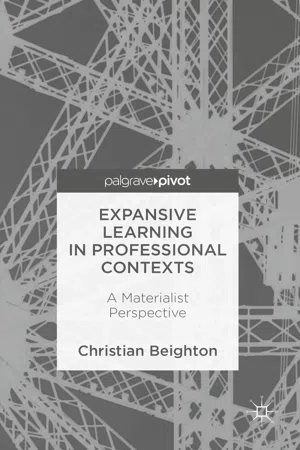
This book discusses approaches to organizational learning from a materialist point of view. Inspired by research into Police Firearms training, features of expansive learning inform the development of perspectives on training which challenge traditional modes of research and delivery. The book critically reviews a range of approaches to expansive learning and organizational research, establishing the bases and limitations of an Expansive Learning Index whose aim is to support collaborative provision in the context of work-based research. Reflecting on this process, it stresses the strangeness and mobility of workplace learning and develops a philosophical pragmatics for professional development. Approaches to knowledge and enquiry which place language and subjectivity at the heart of development are challenged by a more pragmatic approach to expansive learning: its consequences for training, research, and professional development lead to a discussion of the need for immanentforms of professional ethics.
- English
- ePUB (mobile friendly)
- Available on iOS & Android
eBook - ePub
About this book
Information
Topic
EducationSubtopic
Adult Education© The Author(s) 2016
Christian BeightonExpansive Learning in Professional Contexts10.1057/978-1-137-57436-7_11. Introduction: Strange Matters
Christian Beighton1
(1)
Canterbury Christ Church University, Canterbury, Kent, UK
Abstract
Expansive Learning in Professional Contexts: a Materialist Perspective critically discusses developments in professional learning with emphasis on the relevance of pedagogies of expansive learning. It draws on recent empirical and theoretical work developed in the context of Police Firearms training and makes an original contribution to the current debate across a range of professional learning settings.
Its materialist perspective studies the culture and practices of this particular area in depth to bring profound features of expansive learning and organizational research (professional ethics, situated training models, professional responsibility, and transitions) into relief.
Keywords
Expansive learningMaterialismPolicingEthicsWhy study expansive learning from a materialist perspective? I have said elsewhere that learning needs an expansive topology, and that it must be reminded of the strange, the questionable, the terrible, and even the divine which drives it (Beighton 2015a, b: 159). I’m concerned with this expansion because its possibility persists in the most banausic repetition, troubling our anthropocentric self-sufficiency, thrusting its strange otherness on us as material beyond ourselves. I think that environments, bodies, and organs are nothing without this stuff and that the steps we take in learning are inseparable from a dynamic relation with it. We can no longer treat data “as if they were either uncomplicatedly ‘there’; or as mere social constructs and therefore not really there at all” (MacLure 2015: 2).
What Maggie MacLure is stressing is that this stuff is not, of course, inert. Indeed, it often acts in unpredictable ways, and its strangeness is present in organizational learning and research. More than this, it’s actually demanded by today’s changing workplace environments:
In fact, one could say that much of organizing relates to what happens while management is busy making other plans (…) the body of an organization and its organs (similar to the sleepwalkers) can and do achieve things that management, captive in its prejudices, has never dreamt of. (Clegg et al. 2005: 158)
So a rediscovery of the vital strangeness of matter is only the first step. In fact, the real challenge for researchers is to bring profound features of organizational learning into relief, studying the culture and practices of a particular area in depth. But materialist research needs to espouse the presupposition that absolutely nothing is known: “everything to it is equally strange and a problem.” Here, Arthur Schopenhauer (1969: 81) was referring explicitly to philosophy, of course, just as Alfred North Whitehead (1985: 337) remarked that the chief danger to philosophy is narrowness in the selection of evidence. I want to take these ideas seriously, because the things that matter, the material that we deal with—and which deals with us—cannot be narrowed down to a few threadbare concepts, perceptions, or ideas.
In this book, then, I want to suggest that developments in professional learning bring these issues into stark relief while underpinning a suitably sophisticated understanding of what matters. By sophisticated, I mean deploying a rationale for multiple perspectives on practice and, particularly, research, although there is no doubt that this poses problems for practitioners and researchers in organizational settings. Reich et al. (2015: 139) have identified a tension in recent research: while organizational learning needs frameworks and structures which recognize that professional learning is “collective, dynamic and embedded in everyday practices,” at the same time it needs to speak to the concerns of professionals, organizations, and their professional bodies.
What, though, does it mean for learning to be collective? Surely, it means more than just getting people to do things together, an often uninspiring and overrated exercise in human logistics. What is meant by dynamic? We often use the term to mean “speedy,” but I don’t think this can be enough, when learning can take anything from a millisecond upwards to take effect. What, finally, does it mean to embed learning in practice? In what sort of practices, precisely, is learning to be embedded, and how? Does this embedding refer to learning in given contexts, or is the relationship between practice and place properly complex, with all this implies about the properly dynamic relations between the two? These relations certainly matter. If it’s true that small steps shape one’s professional learning environment and build networks beyond the institution (Boyd et al. 2015b: 137), how does this dynamic reciprocal determination work—and what gets in the way?
Trying to answer these questions makes real demands on our conceptual as well as our practical tool kits, and much recent work takes these complex professional spaces and workplace relations seriously. However, as Tara Fenwick and Monika Nerland (2013) have said, there is a feeling of despair about the lack of recognition of this in professional organizational learning itself. While no one would claim to have exhausted the complex phenomenon of professional and workplace learning, they argue that those involved continue to ignore serious criticisms of the decontextualized, individualized, immaterial parameters under which much organizational professional learning continues to operate. Like Fenwick and Nerland, however, I am keen to look closer at specific organizational practices, and where better than policing as a context for such an investigation? Policing evidences both totemic importance as an organization and a certain fragility since its claim to professional status is itself contested (Fyfe 2013). Where better than a section of policing where these issues are affecting daily practice, namely UK Police Firearms1 training? The case of policing spotlights the fact that budget cuts linked to current economic circumstances are radically changing key aspects of professional operational behavior. Policing may even be “in the midst of a paradigm shift” in how officers tackle their daily tasks in this challenging environment (Terrill et al. 2014: 494).
Pedagogies of expansive learning developed in this context are one way of looking into the development of professional knowledge across a range of professional learning settings, and my first goal is to offer principles and tools for research, practice, and even ethics in organizational contexts. I want to place the processes of learning at the center of my analysis, since without them, wider theoretical and practical systems would not exist and the concept of experience as a set of rich, interconnected processes makes no sense. Referring to and reflecting on a longitudinal research project (Beighton and Poma 2013; Beighton and Poma 2014; Beighton et al. 2015) and its data, I wanted to examine the extent to which insights from the field provide a helpful description of practice in an organizational context with much to teach us about professional learning.
One way of doing this is to re-evaluate simplistic pictures of practice by examining properties which have been hitherto ignored, neglected, or misconceived. A candidate for such a re-evaluation is the material of these environments or the recalcitrant stuff which reminds us that the world is not simply a construct to be redefined or a substance to be reformed in our own image. This is the stuff which does so much more than simply surround practitioners as if it did not exist until we noticed it.
This re-evaluation goes somewhat against the grain of course: we are used to the arguments which demonstrate the naivety of realism and cast materialism as some form of dehumanization. My argument here though is that we cannot conceive of change in workplace environments, still less speak of it, without a very specific form of materialism. This is a materialism which shows how the stuff of experience is what makes learning possible and that what things are becoming is an indispensable feature of our entanglement with them. Immanuel Kant, certainly no materialist, notes early in the first Critique (1791/2007: 38) that while experience does indeed teach us that things are thus, it does not teach us that they cannot be otherwise: simply noticing empirical evidence tells us nothing about underlying complexities. This is especially true when these complexities are defined by this tendency toward new forms of emergent property.
Expansive learning theorists Engeström and Sannino (2012) recognize this when they say that the processual nature of learning needs to be thought through. This is a striking idea if it makes us turn to the worlds around us with a sense of wonder again. The particular wonder in question here is a response to the sheer strangeness and the alterity of things, and it’s necessary because it’s an encounter which rescues us from mechanism, repetition, and what Gilles Deleuze (1994) called la bêtise —the sort of animality of which even animals are incapable. If we think of the barely human as that which simply perpetuates itself through automatic, circular relationships which never take it out of itself, then it helps to consider how the really human actualizes that which as people we most relish: learning to become what we are.
But enough of this.
The five chapters which follow tackle these issues by moving from definitions of the problem at hand to its implications.
Chapter 2 presents and discusses the concept of expansive learning a s a response to the demands for a more complex theory of organizational learning mentioned above. The case for expansive learning is made first, and then different definitions of the term are discussed. I consider why it is useful in organizational contexts, suggesting a synthesis of two influential strands of thinking and recognizing some of the points made by its critics. Focusing on key features of expansion in professional learning, I stress the importance of difference , materiality, and change in understanding these processes.
Chapter 3 discusses the ways in which these ideas impact on research into organizational learning. It examines the political background of such research, as well as the practical implications of the concept. A central concern in this chapter is the tension between “what works” and “what matters,” and the resulting implications of research philosophy and its impact on tools, research practices, and the collaborative arrangements which are currently being promoted by some professional organizations.
Chapter 4 continues this discussion with reference to a specific example in Police Firearms training. It focuses on the problems of professional learning environments and how research might go ...
Table of contents
- Cover
- Frontmatter
- 1. Introduction: Strange Matters
- 2. Expansive Learning
- 3. Researching Organizational Learning: Expansive Perspectives
- 4. Expansive Learning in Action
- 5. Toward an Expansive Learning Index
- 6. Ethics and Expansive Learning
- 7. Conclusion
- Backmatter
Trusted by 375,005 students
Access to over 1.5 million titles for a fair monthly price.
Study more efficiently using our study tools.
Frequently asked questions
Yes, you can cancel anytime from the Subscription tab in your account settings on the Perlego website. Your subscription will stay active until the end of your current billing period. Learn how to cancel your subscription
No, books cannot be downloaded as external files, such as PDFs, for use outside of Perlego. However, you can download books within the Perlego app for offline reading on mobile or tablet. Learn how to download books offline
Perlego offers two plans: Essential and Complete
- Essential is ideal for learners and professionals who enjoy exploring a wide range of subjects. Access the Essential Library with 800,000+ trusted titles and best-sellers across business, personal growth, and the humanities. Includes unlimited reading time and Standard Read Aloud voice.
- Complete: Perfect for advanced learners and researchers needing full, unrestricted access. Unlock 1.5M+ books across hundreds of subjects, including academic and specialized titles. The Complete Plan also includes advanced features like Premium Read Aloud and Research Assistant.
We are an online textbook subscription service, where you can get access to an entire online library for less than the price of a single book per month. With over 1.5 million books across 990+ topics, we’ve got you covered! Learn about our mission
Look out for the read-aloud symbol on your next book to see if you can listen to it. The read-aloud tool reads text aloud for you, highlighting the text as it is being read. You can pause it, speed it up and slow it down. Learn more about Read Aloud
Yes! You can use the Perlego app on both iOS and Android devices to read anytime, anywhere — even offline. Perfect for commutes or when you’re on the go.
Please note we cannot support devices running on iOS 13 and Android 7 or earlier. Learn more about using the app
Please note we cannot support devices running on iOS 13 and Android 7 or earlier. Learn more about using the app
Yes, you can access Expansive Learning in Professional Contexts by Christian Beighton in PDF and/or ePUB format, as well as other popular books in Education & Adult Education. We have over 1.5 million books available in our catalogue for you to explore.