eBook - ePub
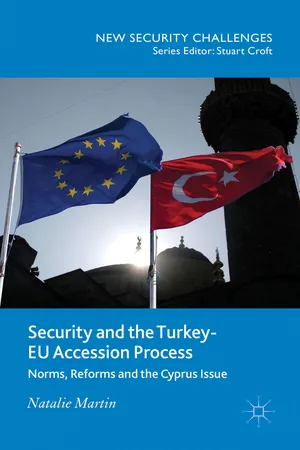
Security and the Turkey-EU Accession Process
Norms, Reforms and the Cyprus Issue
- English
- ePUB (mobile friendly)
- Available on iOS & Android
eBook - ePub
About this book
This study examines the history and politics of Turkey-EU relations since 1959, exploring the complex interaction of geostrategic and normative concerns which have resulted in the current lack of accession progress and Turkey's slide to authoritarianism.
Information
1
The Cold War Effect
Turkey’s application to join “Europe”1 was made in 1959, just two weeks after that of Greece. Ankara’s European quest predates all the countries now firmly ensconced into the institution – including the UK – and yet its own prospects of membership remain remote. This chapter addresses the issue of how and why Turkey was included in the European process in the first place, and why it has languished for so long waiting for accession to happen. It argues that both can be understood if Turkey’s initial inclusion within “Europe” is viewed as an unintended consequence, and artificial construct, of the Cold War.2 Geostrategic considerations after World War II meant that the evolving European integration project saw Turkey as “European” because it was part of “Western” security and integration institutions rather than any integral European nature. Underlying concerns of the member states about Turkey’s religion, culture, demographics and economics were suppressed at that time partly by the geostrategic imperative and partly by the long-term nature of the project.
So the Ankara Agreement, in 1963, formally included Turkey as a potential “eligible” candidate to join the European Economic Community (EEC) one day. In so doing it implicitly acknowledged Ankara’s status as “European” because being “European” was the primary criterion for eligibility into the EEC at that time. In 1963 Turkey’s Europeanness was measured crudely by its inclusion in the post-World War II “Western” group against the Soviet Union and this “geostrategic logic” was “pivotal” in securing the Ankara Agreement.3 In essence it was a geostrategic lucky break for Turkey’s ruling elite to fulfil Mustafa Kemal Atatürk’s Europeanization aspiration.
So Turkish inclusion in the accession process was a fluke in many respects and was not recognition of any real inclination to see Turkey as European by the member states then or since. Nevertheless, it has endured and Turkey is still in the accession process. Even at the time of writing this chapter (September 2014), with the Turkish government heading towards an hubristic authoritarianism, it does not seem likely that the accession process will cease to exist and this is because Turkey remains as geostrategically useful to the EU as it was in the early 1960s. However, Ankara has made very little progress within the accession process since 1963 because the “Western” definition of “European”, which secured its inclusion, began to change soon after and take on a more normative character with an emphasis on liberal democracy and human rights.
This change can be traced back to the Birkelbach Report of 1962 which introduced a more normative aspect to European integration and enlargement. It was written by the German Social Democrat Party (Sozialdemokratische Partei Deutschlands – SPD) politician Willi Birkelbach in response to concern over applications to join the EEC by Spain and Portugal (as well as Greece and Turkey). The socialist group in the European Assembly (the forerunner to the European Parliament) were particularly concerned by Franco’s application as many had fought in the Spanish Civil War and were ideologically opposed. What Birkelbach did was to apply strict conditionality to EEC membership based on “democratic practices and respect for fundamental rights and freedoms”.4 This was taken to the next level with the establishment of the Copenhagen criteria in 1993 which required states to abide by the acquis communautaire body of law, to have a functioning market economy and stable political institutions “guaranteeing democracy, the rule of law, human rights and respect for and protection of minorities”.5 Thus the identity of the EU has come to be seen in terms of liberal democracy and a respect for human rights.
However, Turkey was slow to catch on to this change of emphasis and failed to make the leap from viewing “Europe” in terms of geostrategic criteria to normative concerns. This was largely due to the continuing domination of Turkish politics by the military who, predictably, saw the world through geostrategic eyes made even more acute by the Cold War scenario. It was exacerbated by the strong Europeanization aspect of the Kemalist legacy. A deep-seated desire to be part of “Europe”, therefore, became conflated with the geostrategic need to be part of the “West” after World War II. The consequence of this mixture of motivations was an unrealistic expectation of what Brussels could deliver without concrete democratic reform by Turkey.
Ankara never moved from viewing the symbolic – but actually quite meaningless – affirmation of its “European” nature in 1963 as a guarantee of membership to the need to make firm progress towards improving its record of human rights and democracy before any real progress into Europe could be made. Instead it expected to be “rewarded” for its geostrategic loyalty and value to the North Atlantic Treaty Organization (NATO) by the EU – a completely separate institution with very different entry criteria. This is why Turkey has made very little progress in spite of being one of the first ever applicants. Indeed as time has gone on – and the EU has become increasingly normative – Turkey’s chances of making progress have diminished inversely.
This chapter will contextualize this process by first looking at Turkey’s post-World War II political history and the development of, what is now, the EU up to the Luxembourg European Council of December 1997. It will then examine the process by which Turkey came first to see itself as “European” under Atatürk, and then “Western” in the aftermath of World War II. Finally it will address how and why the nascent EEC made the Ankara Agreement through an examination of the role of security in the Turkey–EU accession process.
Coups and coalitions: Turkish political history
Turkish political history since World War II is a narrative of multi-party politics within turbulent economic and political times and under the eye of a paternalistic and interventionist military acting on an enduring Kemalist legacy. Nevertheless Turkey has been a functioning democracy for most of this time and the military have not retained power longer than they thought necessary to restore “democracy”.6 However, the actions of the Turkish military have infantilized democracy in Turkey by not allowing it to make its own mistakes.
In many senses, the brooding presence of Turkey’s army at the back of the political stage, and the weakness and fragile popularity of the country’s political parties are two sides of the same coin – a coin spinning on the axis provided by Atatürk’s vision of the Turkish state.7
The Kemalist legacy
This Kemalist “vision” won the devotion of the Turkish military and large sections of society at large because Atatürk had liberated the Republic after World War II and restored its pride following the defeat of the Ottoman Empire. Whilst, Kemalism is a complex and contested philosophy8 in essence it revolved around moving Turkey away from the norms of the Ottoman Empire which was “showing its age” towards those of the post-Enlightenment Europe. Whilst the Ottoman Empire was “Muslim, dynastic and medieval” Atatürk looked towards a Europe which had broken the ties between religion and state and was based instead on rational ideas of democracy and secularism.9 Atatürk was born into the “belle époque” of European economic, political and cultural domination in the second half of the nineteenth century, and had also been influenced by the Young Turk movement in the early twentieth century which had rebelled against the injustice of Sultan Abdulhamid II.10 He was attracted by the possibility of Europeanstyle progress and tried to emulate “Europe” with measures such as banning the fez-style hat, changing to Latin script, universal suffrage and the promotion of women’s rights based on “civilized” (European) democracy and secularism.11
Democracy was not introduced to Turkey in Atatürk’s lifetime as he had felt Turkey was not yet ready for it.12 In the immediate aftermath of World War II, Turkey was a one-party, post-Atatürk state living with the uncomfortable consequences of its decision to maintain neutrality during the War. The prime minister and leader of the only political party, the Republican People’s Party (Cumhuriyet Halk Partisi – CHP) was Ismet Inonu – a former close associate of Atatürk. Inonu voluntarily made the move to multi-party democracy in 1946 as he felt that, nearly a decade after Atatürk’s death, the time had come to move towards Western-style democracy as a logical extension of the Kemalist project to “civilize” Turkey.
This move to multi-party politics was “perhaps the most momentous decision affecting Turkish domestic politics in the post-Ataturk period”.13 It was taken partly from the pragmatic recognition that the lid could not be kept on domestic politics forever and partly from the equally pragmatic need to be “on side” with the “West” for security reasons post World War II14 as the USA was keen on promoting “Western” democracy as opposed to eastern communist totalitarianism.15 It was also the start of more than 50 years of weak coalition governments interspersed with three military interventions at roughly ten-year intervals and one “postmodern” military coup.16 In this time, Turkish society became polarized along two different fault lines – political left/right ideology and cultural secularist/Islamist – with an underlying current of violence which threatened to break the thin veneer of “civilization” which Atatürk had wanted so much to implement.
Coup d’états
Whilst Inonu’s CHP won the 1946 election, it lost in 1950 to the Democratic Party (Demokrat Partisi – DP) of Adnan Menderes and the DP won the subsequent elections in 1954 and 1957. Both were politically centrist; however, the CHP drew its support from the Kemalist and secular urban military bureaucratic elite and the DP from the conservative and rural populations to whom Islam remained important. The immature nature of Turkish democracy began to show in the increasing authoritarianism of the DP in the 1950s. It imposed restrictions on the press, political opponents, banned public meetings and removed CHP supporters from the education system and civil service. The army intervened in 1960 with a brutal clampdown on those it held responsible for this betrayal of Kemalism. Menderes and two of his ministers were executed and hundreds of other DP activists were jailed. The army’s motivation has been debated: it has been argued that it was an extension of its prominent role under Ottoman and Kemalist rule.17 Alternatively, it has been described as a more self-interested attempt to re-establish a power base and privileged position.18 Either way, political power was (relatively) quickly handed back to parliament with a liberal constitution designed to prevent future governments abusing their power as the DP had done.
After 1960, began an era of weak coalition governments and the emergence of a deep leftist–rightist schism in Turkish society. Ismet Inonu won the 1961 election but lost in 1965 to the Justice Party (Adelet Partisi, AP), successor to the, now defunct, DP. A number of smaller, more extreme, parties – leftist, Islamist and right-wing nationalist – also began to participate enabled by the liberal 1961 constitution introduced by the military. However, the major parties were not united entities and “violence bred violence with the result that the military intervened on 12 March 1971”.19 It imposed martial law with a crackdown on press freedom and human rights. Many leftists were imprisoned without trial and blamed for the escalating violence. Whilst power was handed back to the politicians within two years, the political system had become fractured and polarized leading to another series of weak coalition governments attempting to deal with domestic political turmoil as well as a weak economy and a global oil crisis.
There were five governments in Turkey between 1973 and 1980 and an increasingly unstable political environment. Debate was dominated by class politics with the leftists underground but still active and a resurgent nationalist right wing with Islamist undertones. Political violence including assassinations of public figures across law, education and journalism were common. Meanwhile the Marxist–Leninist and Kurdish nationalist Kurdistan Workers’ Party (Partiya Karkerên Kurdistan – PKK) was starting to mobilize. Thus the military faced a resurgent Islamism, nascent separatism, underlying violence and a polarized political system paralysed by bickering “both sides had made it a matter of principle never to reach an understanding on any subject at all”.20 Additionally there were serious economic problems and a civil service hindered by being changed five times in seven years. Hence on 12 September 1980 the military in the form of the National Security Council (Milli Güvenlik Kurulu – MGK) took control of the Turkish government for the third time since 1960.
The 1980 coup was about ending “the state of anarchy existing before the 12th September”.21 The MGK blamed the 1961 constitution for allowing leftist activists the freedom to be active. The army leader, General Kenan Evren, turned to a moralizing Islamic discourse to counteract leftism creating the so-called “Turkish Islamic synthesis”. General Evren redefined Kemalism to bring an element of Islam – or social control – back in to public life. Existing party leaders were put on trial and banned from participating in politics. Leftist groups were outlawed, 49 people were executed, journalists were jailed, academics dismissed from their posts and trade unions were closed down. General Evren was elected president and “the underlying theme of the 1982 constitution was to decrease the politicization of the masses and to limit the rights and freedoms that had been introduced by the 1961 constitution”.22
Post-1980
A new party, the Motherland Party (Anavatan Partisi – ANAP) won the 1983 election. It was led by T...
Table of contents
- Cover
- Title Page
- Copyright
- Contents
- Acknowledgements
- List of Acronyms and Abbreviations
- Introduction
- 1. The Cold War Effect
- 2. The Kosovo Effect
- 3. The Helsinki Effect
- 4. The UK Effect
- 5. The Cyprus Effect
- 6. The Arab Spring Effect
- 7. The Erdoğan Effect
- 8. Conclusion
- Notes
- Bibliography
- Index
Trusted by 375,005 students
Access to over 1.5 million titles for a fair monthly price.
Study more efficiently using our study tools.
Frequently asked questions
Yes, you can cancel anytime from the Subscription tab in your account settings on the Perlego website. Your subscription will stay active until the end of your current billing period. Learn how to cancel your subscription
No, books cannot be downloaded as external files, such as PDFs, for use outside of Perlego. However, you can download books within the Perlego app for offline reading on mobile or tablet. Learn how to download books offline
Perlego offers two plans: Essential and Complete
- Essential is ideal for learners and professionals who enjoy exploring a wide range of subjects. Access the Essential Library with 800,000+ trusted titles and best-sellers across business, personal growth, and the humanities. Includes unlimited reading time and Standard Read Aloud voice.
- Complete: Perfect for advanced learners and researchers needing full, unrestricted access. Unlock 1.5M+ books across hundreds of subjects, including academic and specialized titles. The Complete Plan also includes advanced features like Premium Read Aloud and Research Assistant.
We are an online textbook subscription service, where you can get access to an entire online library for less than the price of a single book per month. With over 1.5 million books across 990+ topics, we’ve got you covered! Learn about our mission
Look out for the read-aloud symbol on your next book to see if you can listen to it. The read-aloud tool reads text aloud for you, highlighting the text as it is being read. You can pause it, speed it up and slow it down. Learn more about Read Aloud
Yes! You can use the Perlego app on both iOS and Android devices to read anytime, anywhere — even offline. Perfect for commutes or when you’re on the go.
Please note we cannot support devices running on iOS 13 and Android 7 or earlier. Learn more about using the app
Please note we cannot support devices running on iOS 13 and Android 7 or earlier. Learn more about using the app
Yes, you can access Security and the Turkey-EU Accession Process by N. Martin in PDF and/or ePUB format, as well as other popular books in Politics & International Relations & Diplomacy & Treaties. We have over 1.5 million books available in our catalogue for you to explore.