eBook - ePub
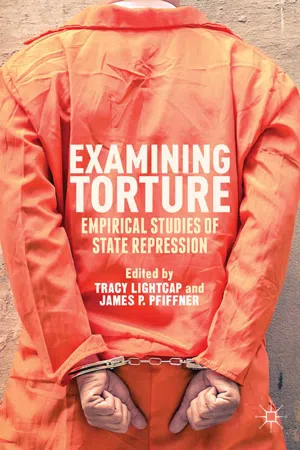
Examining Torture
Empirical Studies of State Repression
- English
- ePUB (mobile friendly)
- Available on iOS & Android
eBook - ePub
Examining Torture
Empirical Studies of State Repression
About this book
The United States' use of torture and harsh interrogation techniques during the "War on Terror" has sparked fervent debate among citizens and scholars surrounding the human rights of war criminals. Does all force qualify as "necessary and appropriate" in this period of political unrest? Examining Torture brings together some of the best recent scholarship on the incidence of torture in a comparative and international context. The contributors to this volume use both quantitative and qualitative studies to examine the causes and consequences of torture policies and the resulting public opinion. Policy makers as well as scholars and those concerned with human rights will find this collection invaluable.
Information
CHAPTER 1
Introduction
Tracy Lightcap and James P. Pfiffner
Studying state repression is one of the most necessary and difficult tasks for scholars in the social sciences today. As Davenport (2012) points out, most of the systematic empirical research on repressive activities by governments has been an afterthought. Studies of both human rights abuses and conflict processes tend to be dominated by explorations of the actions of those opposing state power rather than the actions of the states themselves. Further, what work there has been—and, for historical studies, it has been voluminous—has focused on case studies of the documented depredations of the great authoritarian dictatorships of the twentieth century rather than on more widely comparative research including all types of regimes.
In a way, this is understandable. States are unlikely to fund studies that discuss their repressions, private institutions are seldom interested in confronting state power, and public attention is usually riveted by challenges to state authority rather than uncomfortable truths about political repression. However, as researchers have opened up new fields of analysis, questioning older assumptions about both the breadth and functions of state repression, these artificial barriers have become less onerous.
This book is aimed at helping to break down these barriers. Of the three great evils that states can perpetrate on those they control—genocide, slavery, and torture—only one has positively thrived into the twenty-first century: torture. Indeed, the use of torture in interrogations has had a rebirth in modern police, intelligence, and military organizations. The results have been a rude awakening for those who had thought that the spread of democratic institutions and “domestic democratic peace” would put an end to torture. Indeed, recent research has shown conclusively that modern torture techniques arose in democracies, not in the authoritarian regimes in Germany, Italy, and the Soviet Union (Rejali 2007; McCoy 2006). For all that, however, there remains a reluctance to submit the genesis and mechanics of modern torture to systematic examination.
We are presenting what we hope will be a useful overview of an ongoing research effort to explicate and illuminate the place of torture in contemporary public policy. Of course, that is a tall order for a short book of empirical essays, and we have no pretensions of covering the full range of possible research topics here. Instead, we have sought to present a snapshot of current efforts to subject torture and its place in the toolbox of state repression to systematic empirical examination. We have done this by collecting the ongoing work of a group of serious scholars working on three areas of torture research.
The first area is what Miller, Gronke, and Rejali in their contribution here call the “sub-field of torture approval”—the study of the level and fluctuations of public opinion concerning the use of torture by states. The second area of research concerns the mechanisms by which torture plants itself in the practice of modern states. Finally, we present work looking at the consequences of establishing torture in the interrogation practices and the pitfalls of attempts to squelch its use. These contributions present both quantitative and qualitative examples of empirical research. Since torture is usually conducted in secret, some of the problems in analyzing it cannot be approached with large-N studies. However, as several of the chapters included here show, new data sets allowing for more strictly testable empirical propositions are being developed apace. Finally, the research in this book combines both case studies, usually of the United States, and comparative analyses using either large-N data sets or comparative historical sequences. Altogether, we hope we have caught the cutting edge of this area of work moving forward and provided scholars with examples of the kind of research opportunities it provides.
Public Opinion and Torture
The use of torture under the auspices of the state has a long history in the Western legal tradition. Torture was prescribed in accord with Roman canon law to obtain confessions for serious crimes. The nations of Continental Europe, from the late Middle Ages to the eighteenth century, used torture as a normal part of the legal process in serious criminal cases. Torture was also used in the Grand Inquisition in Spain in order to identify heretics. However, since the eighteenth century and the Enlightenment, torture has generally been condemned in philosophy, scholarship, and the law. In the twentieth century, most states condemned torture, even as some continued to practice it, usually for interrogation purposes, though some for deterrence purposes as well.
What is new, however, is the sudden proliferation of torture in a world dominated by democratic states where public opinion serves both as the justification of public policy and as an excuse for policymakers. One of the vexing problems involving torture is the extent of approval of torturous interrogations by mass publics. It should be surprising that this question is an area of contention; the political programs of governments around the world have hinged on it. Our book has two studies on this, one on trends of approval of torture in the United States and another on comparative levels of approval of torture in several countries.
Peter Miller, Paul Gronke, and Darius Rejali’s study uses data drawn from new surveys conducted during the 2008 and 2010 US national elections and an historical archive of public opinion on torture to answer two questions. First, their work addresses the changes in public attitudes toward torture over time. There is a long-standing controversy that often arises in journalistic accounts of torture: has the public in the United States approved or disapproved of the use of torture? Miller, Gronke, and Rejali find this a more nuanced question than many other analysts. Using polling data from 1942 to 1993, they find no evidence that Americans in the past favored the use of torture, even against captured Nazis during World War II. This trend continued through the second Bush administration, but, as their new data show, public opinion has recently reversed itself since Barack Obama has taken office. Their use of “lowess” (locally weighted regression) curves to show long-range trends reveals shifts in torture approval over time. Their research also shows that support for torture is dependent on levels of presidential approval—as approval for presidents fluctuates, so does the approval of torture by partisans and independents. Similar trends can be found, depending on whether survey respondents perceive that others think that torture is justified. Finally, there is the partisan dimension mentioned in the title of chapter 2. Using correspondence analysis, Miller, Gronke, and Rejali find clear linkages between party affiliations in the United States and approval of torture. Republicans are much more likely support its use than Democratic and independents. Indeed, the authors show that support among Republicans explains most of the increase in support for the use of torture in interrogation. These findings are especially revealing when their analysis discounting the role of media in fostering approval of torture is taken into consideration. As they point out, it is not the television dramas like 24 that led to higher levels of torture approval among Republican partisans, but constant messages from Republican elites (with some exceptions) that torture was both legal and necessary.
The research by Jeremy Mayer, Naoru Koizumi, and Ammar Anees Malik examines whether the level of economic and social development in a society (the “developmental hypothesis”) or the level of threat from terrorism (the “threat hypothesis”) is a more powerful influence on public approval of torture. Their research is based on a survey conducted by World Public Opinion in 21 countries, with a final sample of more than 8,000 respondents. Using sophisticated logistic and hierarchical models to evaluate both individual and national explanations of torture approval, their research shows some support for the developmental hypothesis. Mayer, Koizumi, and Malik find that higher levels of political freedom lead to more opposition to torture, but the anticipated relationships between higher levels of economic development, economic freedom, the existence of an independent judiciary, and prior use of torture by governments did not materialize. Further, they found no relationship between the number of terrorist incidents or recent experience of war and approval of torture, largely refuting the threat hypothesis. While they conclude that more work has to be done on the questions they raise, their finding that political freedom apparently leads to lower support for torture provides more evidence for the domestic democratic peace hypothesis, an encouraging development indeed, given the steady, if slow, spread of democratic institutions in current times.
How Does Torture Become Established?
After the atrocities of 9/11, the United States reversed two centuries of official policy by adopting torture for interrogation purposes in its “war on terror.” Those who defended the aggressive US interrogation policies argued that “enhanced interrogation techniques” did not amount to torture. In the twentieth century, the US State Department regularly published accounts of torture in some countries, publicly condemning its use and urging improvements in human rights in these countries. In particular, the United States condemned the use of torture in Iraq and used Saddam’s horrific torture practices as partial justification for the US invasion of Iraq in 2003. Thus, it is with some irony that the United States itself has been condemned internationally for the use of torture in its interrogations during the war on terror. This use of torture by the United States during the first decade of the twenty-first century has provoked a renewed debate and analysis of torture policy in scholarship and public discourse. The next section in this book makes new contributions to our understanding of torture policy in the United States as well as in other countries.
It is understandable that, immediately after the atrocities of 9/11, President Bush and other US officials felt the acute need to obtain intelligence in any way they could in order to prevent further attacks that they believed were likely. Despite the objections of Secretary of State Colin Powell and officers in the Judge Advocate General Corps of the military, formal policy allowed the use of harsh interrogation techniques. The Bush administration continued to implement these harsh interrogation policies and refused to reconsider them, even when some of its own political appointees sought to return to the strictures of the Geneva conventions. But why would such a commitment to the use of torture emerge in the first place?
Tracy Lightcap’s chapter extends his earlier work postulating that threats to the political projects of regimes are the main reason for the establishment of informal institutions opening opportunities for the use of torture in interrogations. Lightcap presents a typology of the consequences of defeat in asymmetric wars for modern democracies. Basing his work on a matched time-series research design of cases with similar “treatments” (i.e., defeats in asymmetric wars) over time, Lightcap presents qualitative evidence drawn from the history of two cases of democracies that informally instituted torture, France in Vietnam and Algeria and the United States in Vietnam and Iraq/Afghanistan, to illustrate this mechanism. In both cases, the domestic politics and international position of the states involved were eroded by a military defeat at the hands of asymmetrical opponents using clandestine methods of warfare. The chapter attempts to show that the emergence of torture as an informal institution was due to the threat presented by a similar subsequent defeat in another asymmetric war. Faced with such a level of increased regime stress, he finds it predictable that informally instituted torture would emerge as regimes find the political prospects of their domestic and foreign policy severely threatened again. He concludes with some suggestions about how to stop this process.
What these new interrogation policies meant for some detainees held by US personnel was that they would be subjected to “robust” interrogation methods that sometimes amounted to torture. The pressure for “actionable intelligence” began at the top of the chain of command, and Secretary of Defense Rumsfeld authorized a range of techniques that exceeded those allowed by the Geneva Conventions and the US Army Field Manual on Intelligence Interrogation. When detainees captured in Afghanistan began to arrive at the US prison in Guantanamo Bay, they were initially treated according to the Geneva Convention rules. But as pressure for “actionable intelligence” from Washington continued, Secretary of Defense Donald Rumsfeld made personnel changes that ensured that harsh techniques of interrogation would be used on detainees. Later, these techniques “migrated” to Afghanistan and Iraq. In addition, the CIA was given separate permission to use “enhanced interrogation techniques” on “high value” suspects of terrorism. The use of these techniques was approved at high-level meetings in the White House, with the knowledge of President George W. Bush (Lightcap 2011).
In chapter 5, James Pfiffner raises the issue of command responsibility. The concept as a legal principle was established during the post–World War II trials of German and Japanese military leaders who were accused of war crimes. The premise of command responsibility is that commanders of military units are responsible for the illegal actions of their subordinates if the crimes were committed with their knowledge or if they should reasonably have been aware of the crimes. Pfiffner argues that the criteria most often used in determining responsibility for actions taken by subordinates are exhibited at the higher ranks of the Bush administration. Further, although he finds the doctrine of command responsibility relevant to the upper layers of the Bush administration, Pfiffner does not advocate legal action against those who enabled the use of torture in interrogations during the war on terror. He argues that it is more important to undertake an authoritative, thorough investigation of what happened during coercive interrogations and formulate policies to prevent it from happening again. The first step in learning from history is to examine it.
In chapter 6, James Pfiffner argues that the use of torture, even in narrow circumstances, including severe time constraints, is based on the assumption that torture is an effective tool in gaining information. This presumption has much intuitive appeal; most people feel that if they were tortured, they would tell the interrogators whatever they wanted to hear. As Pfiffner shows, however, this presumption leads to two problems. First, if the captive is indeed a committed terrorist, he may be willing and able to resist torture and refuse to give up accurate information (as was the case with some detainees). Second, those of lesser commitment may be willing to confess to crimes never committed or concoct any story that might persuade the torturers to stop the pain. He points out several other problems with common justifications for the use of torture as well. One of the most common—the ticking time-bomb scenario—is based on a number of assumptions. It must first be determined that other means of interrogation cannot work. There must be a “bomb” that is ticking (or a planned attack); it must be certain that the suspect knows where the bomb is (or when and where the attack is coming); the suspect must be willing to divulge accurate information under torture; and there must be sufficient time and means to defuse the bomb (or prevent the attack). If these premises do not hold, the ticking bomb scenario cannot be used to justify the use of torture. Further, at a practical level, it must be certain that the captive knows whatever information is sought, and there must be a clear determination that the person is not lying. As Pfiffner finds, some of the most successful interrogators of terrorists from the CIA, the FBI, and the military services have provided details of their interrogation of terrorists who surrendered important information without being subjected to enhanced interrogation techniques. Noncoercive techniques may take time, but experienced FBI interrogators argue that traditional, nonviolent techniques work more quickly and are more reliable than enhanced interrogation techniques. Pfiffner concludes that using torture should always be illegal in the United States, and posits that if there were a genuine ticking time-bomb scenario, the perpetrator would not likely be convicted by a jury that was convinced that the ticking bomb scenario was genuine.
The Possibilities and Consequences of Torture Reform Efforts
But what can be done to stem the tide of torture? There is a substantial body of international law that condemns the practice. Both international bodies and the governments of nation-states have united, at least publicly, in eschewing torture as a tool of states. Yet the practice continues. The last section of this book addresses the difficulties and pitfalls that await attempts to curtail torture.
Chapter 7 looks at a subject seldom examined: what are the consequences of torture reform? As Courtenay Conrad and Jacqueline DeMeritt point out, international advocacy organizations invest considerable resources in the naming and shaming of human rights violations, including torture. Although the goal of negative publicity is to pressure repressive regimes to better respect human rights and abide by their international commitments, evidence of its effectiveness is mixed. They have doubts about this strategy, arguing that these mixed results occur either because extant literature assumes that international advocacy has identical impacts on different forms of human rights abuse (i.e., that naming and shaming for torture also affects, for instance, targeted assassinations in the same way), or it assumes that advocacy campaigns affect respect for one right (e.g., freedom from torture) without affecting others. Using a new dataset they specifically constructed to examine these assumptions, Conrad and DeMeritt construct a carefully controlled analysis using logistic regression techniques to determine how the shaming of one type of human rights violation—torture—affects the extent to which the government continues to torture, and the extent to which it engages in other violations of human rights. Unfortunately, their results suggest that shaming for torture has no impact on subsequent torture by states, but that it leads to a significant increase in the use of ...
Table of contents
- Cover
- Title
- Chapter 1 Introduction
- Chapter 2 Torture and Public Opinion: The Partisan Dimension
- Chapter 3 Does Terror Cause Torture? A Comparative Study of International Public Opinion about Governmental Use of Coercion
- Chapter 4 Strange, Savage Blood: Defeat and Torture in the War on Terror
- Chapter 5 US Torture Policy and Command Responsibility
- Chapter 6 The Efficacy of Coercive Interrogation
- Chapter 7 Unintended Consequences: The Effect of Advocacy to End Torture on Empowerment Rights Violations
- Chapter 8 Torture Reform in Democracies: A Causal Interpretation
- Index
Trusted by 375,005 students
Access to over 1.5 million titles for a fair monthly price.
Study more efficiently using our study tools.
Frequently asked questions
Yes, you can cancel anytime from the Subscription tab in your account settings on the Perlego website. Your subscription will stay active until the end of your current billing period. Learn how to cancel your subscription
No, books cannot be downloaded as external files, such as PDFs, for use outside of Perlego. However, you can download books within the Perlego app for offline reading on mobile or tablet. Learn how to download books offline
Perlego offers two plans: Essential and Complete
- Essential is ideal for learners and professionals who enjoy exploring a wide range of subjects. Access the Essential Library with 800,000+ trusted titles and best-sellers across business, personal growth, and the humanities. Includes unlimited reading time and Standard Read Aloud voice.
- Complete: Perfect for advanced learners and researchers needing full, unrestricted access. Unlock 1.5M+ books across hundreds of subjects, including academic and specialized titles. The Complete Plan also includes advanced features like Premium Read Aloud and Research Assistant.
We are an online textbook subscription service, where you can get access to an entire online library for less than the price of a single book per month. With over 1.5 million books across 990+ topics, we’ve got you covered! Learn about our mission
Look out for the read-aloud symbol on your next book to see if you can listen to it. The read-aloud tool reads text aloud for you, highlighting the text as it is being read. You can pause it, speed it up and slow it down. Learn more about Read Aloud
Yes! You can use the Perlego app on both iOS and Android devices to read anytime, anywhere — even offline. Perfect for commutes or when you’re on the go.
Please note we cannot support devices running on iOS 13 and Android 7 or earlier. Learn more about using the app
Please note we cannot support devices running on iOS 13 and Android 7 or earlier. Learn more about using the app
Yes, you can access Examining Torture by T. Lightcap, J. Pfiffner, T. Lightcap,J. Pfiffner in PDF and/or ePUB format, as well as other popular books in Politics & International Relations & Civil Rights in Law. We have over 1.5 million books available in our catalogue for you to explore.