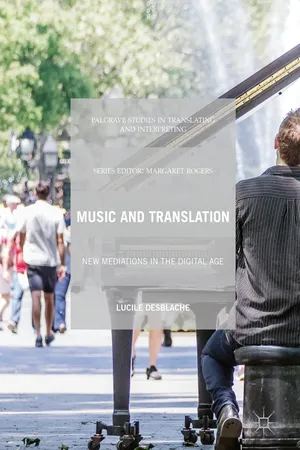
- English
- ePUB (mobile friendly)
- Available on iOS & Android
eBook - ePub
About this book
Information
© The Author(s) 2019
Lucile DesblacheMusic and TranslationPalgrave Studies in Translating and Interpretinghttps://doi.org/10.1057/978-1-137-54965-5_11. Prelude
Lucile Desblache1
(1)
Department of Media, Culture and Language, University of Roehampton, London, UK
Keywords
MusicTranslationDancing to salsa, listening to reggaeton, singing a folk song and many more musical activities allow both the expression of emotions beyond any language or culture, and the sense of an understanding of other cultures. Anyone listening to a samba will instantly be transported to Brazil: the music will be meaningful, with or without words, even if those words are sung in a foreign language, and in spite of some loss of comprehension concerning the lyrics . The complex cocktail of dances from West Africa, Latin America and Portugal that is at the root of samba, is immediately recognised by most human ears as essentially Brazilian, even if the different cultural influences and intersections are identifiable. While the phenomenon of music is universal, its manifestations are varied and distinctive.
The idea of this book grew from the realisation that although music is inspired and created through exchanges between different cultures, it has rarely been considered through a transcultural approach, which is born of a desire for renewal and exchanges between cultures. Music scholars in the late twentieth and twenty-first centuries have broken away from a traditional historical perspective and considered their discipline through a broad spectrum of fields and methodologies: gender (McClary, 1991/2002), literary theory (Korsyn, 1991; Kramer, 2001; Straus, 1990), film and media (Chion, 1995), philosophy (Kramer, 2012), politics (Street, 2011), history (Fulcher, 2011), semiotics (Gorlée, 2005; Nattiez, 1987/1990; Tarasti, Forsell, & Littlefield, 1996) and plural approaches (Tagg, 2012). Recent developments in applied musicology also emphasise the role of habit and previously acquired musical references in the shaping of musical listeners and performers, and are leading to ground-breaking progress in the understanding of the musical mind. Adam Ockelford’s (2013) zygonic theory, for instance, asserts that the principle of music is to imitate through derivations and that human musical ability is based on the capacity to identify these derivations. Yet few have explored how transformations and translations shape musical meanings, developments and the perception of music across cultures. While some music scholars have stressed that music is a major field of development with regard to intercultural exchanges, historical knowledge and cosmopolitan perspectives (Collins & Gooley, 2016), few articulate the vital importance of translation in making them happen.
Music, in spite of being translational in essence, at least in the wider sense since it is based on transforming existing sounds, has long suffered from being perceived as an autonomous art. Its ethereal, ineffable qualities placed it as an ‘absolute’ form of art, disconnected from social expression and untranslatable in essence. This view has been reflected in many titles of volumes focused on music, emphasising the universal abilities of music, detached from its environments: some of the titles of the twentieth century philosopher Vladimir Jankélévitch , Music and the ineffable (1961/2003) and Somewhere in the unfinished (1978), for instance, mirror this stance.
Since the late twentieth century, popular music, however, has been primarily considered in relation to its social and cultural contexts. As Woodstock became associated with hippie culture, studies into the social impact of music started to flourish. This is due essentially to the growing influence of cultural studies as a framework for art forms, to the expansion of ethnomusicology, and to the extraordinary developments of technologies which have brought musical landscapes where they are today. Just as in the sixteenth century, when print revolutionised how music was composed, performed, shared and disseminated, twentieth and twenty-first century technologies have been shaping what is written, produced, performed, consumed and distributed. Nevertheless, the ivory tower syndrome associated with classical music continues to make many non musicians wary of exploring its developments, influences and impacts: on the whole, music is perceived as a discipline that can be accessed by people with a special talent.
This phenomenon has similarities with translation. While traditional musicology has chiefly explored and analysed Western classical music , translation studies has primarily discussed texts considered as ‘worthy’, which belonged essentially to the Western literary canon. Other texts, including multimodal texts, which dominate today’s outputs, are certainly getting more attention from translation scholars today, but the vocabulary and concepts necessary to discuss translation beyond canonical texts are still being forged. It is one of the purposes of this book to explore them in relation to music.
Studies relating to the translation of audiovisual texts as multimodal texts have been given more importance in the twenty-first century, but they tend to focus primarily on visual and linguistic content, often undermining the importance of sound and music, which are also key to their meaning. Some scholars (Gorlée, 2005; Julia Minors, 2013; Low, 2016; Susam-Sarajeva, 2008) have started to explore the intersections and connectivities of their disciplines with music, but most restrict them to aspects of opera or song translation. Since the translation of musical texts involves much more than the ‘straight’ translation of lyrics , as this book will show, scholars who have ventured in this area have used a variety of approaches to frame their analyses: semiotics (Gorlée ), sociology (Fernández, 2015; Susam-Saraeva, 2015 ) and multimodality (Kaindl, 2005, 2013) are the most recurrent. The fast development of audiovisual translation studies in the last two decades has been and is still exciting, but theoretical investigations in the area are still at their beginning. Audiovisual translation also involves a relatively small number of scholars, who often borrow frameworks from each other and from a limited number of disciplines—mainly film, media and psychology—, and who undertake primarily descriptive or empirical research. Curiously, even in practice-oriented research, and in spite of the recent turn of translation studies towards social science, very few reception studies exist in the field of music translation. Yet it is estimated that the average urban person today is exposed to 4 hours 17 minutes of music daily, either through personal choice or contacts in public places (Tagg, 2012, p. 36). Much of this exposure not only involves different cultures and languages, but also the shaping of social and cultural lives across borders.
This volume intends to open the door wider in examining how translation, in its many senses, is shaping music today, and how music has an impact on translation. Chapter 3 will focus on this issue, but it might be useful to clarify from the start the three overarching ideas that underlie the notion of translation in this volume. First, translation refers to the process of transferring a text from one language, be it verbal or not, into another, interlingually, intralingually or intersemiotically, and to the products that are derived from this process. Since Jakobson (1951/2012), it has been the established understanding of translation, and the one that will be referred to when opera surtitles, for instance, are discussed. A second way of referring to translation here concerns aspects of musical communication that are non verbal. In this case, it will refer to how a musical form or element can be transmuted. Although it is not strictly based on the notion of source and target texts and how they relate to each other, nevertheless, the final element is significantly inspired by the first. The travels of polka from a traditional Easter European dance to twenty-first century pop-metal genre will thus be considered as a form of translation (see Sect. 4.2.1). Finally, and primarily in the final part, translation will be considered more broadly as a transformational tool used in music to convey meaning across boundaries: music can therefore be meaningful to the deaf for instance, or facilitate the manifestation of emotion by moving its listeners from one expressive place to another.
Sarah Maitland (2017), inspired by Paul Ricœur’s (2004/2006) views of translation as a form of hospitality reminds us that each individual understanding of the world is built on other people’s, and that this understanding takes place intellectually and physically through different channels of communication: linguistic, mathematic, emotional, and artistic. Verbal and rational expressions can and often are complemented by other forms of communication. For the postcolonial thinker Edouard Glissant , a creative text requires some lack of transparency to ensure its uniqueness and to guarantee that it will not be assimilated into a universal model. Although necessary, verbal language , according to Glissant , cannot be dissociated from power, and tends to favour dominant voices. By contrast, non-verbal forms of expression or verbal forms of expression that frequently defy logic, such as poetry, are not tied to one point of view. They challenge a ‘universal’ ...
Table of contents
- Cover
- Front Matter
- 1. Prelude
- Part I. Music and Translation in a Global Context
- Part II
- Part III
- 10. Coda
- Back Matter
Trusted by 375,005 students
Access to over 1.5 million titles for a fair monthly price.
Study more efficiently using our study tools.
Frequently asked questions
Yes, you can cancel anytime from the Subscription tab in your account settings on the Perlego website. Your subscription will stay active until the end of your current billing period. Learn how to cancel your subscription
No, books cannot be downloaded as external files, such as PDFs, for use outside of Perlego. However, you can download books within the Perlego app for offline reading on mobile or tablet. Learn how to download books offline
Perlego offers two plans: Essential and Complete
- Essential is ideal for learners and professionals who enjoy exploring a wide range of subjects. Access the Essential Library with 800,000+ trusted titles and best-sellers across business, personal growth, and the humanities. Includes unlimited reading time and Standard Read Aloud voice.
- Complete: Perfect for advanced learners and researchers needing full, unrestricted access. Unlock 1.5M+ books across hundreds of subjects, including academic and specialized titles. The Complete Plan also includes advanced features like Premium Read Aloud and Research Assistant.
We are an online textbook subscription service, where you can get access to an entire online library for less than the price of a single book per month. With over 1.5 million books across 990+ topics, we’ve got you covered! Learn about our mission
Look out for the read-aloud symbol on your next book to see if you can listen to it. The read-aloud tool reads text aloud for you, highlighting the text as it is being read. You can pause it, speed it up and slow it down. Learn more about Read Aloud
Yes! You can use the Perlego app on both iOS and Android devices to read anytime, anywhere — even offline. Perfect for commutes or when you’re on the go.
Please note we cannot support devices running on iOS 13 and Android 7 or earlier. Learn more about using the app
Please note we cannot support devices running on iOS 13 and Android 7 or earlier. Learn more about using the app
Yes, you can access Music and Translation by Lucile Desblache in PDF and/or ePUB format, as well as other popular books in Languages & Linguistics & Linguistics. We have over 1.5 million books available in our catalogue for you to explore.